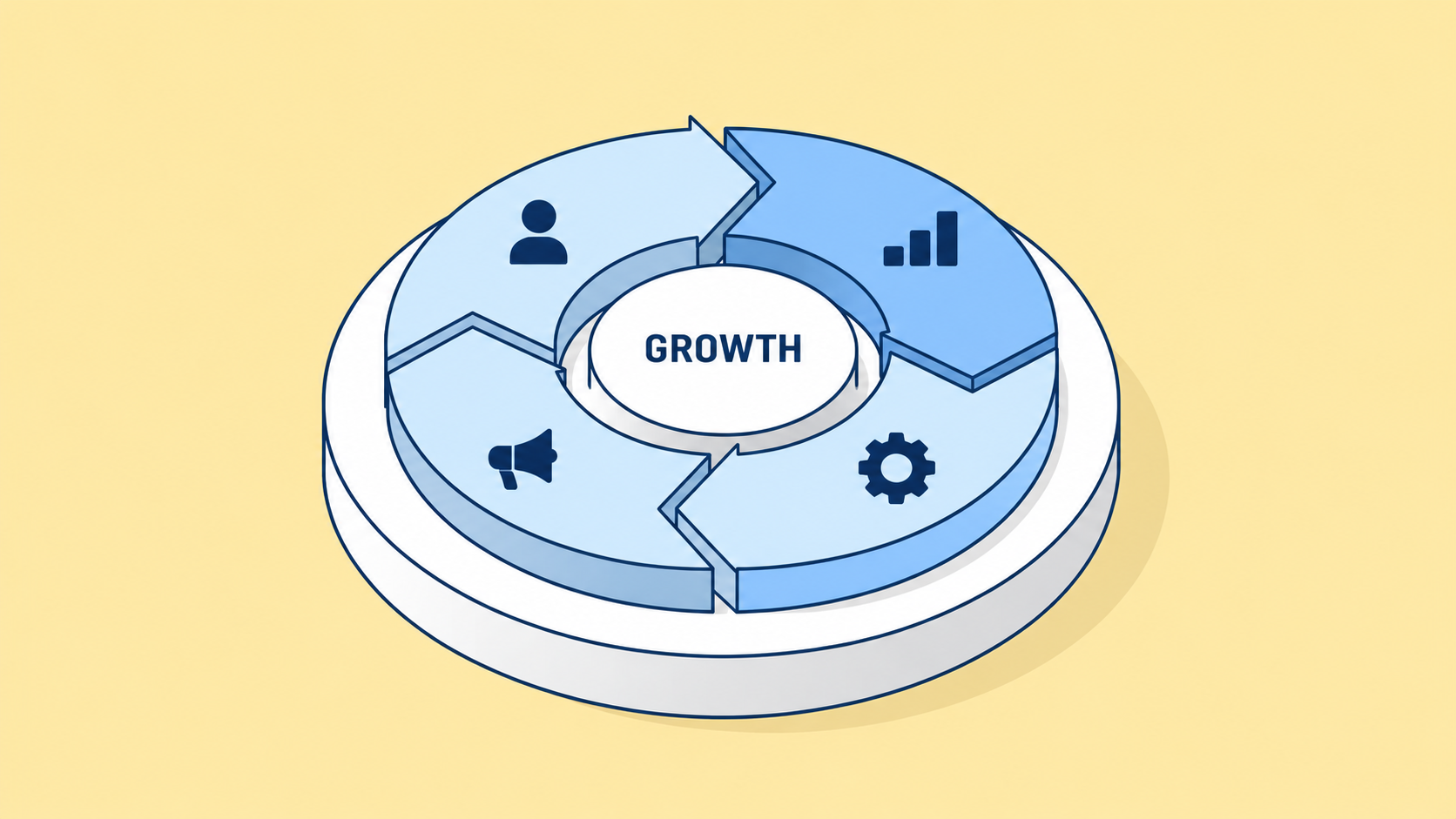
For a CEO, the most frustrating growth challenge is a lack of visibility. When revenue targets are missed or customer acquisition costs rise, it is often difficult to determine if the failure lies in the talent, the product, or the underlying infrastructure.
Most leaders attempt to fix these issues with more activity; more meetings, more hires, or more marketing spend. However, if the engine itself is misaligned, more activity only creates more friction.
The Revenue Engine Scorecard is a diagnostic tool designed to help executives evaluate the structural integrity of their Go-To-Market (GTM) operations. By assessing your business across five critical pillars, you can identify exactly where your scaling struggles are rooted and how to engineer a path to predictable growth.
The Revenue Engine ScorecardThe Revenue Engine Scorecard is a qualitative and quantitative assessment tool used by leadership to measure the maturity of their data, automation, and team alignment. |
How to Use the Scorecard
Evaluate your organization on a scale of 1 to 5 for each of the following pillars. A score of 1 indicates a completely manual or fragmented process; a score of 5 indicates a fully engineered GTM system powered by HubSpot.
1. Strategic Alignment
Does your Marketing, Sales, and Product leadership share a single definition of success?
- Score 1: Teams work in silos with conflicting KPIs and no shared Ideal Customer Profile (ICP).
- Score 5: Total revenue alignment exists; all teams work from a unified GTM strategy with shared revenue goals.
2. Data Integrity
Is your CRM the undisputed Single Source of Truth for your organization?
- Score 1: Data is fragmented across spreadsheets and separate tools; reporting is manual and often inaccurate.
- Score 5: A high-integrity HubSpot architecture tracks every touchpoint from first click to expansion revenue in real-time.
3. Automation Maturity
How much of your buyer journey relies on manual human effort?
- Score 1: Handoffs are manual; sales reps spend hours on admin tasks and generic prospecting.
- Score 5: Scalable growth systems handle lead routing, nurturing, and intent alerts automatically.
4. Revenue Velocity
How quickly and predictably do prospects move through your sales cycle?
- Score 1: Pipeline movement is slow and unpredictable; the sales cycle length is unknown or inconsistent.
- Score 5: High pipeline velocity is achieved through signal-based sales plays and automated sales enablement.
5. ICP Precision
How accurately can you identify and reach your highest-value targets?
- Score 1: Marketing is broad and generic; CAC is rising because you are targeting the wrong audience.
- Score 5: Surgical precision is used to target high-intent accounts based on technographic and behavioral signals.
Interpreting Your Revenue Score
- 5 to 10 (Critical Friction): Your growth is likely stalled or extremely expensive. You are operating without a system, and your business is highly vulnerable to market shifts. You require an immediate GTM Audit.
- 11 to 18 (Fragmented Growth): You have some successful tactics, but they are not synchronized. Your team is likely suffering from burnout due to manual work and data silos. You need a GTM Blueprint to unify your infrastructure.
- 19 to 25 (Engineered Scale): You have a functional revenue engine. Your focus should be on continuous optimization and performance tuning to maintain your competitive advantage.
Conclusion: Data Over Intuition
A CEO cannot manage what they cannot measure. If your scorecard reveals gaps in your architecture, the solution is not to work harder; it is to engineer a better system. By moving from "gut feeling" to a data-driven scorecard, you gain the clarity required to lead your organization to the next level of scale.
Ready to turn your score into a strategy?
Book a GTM Strategy Session with Propello to review your scorecard results and design your 90-day implementation roadmap.
Frequently Asked Questions (FAQ)
While the CEO should lead the assessment, the most accurate results come from having the heads of Sales, Marketing, and Operations fill it out independently. Discrepancies in their scores are often the first sign of internal misalignment.
We recommend a self-assessment every six months. As you scale and enter new markets, new friction points can emerge in your GTM Flywheel that require technical adjustment.
HubSpot provides the infrastructure for a high score, but it must be architected correctly. Simply owning the software is not enough; it must be engineered to support your specific strategy and data protocols.
Strategic Alignment and Data Integrity are almost always the lowest-scoring areas. Most companies invest in sales and marketing tactics before they have established a unified foundation, which creates the "Growth Gap."