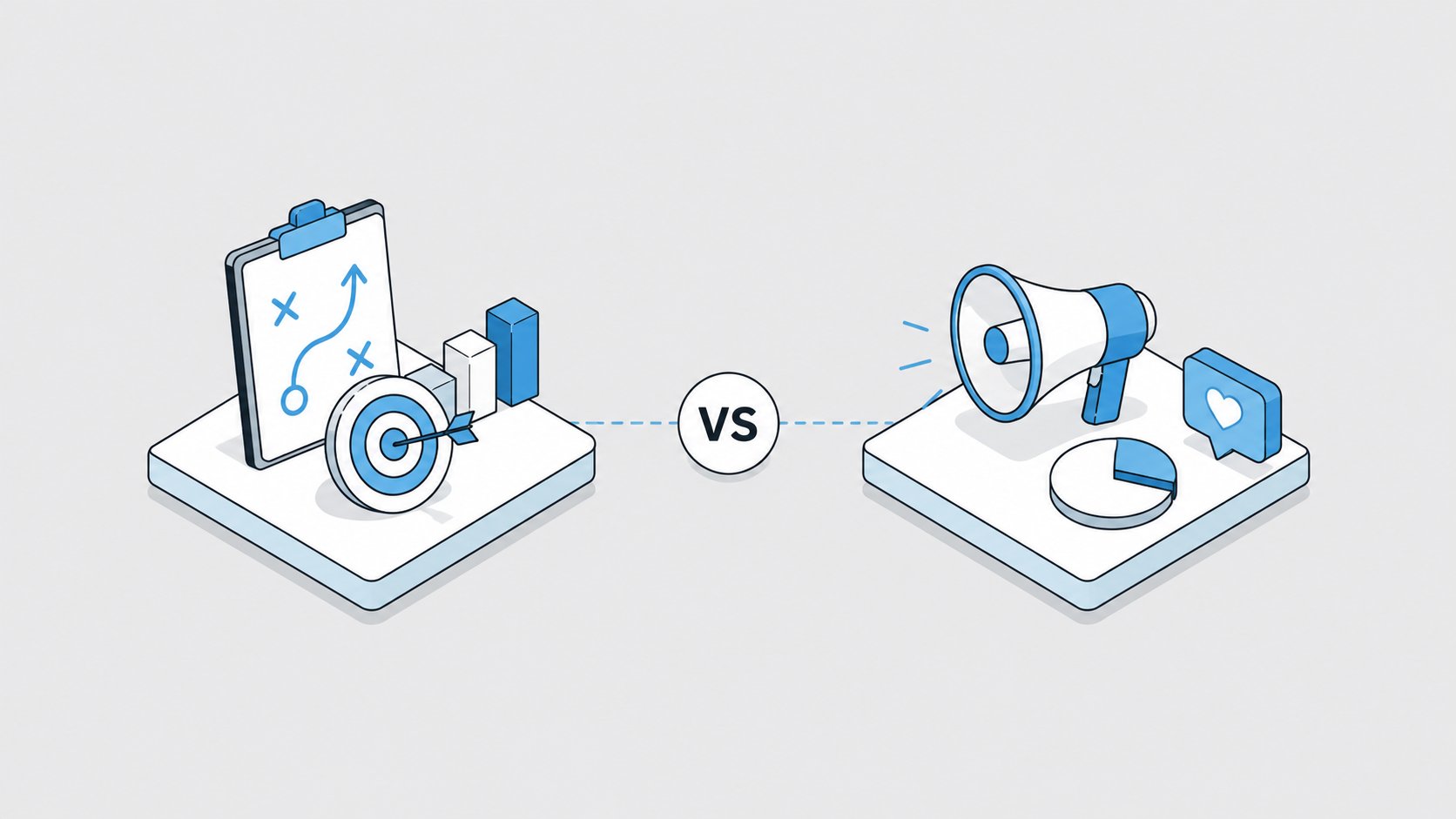
In the world of B2B growth, "scaling" is often used as a synonym for simply hiring more sales reps or increasing ad spend. However, many organizations find that the faster they try to grow, the more friction they encounter; revenue plateaus, customer acquisition costs (CAC) skyrocket, and internal teams become increasingly siloed.
The root cause is rarely the product or the talent. Instead, it is almost always the lack of a unified Go-To-Market (GTM) system. Without a clear strategy, your growth efforts are scattered, leaving your business to rely on luck rather than engineering.
The Growth GapThe Growth Gap is the disconnect between a company’s high-level revenue goals and the actual operational systems required to achieve them. |
The Symptoms of a Missing GTM Strategy
How do you know if your business is suffering from a missing or misaligned GTM strategy? Look for these three common indicators within your organization:
1. Misaligned Teams and Siloed Data
If your marketing team celebrates "leads" that your sales team finds "unqualified," you have a GTM problem. When teams operate in silos, data is trapped in separate tools, making it impossible to see a clear picture of the customer journey.
2. Rising Customer Acquisition Costs (CAC)
When you lack a defined Ideal Customer Profile (ICP), you end up marketing to everyone. This "spray and pray" approach is expensive and inefficient. A healthy GTM strategy narrows your focus to the accounts most likely to convert and stay long-term.
3. Stalled Revenue Despite High Activity
High activity does not always equal high productivity. If your team is sending thousands of emails and booking dozens of meetings, but the "Closed-Won" column is not moving, your messaging or sales motion is likely disconnected from the market's reality.
Why "More Marketing" Is Not the Answer
When growth stalls, the first instinct is often to increase the marketing budget. However, if your underlying system is broken, adding more leads is like pouring water into a leaky bucket.
You do not need more volume; you need more precision. This is where the transition from traditional marketing to GTM Engineering becomes critical. By engineering your growth, you ensure that every dollar spent on marketing is supported by a robust sales handoff and a CRM that tracks every touchpoint.
Closing the Gap with Propello’s Flywheel
At Propello, we help businesses move away from fragmented tactics and toward a unified GTM system. We align your growth efforts through:
- Systemic Alignment: Ensuring HubSpot is the single source of truth for Sales, Marketing, and Success.
- ICP Refinement: Moving beyond basic demographics to understand the behavioral triggers of your best customers.
- Revenue Attribution: Clearly seeing which channels are driving actual revenue, not just vanity metrics.
Conclusion: Stop Guessing and Start Engineering
Scaling a business is a science, not an art. If your growth has hit a ceiling, it is time to look past the individual tactics and evaluate the system holding them together. A well-engineered GTM strategy ensures that as you scale, your efficiency increases rather than decreases.
Ready to bridge the Growth Gap?
Get a Free GTM Audit to identify the gaps in your revenue engine and start building your scalable growth blueprint today.
Frequently Asked Questions (FAQ)
This usually happens because the Ideal Customer Profile (ICP) has not been agreed upon by both teams. A GTM strategy defines "quality" for everyone involved.
HubSpot is a powerful tool, but it is only as effective as the strategy behind it. We use HubSpot to operationalize your GTM strategy, turning "plans" into "automated workflows."
The first step is a comprehensive audit of your current customer journey. You must identify where prospects are dropping off and whether those drop-offs are caused by messaging, tech friction, or team misalignment.
GTM Engineering removes manual bottlenecks. By automating repetitive tasks and creating clear data loops, your team can handle more volume without losing the personal touch required to close deals.