You do not rank in AI Overviews the way you rank in a list of blue links: you make your pages eligible, readable and worth linking, and Google's systems decide what to show. This guide is for B2B CEOs, founders, CROs and marketing leaders.
You get a six-step plan your marketer or GTM Engineering team can run, a short list of mistakes that waste effort and a plain statement of what Google does not promise.
|
AI Overviews AI Overviews are summaries written by generative AI that Google Search shows above its normal results for some queries, with links to web pages where you can read more. |
By the end you will have a plan you can run
When you finish the steps below you will have:
- A confirmed list of URLs that Google can crawl, index and show with a snippet.
- A set of buyer questions, each matched to one page that answers it.
- Rewritten key content that leads with the answer and reflects what your company knows first-hand.
- Structured data and business details that match what users see on the page.
- A monthly routine in Search Console that shows how your website appears in Google Search.
What to have in place before you start
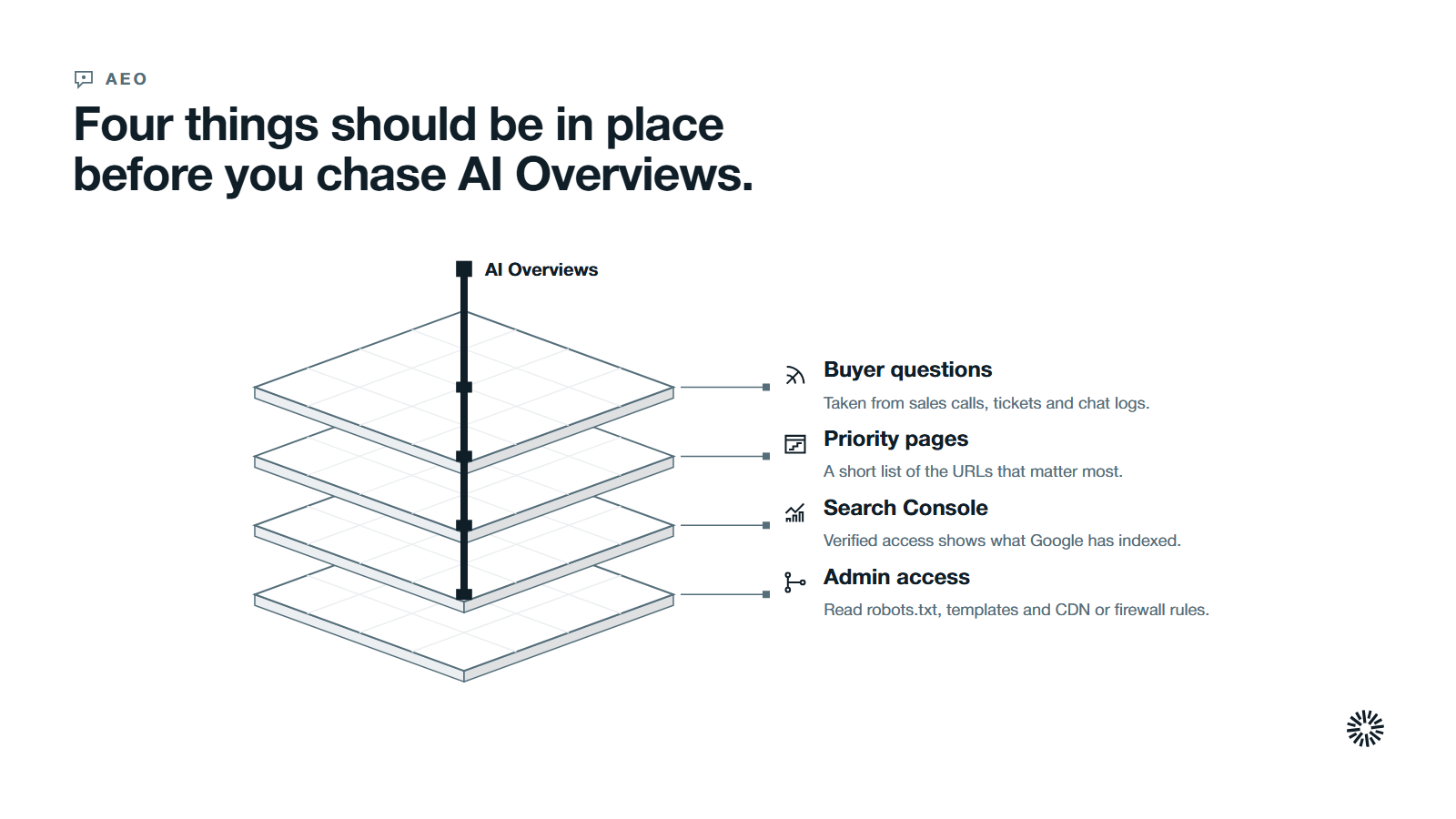
Check these four things first.
- Admin access to your website. You need to read your robots.txt file, your page templates and any CDN or firewall rules, or reach the person who controls them.
- Verified access to Google Search Console. It shows whether a URL is indexed and how your website performs in Google Search.
- A list of the ten URLs that matter most.
- Real buyer questions. Collect them from sales calls, your best research, plus support tickets, chat logs and talking to customers.
Google says there are no additional technical requirements for appearing in its AI features beyond being indexed and eligible to appear in Search with a snippet. That means the work below is mostly good SEO strategy applied with care, for your business, your website and the users who search on Google and other search engines.
How Google Search chooses the pages AI Overviews link to
Google's documentation says AI features in Search use query fan-out: while the response is generated, the system runs several related searches across subtopics and data sources. It then shows a wider and more diverse set of helpful links than a classic search.
That greater diversity is the point: AI Overviews are AI-generated snapshots that draw on a broader group of sites than the top few results.
Some practitioners call this work generative engine optimization, or GEO, and describe systems that fetch passages from the web to ground an answer as retrieval-augmented generation. Google's own guidance says AI Overviews follow existing SEO principles, with no separate set of requirements.
Two limits apply. First, AI Overviews appear only when Google's systems judge that they add something to a classic search, so many queries never show one.
Second, AI Mode and AI Overviews can use different models, so the sources you see in one may not match the other, and search engines other than Google run their own versions with their own logic.
So a URL can earn a place for a sub-question you never targeted, which rewards pages that explain a topic completely. For the wider picture of how engines choose sources, see AI search ranking factors.
When Google's AI Overviews appear in search results and how to see them
Google's help page on AI Overviews says Google's AI Overviews appear when its systems determine that generative AI can be especially helpful. Each one gives an AI-generated summary with links for further reading, and users are told to check the supporting web sources and other search results too, because AI Overviews can make mistakes.
You cannot switch AI Overviews off, but Google says the Web filter shows text-based links without them, which is the quickest way to compare them with a classic search results page.
Users can also continue a question in AI Mode, the AI-powered conversational view of Google Search, and the original query carries over. For what AI Mode changes for B2B buyers, see how Google AI Mode affects B2B search.
The history is short. Google first previewed this generative AI experience to Search Labs users in May 2023, under the name Search Generative Experience. In a 2025 study of 55.8 million AI Overviews, Ahrefs estimated they showed for 12.8% of Google searches by volume, so most searches still return classic search results.
Observers report that an overview can fill much of the screen, pushing classic search results down, and that some entries lead back to other Google pages.
Because the summary in these AI responses covers part of the question on the page itself, users may not click, and some sites lose visits.
That makes the sources inside Google's AI Overviews a scarce place for brand visibility on the internet, so measure impressions and traffic together.
How to rank in AI Overviews in six steps
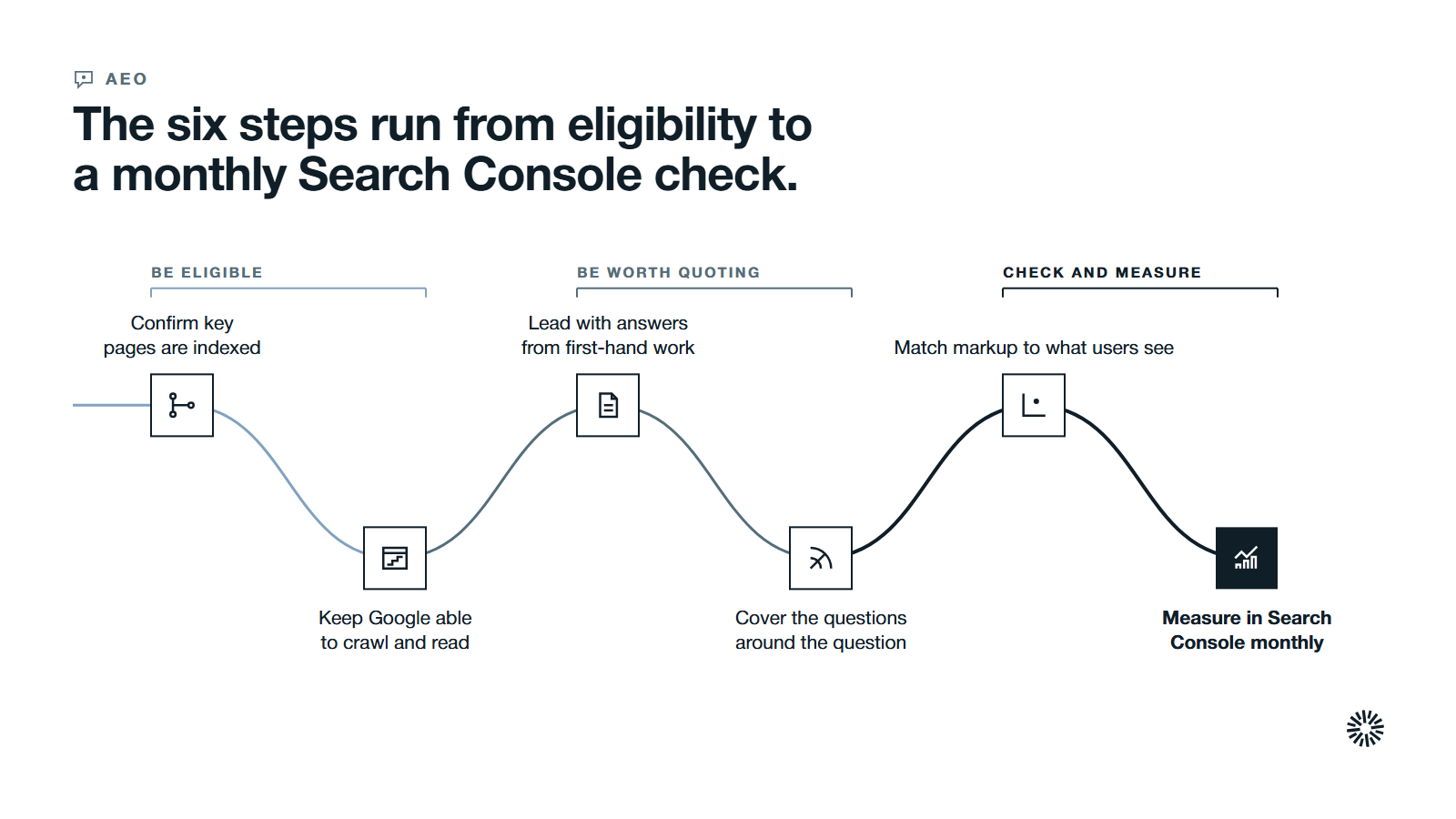
Each step ends with what done looks like.
1. Confirm your key pages are indexed and can show a snippet
Google states that a page must be indexed and eligible to appear in Search with a snippet to be a supporting link in AI Overviews, AI Mode or other AI features. Open each of your ten priority URLs, whether a blog post or a service description, in the URL Inspection tool in Search Console and read the result.
Then look for controls that hide your text. The nosnippet tag, the data-nosnippet attribute, a short max-snippet value and noindex all limit what Google Search can display, as the snippet documentation explains. For example, they suit a draft you want to protect and damage a page you want quoted.
You are done when all ten URLs are indexed and none carries a preview control you did not choose on purpose.
2. Keep Google able to crawl and read your content
Google says standard SEO practice still applies: allow crawling in your robots.txt file and any CDN, link to the URL from other articles on your website, give users a good page experience and keep important content in text so Google can display it.
Add a clear internal path to each priority URL from relevant posts on your website, so internal links show the relationships between your topics and search engines can discover every page. Use descriptive anchor text and alt text on images so Google's systems can determine what each page covers.
You are done when each priority URL is linked from at least two related articles and shows its main answer as plain HTML text.
3. Write the answer first, from what your company knows first-hand
Google's helpful content guidance asks whether a page provides original information, reporting, research or analysis, and whether it shows first-hand experience. Its generative AI guide says to create the content yourself based on what you know about the topic, so your page offers a perspective that generic summaries lack.
The same guidance describes experience, expertise, authoritativeness and trustworthiness, or E-E-A-T, as a way to judge quality, with trust the most important, and says it is not a specific ranking factor.
Cite credible statistics and sources, naming the publisher and year and linking the original reference. Practitioners also report that AI models tend to cite recent material, so review key facts regularly and update them. Google also warns against changing dates without real changes.
Put the answer in the first two sentences under each heading, then add the reason, an example and the exceptions, in your own voice. Give each claim a reference.
Name the subject in each paragraph so every passage is semantically complete on its own: lifted out, it still carries its meaning. Practitioners say AI models prioritize semantic and passage-level completeness for this reason.
Name the author and their expertise on the page, because that guidance asks about clear authorship.
You are done when a stranger reading only the first two sentences under any heading gets the answer, and a named person has signed off each page and blog post.
4. Cover the questions around the question
Because of query fan-out, one buyer question becomes several related searches. Write down the questions a buyer asks, not a list of keywords, before, during and after the main one: what it is, how to do it, what can go wrong and how to compare options.
The idea is to match each to one URL. Give each a relevant heading on the same page, or create a new page if the answer needs room. An FAQ section suits the smaller questions, because short, self-contained answers in a clear structure are easy for search engines to extract.
Link related articles into a topic cluster. Comprehensive coverage of a topic gives Google more of your content to consider for each related search, and clustering creates more chances to earn a place. Multi-modal content helps: add clear images and video, including on YouTube, where they explain something, placed next to the text they support.
You are done when every priority URL answers its main question and at least four related questions, each under its own heading.
5. Match structured data and business details to what users see
Google says structured data should match the visible text on the page, and that you do not need special markup or new files to appear in these features.
Structured data stays worth keeping because it makes pages eligible for rich results in Google Search. Practitioners add that schema helps AI interpret the intent and context of content, while it is optional for these features.
Use one business name, one description and one set of contact details everywhere.
Practitioners report that broad ecosystem authority, meaning mentions of your company on respected sites, reviews and communities across the internet, supports visibility and citations, but that is not a published rule. If you manage a Business Profile account, keep it current.
You are done when the markup on each priority URL describes only what a user can see, and your company details are identical on your website and your profiles.
6. Measure in Search Console every month
Google says sites that appear in its AI features are counted in the Performance report in Search Console under the Web search type. AI appearances are not broken out on their own, so read the report for trends: which queries and pages gain impressions after your edits.
Pair it with Google Analytics to see which organic landing pages bring traffic.
Run a monthly test as research: ask your ten questions in Google Search, for example, and log the edits you made and the changes you saw, so you can figure out what worked.
Check that what an overview says about your company is correct. Make it a monthly process. For a full setup, read AI search analytics.
You are done when you hold a monthly record of impressions, clicks and landing pages for your ten pages, with a note of what you will change next.
What Google does not promise about AI Overviews
Google states that meeting the requirements does not guarantee crawling, indexing or serving. Its guide to generative AI search also says no third-party tool has access to its internal ranking or AI systems, so any agency that sells guaranteed placement in its AI features is guessing.
Responses also vary between queries, so treat the six steps as practices that raise your odds, judged as a trend over months, not as a promise. If you want to understand what these answers do to clicks, read zero-click searches and AI Overviews.
How AI Overviews fit into your SEO strategy
AI Overviews do not replace your SEO strategy. They draw on the same index as Google Search results and, like other search engines, reward the same fundamentals.
A buyer may read an AI-powered summary, see your company named and search for you later by name, which shows up as branded traffic, so watch branded searches in Search Console.
Mistakes that waste effort on generative AI content
- Chasing special markup or files. Google says none is needed.
- Mass-producing AI-written content. Google's guidance treats generative AI text produced without manual oversight or curation as little to no effort. Draft with tools, then add what only your company knows.
- Rewriting content around keywords. A rewrite bent around a keyword can end up worse for users.
- Measuring only rankings. A URL can appear in AI Overviews without holding a top position, so watch impressions and landing pages too.
For a page-level review, use the annotated AEO checklist.
What you gain when this is done properly
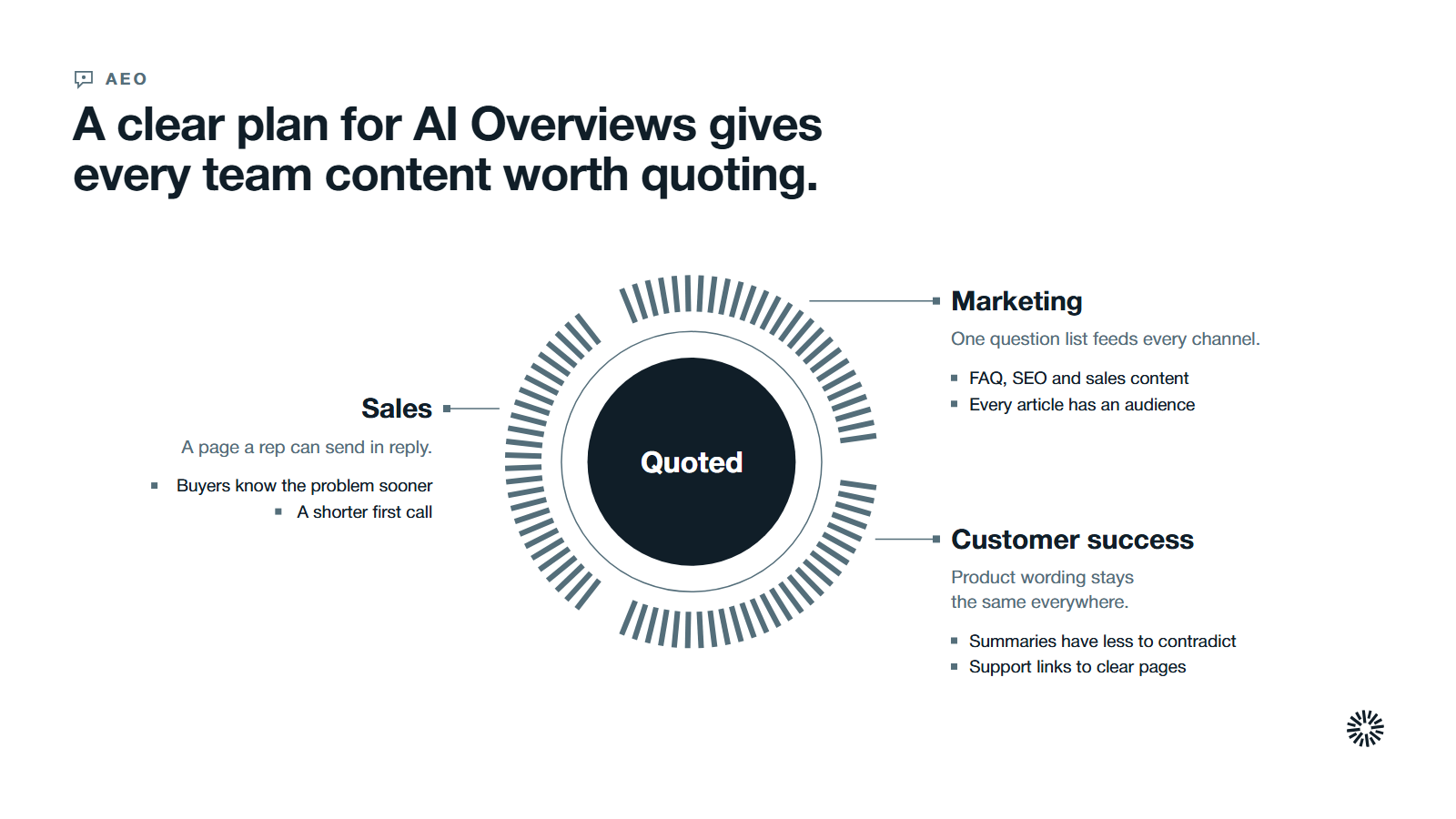
Sales gets content worth sending
A page that answers one buyer question in its opening sentences is something a rep can send in reply to that exact question. Buyers who discover your page after reading a clear summary already know the problem you solve, which shortens the first call.
Marketing works from one question list
The question list replaces a calendar of loosely related posts and gives every article a clear audience. The same list feeds your FAQ, your SEO strategy, your visibility in AI-generated answers and your sales content.
Customer success gets consistent language
When all your content describes your product and company in the same words, an AI summary built from several of your articles has less to contradict.
Start with eligibility, then measure for three months
Open Search Console this week, inspect your ten priority URLs and confirm each is indexed and free of preview controls you did not choose. Then rewrite the opening of each priority URL, add the related questions to an FAQ and start your monthly record.
After three months you will know which URLs Google shows and what to fix next.
Propello is a HubSpot partner and designs and builds connected go-to-market systems on HubSpot. If you want an outside view of how your content performs in Google Search and AI answers, an audit is the place to start. For the method that applies to every AI engine, see how to optimize content for AI search.

/ultimate-guide-ai-engine-optimization-share-1200x630-v3.png)