To optimize content for AI search, answer the questions your buyers ask in plain, specific passages, source every claim, show who wrote the page and when it was updated, and keep it easy for search engines and AI systems to fetch. This guide is for CEOs, founders, CROs and CMOs who brief a content team.
You get eleven steps you can hand to a writer, a before-and-after rewrite of one paragraph, the markup that is still worth adding, and the mistakes that waste a quarter. AI Engine Optimization (AEO) is Propello's name for this discipline, and the wider market calls it answer engine optimization.
|
AI Search Optimization AI Search Optimization is the practice of writing and structuring web content so AI search engines can retrieve it, understand it and use it, with a source link, when they assemble an answer. |
What to settle before you start
Content that is easy to cite starts with decisions made outside the document:
- Your buyers and their stages. Name the segments, the roles on a buying committee and the questions each role asks at each stage.
- A content owner. One named person keeps each page accurate, or the pages drift out of date.
- Access to your own data. You need call notes, chat logs, support tickets and search reports, because they hold the real questions.
- A way to measure. Rankings alone will not show your AI visibility, so plan for the AI reports in Google Search Console and Bing Webmaster Tools.
Your GTM Engineering team or HubSpot admin is often the right owner for the measurement and markup parts, and HubSpot ties page visits to contacts and revenue.
How to optimize content for AI search in eleven steps
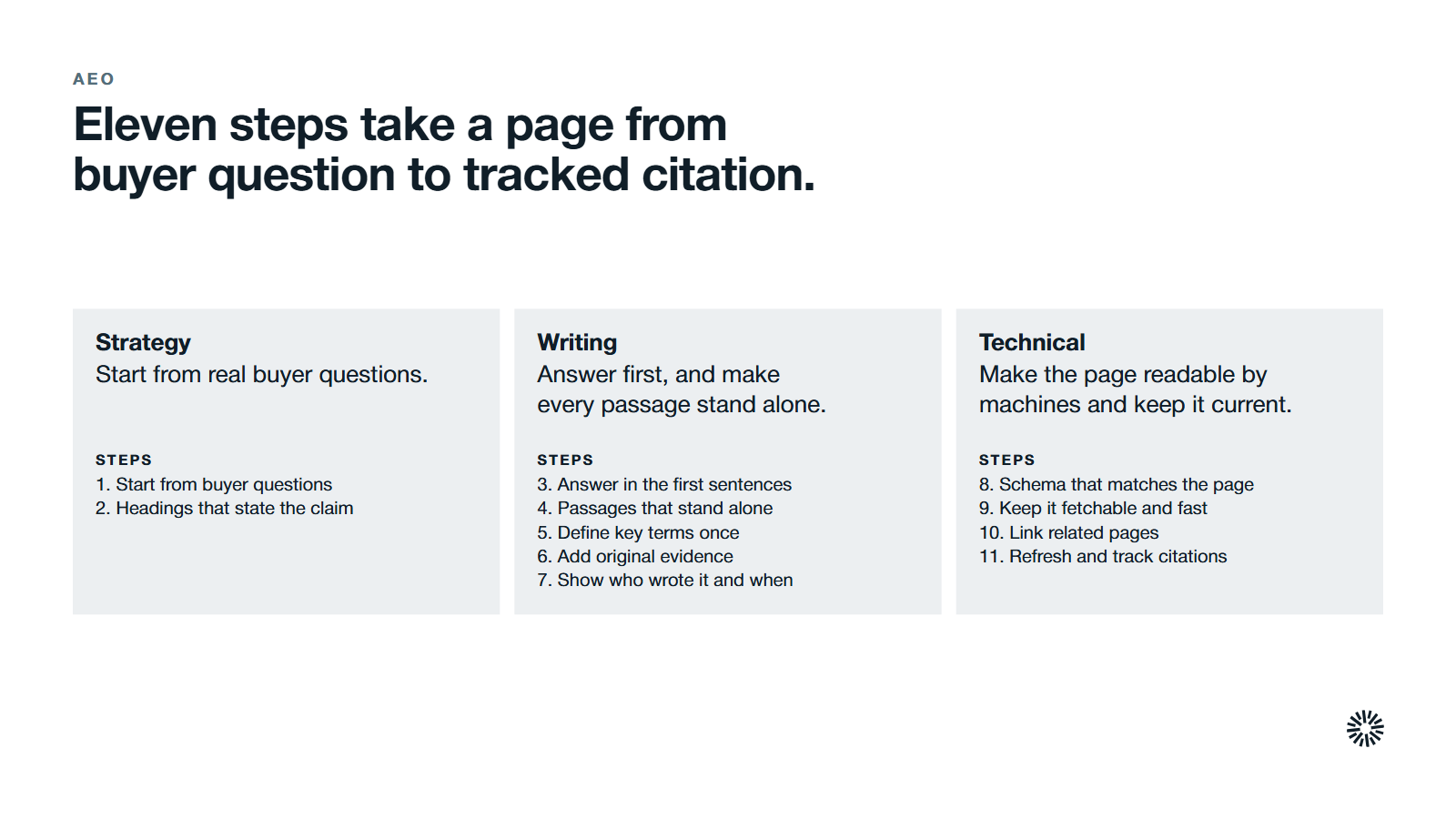
Each heading below is an instruction. The order runs from strategy to writing to technical work.
Start from the questions buyers ask at each stage
Collect real user queries before you open a document. Ask sales, customer success and support for the exact words buyers use, then sort them by stage: problem, options, vendor choice, risk check and onboarding.
Write each one in natural language, the way a buyer would type it into an AI tool. Keep the conversational, long-tail questions that sales hears, because they carry the specifics.
"What breaks when we merge two CRM instances?" is worth a page. "What is a CRM?" is already answered everywhere.
Write headings that state the question or the claim
A heading should tell a skimming reader, search engines and AI systems what the section settles. "Benefits" says nothing. "What changes when sales and marketing share one pipeline" says exactly what follows.
Question-based headings mirror the prompts buyers type, so use their phrasing where you can. A heading that cannot be understood alone cannot be quoted alone.
Answer the question in the first sentences, then support it
Put the answer in the first two sentences under the heading, then add reasons, an example and the exceptions. To see these rules applied together on one real page, read the annotated AEO checklist example. Readers get direct answers at once, and a system that lifts a short passage into its AI answers lifts the part that matters.
Check each section against three tests. Bullet points keep parallel items like these easy to read:
- The first two sentences answer the heading.
- The subject is named, so the passage works alone.
- The next sentences add a reason, an example or an exception.
Here is a before-and-after, written for this article as an illustration. The question is "How do I brief a content team on AI search?"
Before: "There are many things to consider when briefing a team on a topic like this. It is important to think about goals, and the main point is that everyone should understand what the work involves and how it changes the process."
After: "Brief your writers by defining AI search optimization in one sentence, sharing the eleven steps in this guide as the standard and naming an owner for each step. A written standard lets any editor review a draft against the same checklist."
The second version names its subject and answers the question.
Write passages that stand alone when lifted out of the page
Name the subject in each paragraph instead of writing "it" or "this" and relying on the previous paragraph. A passage quoted by itself has no previous paragraph. Write "the onboarding checklist" and not "that." Clear entity references help AI systems tell which company, product or person a passage describes, so name each one.
Google's documentation says you do not have to break content into small pieces for its AI features, and that its systems can show the relevant piece of a page that covers several topics.
So the aim is clear writing, not chopped writing. Sections that make sense alone also help readers who jump into the middle of a blog post.
Define key terms once and use them the same way everywhere
Pick one name for each concept and keep it. Do not call one feature "routing rules" in one article and "lead distribution" in another.
Define each term in one sentence the first time it matters, then reuse the exact words across marketing, product and help content. Some practitioners call this entity consistency. It means passages from different pages agree when AI systems combine them.
Add original evidence and link every other source
Google's guidance on its AI features asks for non-commodity content with a unique point of view, not a summary of what other pages already say. For a B2B team, original evidence means your own method, your own checklist, your own anonymized worked example, or a question you tested and recorded.
For everything else, link the primary source on a short anchor and say who published it and when. Never state a figure you have not seen on the original page, because a wrong number travels further than a right one.
Show who wrote the page and when it was updated
Put a named author, a role and a short bio on the page. Google's guidance on helpful content encourages accurate bylines where readers expect them, and warns against inventing author profiles.
Show a publication date and a last updated date. The same guidance warns against changing dates to make pages look fresh when the content has not changed, so update the date only when you have checked that the page remains accurate and changed something real.
Implement schema markup that matches what the page is
Implement schema markup in the JSON-LD format, placed in a script tag, so the structured data stays separate from the visible text. The schema types worth knowing are Article, Organization, FAQPage and HowTo. Local business schema matters only if you serve customers at a physical location.
Schema markup helps search engines understand the page. Structured data is not required for generative AI search, according to Google's guide, so treat schema markup as a description and not as a ranking lever. Have a developer check the schema code before it ships.
Add Article markup with the author and dates, which Google says helps it show better title text, images and date information.
Add Organization markup that names your company, so every page points to the same publisher. Fill in the schema properties you can support and leave out the rest. Markup you cannot support should stay off the page.
Use FAQPage only when the page really contains questions and answers, and HowTo only when it really teaches a sequence of steps, using the definitions on schema.org. Google's structured data policies say markup must describe content that readers can see on the page.
Be clear about what that markup buys you. Google's Search Central changelog says the FAQ rich result stopped appearing in Google Search from May 7, 2026, and the HowTo documentation was removed in September 2023 because that result no longer showed.
Google also says AI Overviews and AI Mode need no special schema. FAQ schema markup still describes your page, but do not expect a rich snippet from it.
Keep the page fetchable and fast
A page cannot be quoted if it cannot be fetched, and search engines and AI tools both start there.
For Google AI Overviews and Google AI Mode, the page must be indexed and eligible to appear in Search with a snippet. Check that your robots rules, your canonical tags and your rendering do not hide the text.
Other search engines and AI platforms run their own crawlers. For how engines pick what to cite once they can reach you, see AI search ranking factors. OpenAI recommends allowing OAI-SearchBot in robots.txt if you want a site to appear in ChatGPT search results. Keep the text in the HTML structure, keep each of your web pages light and keep URLs stable.
Link related pages so the cluster reads as one body of knowledge
Link each page to the page that answers the next question a buyer will ask: the explainer to the how-to, the how-to to the comparison pages your buyers use when they shortlist, the cluster to its pillar.
Every page that raises a shortlist question should link to your comparison pages. Use anchor text that describes the destination, not "click here." In HubSpot, topic clusters make these relationships visible to your team.
Refresh on a schedule and track AI citations
Set a review date for every important page, quarterly for the ones that matter most. To turn those reviews into a routine, an AEO test-and-learn loop shows how to decide what to change next. Check facts, links, terms and examples, and log what changed. Google describes its AI features as retrieving up-to-date pages from its index, so a page that stays accurate gives them current facts to use.
AI citation tracking starts with a fixed list of buyer questions. Ask the same query in the same wording each month and record which sources the AI answers cite.
Comparing that record against competitors shows who is cited instead of you, and that is where citation optimization begins. Your own question log is original evidence nobody else has.
The Generative AI performance report in Search Console covers Google's AI features, such as Google AI Overviews. Bing's AI Performance report counts citations in Microsoft Copilot and Bing's AI summaries.
Position data cannot tell you whether an answer cited you, so make AI citation rate your first measure of AI search visibility. Ongoing monitoring is part of the job.
What you gain when this is done properly
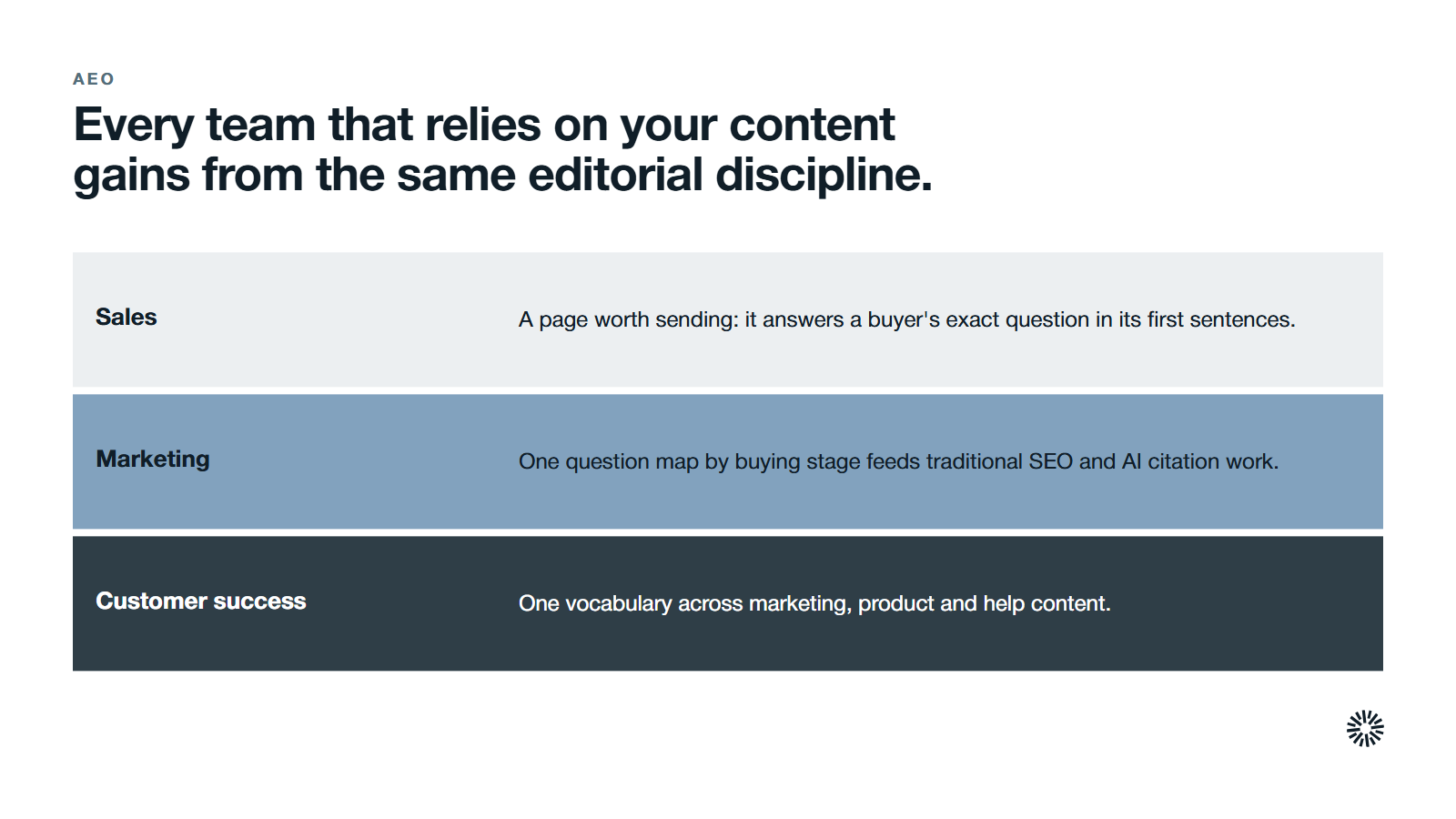
The work is mostly editorial discipline, so the gains show up in the teams that already depend on your content. Nothing here guarantees that an engine will cite you, and the section on common mistakes explains why a promise like that should make you wary.
The case for doing it is practical. A Pew Research Center analysis of March 2025 browsing data from 900 U.S. adults found that users who saw a Google AI summary clicked a traditional result in 8% of visits, against 15% for users who did not.
Buyers who ask AI tools a question may read the AI generated answers and move on, so appearing in the answer matters as much as ranking beneath it.
Sales gets pages worth sending
A page that answers one buyer question in its first sentences is a page a rep can send in reply to that exact question. Answer-first writing also gives a buying committee passages they can paste into their own evaluation notes, with your wording and your name attached.
Marketing works from one question map
A question map organized by buying stage replaces a calendar of loosely related posts. The same map feeds traditional SEO and AI citation optimization, so you extend work you already do and can report AI search visibility against the business objectives you already track.
Customer success gets consistent language
When marketing, product and help content use the same term for the same thing, an AI answer built from several of your pages has less to contradict. Customers meet one vocabulary, and your support team spends less time correcting answers that mixed two names for one feature.
What generative engine optimization changes and what it does not
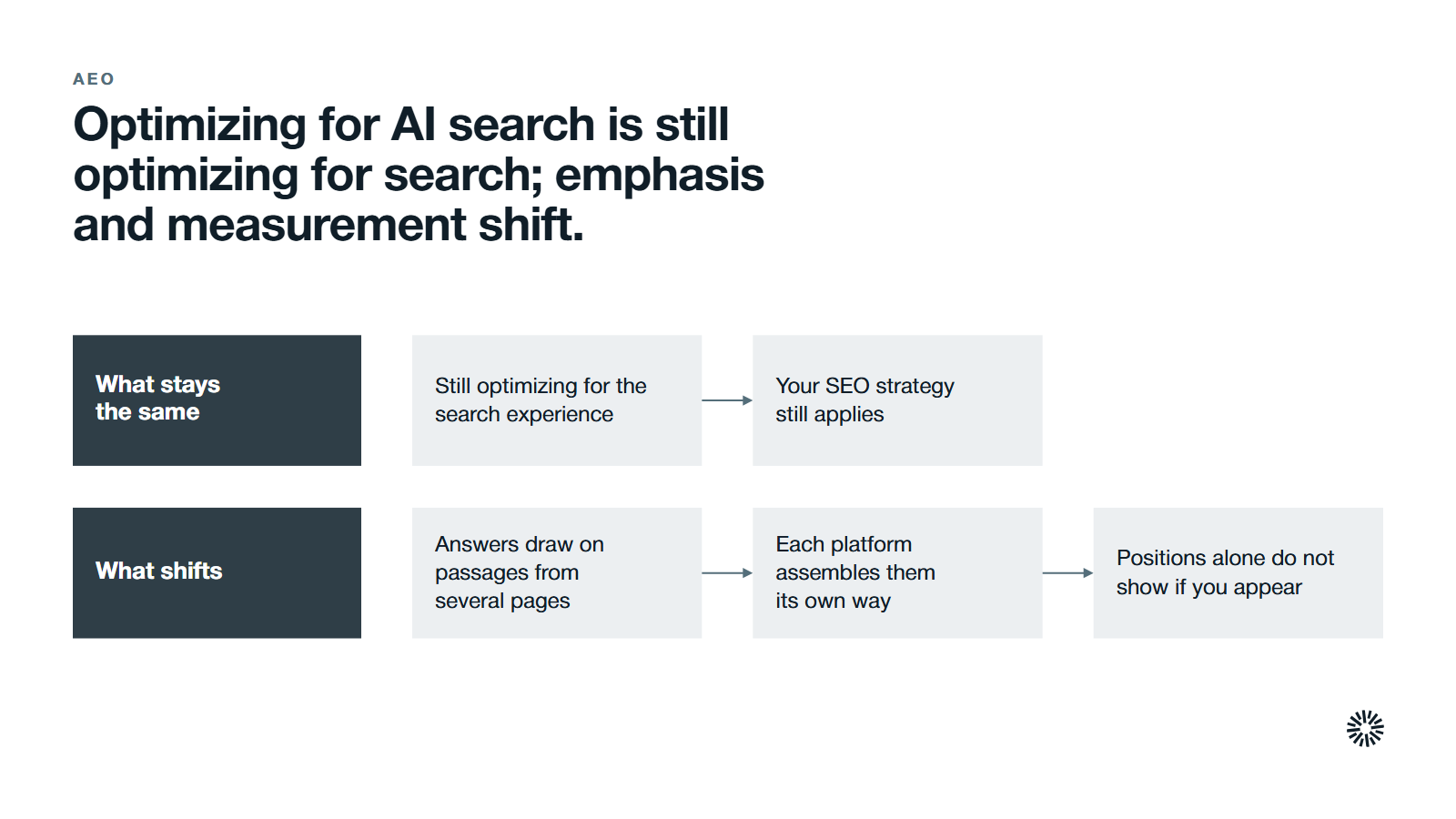
You will also see this work called generative engine optimization. Google's guide says that from its perspective, optimizing for generative AI search is still optimizing for the search experience. Your SEO strategy still applies.
What shifts is emphasis and measurement. Search results compete as pages among the blue links, while AI generated answers draw on passages from several pages, and each of the AI platforms assembles them its own way. Search results positions alone do not tell you whether you appear in them.
Common mistakes that waste the effort
Four mistakes account for most disappointing programs.
Writing for the engine and not for the buyer
Content built around keyword stuffing and artificial questions reads badly for people, and people are still the audience. Google's guide says there is no need to rewrite content just for AI systems. Write for the buyer, then check that the answer comes first.
Stuffing pages with questions and thin answers
A long FAQ with dozens of near-duplicate questions and one-line answers has little to lift. Google warns that creating separate pages for every query variation to manipulate responses violates its scaled content abuse policy. Fewer questions with real answers serve you better.
Adding schema markup that does not match the page
Marking an ordinary article as FAQPage, or a sales page as HowTo, describes something the page is not. Structured data should mirror what a reader sees. If you cannot point to the questions or steps on the page, remove the markup.
Publishing volume over substance
Frequent shallow posts cost you the time you would spend refreshing pages that matter. Google states that a high quantity of pages does not make a website higher quality. Publish fewer pages, maintain them and keep a named owner on each.
Make AI search part of your GTM system
Question research, answer-first drafting, consistent terms, honest markup and a refresh calendar apply whichever engine your buyer uses. None of them promises a citation, and all of them improve the page for readers.
Your writers can usually run the question research, the drafting standard and the refresh calendar. The harder parts are connecting content performance to pipeline and keeping markup, analytics and your CRM consistent as the site grows, which is GTM Engineering work.
Propello designs and builds connected GTM systems on HubSpot. If you want your content to work for search, sales and customer success together, an audit is the place to start.