This article is for CEOs, founders and revenue leaders at growing B2B businesses who are asked to fund AI search work and want to understand the mechanism first. The short answer: an engine retrieves live pages it can reach, picks passages that answer the question and cites the pages it used.
You will get a plain account of how an engine builds an answer with sources, what nobody outside the engines knows, the factors that are well grounded and what they mean for your budget. Claims about named engines come from their own documentation, linked.
|
AI Citations The sources an AI engine links or names beside the answer it writes, usually pages it retrieved live rather than text it memorized in training. |
How an AI engine builds an answer with sources
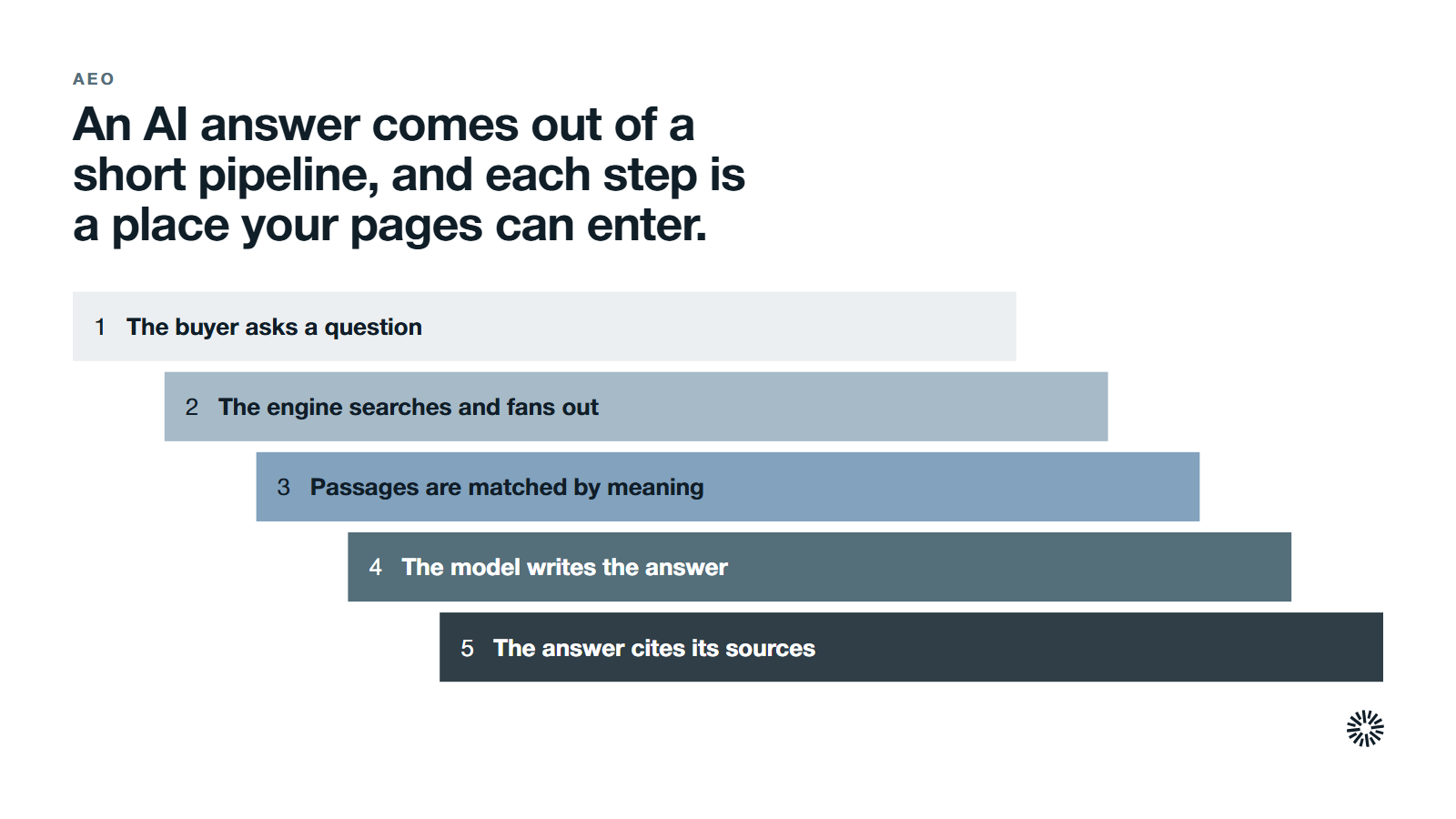
Traditional search engines return a ranked list of links for search queries. AI search engines write an answer and attach sources, which changes what your page has to do. The answer is the output of a short pipeline, and seeing each step shows you where your pages can enter it.
What a model learned in training and the current information it retrieves
Large language models, a kind of foundation model, are built through machine learning on a huge body of text and then frozen at a cutoff date. That training data gives generative AI models general knowledge and fluent language, but nothing that happened afterward.
Your current pricing, product changes and positioning are unlikely to be in it.
When a buyer asks about a vendor, a model working from memory alone can only guess. To answer with current information, the engine has to fetch new data. OpenAI describes this in its introduction of ChatGPT search: ChatGPT chooses to search the web based on what you ask, and chats then include links to sources.
What retrieval augmented generation adds
Retrieval augmented generation, often shortened to RAG, is the pattern behind most answers with sources. The engine takes the user query, searches indexes, knowledge bases and other external data sources, fetches relevant documents and passages, and asks the model to write an answer grounded in that material.
The passages are added to the prompt, so the model writes from an augmented prompt rather than from memory alone. The model supplies the language. The retrieved text supplies the facts and the citations.
Because retrieval can reach external data that changes daily, an organization can reuse its existing authoritative data instead of paying to retrain a model each time. Grounding in real documents can also lower the risk of hallucinations, where a model states something false with confidence.
How query fan-out widens the search for conversational queries
Buyers now put long questions to engines where they once typed short search queries, and spoken ones run longer still. The engine has to work out the user intent behind them. Voice questions are often asked on phones, so mobile-friendly pages suit them, and question-based, long-tail phrasing is how many buyers ask.
Google says AI Overviews and AI Mode may use a query fan-out technique, issuing multiple related searches across subtopics and data sources to develop a response.
Google adds that its systems identify more supporting pages while a response is generated, so the links shown can be a wider and more diverse set than classic web search results show. Other engines have not documented fan-out in the pages we reviewed, so treat it as a Google fact, not an industry rule.
For you, the lesson is practical. A page can be pulled in for a sub-question the buyer never typed, so pages that answer narrow questions well have more routes in.
Systems also assess the depth of topic coverage across related subtopics, which favors a page that explores a question properly over one that touches it.
Why semantic search selects passages, not whole pages
Retrieval systems rarely hand a whole page to the model. They split pages into passages and compare each one with the question, often by turning text into numerical representations stored in a vector database so that passages can be matched by meaning rather than exact words.
That is semantic search at work: relevance is judged by meaning and user intent, not only by a matching phrase.
The consequence is that a passage has to make sense on its own. A paragraph that says "as noted above" gives the engine nothing clean to lift. The passage is the unit that gets chosen.
Where AI citations come from
Citations point at the pages whose passages were retrieved and used to write the answer.
That is not the same as ranking first: Google's description of a wider, more diverse set of links suggests visibility in an answer can differ from the top organic position.
Perplexity's documentation fits the picture. It says PerplexityBot is designed to surface and link websites in search results on Perplexity, and that Perplexity-User may visit a page to help answer a question and include a link to it.
Microsoft shows the same mechanism from the publisher side. In its announcement of AI Performance reporting, Microsoft describes counts of the citations displayed as sources in AI-generated answers, and grounding queries: the key phrases the AI used when retrieving content that was referenced.
What nobody outside the engines knows about AI search ranking factors
No engine has published a list of the factors that decide which sources it cites. Anyone who hands you a ranked list of AI search ranking factors, with weights, is describing a guess.
Google's documentation says there are no extra requirements and no special optimizations for appearing in AI Overviews or AI Mode, and that no special schema.org markup is needed.
Correlation studies are the other source of folklore. A study can find that cited pages share a trait, such as a format or a length. It cannot show that the trait caused the citation, and results shift as engines change. Use such studies to design tests, not to set policy.
This work is what Propello calls AI Engine Optimization (AEO). The wider market calls it answer engine optimization, and some call it GEO, for generative engine optimization. Our guide to AEO covers the whole practice. What follows is narrower: the factors with solid grounding.
The AI search ranking factors that are well grounded
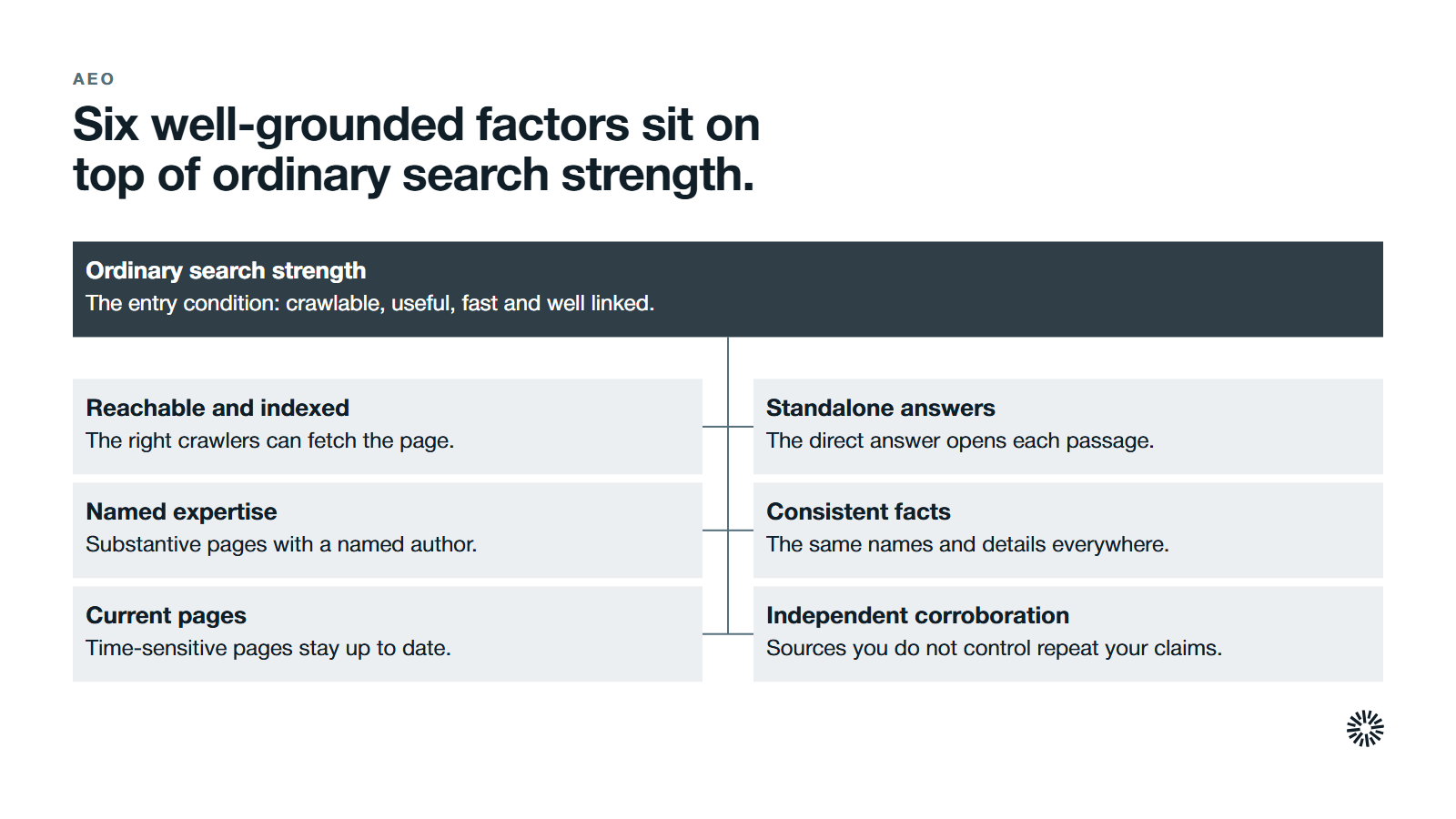
Each factor below is either stated in an engine's documentation or follows directly from the mechanism above. None is a guarantee.
Make sure the right crawlers can reach and index your pages
According to Google's AI features documentation, a page must be indexed and eligible to be shown in Google Search with a snippet to appear as a supporting link in AI Overviews or AI Mode.
OpenAI separates its crawlers by purpose. Its crawler documentation says OAI-SearchBot is used to surface websites in ChatGPT's search features, and that sites which disallow it will not be shown in ChatGPT search answers, though they can still appear as navigational links.
GPTBot is a different crawler, used for content that may train models. Perplexity draws a similar line between PerplexityBot and Perplexity-User, and recommends allowing PerplexityBot if you want your site to appear in its search results.
So a blanket block on AI bots and crawlers, often set for training concerns, can also take you out of the answers. Decide the policy crawler by crawler, with legal and security in the room.
Site architecture matters here too. Crawlers need accessible site configurations to index content correctly: working links, readable page code and sensible robots.txt and meta tag settings. Technical SEO is where that gets fixed.
Answer the question directly in passages that stand alone
Because engines pick passages, put the direct answer at the start of each section, in plain sentences that make sense without the paragraphs around them. Headings that state the question or the point help a system, and a reader, find the passage that matters. A worked version of this advice is in our guide to content optimization for AI search across every page type.
Clear headings, lists and tables make passages easier for AI systems to extract. Structured data can describe a page accurately, but Google says no special schema.org markup is needed to appear in its AI features, so do not treat schema markup as a shortcut.
Write substantive pages with named expertise
Google's guidance on helpful content frames quality as experience, expertise, authoritativeness and trustworthiness, or E-E-A-T, and says trust is the most important of the four. Its guidance on generative AI content warns that producing many pages without adding value for users may violate its spam policy.
Google says its systems identify content that shows these qualities, which is the reason to demonstrate them.
Thin, mass-produced pages are a poor bet with any engine, and search engines have long preferred quality content over pages stuffed with repeated phrases. Fewer pages with verifiable depth, original data and a named author are a better one.
Keep entities and facts consistent
An entity is something an engine can recognize as a distinct thing: your company, a product, a person, a place. If your site calls one product by three names, or gives different details on different pages, a system assembling an answer has to choose, and a cleaner source may win.
Align names, descriptions, dates and prices across your site, your profiles and your press pages. The full method behind this work is explained in knowledge graph SEO and entity authority.
Keep time-sensitive pages current
Pricing, product details, regulation and anything a buyer would qualify with the word latest need frequent attention.
An engine that retrieves live pages works from what is current on the web at that moment, so a stale page is a weak basis for an answer. Show a clear update date and review critical pages on a schedule.
Earn independent corroboration
A claim that appears only on your own site is a claim. One that analysts, customers, partners, directories and publications also repeat is safer for a system to rely on.
This is about being accurately described by sources you do not control, not about collecting backlinks. Off-site brand visibility matters for citation: a system looking for evidence about your brand meets what others say about it, not only what you say.
Authoritative content has several parts: citations of your work, the expertise of named authors and original research all contribute. Pages that cite credible primary research give readers and systems something to verify, and quoting named experts embeds context that an engine can use when it synthesizes the material.
Build ordinary search strength
Where AI search engines build on an existing search index, the usual foundations apply: pages that are crawlable, useful, fast and well linked. Google says the best practices for SEO remain relevant to its AI features, so traditional SEO is not replaced. Whether you need both disciplines is the question AEO vs SEO answers, with a plan for funding each. It is the entry condition.
What this means for how you invest in AI visibility
Treat AI search as a property of your content and your site, not a separate channel with its own bag of tricks. The reason to care is behavior. Pew Research Center analyzed the browsing data of 900 U.S. adults in March 2025.
In that 2025 Pew analysis, adults who saw a Google AI summary clicked a traditional result link in 8% of visits, against 15% of visits when they did not. If fewer people click through, being present and accurately described inside the answer carries more weight.
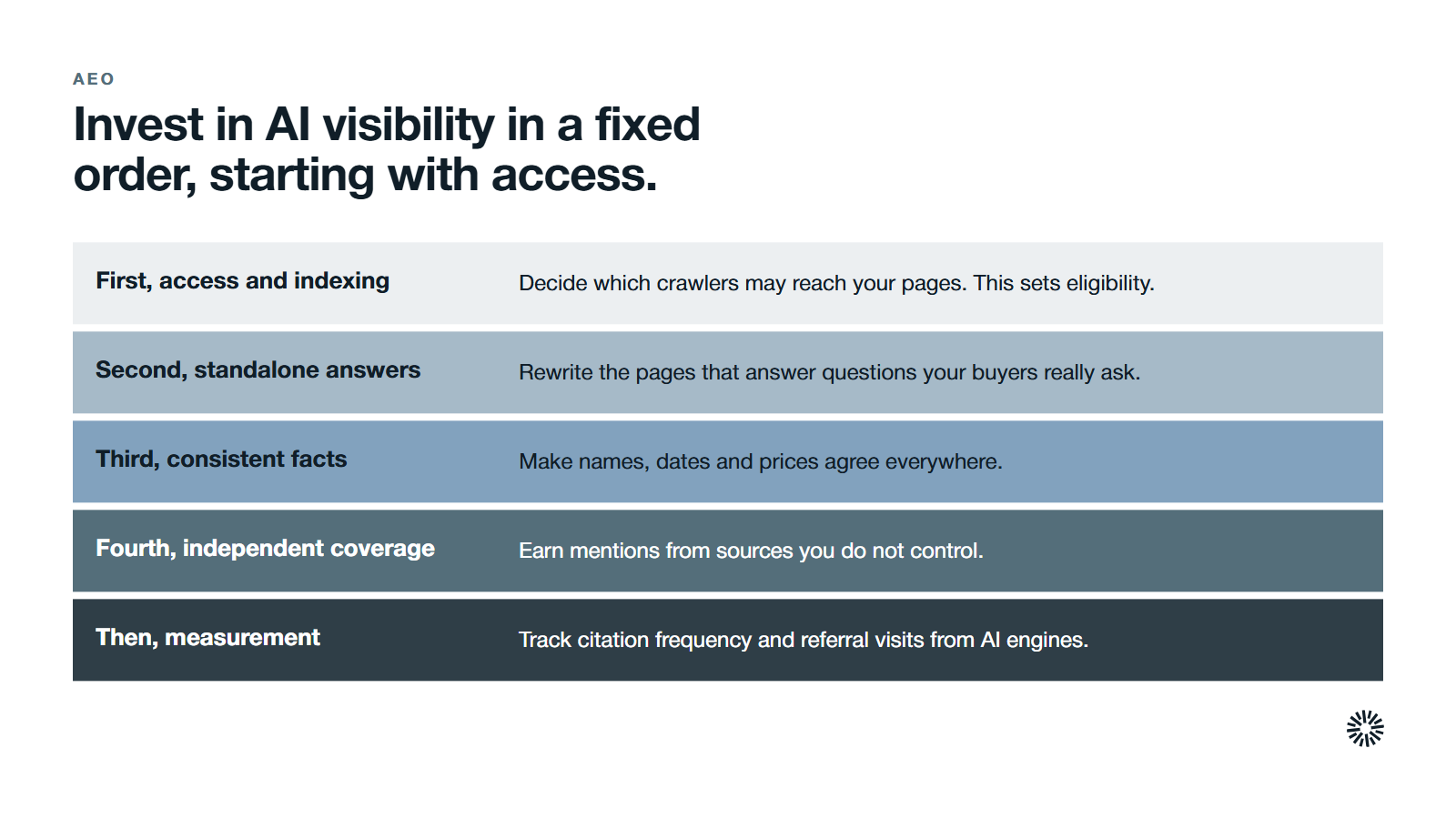
Spend in this order. First, fix access and indexing, which decides eligibility. Second, rewrite the pages that answer questions your buyers really ask, so each answer stands alone. Third, make your facts agree everywhere. Fourth, earn independent coverage. Then measure: track citation frequency and referral visits from AI engines alongside rankings and impressions.
Be wary of anyone who sells a guaranteed citation. Google says indexing and serving are not guaranteed even when a page meets every requirement, and no outside party sees an engine's selection logic.
What you gain when this is done properly
The gains come from the mechanism, not from a promise: accurate, consistent, reachable pages give engines better material to quote. The effect differs by team.
Sales: buyers arrive with a more accurate picture
When an engine describes your offer from accurate, consistent pages, prospects reach your reps with fewer wrong assumptions. Sales spends less of the first call correcting what a summary got wrong.
Marketing: your explanations shape the question
Pages that answer questions directly serve the people reading them and the engines quoting them, so one piece of work does two jobs. Marketing also gets a clearer brief: write for the sub-questions buyers ask, and watch presence in answers alongside visits.
Customer success: fewer avoidable questions after the sale
Customers ask AI tools how to use your product. Documentation that is current, consistent and written as direct answers gives those tools better material, so fewer tickets should begin with a wrong answer. Keep help pages dated and reviewed.
Start with the pages a buyer would put to an AI engine
Pick the questions buyers ask before they shortlist a vendor. Check that the right crawlers can reach the pages that answer them, that each answer stands alone and that your facts agree everywhere they appear. That is a sound first step whatever the engines change.
If your pages, forms and CRM records live on HubSpot, keeping them consistent is part of our HubSpot services.
Propello designs and builds connected GTM systems on HubSpot. If you want to know whether AI engines can reach and correctly describe your offer, an audit is the place to start.