AEO does not replace SEO. It extends the same foundation to engines that answer questions instead of listing links, so the SEO foundation you already have is the base for being found in AI search.
This article is for CEOs, founders, CROs and revenue leaders whose companies already invest in search engine optimization. You will get a side by side comparison, what Google itself says, where the two genuinely differ and how to fund both from one program.
|
AEO vs SEO SEO earns rankings and clicks from search results, while AEO extends the same work so answer engines can pick your content as the direct answer or cite it as a source. |
What search engine optimization and answer engine optimization each try to do
Traditional SEO aims to rank your pages in search engine results so buyers click through. Your SEO strategy rests on technical SEO, keyword research that reflects search terms and search intent, and content quality. It has long emphasized comprehensive content and strong backlink profiles, because traditional search engines like Google and Bing weigh authority.
You judge it by keyword rankings, organic clicks, organic traffic and engagement signals such as dwell time. Those SEO metrics are mature, and your team already knows how to read them. Third party scores such as domain authority are rough proxies, so use them to compare sites, not as the goal.
Answer engine optimization (AEO) aims to make your content the answer, or the source behind it, when AI systems respond to a question directly, drawing on content from across the web. AI Engine Optimization (AEO) is Propello's name for it, and answer engine optimization is the same idea in the wider market.
You will also see generative engine optimization (GEO) used for the same territory. People use the labels loosely.
For a revenue leader the useful point is the shared goal: appear inside AI generated answers on the AI platforms your buyers use, such as Google AI Overviews, Google AI Mode, ChatGPT, Perplexity and Gemini. SEO, AEO and GEO are interconnected, not rival programs.
AEO vs SEO compared on goal, content, measurement and where buyers see you
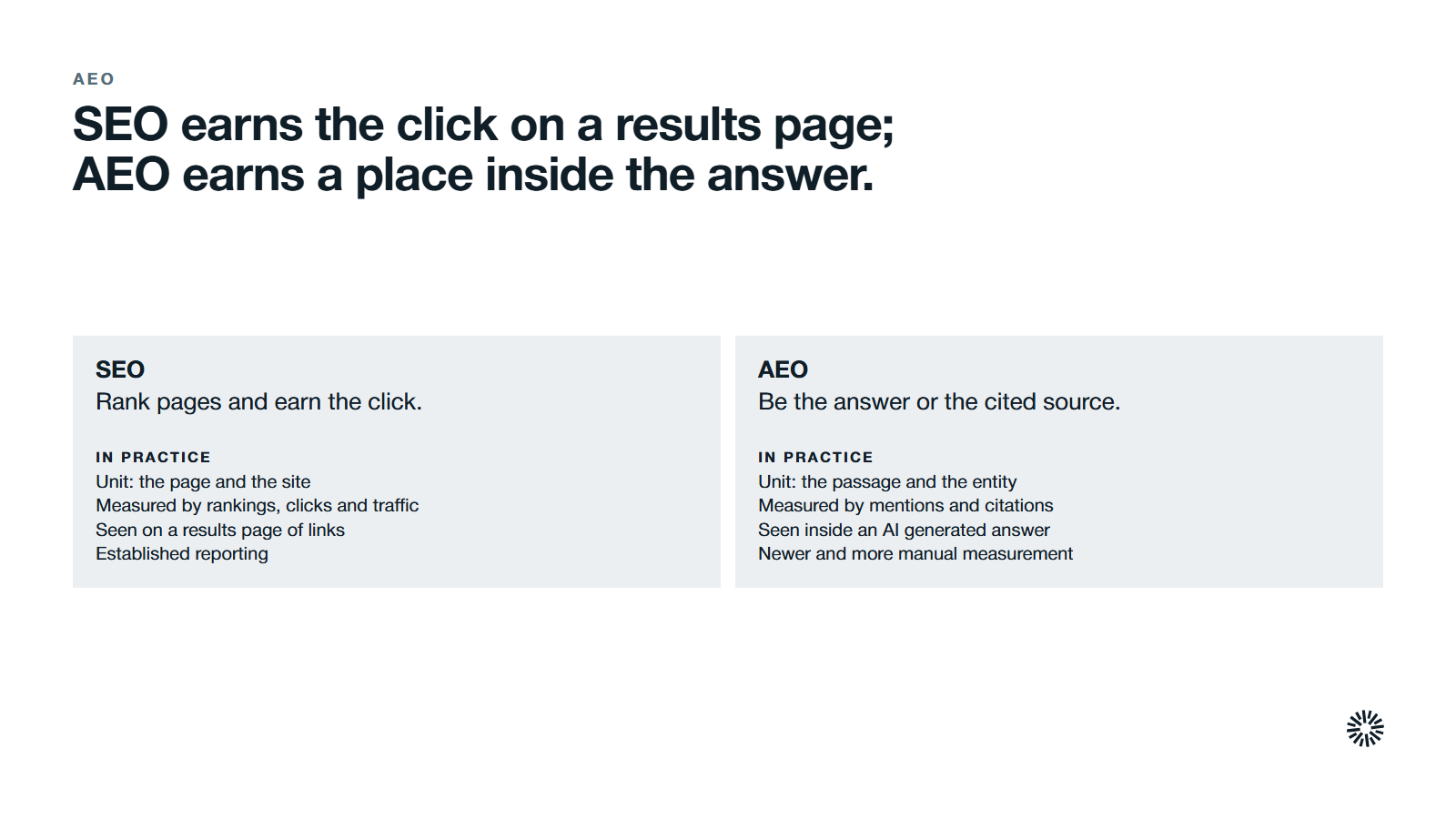
The table sets the two side by side.
| Criterion | SEO | AEO |
|---|---|---|
| Goal | Rank pages and earn the click | Be the answer or the cited source |
| Unit of content | The page and the site | The passage and the entity (your company, products, people) |
| How success is measured | Rankings, clicks and traffic | Mentions, AI citations, share of voice and assisted pipeline |
| Where the buyer sees you | A results page of links | Inside an AI generated answer |
| Core inputs | Crawlable pages, keyword relevance, content quality, authority, technical health | The same inputs, plus answer first structure and consistent entities |
| Measurement maturity | Established reporting | Newer and more manual |
The goal changes from earning the click to earning a place in the answer
In traditional search, a win is a high position in the search results and a visit. In AI search, a win is being named or cited inside the response, often before the buyer visits anything. The first impression can now happen without a visit.
The unit of content moves from the page to the passage and the entity
A page is still the container, but AI systems tend to build an answer from passages that respond to a question, and from an understanding of the entity behind them: who you are, what you sell and what you are known for. Consistent naming becomes a content job.
Success moves from rankings and traffic to presence in answers
Rankings and traffic remain useful. You add measures of presence, such as featured snippet placement, direct answer share and appearance in voice search results.
That means tracking how often your brand is mentioned, which of your pages are cited, how your share of voice compares with competitors across the questions your buyers ask, and how much assisted pipeline those buyers go on to create.
In AI powered search, the buyer meets you inside the answer
A results page lists options and lets the buyer choose. AI answers compress the options into a paragraph, and many buyers stop there.
Pew Research Center looked at this in a study of 900 U.S. adults' browsing in March 2025: people who saw a Google AI summary clicked a link in the traditional search results in 8% of visits, against 15% of visits for people who did not.
Zero click searches, where the buyer gets what they need without visiting a site, are why presence in the answer matters. AI powered search results make them more common.
The Pew data covers one panel over one month, so treat it as a signal, not a forecast. The practical reading is that a ranking position alone may be worth less than it was, and the content of the answer matters more.
What stays identical between AEO and SEO
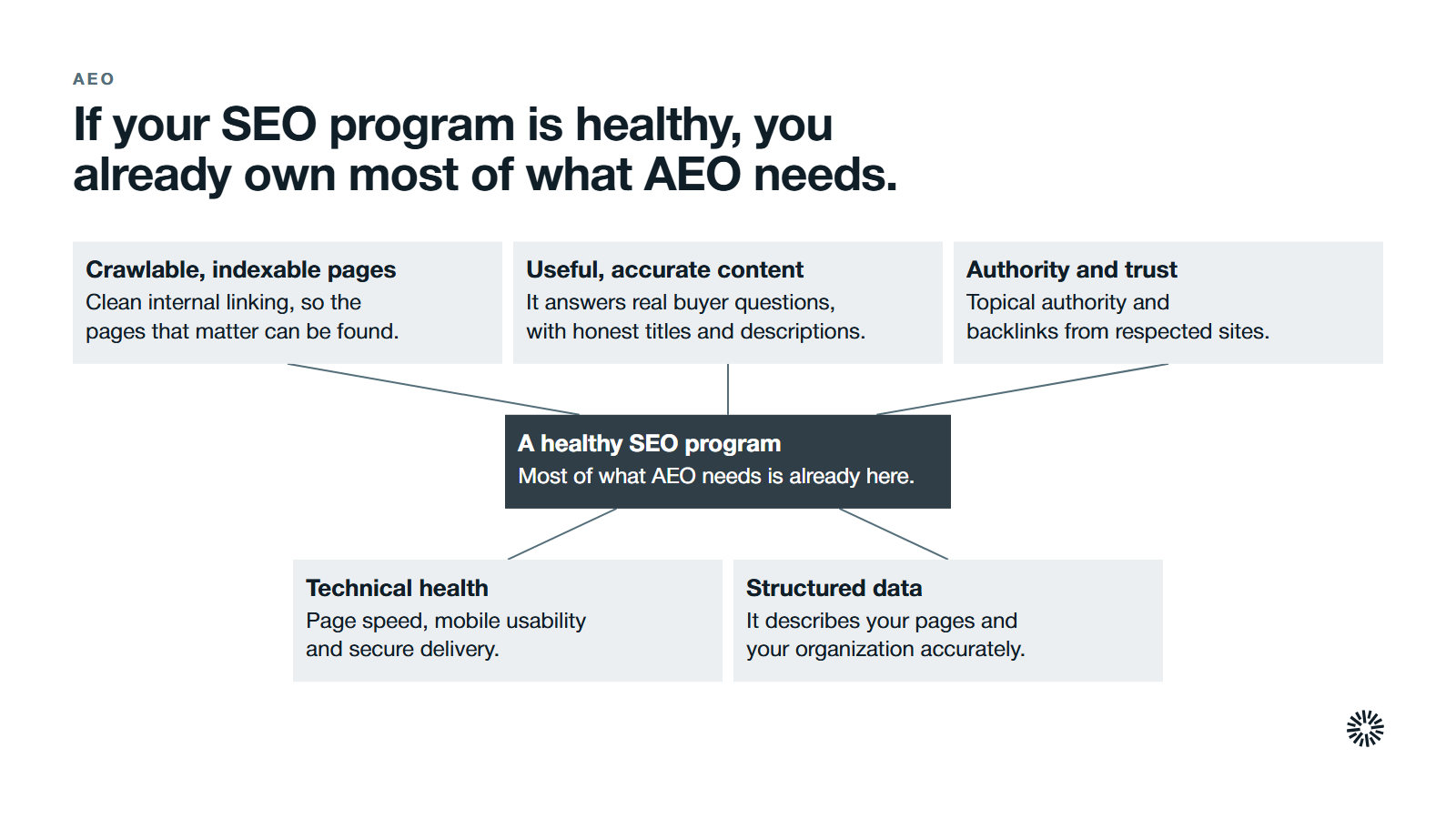
If your SEO program is healthy, you already own most of what AEO needs.
- Crawlable, indexable pages with clean internal linking across relevant pages, so the indexed pages that matter can be found.
- Useful, accurate on page content that answers real buyer questions, with honest titles and meta descriptions.
- Authority and trust, including topical authority and high quality backlinks from respected sites, the same credibility signals in both.
- Technical SEO health, including page speed, mobile usability and secure delivery.
- Structured data that describes your pages and your organization accurately.
Whichever of the AI engines answers a question, it needs a reason to trust the source. The credibility your SEO program has built for years carries straight over, and strong content quality is what makes a source worth quoting.
What Google says about AI search and SEO fundamentals
Google has published how it sees AI features in Google Search, and it is blunt. These statements are about Google Search only. They do not describe how ChatGPT, Perplexity or any other engine works, and they do not explain how Google evaluates any single page.
- On AI features and your website (updated 10 December 2025), Google says SEO best practices remain relevant for AI Overviews and AI Mode in Google Search, with no additional requirements to appear in them.
- On the same page, Google says a supporting link must come from a page that is indexed and eligible to show with a snippet, and that you need no special markup, AI text files or schema.org structured data.
- Also on that page, Google says traffic from AI features is included in your overall search traffic in Google Search Console, in the Performance report under the Web search type.
- In its guide to optimizing for generative AI features (last updated 10 July 2026), Google says optimizing for generative AI search is optimizing for the search experience, and thus still SEO.
The same guide says there is no requirement to break content into tiny pieces, that there is no ideal page length, and that you can ignore tactics such as AI text files or inauthentic mentions. It names unique, non-commodity content as the factor likely to matter most.
Search is changing, but the takeaway is not that AEO is fake. It is that, for Google at least, the foundation is SEO, and the things worth adding are the ones that make your content more useful and your brand more clearly understood.
Where AEO and SEO genuinely pull in different directions
Some leaders worry that SEO wants long pages and AEO wants short passages. That is not a real conflict. Google says there is no ideal page length, and a good long page already answers each question in a clear passage before going deeper.
The real differences are elsewhere.
Rankings and AI citations are related, not the same
A page can rank well in the search results and never earn AI citations, and the reverse can happen. Ranking pages are a start, not a guarantee.
Ahrefs' analysis of 863,000 keyword results pages, published in March 2026, found that 37.9% of URLs cited in Google AI Overviews also ranked in the first ten organic results. The same report compares that with about 76% in July 2025 and notes that its citation parsing has improved since.
Treat both figures as snapshots from one publisher's method. The lesson is not a number: ranking well is a starting point for AI search visibility, not the outcome.
Brand authority and brand mentions beyond your own site carry more weight
AEO means building brand authority across several channels, not only on a single domain. What is said about you across the web matters as well as what you publish.
Google's guide notes its generative AI features can reflect what is said about products across blogs, videos and forum discussions, while warning that seeking inauthentic mentions is not as helpful as it looks.
Real brand mentions in industry publications and in YouTube videos your buyers watch build brand authority, and they take time.
Measurement is newer and noisier
Generated AI responses can differ each time the same question is asked, and the generative AI models behind them change. Presence is a pattern across many questions, not a single position you can look up.
Your SEO dashboards are mature. Your view of AI powered search results and AI visibility will be newer, partly manual and less precise, so say so when you report it.
AI citations are never a promise
No tactic guarantees that an engine will cite you, and anyone who promises it is selling certainty the field does not have. What you can control is the quality of your content, the clarity of your entities and whether you can see where you stand.
One program can serve both: practical tips for extending what you already do
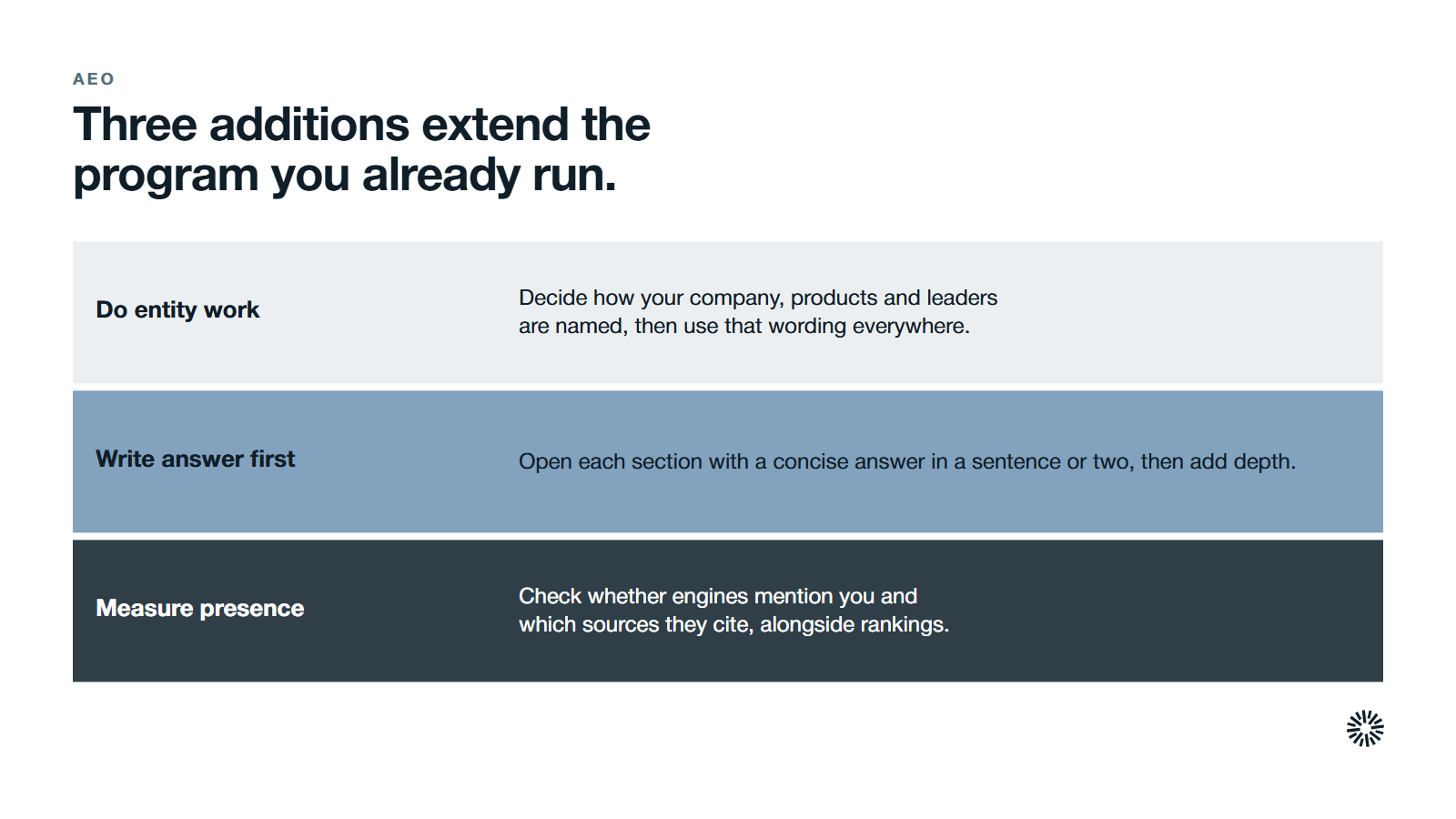
You do not need a second team, plan or report. If you need help deciding who runs the extra work, see how to choose between agency and in-house. Three additions to your existing program cover most of what AEO asks for.
Do entity work so engines can tell who you are
Decide how your company, products, priority industries, leaders and core frameworks are named and described, then use that wording everywhere: your site, your service pages, your internal linking, your Google Business Profile, partner pages and bylines.
Implement schema markup for your organization and articles so structured data describes them accurately, and treat it as clean description, not a lever, because Google says no special schema is needed.
Consistent entities help AI models connect your brand to its topics.
If you sell to local businesses or depend on local search, your business listings belong in this work too.
Write answer first: lead with a concise answer, then add depth
Open each section with a concise answer in a sentence or two, then add the evidence and nuance. Our guide to optimizing content for AI search walks through the full drafting method. Write headings as the questions buyers ask.
This helps human readers first, and it gives any engine a clean passage to quote. Content optimized for AEO this way lines up with how search engines have long extracted snippets. Featured snippets, which show a direct answer above the links, and voice search were early versions of the same format.
A short FAQ section helps readers who arrive with a specific question. FAQ markup is optional, because Google says no special structured data is needed to appear in its AI features.
Measure presence in answers alongside rankings
List the questions your buyers ask at each stage. A routine for acting on what you find is described in the AEO test-and-learn loop. Check regularly whether AI engines mention you in their AI generated responses, which sources they cite and how they describe you across the AI platforms your buyers use.
Whichever AI tools you try, an AI visibility tracker can help, and a manual check is a fair start. Use Google Search Console for Google traffic, keep tracking search rankings, and keep HubSpot as the system of record that connects organic visits to assisted pipeline.
What you gain when you extend SEO to answer engines
Buyers now research inside answers before they talk to you, so the benefits reach every revenue team.
Sales starts conversations on shared ground
When answers describe your category and the problem you solve in terms that match how your team sells, early calls begin from a shared picture. Reps can reuse answer pages as follow ups and hear fewer basic questions.
Marketing gets one plan instead of two competing ones
Your demand generation program already creates the questions buyers ask. Extending SEO lets the same content, the same editorial calendar and the same budget work for rankings and for answers, and gives marketing a clearer picture of brand mentions and share of voice.
Customer success protects how the product is explained
Customers also ask AI tools and voice search how to do things with your product. Clear help content, consistent product names and well organized documentation give those answers something accurate to draw on, which supports adoption and renewals without a separate project.
Do not split the budget, and know when a specialist helps
A separate AEO budget invites two programs that compete for the same writers, the same pages and the same attention. Keep one program and fund the additions: entity work, answer first structure and presence tracking. Reassign part of the existing SEO effort to them first.
A specialist is worth bringing in when you lack capacity for a larger rebuild, such as restructuring a big site, cleaning up entity descriptions across many properties, building a measurement approach for AI powered search, or earning credible coverage outside your own domain. Ask how any AI optimization work will connect to your SEO program.
Start with the SEO you already have
The decision is not SEO or AEO. It is how much of your current program to point at answer engines, and the answer is some, starting with the pages that already matter to your pipeline.
Ask one question to guide the order of work: when a buyer asks an AI tool about your category, which brands do the AI answers name, and how do they describe the problem you solve? If it does not name you, that is your first piece of work.
Propello designs and builds connected GTM systems on HubSpot. If you need to see where your search program, your content and your revenue engine are not yet working together, an audit is the place to start.