This article is for CEOs, founders, CROs and revenue leaders at growing B2B companies who have decided AI search visibility matters and now need to choose who does the work. You will get a fair comparison of an AEO agency, your current SEO agency and an internal team.
The short answer: hire an AEO agency when you need method and measurement fast, extend your SEO agency when it already thinks in entities and can measure answers, and build in-house when you have the people and a long horizon. All three can work.
|
AEO Agency An AEO agency, also called an answer engine optimization agency, is a team that plans, builds and measures how your brand appears in AI generated answers, from entity clarity to reporting tied to pipeline. |
What an AEO agency does and what AEO services include
Your buyers now research vendors with AI tools, in AI driven search such as Google AI Overviews, ChatGPT and Perplexity. If your brand is missing from those AI summaries, you lose influence before your sales team gets a conversation. AEO services are the work an agency does to improve AI visibility.
AI Engine Optimization (AEO) is Propello's name for this discipline. The wider market calls it answer engine optimization, and some agencies say generative engine optimization (GEO). The goal is the same: AI discoverability, meaning your content is easy for AI systems to find, extract and cite when they are generating responses.
Agencies sell this work under many names: AEO agency, GEO agency, AI SEO agency, AI search optimization agency, or simply GEO services. Judge the method, not the label.
AEO is also a customs status, Authorized Economic Operator, granted to trusted traders that meet compliance standards in return for fewer checks, and GEO often means geography, so check which meaning a page uses.
AEO services usually include five workstreams:
- Entity and schema work: make clear who your brand, products and people are, keep descriptions consistent across public sources, and add structured data markup so AI systems interpret your pages correctly.
- Answer-first content: build a content strategy around real buyer questions, then optimize content so each page answers one directly, with comparisons, FAQs and plain explanations that are easy to extract.
- Technical access for AI crawlers: check robots rules, sitemaps and rendering so search engines, AI platforms and other AI powered systems can reach and read your own site.
- Authority and mentions: earn coverage and mentions on other sites through digital PR and partnerships, because the sources AI models learn from and retrieve include third-party sites.
- Measurement of presence in answers: track where your brand appears for the questions buyers ask, and link what you find to pipeline in your CRM.
AEO focuses on intent fulfillment and answer precision, not keyword rankings alone. Content has to be semantically rich and contextually accurate, or there is nothing worth extracting.
Most of the foundation is shared with a good SEO strategy
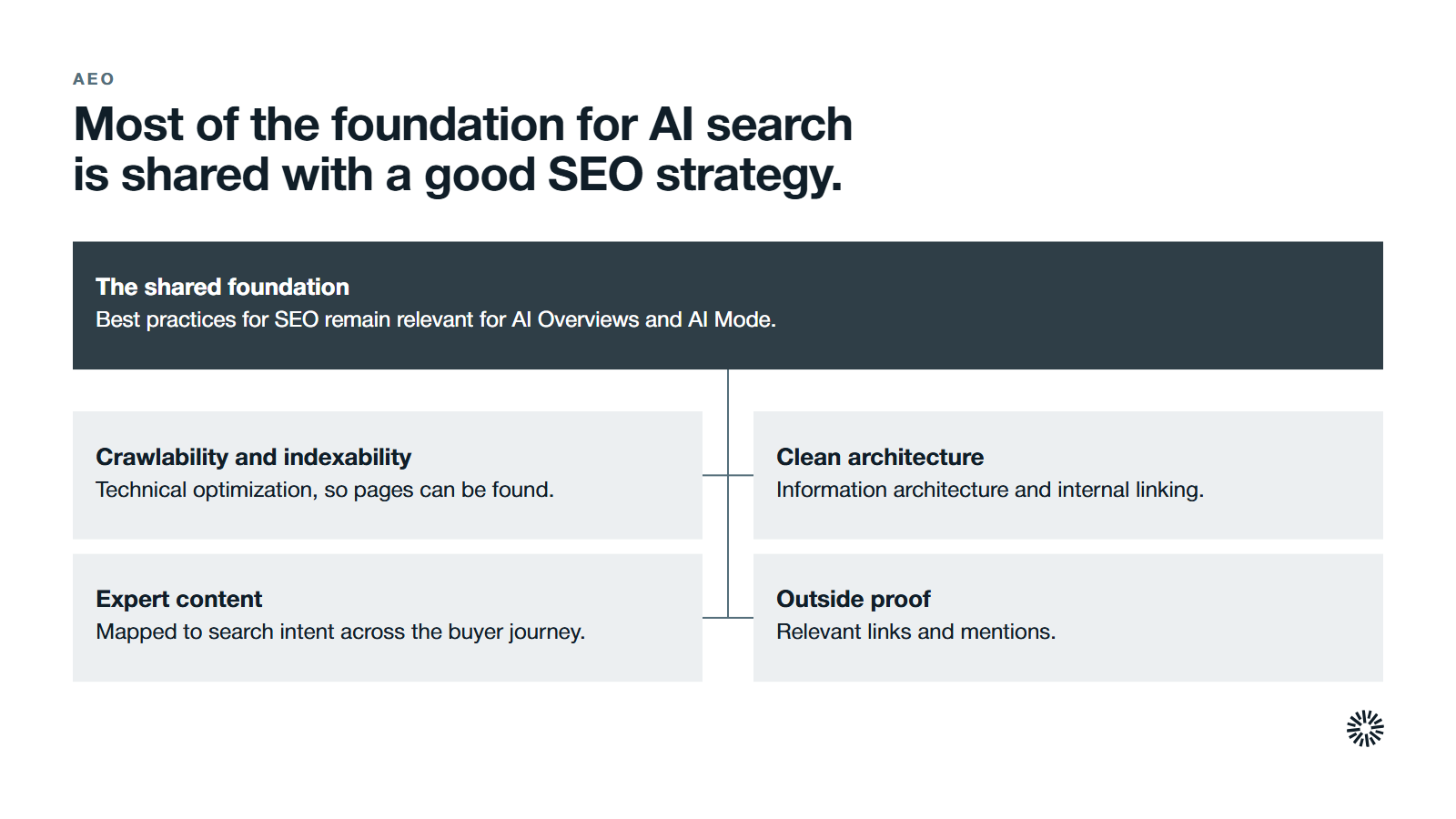
Be wary of anyone who says AI search needs a separate playbook. For the detail behind that point, read AEO vs SEO and how to fund both from one program. Google's own guidance says the best practices for SEO remain relevant for AI Overviews and AI Mode, with no additional requirements and no special schema.org markup to add. A page still has to be indexed and eligible to show with a snippet.
So the shared foundation matters most:
- Crawlability, indexability and technical optimization
- Clean information architecture and internal linking
- Expert content mapped to search intent across the buyer journey
- Relevant links and mentions as outside proof
Structured data fits here too. It helps machines read what a page is about and supports how systems understand your brand, but it is not a switch that earns a citation.
Where AEO work differs from traditional SEO
The differences sit in what you aim at and what you measure.
- Entity clarity: planning around who and what you are, as in semantic SEO, not only keywords, so systems can match your brand to the right description.
- Mentions and citations: measuring AI citations and mentions in AI generated answers, instead of rankings in traditional search or on the search results page alone.
- Third-party presence: watching what other sites say about you, since AI answers draw on more than your own pages.
- Pipeline: tying AI visibility to CRM records and revenue, not just qualified traffic.
Measurement matters because behavior changes. Pew Research Center studied the browsing of 900 US adults in March 2025 and found that users clicked a traditional result link in 8% of Google visits that showed an AI summary, against 15% of visits without one. A ranking report cannot show you what happens inside the answer. To judge your own pages, an annotated AEO checklist shows what a ready page looks like.
Zero-click visibility is part of the same shift. A 2024 clickstream study from Datos, published by SparkToro, found that 58.5% of US Google searches ended with no click. Answer engines put a direct answer ahead of a list of blue links.
What a good SEO agency already brings to AEO
A strong SEO agency owns technical SEO services, keyword research, on-page content optimization, link building and content marketing. These skills are the base that AI search optimization needs. If you trust your agency, you do not have to leave it.
Technical access is a good example. OpenAI documents separate crawlers: OAI-SearchBot for ChatGPT search features and GPTBot for model training, and a site can allow one while disallowing the other in robots.txt. A good technical SEO already knows how to manage those rules.
Many SEO agencies can extend into AEO if they already work with entities and structured data and will change how they report. Others have renamed their search optimization services as AI powered SEO. Not all agencies rely on the same methods, so ask what is new in the deliverables, such as entity mapping.
What building AEO in-house takes
Building in-house gives you control, tight links to product and sales, and knowledge that stays with you. It is rarely one hire, and it builds on your SEO, content, RevOps and data functions.
You usually need these roles covered inside your internal team:
- Technical lead: crawling, schema, logs and how AI crawlers reach your site.
- Content strategist and writers: answer-first formats, plus updating older pages.
- Data or RevOps partner: connecting AI visibility to CRM data and revenue.
- Digital PR or partnerships: earning mentions in industry media and communities.
- Sponsor: a senior marketer or revenue leader who sets goals, budget and cadence.
Expect hiring lead times and a learning curve if your own team is new to AI optimization.
In Acquia's 2025 survey of 516 US and UK marketers, 45% named budget constraints as the biggest barrier to adapting an AEO strategy, followed by lack of internal expertise at 40%. Both barriers are real, and both are solvable with the right plan.
How the three routes compare
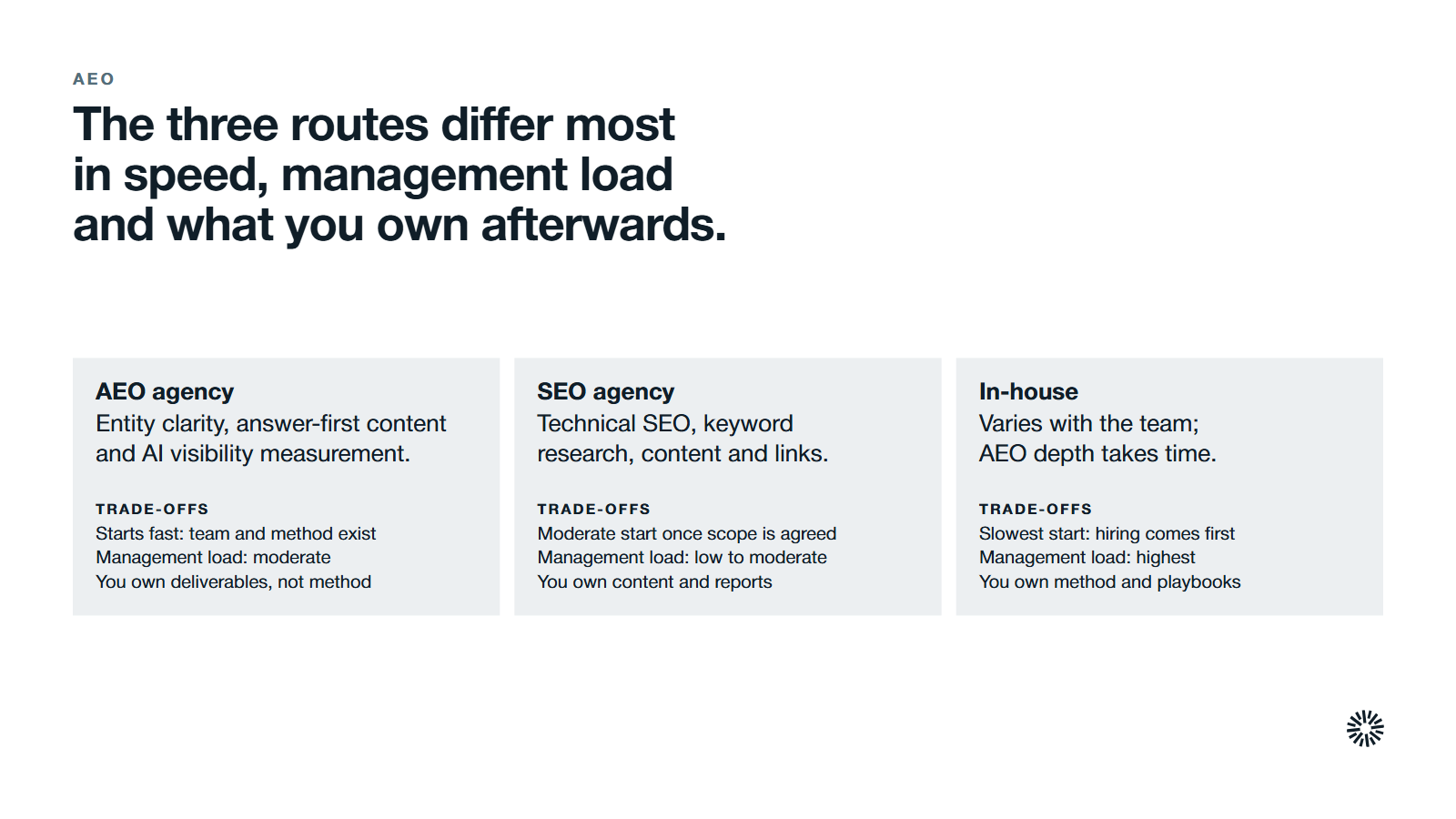
This table sets out the trade-offs a revenue leader should weigh. It describes how work is usually delivered, not how any firm markets itself.
| Criterion | AEO agency | SEO agency | In-house |
|---|---|---|---|
| Skills | Entity clarity, answer-first content, AI visibility measurement | Technical SEO, keyword research, content and links | Varies with the team; depth in AEO takes time |
| Speed to start | Fast, since a team and method already exist | Moderate, once scope and buy-in are agreed | Slowest, because hiring and learning come first |
| Connection to CRM and revenue data | Depends on access; the best tie it to pipeline | Often reports traffic, not pipeline | Strongest when RevOps is mature |
| Measurement | Prompt-based tracking of answers plus classic reporting | Rankings, traffic and impressions, unless extended | Whatever you build and maintain |
| Management load | Moderate: review, input and approvals | Low to moderate in an established relationship | Highest: you hire, coach and set priorities |
| What you own afterwards | Deliverables and content; method stays with the agency unless documented | Content and reports; same caveat | Method, playbooks and knowledge |
Which route fits your situation
Hire an AEO agency when speed and method matter most
This route fits when you need specialized expertise and your internal team is at capacity, your offer is complex enough to need entity clarity, and you want a baseline before committing to an AI visibility strategy. It also fits when your Google rankings are strong but your brand rarely appears in AI answers.
Extend your SEO agency when the trust and the skills are already there
This route fits when your agency understands your buyers and deal cycle, already works with structured data, and will pilot an AEO workstream tied to qualified leads. It saves you onboarding a second agency.
Build in-house when you have the team and a long horizon
This route fits when SEO, content and RevOps are strong, you value close control of data and messaging, and you can wait for results to compound with your own team. Plan for the roles above and for sustained sponsorship.
What you gain when this is done properly
Whoever does the work, the payoff comes from doing it well and keeping it going. The routine that keeps it going is set out in an AEO test-and-learn loop you can run each month. When AI answers describe your company accurately, three teams feel it first.
Sales: buyers arrive better informed
Prospects meet your thinking early, before they visit your site. Answer-first content doubles as follow-up material and objection handling, and what AI tools say about you lines up with how your reps position you.
Marketing: you see the gaps and fix them
Marketing teams can see where you are absent from AI answers and fix specific pages. Content follows real questions instead of generic keywords, and reporting links AI visibility to lead quality and pipeline.
Customer success: customers get current answers
Customers asking AI tools about your product see accurate descriptions, not outdated documentation or conflicting third-party explanations. The same help content serves your knowledge base and supports expansion use cases.
Questions to ask any agency that sells AEO
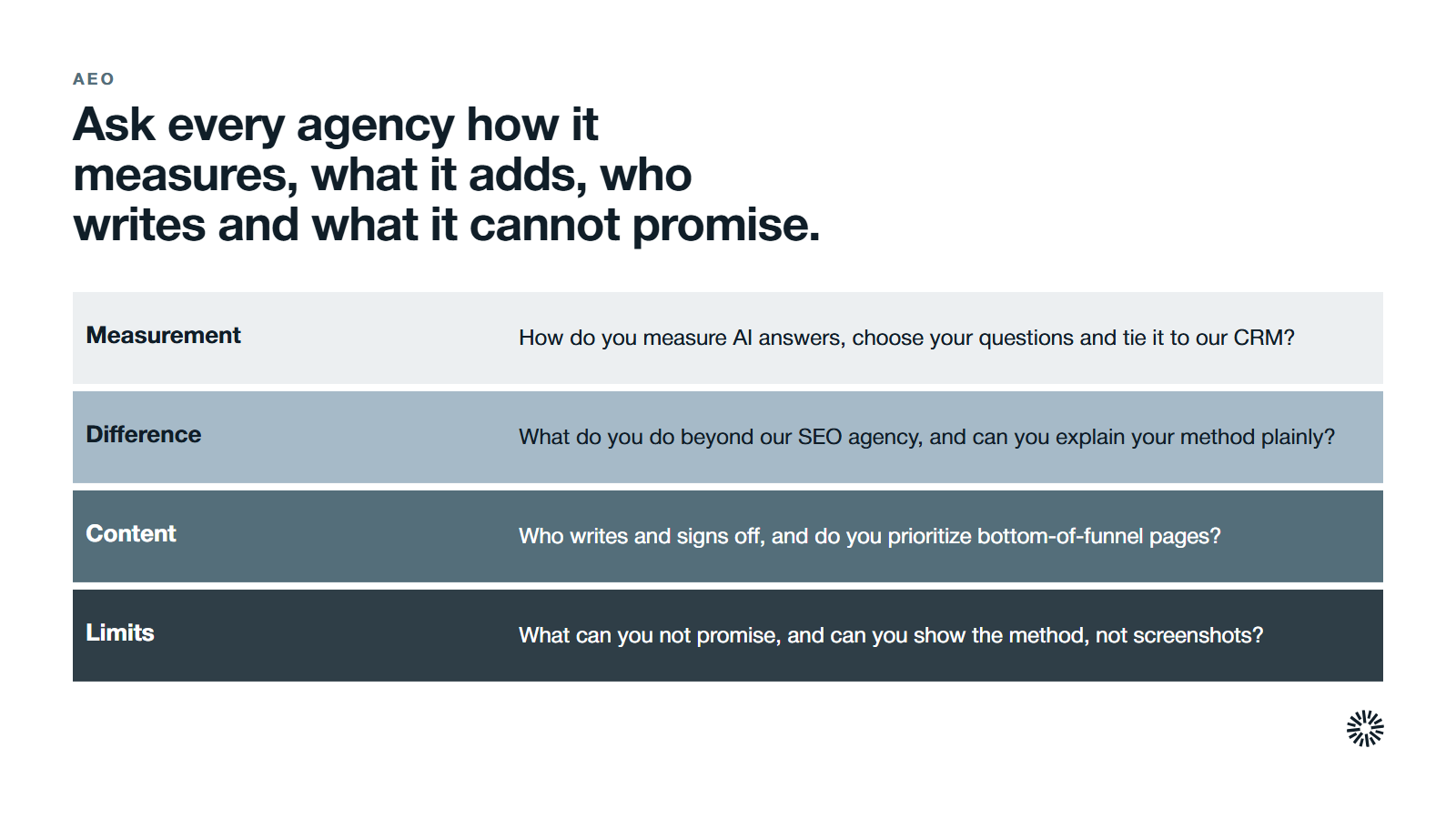
These work for an AEO-branded agency and for an SEO agency proposing generative engine optimization services.
- How do you measure presence in AI answers, and across which engines?
- How do you choose and maintain the set of questions you track?
- What do you do that our SEO agency does not?
- How do you tie AI visibility to our CRM and revenue data, and is the reporting real time data or a monthly snapshot?
- How would you explain your GEO methodology in plain language?
- Do you prioritize bottom-of-funnel content, the pages closest to a buying decision?
- What can you not promise about citations or rankings in AI answers?
- Can you show the method, not screenshots?
- Who writes and signs off content, and what expertise do they bring?
Red flags that should end the conversation
Strong AEO work is methodical and transparent. No one can guarantee a citation, so treat these as warning signs:
- Guaranteed rankings or citations in any AI engine or Google AI Mode
- Secret methods, including a GEO strategy that cannot be explained in plain language
- Screenshots of AI answers offered in place of process and performance tracking
- Tricks aimed at manipulating AI models instead of improving your own site and content
- Long commitments demanded before any diagnostic or pilot
- Reluctance to connect results to pipeline in your CRM
How Propello works
Propello is a HubSpot-powered Go-to-Market Agency. It designs and builds GTM systems on HubSpot, and work starts with a paid GTM audit. AI search visibility is treated as part of customer acquisition and tied to pipeline in the CRM. You can see the HubSpot services behind that approach.
Choose by your biggest constraint, then start small
Ask what limits you most: expertise and method, capacity, or long-term ownership. If it is method, an AEO agency gets you moving. If it is capacity and you already have the knowledge, extend your SEO agency. If it is ownership, build in-house.
Whichever you choose, begin with a time-boxed diagnostic tied to pipeline, and avoid long contracts before you have a baseline.
Propello designs and builds connected GTM systems on HubSpot. If you are choosing who should do this work, an audit is the place to start.