If you lead revenue at a B2B company, or run the marketing that feeds it, this AEO checklist shows you whether a page gives AI engines and human buyers a clear, quotable answer. It is built around a worked example you can copy for your own service and solution pages.
You will walk down one page from top to bottom and see what each part does for answer engines and buyers. Then you get the checklist, a way to score your ten key pages and the common mistakes. Propello calls this practice AI Engine Optimization (AEO), and the wider market calls it answer engine optimization.
|
AEO Checklist An AEO checklist is a short list of yes-or-no checks that shows whether a page gives answer engines and buyers a clear, complete and quotable answer. |
Start with one ordinary service page
Take an illustrative company that sells managed cybersecurity monitoring to mid-market manufacturers. Its page is called "Managed Cybersecurity Monitoring for Mid-Market Manufacturers." The company, page and wording are invented, so copy the structure, not the words.
A service page is where a buyer reads when close to a decision, which makes it the right place to practice AEO best practices first.
An AEO checklist asks a different question from a traditional SEO audit
A traditional SEO audit asks whether traditional search engines can find a page and where it ranks in search engine results pages. If you are deciding how the two fit together, read AEO vs SEO before you commit budget. Search engine optimization has long focused on keywords and backlinks, and it measures success in search rankings and clicks from Google search results.
An AEO checklist asks whether an AI system can lift a clear answer from the page and use it in AI-generated answers. Unlike traditional SEO, the unit of success is the passage, not the page. Your existing SEO strategy stays the foundation, because an engine can only use a page it can crawl.
Your aim on each page is to be the most relevant answer to one clear question.
Answer formats are not new. Featured snippets and knowledge panels gave searchers quick answers long before AI-powered search results arrived, and AI products such as Google AI Overviews and ChatGPT now write whole answers. Buyers expect instant answers, so write standalone passages. You may also meet the related term generative engine optimization, or GEO.
The hero names the service and the audience in two sentences
The title tag and main heading say what the thing is and who it is for. The two sentences under it answer "What is it?" and "Who is it for?" in plain words, before any slogan.
For example: "Managed cybersecurity monitoring is a service that watches your plant and office networks around the clock and escalates real threats to your team. It is built for mid-market manufacturers without a full internal security operations center."
What it does for answer engines. A page that states its subject and audience immediately gives an engine a clean passage to lift, so answer the question in the first lines.
What it does for the buyer. A plant manager or finance lead knows within seconds whether this page is for them.
A definition block gives the page a quotable core
Below the hero sits a short block titled "What is managed cybersecurity monitoring?" It holds one definition paragraph, a direct answer of roughly forty to sixty words, followed by a few bullet points: coverage hours, industrial focus, alert triage and onboarding support.
Answer engines and other AI platforms can quote a self-contained passage without needing the text around it. Buyers use the same block to align colleagues who do not work in security.
Question-led headings with answer-first paragraphs match how buyers ask
Each section heading is a question a buyer would actually type or say, such as "How does monitoring work in a factory?" The heading states the question, which is where user intent meets page structure, and the paragraph below answers it.
Start every section with the answer in one short paragraph, then add detail. The writing process behind each checklist item is in our guide to optimizing content for AI search. Match search intent rather than exact phrases, and match the wording of real user queries, including the longer conversational queries people speak, whether as voice queries or through voice search. Use straightforward language, not jargon the buyer would never say.
Cut anything that does not serve the question, so every section holds relevant content. Include a fit section that says who the service is and is not for. Buyers who can self-qualify trust the page more, and clear limits are easier for an AI model to quote accurately.
A comparison table gives buyers and answer engines a clean contrast
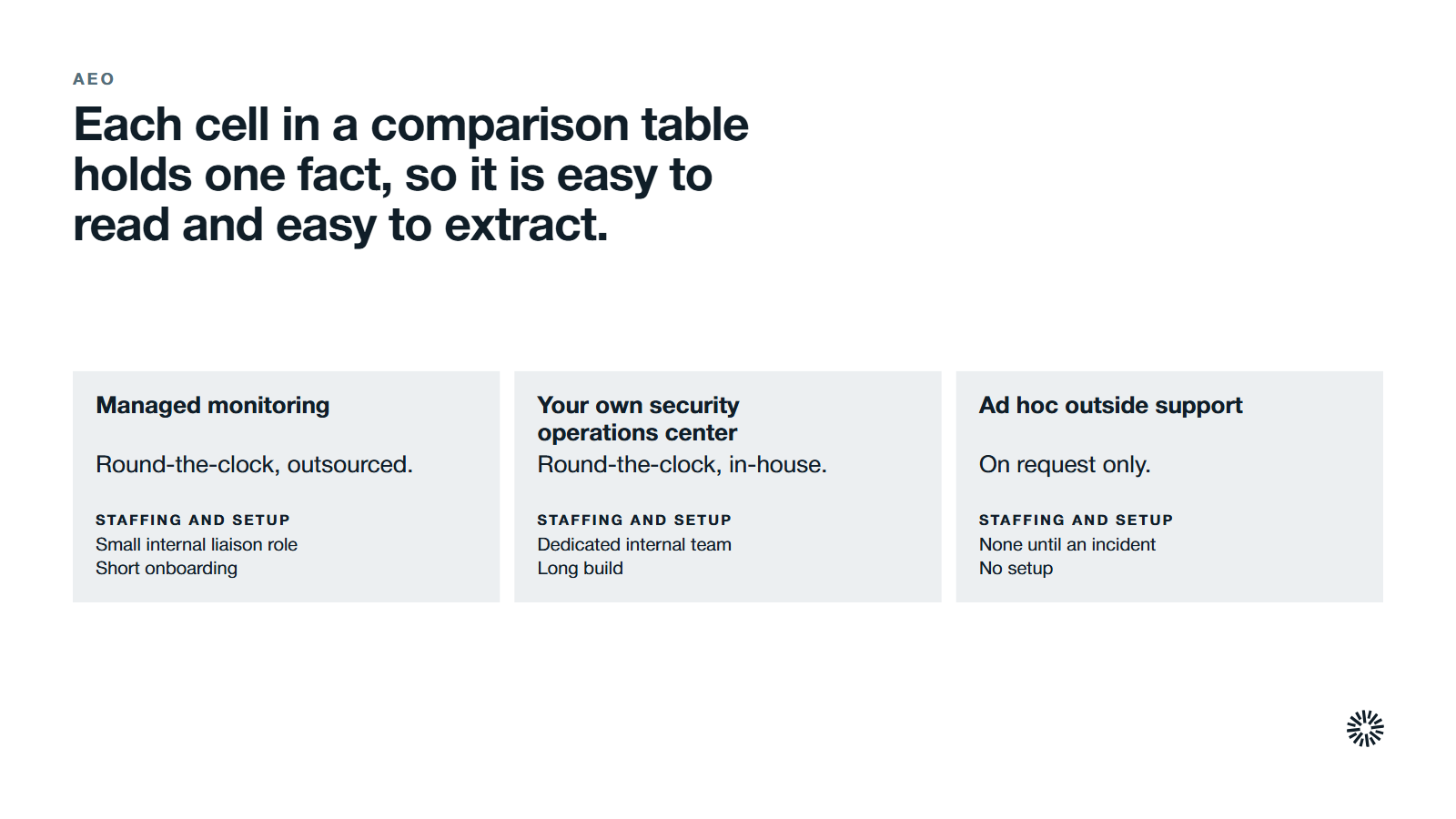
Most service pages bury their comparison in prose. A table is easier to read and easier to extract, because each cell holds one fact. On the example page the table compares three ways of getting the same outcome.
| Option | Staffing impact | Setup effort | Coverage model |
|---|---|---|---|
| Managed monitoring | Small internal liaison role | Short onboarding | Round-the-clock, outsourced |
| Build your own security operations center | Dedicated internal team | Long build | Round-the-clock, in-house |
| Ad hoc outside support | None until an incident | None | On request only |
| Write column headings as plain nouns, and make every cell make sense on its own. |
Evidence and sources show where a claim comes from
Anything a skeptical reader could check needs a visible source. The example page ends its main argument with a short evidence section that names the recognized security frameworks the service maps to and explains how, rather than listing logos.
State what you know, say who published it, and link to it. Accurate answers with a visible source are safer for an AI model to repeat, and clear attribution is part of the experience, expertise, authoritativeness and trustworthiness signals that Google describes as E-E-A-T.
An author and last-updated line show who stands behind the page
Near the foot of the page, the example shows a named author with a role, a short link to their profile, and a "Last updated" date.
A named owner and a real date tell a buyer the page is maintained. Regularly update content to maintain relevance and accuracy: refresh pages on a fixed rhythm, and change the date only when the content changed.
An FAQ section answers the questions buyers ask sales
Close the page with five to eight questions taken from real sales calls, written as headings with a direct answer of two or three sentences each.
Each answer should stand alone, with the main point first. Concise answers give an engine passages to lift.
Internal links place the page inside its topic cluster
An AEO-ready page does not stand alone. The example links to a pricing explanation, a how-it-works page, a guide to manufacturing cybersecurity and an overview of managed security services. Anchor text names the destination.
These internal links tell a reader where to go next and help search engines understand how your pages relate. A tight cluster around one subject builds topical authority better than scattered one-off pages. If your pages and buyer journeys live in HubSpot, those paths can be tied to pipeline stages.
Schema markup should describe only what the page shows
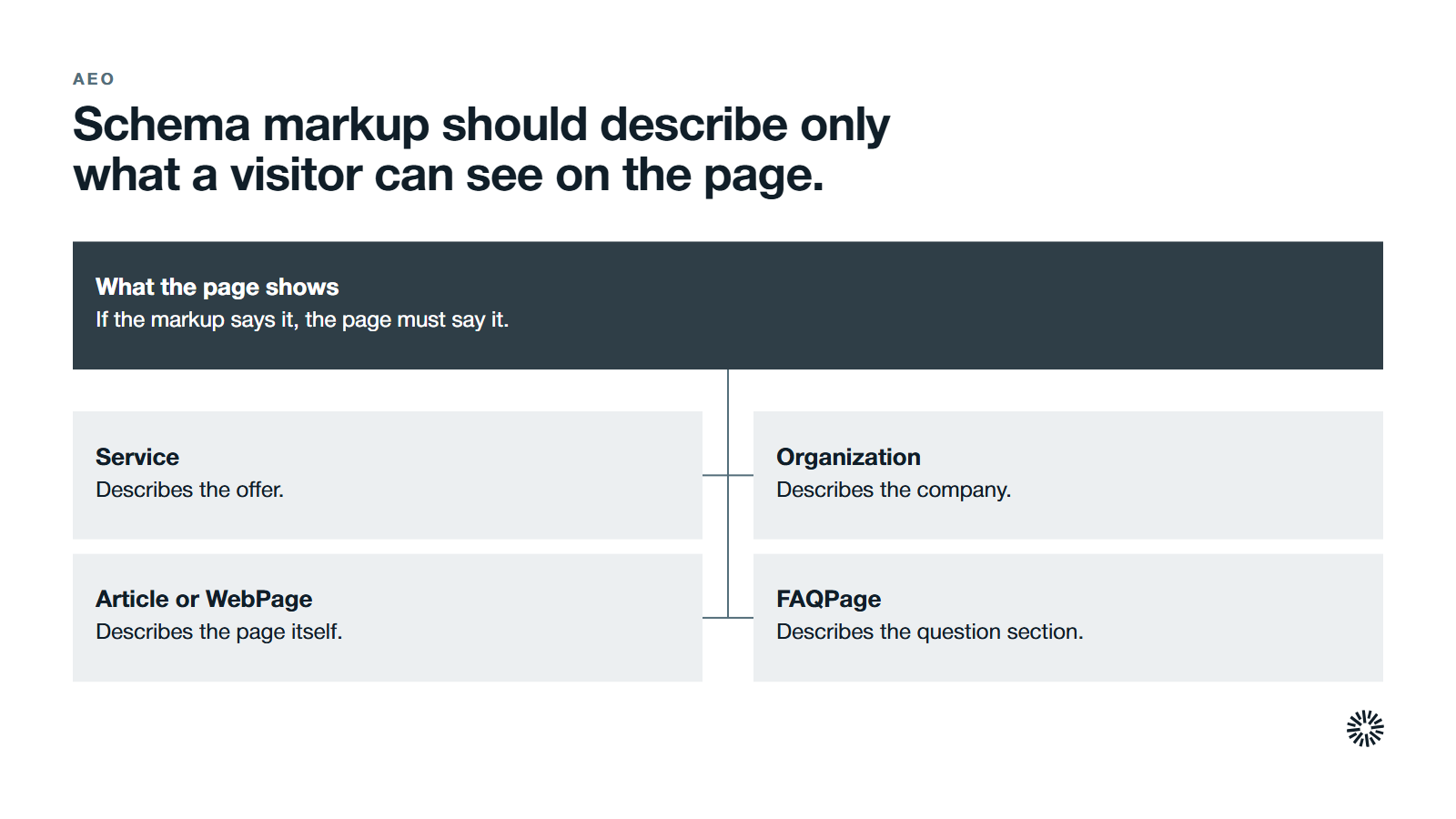
Structured data labels a page in a form software can read directly, so search engines understand what each part is. For the example page the sensible types are Service for the offer, Organization for the company, Article or WebPage for the page itself, and FAQPage for the question section.
Schema.org describes a Service as a service provided by an organization, with properties such as provider, areaServed and audience.
One rule matters more than the types. Google's guidelines say not to mark up content that is not visible to readers of the page. If the markup says it, the page must say it.
Be careful about what markup can promise. Google states that no special schema.org structured data is needed to appear in AI Overviews and AI Mode, and that a page only has to be indexed and eligible to show with a snippet.
Google has also removed the FAQ rich result from Search. Keep FAQ markup if it matches the page, but do not expect a feature from it. Structured data is one way to make a page easier to understand, not a way to buy a place in answer boxes.
Crawlability basics decide whether anyone can read the page
Nothing above works if the page cannot be fetched and read. Three plain checks cover most of it: the page is not blocked, the main content appears without scripts, and a canonical address is set.
Google explains that a robots.txt file is not a way to keep a page out of Google, so use it to manage crawling and use noindex for exclusion. A canonical link element is a strong signal for the preferred address among duplicates.
On scripts, Google notes that not all bots can run JavaScript, so server-side rendering helps.
Switch scripts off and see what remains. Some AI-powered search tools use retrieval augmented generation, which fetches passages from pages before writing an answer, so content that vanishes without scripts may never be fetched. Keep descriptive URLs and unique title tags and meta descriptions on cloned pages.
Use the AEO checklist and tick each check honestly
Each line below is a statement you can answer yes or no for a given page. A check you cannot honestly tick stays unticked.
Entity checks make the service and the company unmistakable
- The title tag and main heading name the service and the audience.
- The service has one name, used the same way across your site, profiles and press mentions.
- A named author and the company are visible in plain text on the page.
- Independent sites, such as industry publications or directories, describe you the same way.
Content checks make the answer easy to quote
- The first two sentences answer the page's main question.
- A definition block of a few sentences sits near the top.
- Section headings are questions in the buyer's own words.
- Each section opens with a direct answer before any detail.
- Claims that a skeptic could challenge carry a named source.
- The page says who the service is not for.
Structure checks make the page easy to scan and lift
- The page has one main heading and a logical order of subheadings.
- A comparison or specification table exists where options are compared.
- An FAQ section holds self-contained answers taken from real sales questions.
- Internal links connect the page to its cluster with descriptive anchor text.
- The author line and last-updated date are visible.
Technical checks make sure the page can be fetched and trusted
- The page is not blocked by robots rules and is not marked noindex by mistake.
- The main content is in the HTML that loads, without scripts.
- One canonical address is set and matches the live page.
- Structured data validates and matches what is visible.
Measurement checks tie the page to pipeline
- You know which buyer journeys and deal stages the page supports.
- The page is tagged as a key asset in your reporting.
- Someone asks a fixed set of buyer questions in AI tools on a schedule, across the major AI platforms, and records whether your brand appears in the AI responses.
- Sales logs when prospects mention an AI tool in a call.
- A review date is set, and a named person owns it.
Score the ten pages that matter most to pipeline first
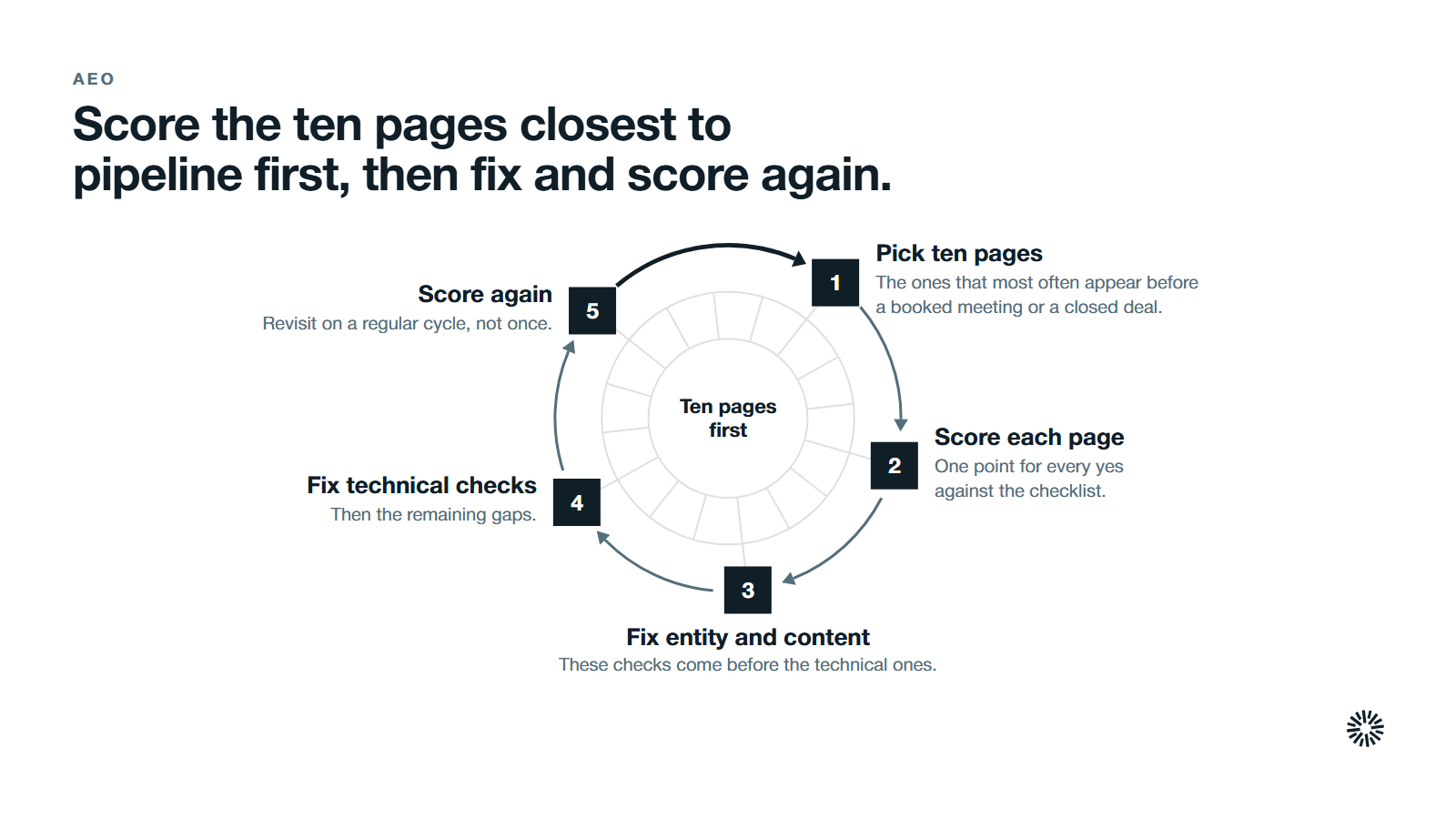
Do not audit the whole site. Pull the ten pages that most often appear before a booked meeting or a closed deal: core service pages, solution pages, pricing explainers and comparison pages. Score each against the checklist, one point per yes. After fixing the gaps, AI search analytics shows how to measure whether your visibility improved.
Start with the high-value pages that have the most unticked checks, and fix entity and content checks before technical ones.
Link each check to your standard operating procedures and training documentation, so writers, editors and developers know which checks they own. Revisit the scores on a regular cycle, not once.
Common AEO mistakes and the checks that catch them
The page does not say what it is. A vague opening leaves the main question unanswered. The entity and content checks catch this.
Markup says more than the page. Schema that describes things readers cannot see breaks Google's guideline and invites distrust. The technical checks catch it.
Content is stuffed for machines. Keyword optimization pushed too far makes copy worse for people, and chasing keyword density helps no reader. Use keyword research to choose target keywords in the buyer's own words, then write for the buyer.
Nobody owns it. A page without an owner and a review date drifts out of date. The measurement checks fix this.
What you gain when this is done properly
No checklist can guarantee that an engine will cite a page, and no honest one promises AI citations. What it does is make your core pages clearer, and well structured content helps every team.
Sales gets better-prepared buyers
Buyers arrive with shared definitions and fewer basic questions. Discovery starts further along, and the buying committee has a page to point to.
Marketing gets a repeatable page standard
Instead of debating style page by page, marketing works from one agreed list for content creation. Scores feed your content strategy by showing which pages need work next, and HubSpot reporting can show which of those pages sit in real deals.
Customer success gets a reference to onboard from
A well-built service page doubles as a reference for what was bought. New contacts at a customer can read it, and expansion conversations start from a shared description.
Start with one page and one honest score
Pick your most important service page and score it today. Share the result with sales and customer success, since they hear the questions the page should answer. Fix the first two sentences before anything else.
The HubSpot research on buyer behavior supports the effort. HubSpot's 2026 survey of more than 3,000 CRM purchase decision-makers found that 42% of CRM buyers used AI search during their evaluation. That is one software category, so treat it as a signal and not a universal rate.
Propello designs and builds connected GTM systems on HubSpot. If you want your core pages to answer buyers and AI engines clearly, an audit is the place to start.