If you lead revenue at a growing B2B company, you keep hearing AEO, GEO, LLMO and "AI SEO" and need to know whether they are four jobs or one. The short answer is one: the work overlaps almost entirely, so pick one name for it inside your company and fund one program.
This article is for the CEOs, founders, CROs and revenue leaders who have to make that call. You will see where each term came from, what it emphasizes, how it relates to SEO, the few differences that are real, and what to do first. It builds on our guide to AEO.
|
Generative Engine Optimization (GEO) GEO is the practice of shaping content so that generative engines cite, quote or accurately describe your brand when they compose answers. |
Why you keep hearing three names for one job
Your buyers now type natural language queries into conversational AI assistants and get AI generated answers back, often with a few sources attached. As search behavior shifted, agencies, consultants and software vendors each reached for their own label for the work of showing up in those answers, and the labels stuck.
The change shows up in behavior. A Pew Research Center analysis of 900 U.S. adults' Google searches in March 2025 found clicks on a traditional result link in 8% of visits that showed an AI summary, against 15% of visits that did not.
Pew published that in July 2025. When fewer people click, being named inside the answer matters more. The pipeline side of that shift is covered in zero-click searches and AI Overviews, written for revenue leaders.
So your SEO lead may say GEO, a consultant may say LLMO, and a conference speaker may say "AI SEO." The confusion is about language, not about the work. "Answer engine optimization" is the wider market's name for what Propello calls AI Engine Optimization (AEO). They mean the same thing.
One caution on vocabulary. GEO also means geography or geopolitical risk, and in customs AEO means Authorized Economic Operator, a status that European customs authorities grant to traders with a clean compliance record, who then face fewer controls and get priority treatment if selected for one, with the status recognized in every EU member state.
This article covers only the digital marketing meanings.
What AEO, GEO and LLMO each mean in digital marketing
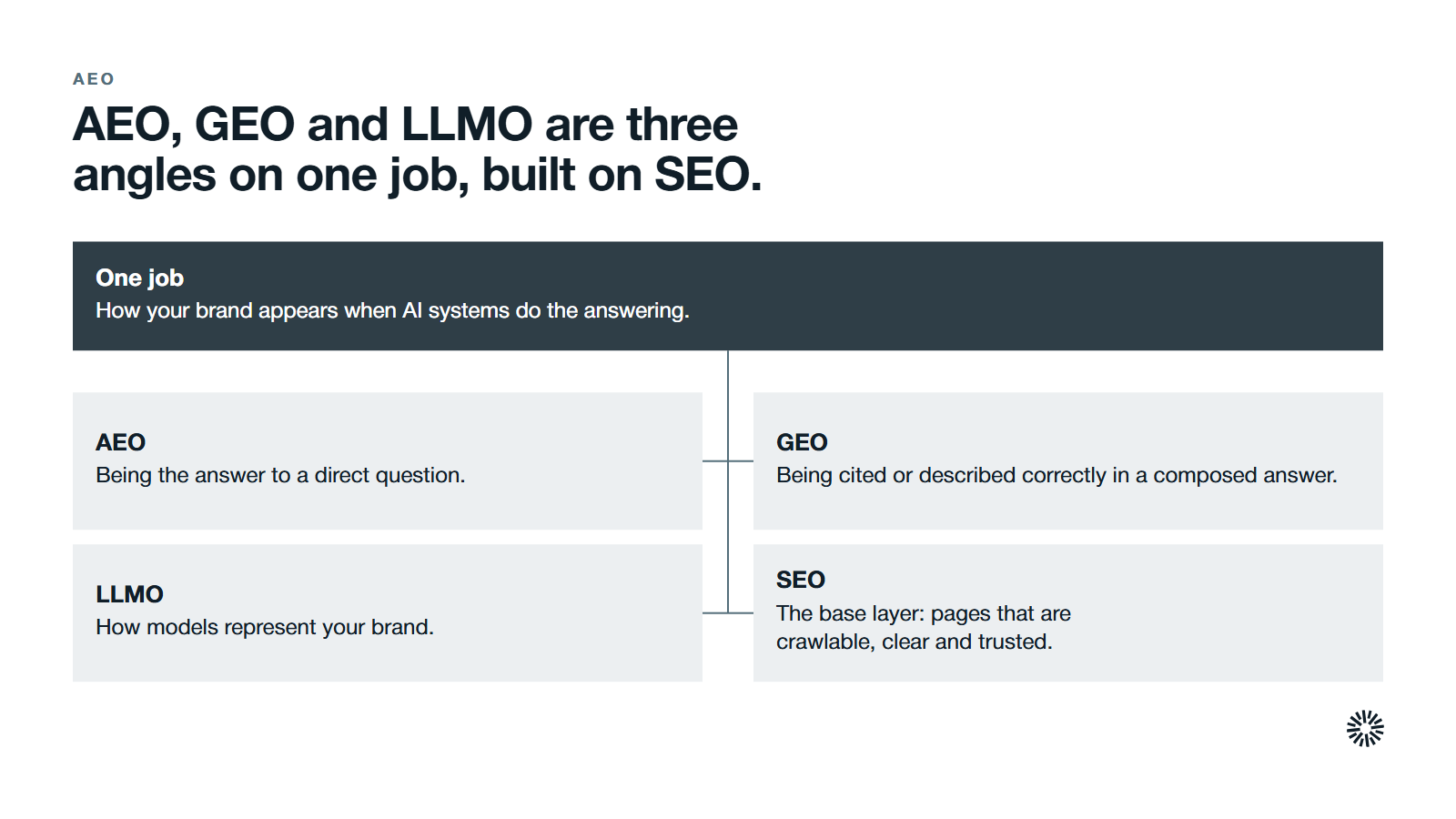
The names differ in emphasis, not in the underlying work. Each one points at a different part of the same problem: how your brand appears when AI systems do the answering.
AEO is about being the answer
AEO, short for answer engine optimization, is aimed at engines such as Google AI Overviews and ChatGPT that respond with an answer instead of a list of links. The goal is that your page, or your brand, is what the engine reaches for when a buyer asks a direct question.
The idea is often explained through featured snippets and smart speakers, where one answer is all the person sees. Voice assistants and voice searches work the same way: one answer is read out, so being that answer is what counts. People speak voice queries in full sentences, which is why question-led pages fit.
In practice it means question-led pages built around user intent, tight direct answers, clear headings and FAQ sections. Done well, it feeds demand generation, because it shapes what a prospect learns before they ever talk to you.
Many AEO guides treat schema markup as mandatory. Google's documentation says otherwise for its own features: a page needs to be indexed and eligible to show in Google Search with a snippet, and there is no special schema.org markup to add. Use structured data to help machines read a page, not as a switch.
GEO is about being cited or mentioned
GEO, short for generative engine optimization, comes from a 2023 academic paper, GEO: Generative Engine Optimization, by Pranjal Aggarwal and co-authors. It was first posted on arXiv in November 2023 and presented at KDD 2024.
The authors described generative engines as systems that gather information from several sources and summarize it with a large language model.
So GEO emphasizes being cited, quoted or described correctly when a longer answer is composed from many sources. It is a label for that goal, not a certification or a standard you can pass.
Any of these AI systems needs credible, well-structured material to draw on, so authority signals matter, and you need to maintain consistency across every platform and touchpoint.
In the authors' tests, citing sources, adding quotations and adding statistics were the strongest methods, and keyword stuffing offered little to no improvement. The paper's abstract reports visibility gains of up to 40% on their benchmark. Read that as one controlled experiment, with results that vary by domain, not as a promise of citations.
LLM optimization is about how models represent you
LLMO, short for large language model optimization, concerns how large language models, the engines behind conversational AI, describe your brand, products and category. That covers what an AI model absorbed during training and what it draws in when it answers.
No single standard definition sits behind the term, and writers use it at different scopes. Some mean the whole discipline, others only how the model remembers you.
If a model learned inconsistent facts about your company, it can repeat them. LLM optimization is mostly entity clarity and consistent descriptions, which give a model the context to describe you correctly.
It also helps to write conversational content in the words your buyers actually use.
SEO is still the base layer
Traditional search engine optimization is the long-standing practice of making your site visible in search engines: crawlable pages, clear structure, relevant content, meta tags, backlinks and speed. It is where the AI work starts.
Google's guidance for its AI features tells site owners to apply the same foundational SEO practices they use for Google Search generally. If your pages are slow, thin or hard to crawl, no new acronym will repair that.
Traditional SEO still decides whether a page is crawled and indexed. That is why SEO remains the base for every AI platform, and why organic traffic stays worth protecting. If you are weighing the two disciplines, AEO vs SEO sets out where they differ and where they overlap.
How AEO, GEO, LLMO and SEO compare at a glance
| Term | What it stands for | Where it came from | What it emphasizes | What success looks like |
|---|---|---|---|---|
| SEO | Search engine optimization | A long-standing practice built around web search engines | Being found and ranked as a link | Qualified organic traffic and leads |
| AEO | Answer engine optimization (Propello: AI Engine Optimization) | The wider market's label for engines that answer directly | Being the direct answer | Your page or brand is the answer a buyer sees |
| GEO | Generative engine optimization | A 2023 paper by Aggarwal and co-authors, presented at KDD 2024 | Being cited or mentioned in composed answers | Your brand is cited or named accurately |
| LLMO | Large language model optimization | A practitioner and vendor label with no single standard definition | How models represent your brand | Your brand is described correctly, consistently |
What actually differs in practice
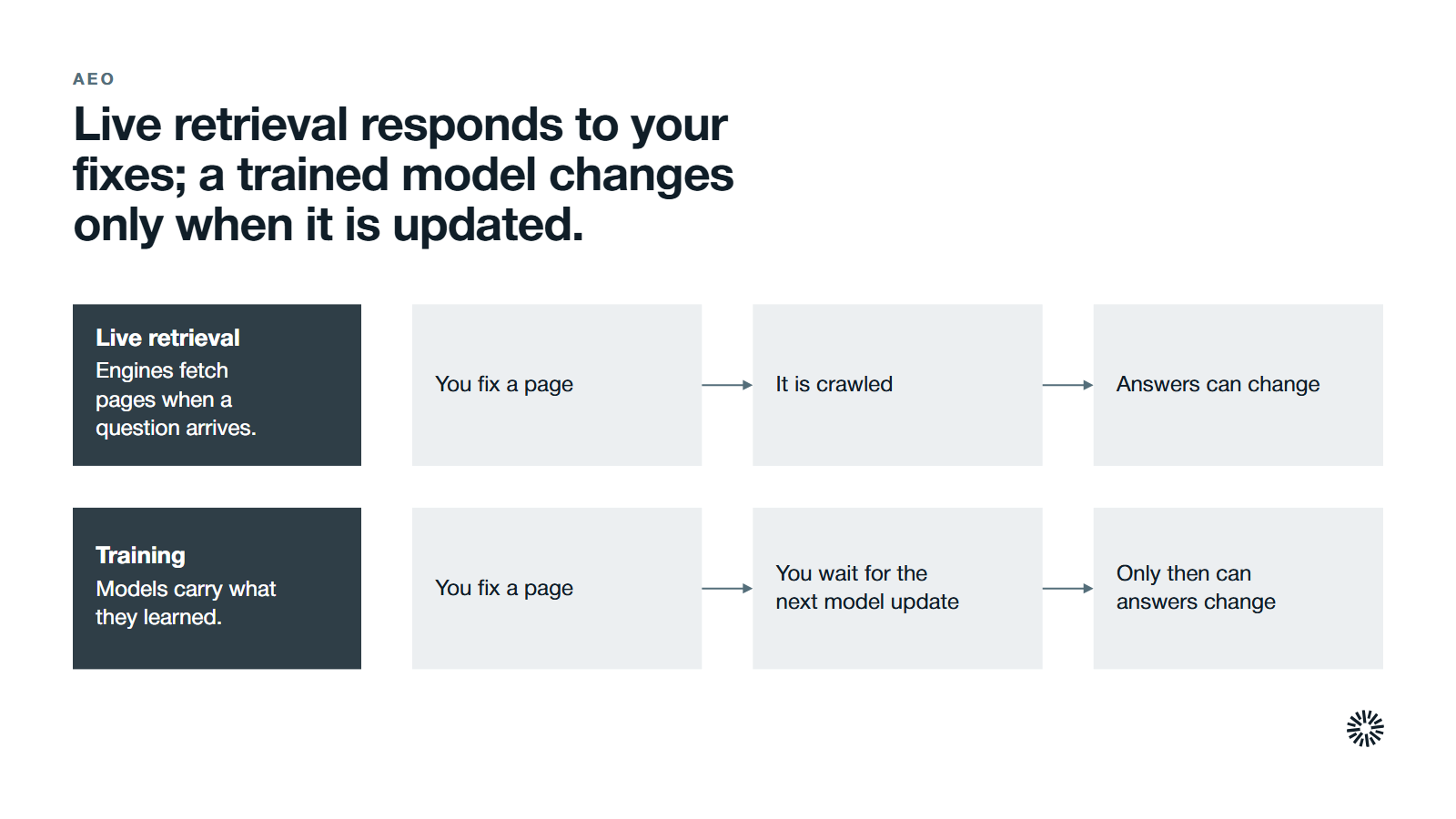
Almost nothing about the daily work changes between the three terms. Two differences are real, and both are about mechanism, not about which acronym you choose.
Live retrieval and training are separate layers
Some AI systems fetch pages when a question arrives. Models also carry what they learned in training. A page you fix today can influence an answer that is retrieved from live pages once it is crawled. Changing what a trained model absorbed depends on when that model is next updated, which you do not control.
OpenAI's crawler documentation shows the split. One crawler, OAI-SearchBot, surfaces sites in ChatGPT search, while GPTBot collects content for training generative models, and each is controlled separately in robots.txt. A site that blocks the search crawler will not be shown in ChatGPT search answers, so check what you block. The factors engines weigh when choosing sources are explained in AI search ranking factors for revenue teams.
A citation, a mention and silent influence are different outcomes
A citation is a linked source. A mention names your brand without a link. Silent influence means your content shaped the answer and your brand never appears by name. GEO talk leans toward the first two. LLM optimization talk leans toward whether the description is right.
You cannot choose which form a given engine will use, and no tactic guarantees any of them. So measure all three, and judge accuracy as well as presence, because a wrong description does more harm than an absence.
Why one program beats three
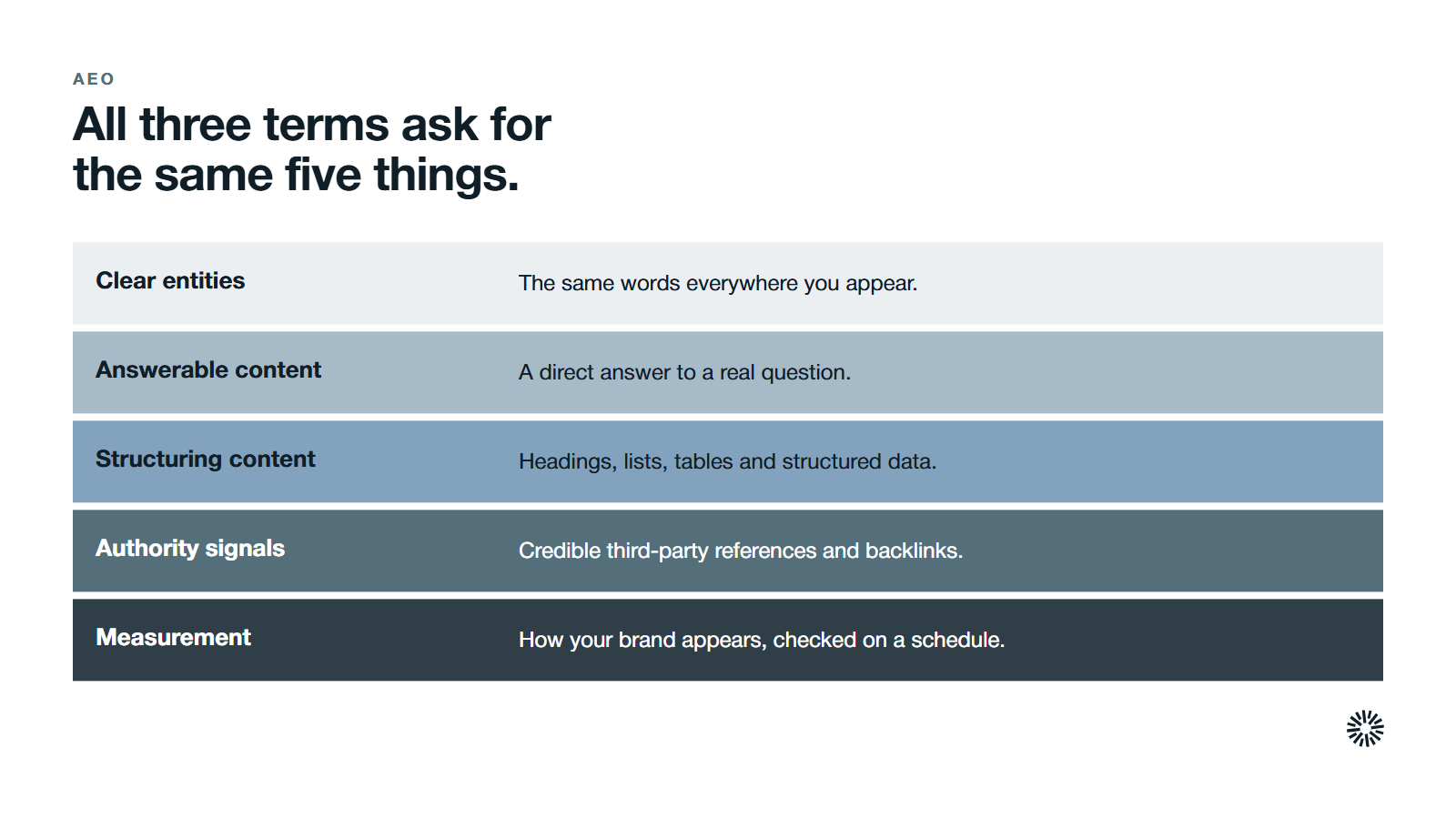
All three terms ask for the same five things, which is why separate budgets waste money:
- Clear entities: describe your company, products and categories in the same words everywhere you appear.
- Answerable content: write pages that open with a direct answer to a real user question.
- Structuring content: use headings, lists, tables and structured data so engines and people can pull out what they need.
- Authority signals: earn references and backlinks on credible third-party sites your buyers already trust.
- Measurement: check on a schedule how your brand appears in AI assistants compared with competitors.
Optimizing content under three labels gives you three sets of definitions, overlapping briefs and no single owner. Most of the work sits with your SEO team already. Fund one program that builds on your existing search optimization, and the same page serves classic search, featured snippets and AI answers.
What you gain when this is done properly
The benefit shows up across the customer journey, not only at the top of the funnel.
Sales starts from a shared picture
When AI tools describe your company accurately in AI generated responses, prospects arrive knowing your category and how you position yourself. Reps spend less of the first call on basics and more on fit and next steps.
The flow runs the other way too. Objections and lost-deal questions that sales hears become the questions your pages answer next.
Marketing merges three content strategies into one
One content system can serve search, AI Overviews and assistants at once when it is built by structuring content around entities and buyer questions. You stay visible in search while adding the surfaces where buyers now ask.
That also means one brief, one set of definitions and one review cycle, instead of three content strategies that contradict each other.
Customer success gets accurate answers into customers' hands
Customers ask AI tools how to configure your product. Help articles that state steps, limits and terms plainly give those AI tools authoritative answers to draw on.
It also gives your support team a single source of truth to maintain, since the same pages serve your customers, your agents and the engines.
What to do first if you lead revenue
Start with groundwork, in this order:
- Ask your most important buyer questions in ChatGPT, Perplexity, Google Gemini, Microsoft Copilot, Claude, Google AI Overviews and Google AI Mode, and write down how you are described and who is named.
- Check access. Ask your SEO lead to confirm that your robots.txt and security settings are not blocking crawlers you want, and that your key pages are indexed.
- Choose one internal name and one owner for the program.
- List the questions buyers ask in sales calls, RFPs and support tickets, then answer each on a page that opens with the direct answer, in the conversational language your buyers use.
- Make your entities consistent across your site, profiles and partner listings.
- Have your SEO team add structured data, including FAQ schema, and FAQ sections that give structured answers where they clarify a page, remembering they are not a requirement.
- Re-run the same questions monthly and record the results in your revenue reporting.
Pick one name and write it down
The name matters because it decides who owns the work, how it is funded and whether leadership treats it as a revenue program or a traffic experiment. Weigh three things:
- Which term your leadership team already uses in board and planning conversations.
- Which term your marketing and SEO people use for their current work.
- Which term sales and customer success will recognize as tied to revenue.
Then write a short brief that describes one program across acquisition, retention and expansion, framed around the buyer's journey instead of the acronyms. Keep its questions, owners and review dates beside your pipeline reporting in HubSpot, so it is reviewed with revenue and not with traffic.
One program, one name, one owner
AEO, GEO and LLM optimization describe overlapping work from three angles: being the answer, being cited, and being described correctly. You do not need to settle the vocabulary debate to act. You need one name, one owner and a repeatable routine that builds on the SEO you already run.
Propello designs and builds connected GTM systems on HubSpot. If you want to treat AI search as part of your revenue engine, an audit is the place to start.