
If you run revenue at a B2B company, your buyers are no longer typing three words and scanning ten links. They ask a full question, read an answer, and ask a follow-up. That habit is conversational search, and it decides which companies get named while a shortlist forms.
This article is for the CEOs, founders, CROs and revenue leaders who own pipeline. You will see how conversational search works, how buyers phrase questions to AI engines, and what that changes for the content on your site. Our guide to the B2B buyer journey shows where these questions land in a deal.
|
Conversational Search Conversational search is a way of finding information by asking questions in natural language and following up in a dialogue, where the system uses earlier turns to return relevant answers. |
How conversational search works
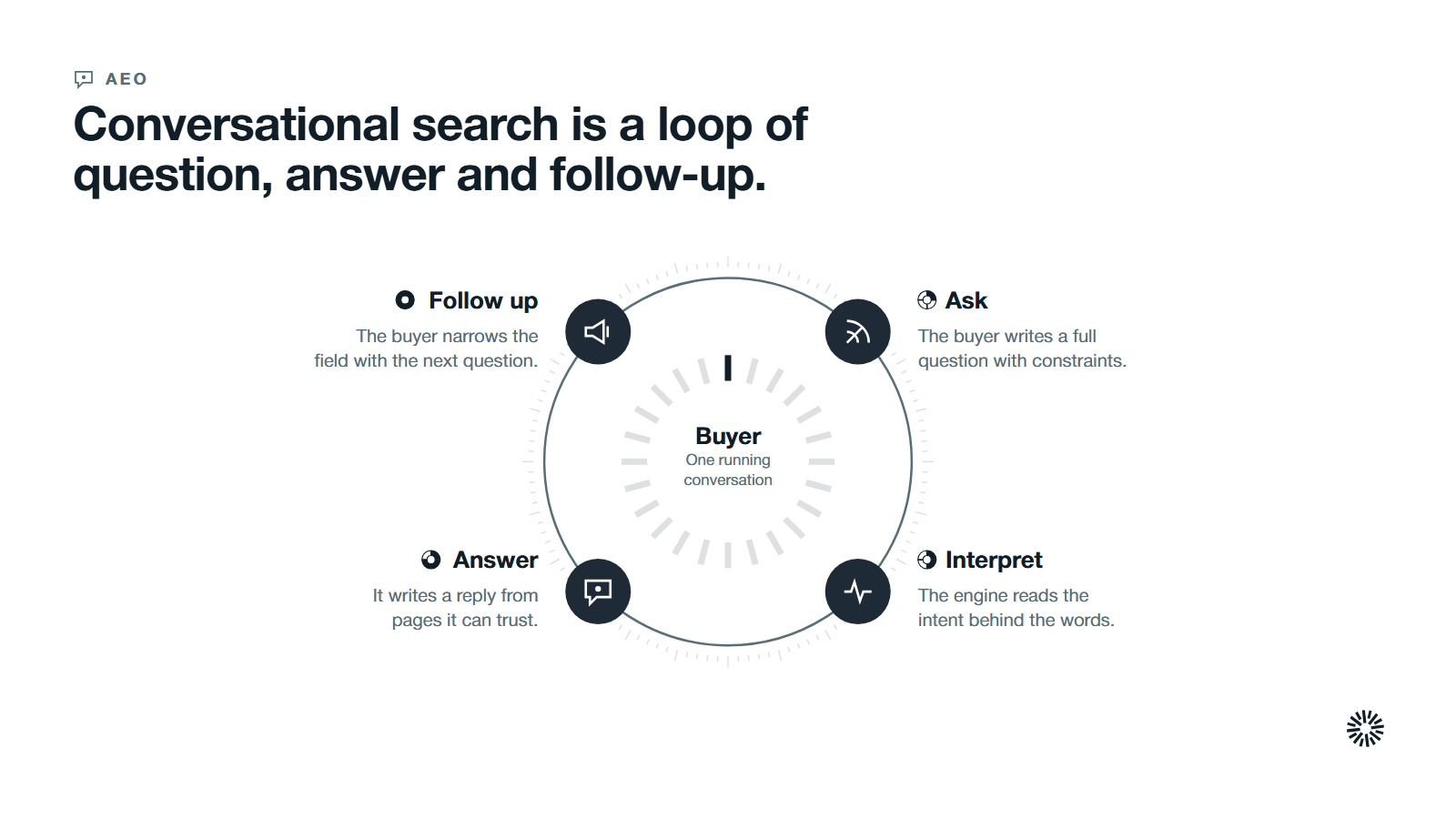
A conversational search system does four jobs in a row. It reads your question, works out what you mean, finds material that answers it, and writes a reply. Then it remembers, so your next question builds on the last.
These are the core components, and each one explains something about how buyers behave. Together they give users something close to human conversation with a search engine, instead of a box that waits for isolated keywords.
Natural language processing reads the question
The first job is natural language processing, the part of artificial intelligence that turns a sentence into something a machine can act on. It splits your wording into parts and reads them together instead of one by one, so users can ask questions naturally.
Intent recognition finds the goal behind the words
The second job is intent recognition. "Pricing for a CRM" and "what should I budget to replace our CRM" use different words and ask for different things. Understanding intent lets the system handle complex queries that a single phrase cannot carry, and match user intent to the right kind of answer.
Retrieval pulls relevant information
The third job is retrieval. Large language models help the engine read intent, then it pulls pages and passages that fit and writes an answer from them. This pattern, called retrieval-augmented generation, keeps answers tied to real sources.
Google says AI Overviews and AI Mode may use a "query fan-out" technique, issuing multiple related searches across subtopics and data sources, as described in Google's guidance on AI features.
Contextual understanding links one question to the next
The fourth job is memory. Conversation history lets the system treat "and what about for a team of ten?" as a continuation, not a new search. Previous interactions and previous questions shape the next reply, which is what makes these contextual conversations instead of a string of separate lookups.
That memory also lets a system seek clarification. If your question is vague, a good engine asks what you meant, and context aware results follow from your answer.
The exchange is multi-turn. The system retains context from prior prompts in the thread and keeps going until the need is met, so nobody has to rephrase.
How buyers phrase questions to AI engines
Buyers talk to an AI engine the way they would talk to a colleague. They write full sentences, add their constraints, and say what they are trying to do. The shape of the question has changed, and the data shows it.
Pew Research Center studied 68,879 Google searches in April 2025. It found that just 8% of one- or two-word searches produced an AI summary, compared with 53% of searches of 10 words or more. Pew also found that 60% of queries beginning with a question word produced one.
Google reports a similar pattern in its own product. In a 2025 post it said that on average, AI Mode queries are twice as long as traditional search queries. People use the extra words to describe a situation.
Buyers also use these tools for real research. Forrester's Buyers' Journey Survey 2025 found that 94% of business buyers use AI in their buying process, and that buyers named generative AI or conversational search as a more meaningful or important source of information than any other source.
G2 surveyed 1,076 B2B software buyers in March 2026. It found that 51% now start research with an AI chatbot more often than with Google, up from 29% a year earlier.
What a buyer question looks like at each stage
The same buyer asks different kinds of questions as a deal moves along.
- Early: "Why do our leads go cold between marketing and sales?" The buyer names a problem, not a product.
- Middle: "What is the difference between a RevOps consultant and a fractional RevOps team?" The buyer compares options.
- Late: "What should we ask before we hire a HubSpot partner for a migration?" The buyer looks for a way to decide.
These are natural language queries, and each carries the company size, the pain and the decision in one line. A keyword search would have split that line into fragments and lost most of what the buyer said.
Why follow-up questions matter most
The first question is rarely the one that matters. The follow up questions are where a buyer narrows the field: "which of those works with our CRM?", "what would that cost for a team our size?", "who has done this for a company like ours?"
Each follow-up is answered from the same conversation, so a company that is named early keeps getting considered as buyers dive deeper. A company that is missing from the first answer rarely appears later. Clear answers also support faster decision making.
The parts of a conversational search experience
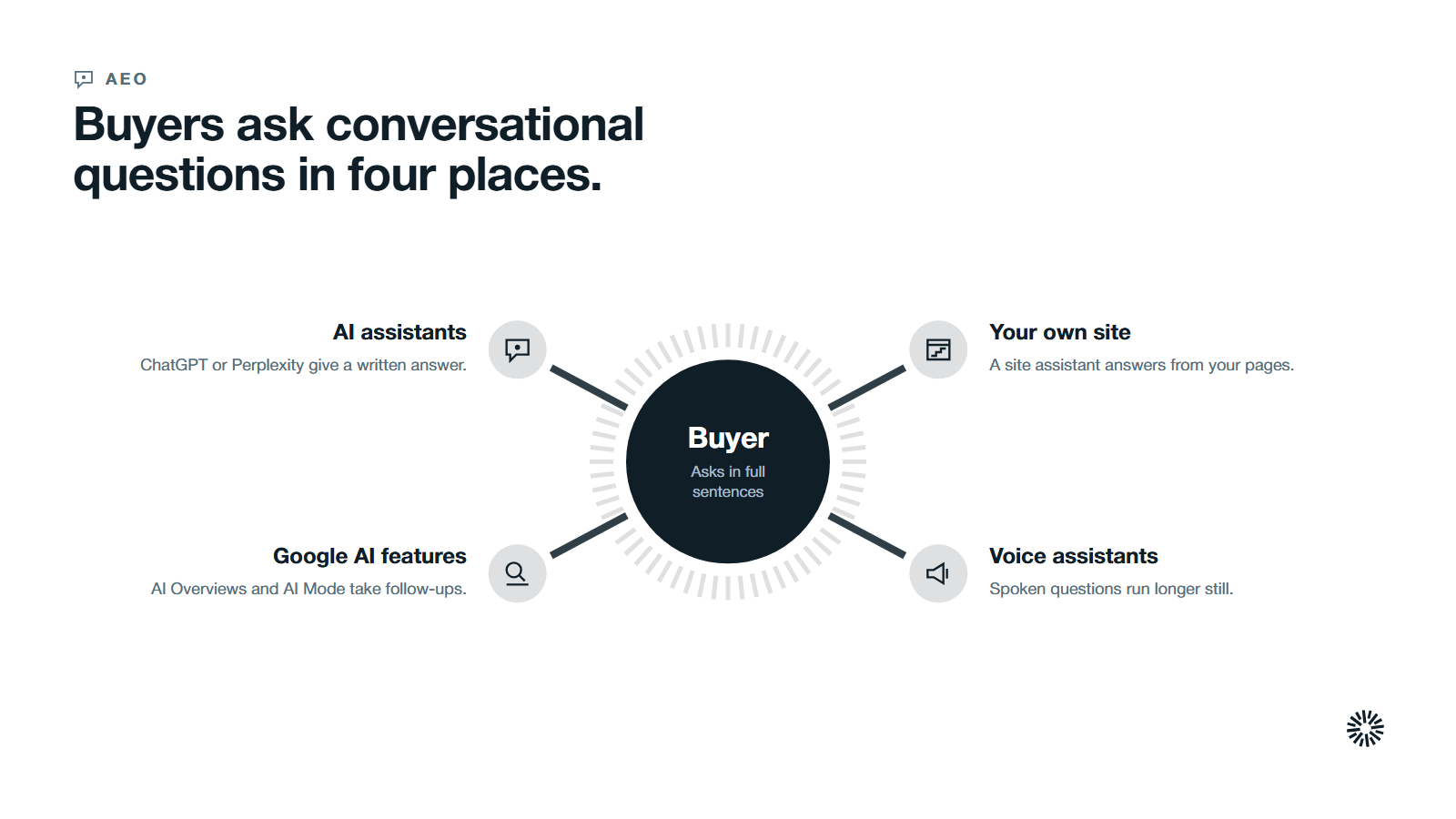
Conversational search shows up in three places, and a B2B buyer moves between all of them in a week.
| Where it happens | What the buyer does | What decides if you appear |
|---|---|---|
| AI assistants such as ChatGPT or Perplexity | Asks a question and reads a written answer | Whether your pages are clear, quotable and reachable |
| Search engines with AI features, such as Google AI Overviews and AI Mode | Asks in full sentences and follows up | Whether your pages are indexed and eligible to show with a snippet |
| Conversational search tools on a company site | Asks the site's own assistant for an answer | Whether the product data and content behind it are accurate |
The first two sit outside your control. You influence them by publishing pages that answer questions well. The third sits on your own site, where you have full control over the content, the tone and the data.
Google is plain about the second row. To be shown as a supporting link in AI Overviews or AI Mode, a page must be indexed and eligible to appear in Google Search with a snippet, and Google says no extra optimization is needed beyond that.
Spoken input, on phones and through voice assistants such as Google Assistant, pushes questions further toward human like interaction. Spoken questions are longer still, which is a good reason to write answers that stand alone.
Conversational search on your own site
Conversational search functionality on your own site works the same way in miniature. It lets users interact with your content by asking a question and getting an answer drawn from your pages, allowing users to explore a topic without clicking through menus.
Customers can describe a problem in their own words, at any hour and in more than one language, and the tool surfaces the relevant knowledge instantly. For technical questions it can guide a customer through a few clarifying questions, which helps with troubleshooting and with first-contact resolution of complex queries.
It only works when the knowledge behind it is reliable and retrieval is context aware. Your support team gains too: the tool can triage incoming requests and speed up agent-assist lookups.
How conversational search differs from keyword and semantic search
Three terms get mixed up, and they describe different layers.
Keyword search matches the words you typed against the words on a page. It rewards exact matches, treats each query as new with no memory of the last, and can bury a reader in information overload. Traditional search methods work for short lookups and struggle to read intent in a full question.
Semantic search looks for meaning. It understands that two different phrasings can ask the same thing, so it can return relevant results without exact keyword matching. It is a capability that conversational search relies on.
Conversational search adds the dialogue. It prioritizes what the person means over exact words, keeps context across turns, can ask you to clarify, and writes an answer instead of listing links. Adapting to each turn makes answers more personal. In short, semantic understanding is how it reads, and the conversation is how it behaves.
For a B2B team, the practical difference is the unit of competition. In traditional search, your page competes for a position among the search results. In conversational search, your passage competes to be used inside an answer. Our AI search statistics piece collects what the original studies say about that shift.
Where conversational AI search meets the buyer
Conversational AI search is the version most buyers meet first, because it sits inside tools they already use. AI conversational search brings the loop together: a question in plain words, an answer written from several sources, and a follow-up one tap away. It improves relevance and cuts the effort of hunting through fragmented pages.
What conversational search changes for your content
Nothing here replaces the basics. What changes is how a page gets used: as a source for an answer, in pieces, often without a visit. A sound content strategy starts from the question.
Answer the whole question near the top
An engine builds a response from passages that answer the question directly. Put the answer in the first one or two sentences under a heading that states the question, then add the detail. A reader gets what they came for, and an engine gets a clean passage to lift.
Write for the follow-up, not just the first question
Map the questions that come after the obvious one. If you explain what a service is, also cover what it costs to start, who it is for, and when it is the wrong choice. Each is a follow-up a buyer will ask next, and good answers guide users toward the next step.
Close content gaps with relevant content
Look for the questions your buyers ask that no page of yours answers well. Those content gaps are where a competitor, or a poor third-party source, gets quoted instead of you. Relevant content that names the customer intent behind the question fills them.
Keep your wording consistent and on brand
Engines draw on many pages to decide who you are. Use the same names for your services and the same definitions across your site, so answers grounded in your content describe you correctly. A consistent brand voice also makes passages feel like they came from one source.
Keep product facts current so answers stay accurate
Pricing models, integrations, who you serve and what you do not do are all things a buyer will ask. Out-of-date product data produces wrong answers. Accurate answers and accurate results build trust, which one confident wrong answer can undo.
How to find the questions your buyers ask
You do not need a tool to start. The best source is the language your own team already hears.
Read recent sales calls and notes, and copy the questions in the buyer's own words. Add the questions from your website chat and support inbox, and the logs of any conversational search tool on your site, which capture real phrasing and unmet needs.
Ask new customers how they first described the problem before they found you.
Then test the questions yourself. Type each one into an AI engine in full-sentence form, add a constraint or two, and follow up the way a buyer would. Note which companies are named, what the answer says about you, and where it is wrong or silent.
Last, put the findings where your content teams will use them. A short list of buyer questions by stage, reviewed each quarter, is more useful than a long list of isolated keywords. Content teams then write to the conversation instead of guessing at it.
What you gain when this is done properly
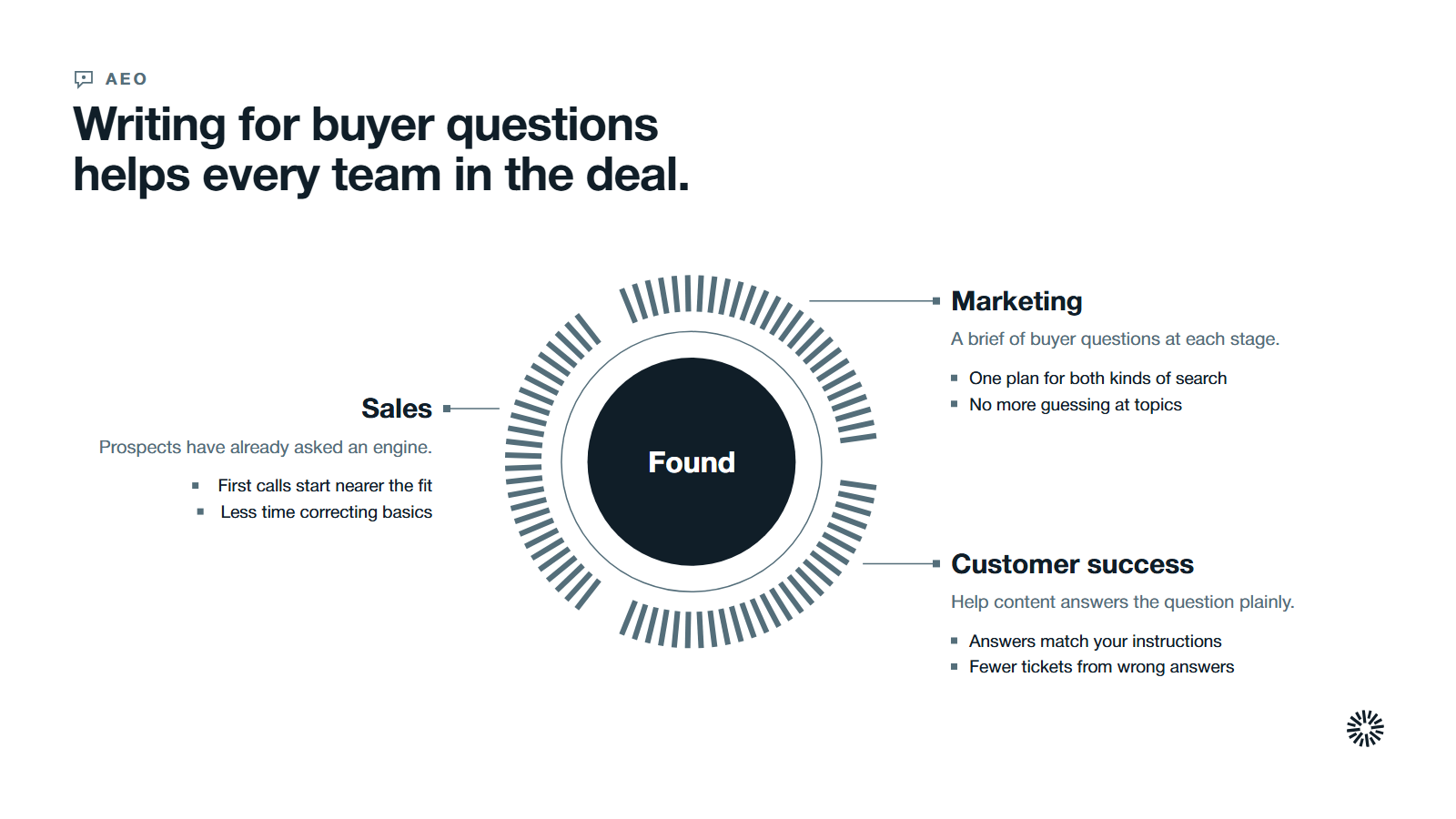
Treating buyer questions as the starting point for content helps every team that touches the deal, and it improves the search experience and user experience for the people you want to reach.
Sales
Prospects arrive having already asked an engine about their problem. When your pages shape those answers, a first call starts closer to a real conversation. Reps spend less time correcting basics and more on the fit.
Marketing
Marketing gets a clear brief: the questions buyers ask at each stage, in their own words. That ends guesswork about topics, and it keeps traditional search and AI search working from one content plan.
Customer success
Customers also ask AI tools how to use your product. When your help content answers the question plainly and stays current, the answer they get matches your instructions, which supports user satisfaction. Your team then handles fewer tickets caused by a wrong answer.
Write for the conversation your buyers are already having
Conversational search is a change in how buyers ask, not a new channel to staff. Write answers to the full question, cover the follow-ups, and keep your facts consistent across every page.
Propello designs and builds connected GTM systems on HubSpot. If you want your content planned around the questions your buyers ask, an audit is the place to start.
