If you run content marketing for a B2B company, the short answer is this: publish evergreen content for the questions your buyers ask every year, and publish timely content only when a dated event gives you something to say that nobody else can.
Most teams need both, in a deliberate order. Evergreen content is the foundation of a content marketing strategy. Timely content is a short, planned layer on top of it.
This article is for marketing leaders, content marketers and founders who share a small team and a small calendar. You will get a plain definition of each type, evergreen content examples, a side-by-side comparison on the same criteria, decision rules by goal and stage, and a maintenance routine for each.
|
Evergreen Content Evergreen content is material built around questions and topics that stay relevant for a long period, so it can be found, read and used long after the day it was published. |
|
Timely Content Timely content is material tied to a current event, trend, season or announcement, written to be useful while that moment lasts and then retired or archived. |
Evergreen content is written to stay useful, so its value comes from maintenance
Think of evergreen content as a reference page. It answers a question your target audience keeps asking, such as how a process works, what a term means or how to choose between two options. The answer does not depend on this week's news.
Common formats include how to guides, definitions, checklists, comparisons and explainers. Our guides on what content marketing is and how to get started with content marketing are evergreen articles of this kind.
Evergreen topics come from steady questions, not from the news
Good evergreen topics are timeless topics: the basics of your field, the decisions a buyer faces in every cycle and the terms your sales team explains on every call. Look at sales calls, support tickets and search queries for questions that repeat.
A steady stream of the same question is the signal, and steady search volume for it is a useful check. If the question changes with each quarter, it is not an evergreen topic yet.
Evergreen content that remains relevant still needs upkeep
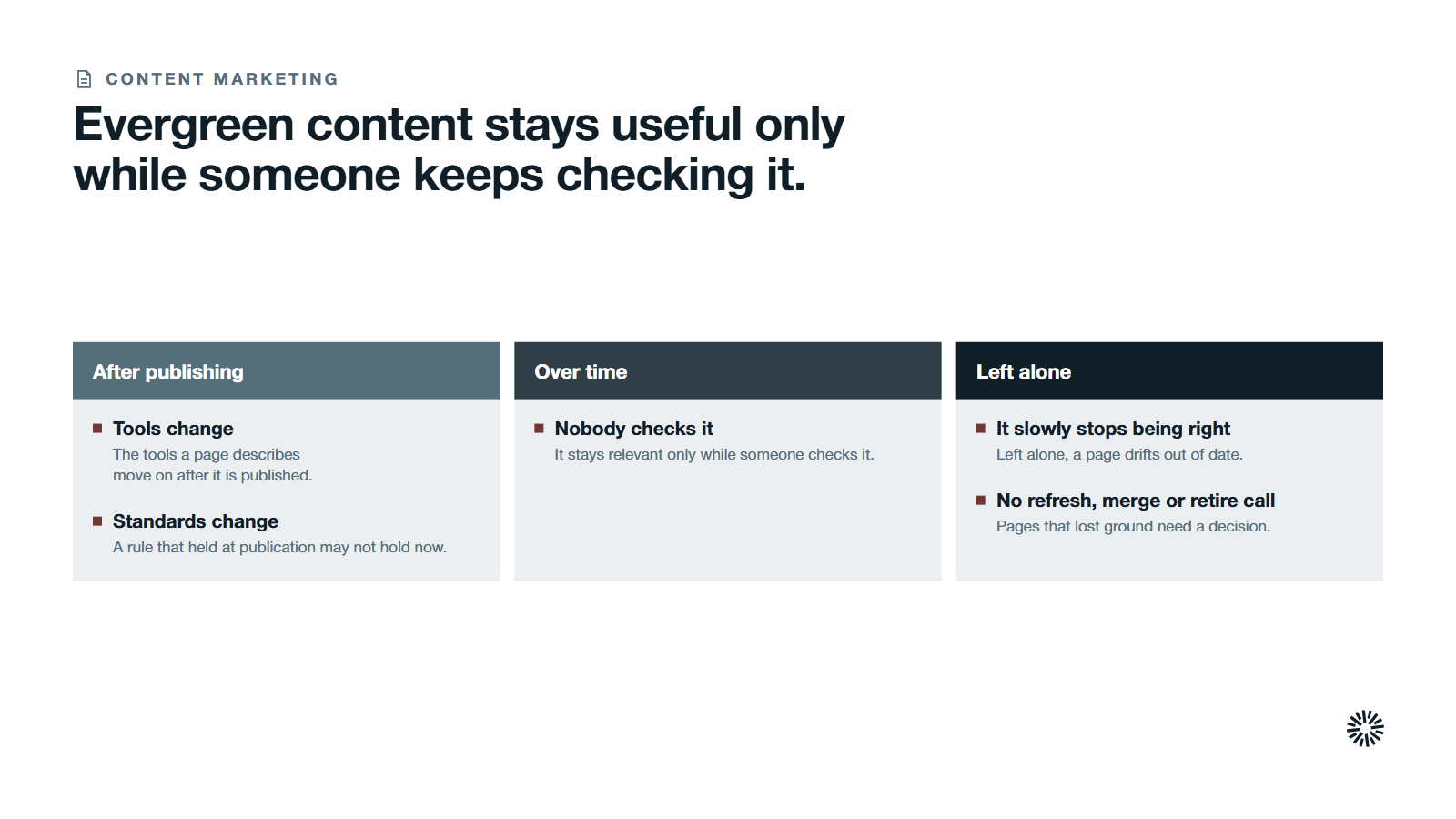
No page stays correct forever. Prices change, tools change and standards change. Evergreen content remains relevant long past publication only because someone keeps checking it.
Left alone, it slowly stops being right. Our guide to content decay explains how to find the pages that lost ground and decide whether to refresh, merge or retire them.
Evergreen content examples and timely content examples
Examples make the difference concrete. These are formats, not results, and the same company can publish all of them.
- Evergreen content examples: a definition page, a how to guide, a glossary, a buyer's checklist, a comparison of two approaches, an explainer on a process, an infographic, a case study written around a timeless lesson
- Timely content examples: a reaction to an industry report, a conference recap, a seasonal planning guide, a note on a rule change, a launch announcement
For more formats in action, see our content marketing examples.
Timely content earns attention while a moment lasts
Timely content responds to something happening now. That can be current events in your industry, a product launch, a regulation, a seasonal buying window or a report that every competitor is quoting.
Its value is concentrated. Done quickly and with a real point of view, timely content can put your company into a conversation while the audience is already paying attention. After the moment passes, its job is done.
Timely does not have to mean breaking news
For most B2B teams, timely content is calmer than it sounds. Trending content might be your reaction to a new industry report, or a note on what a rule change means for your customers.
Seasonal topics are the most predictable kind, because you can plan them on the content calendar months ahead.
Search engines treat freshness as a need, not a bonus
Google's guide to its ranking systems describes "query deserves freshness" systems that show fresher content for queries where it would be expected. Its example is a newly released movie, where searchers want recent reviews instead of older articles.
The lesson is narrow. Freshness matters for queries about recent events. It does not mean every page must be new. For steady questions, a correct and complete answer is what the search engine is trying to find.
Evergreen vs timely content compared on the same criteria
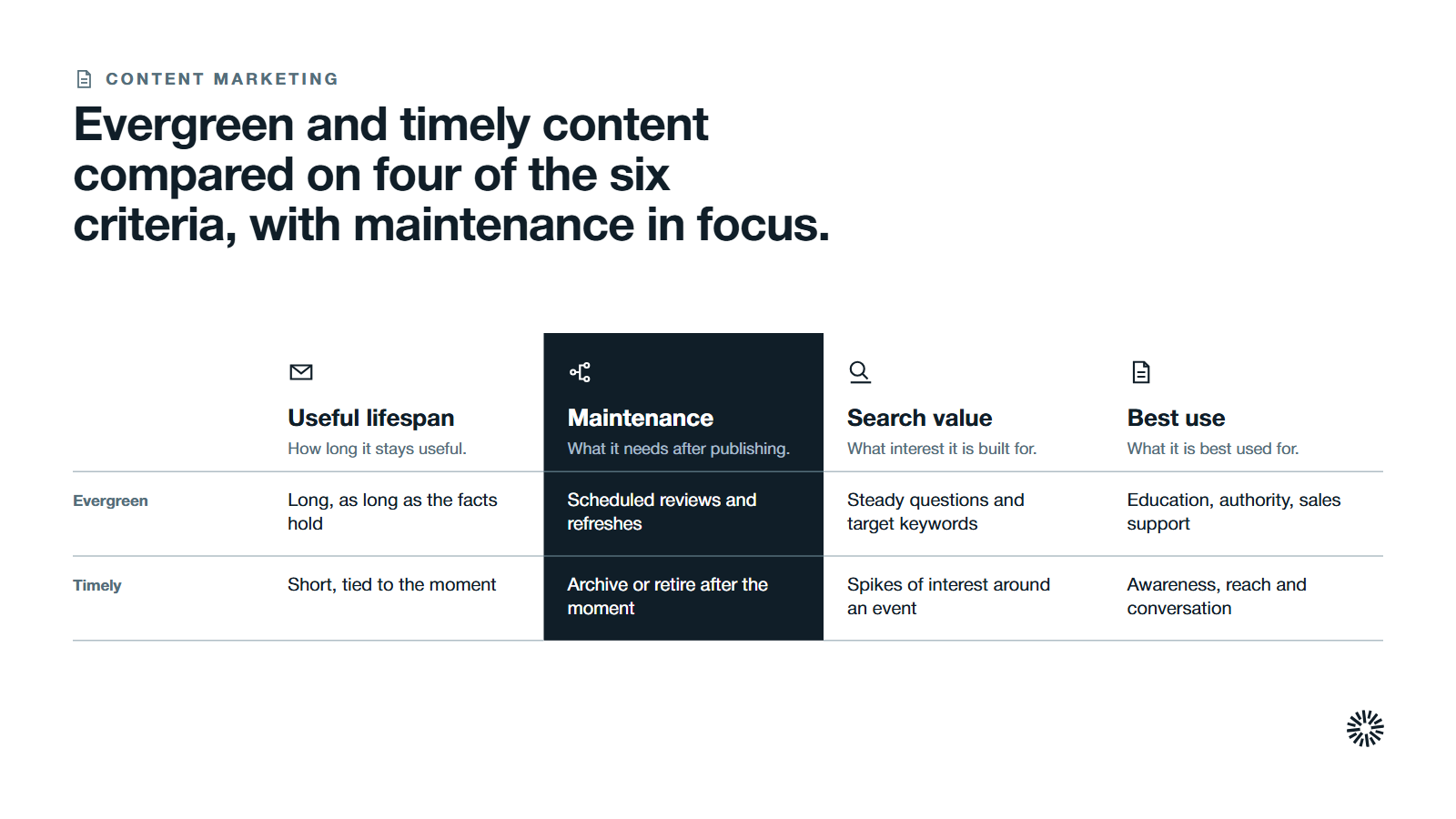
The two types differ in how long they stay useful, how much work they need after publishing and what they are best used for. This table compares evergreen content and timely content on the same six criteria.
| Criterion | Evergreen content | Timely content |
|---|---|---|
| Useful lifespan | Long, as long as the facts hold | Short, tied to the moment |
| Effort | Higher upfront research and structure | Lower length, but speed matters |
| Search value | Built for steady questions and target keywords | Built for spikes of interest around an event |
| AI answer value | Clear definitions and steps are easy to quote | Useful only while the event is current |
| Maintenance | Scheduled reviews and refreshes | Archive or retire after the moment |
| Best use | Education, authority and sales support | Awareness, reach and conversation |
Read the table as our reading, not as a measured result. We are not claiming that one type produces more traffic or leads. Results depend on your topic, your audience and your execution.
What the effort row means in practice
Writing evergreen content takes more thought before drafting. You need a clear question, a correct answer, a structure that is easy to scan and sources you can defend. Timely content takes less structure but more speed, because a late reaction has no audience.
Neither is cheap. They spend the same budget in different places.
What the AI answer row means in practice
AI answer engines look for pages that state a clear answer and support it. A definition, a short list of steps or a labeled comparison is easy to lift into an answer.
Pew Research Center found that in March 2025, Google users who saw an AI summary clicked a traditional search result link in 8% of visits, versus 15% of visits without one.
That finding is about clicks, not about content type. It is a reason to make every page answer-ready. Our guide to optimizing content for AI search covers how.
How to create evergreen content that fits your content strategy
To create evergreen content that earns its place, start from the question, not the keyword. Write the complete answer first, then check it against target keywords and search engine optimization basics.
Writing evergreen content for a small business or a lean team works best when each piece has one owner, one review date and one job in the content strategy. Valuable evergreen content also uses visual elements, such as a diagram or table, only where they make the answer clearer. For the full picture, read our complete guide to content strategy.
Do thorough research so the facts are accurate, and avoid time-sensitive elements such as dated references that would age the page. Depth matters, but usefulness takes precedence over length.
Plan to promote evergreen content after publishing. Link it from related blog posts, share it in email marketing and use it in social media posts, so the audience engaged by a timely piece can find the lasting page behind it. Measure performance over time to tell content with lasting value from content that earned only temporary attention.
The key benefits of each type for your marketing strategy
The key benefits differ, and neither type guarantees a result. Evergreen blog posts and evergreen articles aim at long term traffic and steady traffic, because the same question keeps coming back. They give a content marketing strategy lasting value and long term value, and a primary focus when creating content.
Timely content suits short term marketing campaigns. Topical articles and more topical articles react to industry developments and aim to reach a wide audience while interest is high.
Many teams create evergreen posts first, then reuse content from them in a social media marketing strategy and in email marketing strategies. New customers and other websites can find the lasting page, while timely pieces keep your content fresh and aim to drive traffic to it in the moment.
For real world examples of this mix, look at how your own best pages were found, and note new examples as they appear.
How to decide: rules by goal
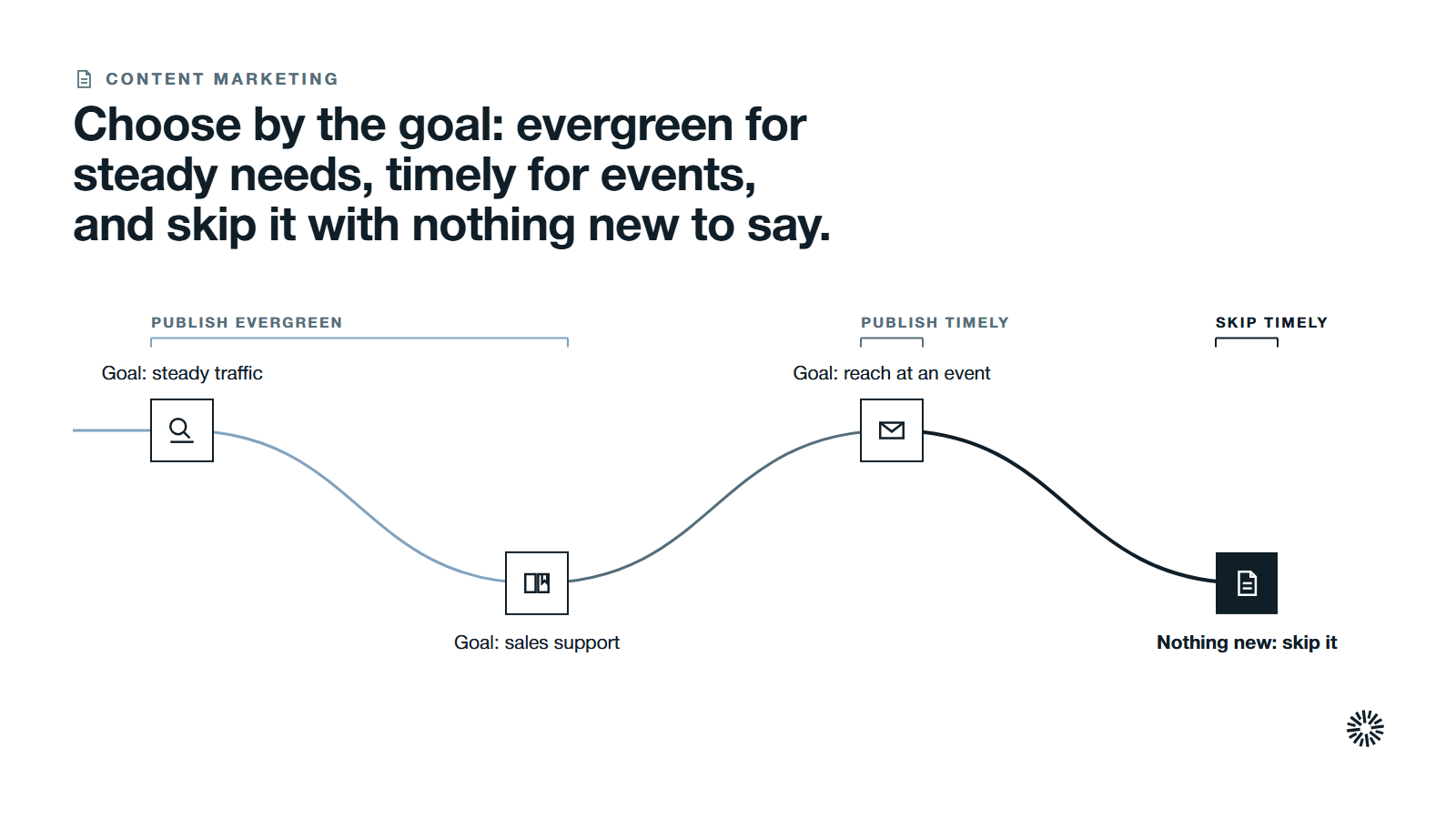
Choose by the job the content must do, not by which type sounds more modern. These rules are our reading and are meant to be argued with.
If the goal is consistent traffic from steady questions, publish evergreen
Search demand for a basic question is steady, so a complete answer has a long working life. Build the page once, link it from related articles and review it on a schedule.
If the goal is to support sales, publish evergreen
Sales needs pages it can send after a call: comparisons, how to guides and explainers. This content works best when it stays accurate and up to date for the next buyer too.
If the goal is reach around an event, publish timely
A conference, a launch or a rule change gives people a reason to look now. A short, specific piece published quickly can use that immediate interest. Plan how you will share it, because a late post has little time to be seen. Our guide to content distribution strategy shows how to amplify one story.
If you have nothing new to say, skip the timely piece
A recap that repeats what every other site says adds nothing. Timely content earns its place only with an original angle, your own data or a clear opinion.
How to decide: rules by stage
Where you are in building your content library changes the answer.
If you are starting out, build a small evergreen base first
A new blog has no library to defend. Start with a few evergreen posts on the questions buyers ask most, written well, and keep the first batch small enough to maintain.
If you have a library, shift effort to upkeep
An established site often gains more from reviewing and refreshing existing content than from adding more. Check which pages lost visibility, update the facts and merge duplicates before you commission new ones.
If you have a launch or event coming, plan one timely piece around it
Reserve a slot in the content calendar. Decide who writes it, who approves it and which evergreen page it should point to. The timely piece borrows attention, and the evergreen page keeps it.
A workable mix links timely pieces to evergreen content
The best mix is not a ratio. It is a structure. Treat each core evergreen page as a hub, and let timely and topical pieces support it.
When you publish a timely post, link it to the evergreen page on the same subject. When the moment passes, the evergreen page keeps the link, and you can repurpose content from the timely piece into a section update. Our guide to content repurposing shows how to turn one asset into many formats.
For more ideas on balancing the two, see our guide to content marketing tactics to try.
How to maintain each type so content stays fresh
Maintenance is where the two types diverge most.
Review evergreen content on a schedule
Set a review cadence by how fast the subject changes. Check facts, links, screenshots and examples. Update the page when something is wrong or missing.
Google's guidance on creating helpful content lists a question worth asking yourself: are you changing the date of pages to make them seem fresh when the content has not substantially changed? Change the date only when the update is real.
Show honest dates on every page
Google's guidance on publication dates recommends a user-visible date labeled "Published" or "Last updated," matched in structured data with datePublished and dateModified. The date must describe the page's publication or update, not the events it describes.
For timely content, the date is part of the message. Readers should see when it was true.
Retire timely pages once the moment passes
Decide up front what happens to a timely post: archive it, redirect it to the evergreen page or update it into a lasting resource. Do not leave dated promotions or old announcements live as if they were current.
Mistakes to avoid
Four mistakes come up again and again.
- Calling a timely topic evergreen because the first draft ranked well
- Publishing timely pieces with no link to a lasting page
- Refreshing dates without refreshing facts
- Letting a content calendar fill with reactions and no foundations
Each one has the same cause: no one decided what each piece is for before writing it.
What you gain when this is done properly
When every piece has a clear job, the content library becomes a system instead of a pile. Your teams stop guessing what to publish next.
Sales gets pages it can trust
Sales can send evergreen content that is checked on a schedule, so a prospect never lands on an outdated claim.
Marketing gets a calmer calendar
Marketing plans timely content around real events and spends the rest of its time on lasting pages, instead of chasing every trend.
Customer success gets answers that stay current
Customer success can point customers to guides that are reviewed and dated honestly, which reduces repeated questions about how things work.
Decide what each piece is for, then match the type
The real choice is not between two content types. It is between publishing with a purpose and publishing to fill a calendar. Define the job, pick the type that fits, and set the maintenance before you write.
Propello designs and builds connected go-to-market systems on HubSpot for CEOs and revenue leaders at growing B2B companies, so content, data and follow-up work from the same plan.
If you want a second opinion on how your content mix supports your pipeline, an audit is the place to start.