If you lead revenue at a growing B2B company, a content distribution strategy is the plan that puts one finished story in front of your buyers on every channel they use. It is vital for visibility: you choose the story, adapt it for each channel, publish on a schedule and review.
This guide is for CEOs, founders, CROs and revenue leaders, and for the marketing lead who runs the plan. You get seven steps with a finish line for each, the checks to make first and the mistakes to avoid. It is the Amplify stage of HubSpot's Loop Marketing framework in practice.
|
Content Distribution The planned process of getting a piece of content in front of the right audience through owned, earned and paid channels, so that it is seen and acted on, not only published. |
By the end you will have one story working on every channel
Most teams publish a blog post, share the link once and move on. A working plan gives you more than that, and each of these items is something you can point to.
- One core story and the single action you want a reader to take next.
- A short map of the channels where your buyers already spend time, split into owned, earned and paid.
- A content calendar that schedules every adapted version, not only the original.
- A weekly review that tells you which channels earned a second push and which to drop.
What to have in place before you start
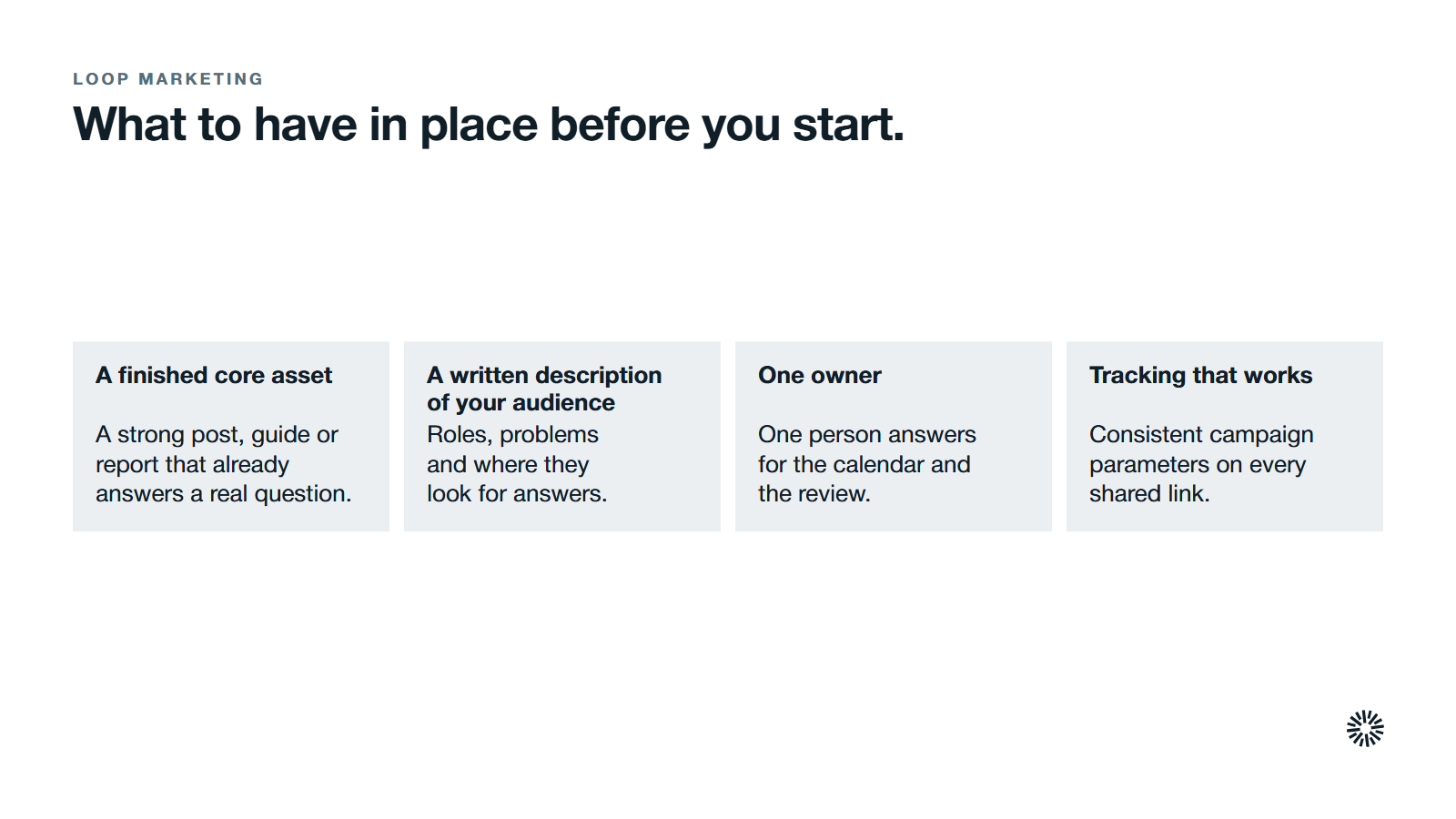
Distribution fails most often because of what is missing before the first post goes out. Check these four things, and fix any gap before you build the plan.
- A finished core asset. High quality content, such as a strong blog post, guide, report or recorded talk, that already answers a real question. Distribution multiplies what exists; it cannot rescue a weak piece.
- A written description of your target audience. Roles, problems and the places they look for answers, drawn from your CRM and from sales calls.
- One owner. A single person responsible for the calendar and the review, even when several people publish.
- Tracking that works. Every link you share needs consistent campaign parameters, so your analytics can tell one channel from another.
If your story is not written yet, start with how to get started with content marketing and return here once the first asset exists.
Where HubSpot's Amplify stage fits
HubSpot describes Loop Marketing as a four-stage framework: Express, Tailor, Amplify and Evolve. Amplify is the stage that makes sure you are discoverable across channels, and HubSpot lists three jobs inside it: publish across your owned channels, optimize for answer engines, and activate targeted ads and creators.
Distribution only works if the earlier stages are done. Express gives you the story, and Tailor turns it into the versions each channel needs. Evolve feeds what you learn back into the next cycle. For all four stages together, read the Loop Marketing playbook.
How to build a content distribution strategy in seven steps
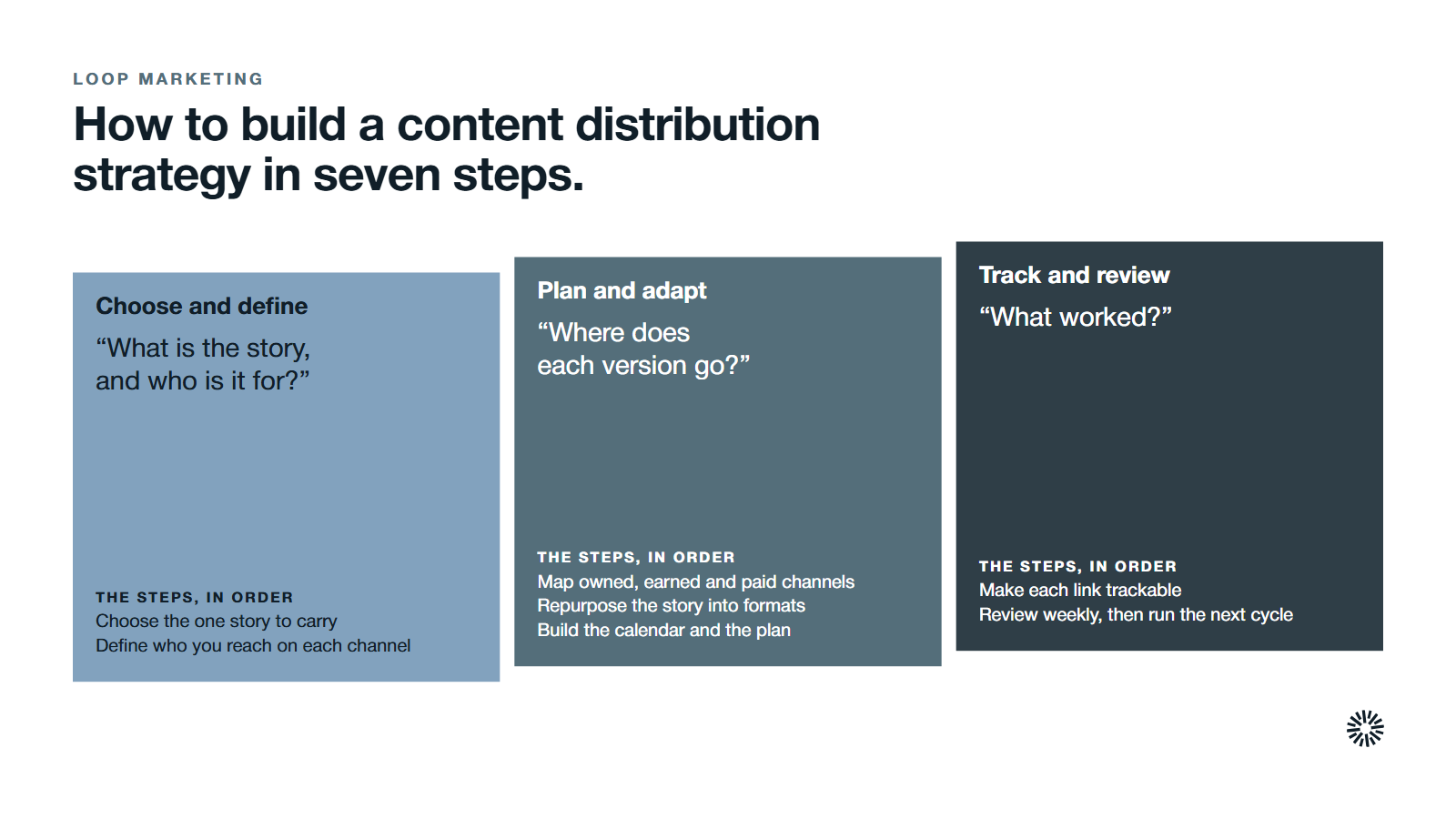
Each step ends with what done looks like, so you know when to move on.
1. Choose the one story to carry
Pick a single core asset from your content marketing strategy and write its message in two sentences: who it helps and what changes for them. Every adapted version will repeat that message in a different shape, so keep it narrow.
Creating content for every channel from scratch is what drains a team, so the next steps work from this one story. Decide the one action you want after reading, such as booking a call or downloading the full guide. A story with no next step produces attention and no lead generation.
Then set one or two KPIs that track content performance, such as qualified replies or demo requests, so the review has something to measure.
You are done when anyone on the team can state the message and the next step without opening the document.
2. Define who you are reaching on each channel
Researching your target audience is the first step, and it starts with detailed buyer personas. Your target audience is not one crowd. A finance lead reads email newsletters at their desk, while a founder may see your social media posts on a phone between meetings.
Write down audience preferences for each group: where they look online, how long they will read, and what they trust.
Note the demographic data you hold, such as role, company size and region, so every version is written for the intended audience.
Use your CRM, sales notes and customer interviews rather than guesses. These audience insights tell you which social media platforms and other media channels deserve effort, and which can wait.
You are done when each audience has two or three named channels and one sentence on what it expects there.
3. Map owned, earned and paid channels
Sort your distribution channels into three groups. Owned media is what you control: your website, blog, email list and social media accounts.
Earned media is attention you win from others, such as positive press coverage, mentions on third party sites, podcast invitations, guest articles and endorsements from customers or partners. Paid channels buy reach: search ads, social ads and sponsored content.
The mix matters because each group does a different job. Owned content distribution comes first, because you control it, and paid content distribution comes last, because it works best on proven pieces.
Owned channels build a base you keep, earned channels borrow trust, and paid channels speed things up when you already know a message works.
Social media channels deserve a closer look, because each platform favors a different shape of post. Your social media pages carry short social media posts well, and social media ads can extend the best of them. A short post suits a busy feed, while a longer article or a recorded talk suits your own site.
User generated content, such as a customer's comment or a partner's post, can be the most credible piece of all, so plan a place for it. Influencer generated content and invitations from leading content creators in your business niche work the same way.
For your size of team, pick fewer channels than feels comfortable. The Content Marketing Institute surveyed 1,015 B2B marketers in 2025 and asked which channels work best for thought leadership.
A professional networking site came first at 76%, followed by email newsletters at 54% and speaking events or webinars at 52% (Content Marketing Institute, 2025). Those answers are a starting point to test against your own audience, not a rule.
You are done when you have a short list of content distribution channels, each marked owned, earned or paid, with a reason beside it.
4. Repurpose the story into the right content formats
Repurposing means turning one asset into several pieces for different channels. A long guide can become a short article, a set of social media posts, an email to your list, a slide summary, a short video and a quote graphic.
Content assets you have already paid for become a source of new material, and a repurposing plan saves the content creation process from starting at zero each month.
HubSpot places this work in its Tailor stage, where a core asset is remixed into the formats your audience consumes. Its setup guidance for Loop Marketing also describes using AI to produce campaign assets for several channels from one core asset.
Adapt each version instead of pasting the same text everywhere. Channel-specific optimization means tailoring content to the expectations of each platform. A real adaptation changes the opening, the length and the call to action to suit the channel.
In the same Content Marketing Institute research, 89% of B2B marketers said their organizations personalize content, yet 59% described their personalization as basic, meaning simple changes in one or two channels (Content Marketing Institute, 2025).
You are done when each chosen channel has a version written for it, and every version points back to the core asset.
5. Build the content calendar and the distribution plan
Put every version on a content calendar with a date, a channel, an owner and a link to the core asset. Stagger the releases. Publish the original on your site first so it can gather organic traffic, then release the adapted pieces over the following days and weeks.
Content distribution tools such as schedulers are optional at this stage, because a shared sheet is enough to start.
Add the paid side deliberately. Paid media should follow proof, so promote only the pieces that have already earned attention organically, and send readers to dedicated landing pages that match the message of the ad.
If you use search advertising, Google Ads, Google's online advertising program (Google Ads Help), can carry a proven piece to buyers who are searching for the topic. Pay per click ads of this kind appear on search engine results pages, so the landing page has to answer the query at once.
The calendar is also where earned media gets a slot, so your distribution efforts are not all paid. Schedule outreach for guest articles, podcast pitches and partner mentions, because they take longer to land than a post.
You are done when the next four weeks are scheduled with owners, and the paid budget for the story is written down.
6. Make each link trackable and each answer findable
Tag every shared link with campaign parameters so you can see which channel sent each visit. Google Analytics reads three of them, and the Analytics Help page on URL builders explains each: source names where the traffic came from, medium names the type of channel, and campaign names the effort.
Use the same naming pattern across the team.
Buyers also ask AI assistants before they open a website. HubSpot's Amplify stage includes optimizing for answer engines, which means writing plain, well-structured pages that a search engine or an AI tool can find and quote.
Put a direct answer near the top of the core asset, and keep your key facts in text rather than in images.
You are done when every link in the calendar carries parameters and the core asset opens with a clear answer.
7. Review weekly, then run the next cycle
Look at results once a week for the first month, then evaluate content performance every month. Compare channels by customer feedback, qualified conversations and pipeline movement, not only views.
Monitor engagement rates, and use Google Analytics to track traffic and conversions from each tagged link. A channel that sends a modest number of readers who book calls beats one that sends many who leave.
Measurement is where many teams stall. In HubSpot's 2026 State of Marketing survey of more than 1,500 marketers, measuring the ROI of marketing activities was the top challenge, named by 33% (HubSpot, 2026). A simple weekly review of one dashboard is enough to start.
This is the Evolve stage at work. Repurpose high-performing content to maximize reach, double down on the two channels that performed, change or drop the weakest, and carry the lessons into your next story.
You are done when you have written down one channel to expand, one to change and one to stop.
Mistakes that hold back successful content distribution
A solid content distribution strategy is mostly discipline. Check your plan against this list before you publish.
- Publishing and stopping. Publishing content and sharing a link once is not distribution. Plan several releases across weeks.
- Pasting the same text everywhere. Each channel has its own length, tone and etiquette. Adapt before you post.
- Spreading across too many channels. A thin presence on ten channels loses to a strong presence on three.
- Relying on a single type of channel. An all-paid plan stops working the moment you stop paying, and an all-owned plan reaches only people who already know you.
- Skipping the review. Without a regular look at results, the same weak channels keep getting the same effort.
- Selling in every post. Lead with something useful. Keep the offer for the end and for the landing page.
What you gain when this is done properly
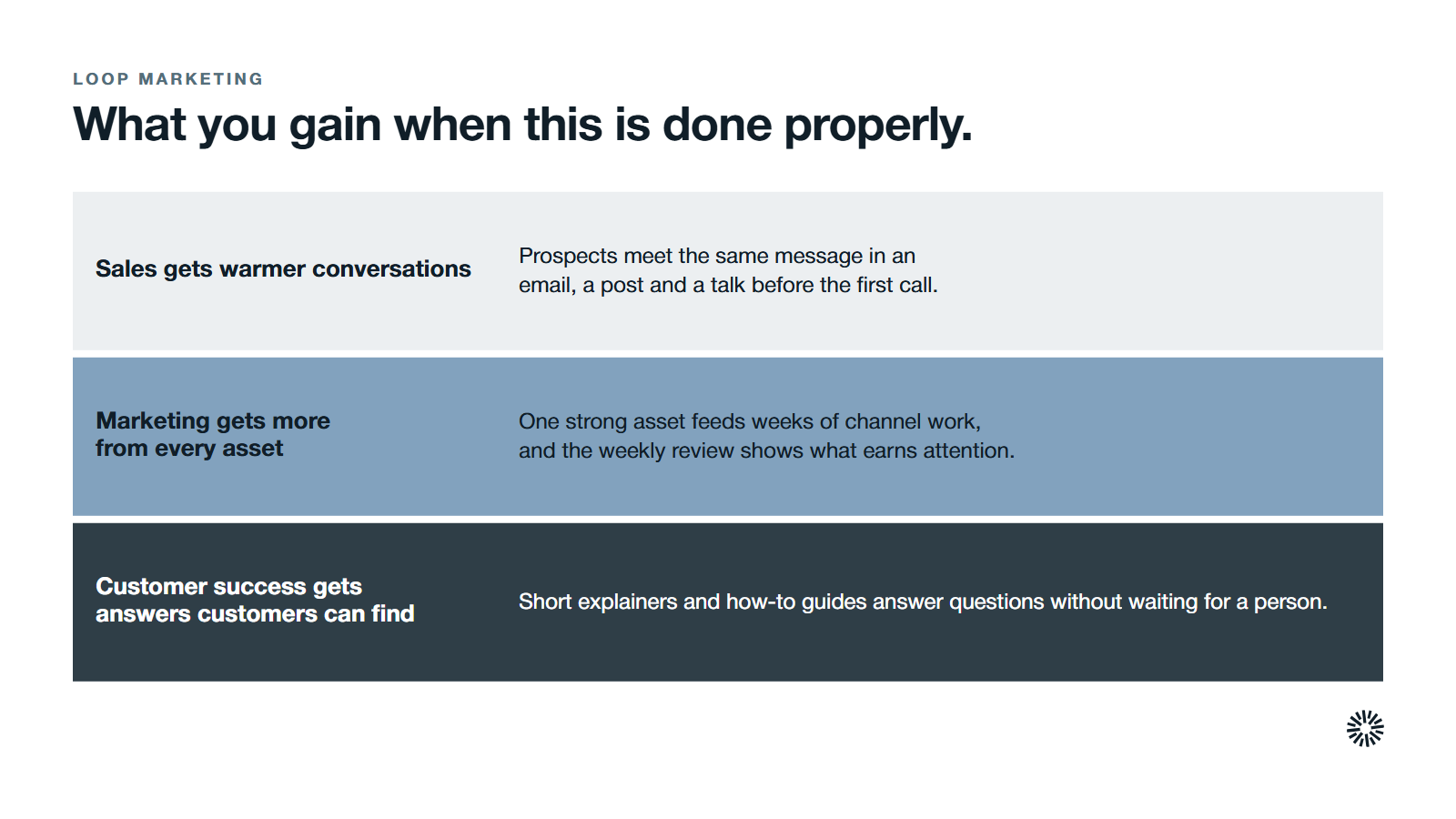
A distribution plan turns content from a cost you pay once into an asset your whole revenue team can use. The benefits show up differently for each team.
Sales gets more conversations that start warm
Prospects who meet the same message in an email, a post and a talk arrive with context. Sellers can reuse the adapted pieces in outreach and follow-up, and they see which topics a buyer has already read before the first call.
Marketing gets more from every asset
One strong asset feeds weeks of channel work, so the team spends less time starting from a blank page. The weekly review shows which channels and formats earn attention, which lets the team put effort where it pays back. Our guide to content repurposing shows how to reshape one asset before you distribute it.
Customer success gets material that answers real questions
Adapted pieces such as short explainers and how-to guides give customers answers they can find without waiting for a person. Customer stories gathered from this work also feed the top of the next cycle.
Put one story to work on every channel
Most marketing teams already have the content. An effective content distribution strategy is a habit of choosing a story, adapting it, scheduling it and learning from the result. Start with one asset and one month of content distribution efforts, and let the review decide what to expand.
Propello designs and builds connected GTM systems on HubSpot. If your content reaches too few buyers and you cannot tell which channels work, an audit is the place to start.