If you run marketing, demand generation or growth at a B2B company, the short answer is this: use gated content only when the reader gets something worth a name and an email address, and keep ungated content for everything that builds trust or helps buyers decide.
Most teams need both. Ungated content is freely accessible and earns attention, organic traffic and trust. Gated content turns the readers who want more into known leads, so it helps you generate leads. The skill is deciding which asset goes where in your content marketing strategy and your wider marketing efforts.
This article is for marketing leaders, content owners and revenue leaders who are choosing a gating policy. You will get a definition of each approach, gated content examples, a side-by-side comparison on the same criteria, gated content best practices and decision rules by buyer's journey stage.
|
Gated Content Gated content refers to a resource that a visitor can only open after completing a lead capture form, usually by sharing a name and business email address. |
|
Ungated Content Ungated content is a resource that anyone can read or download immediately, with no form, login or other exchange of contact details. |
Gated content puts a form between the reader and the asset
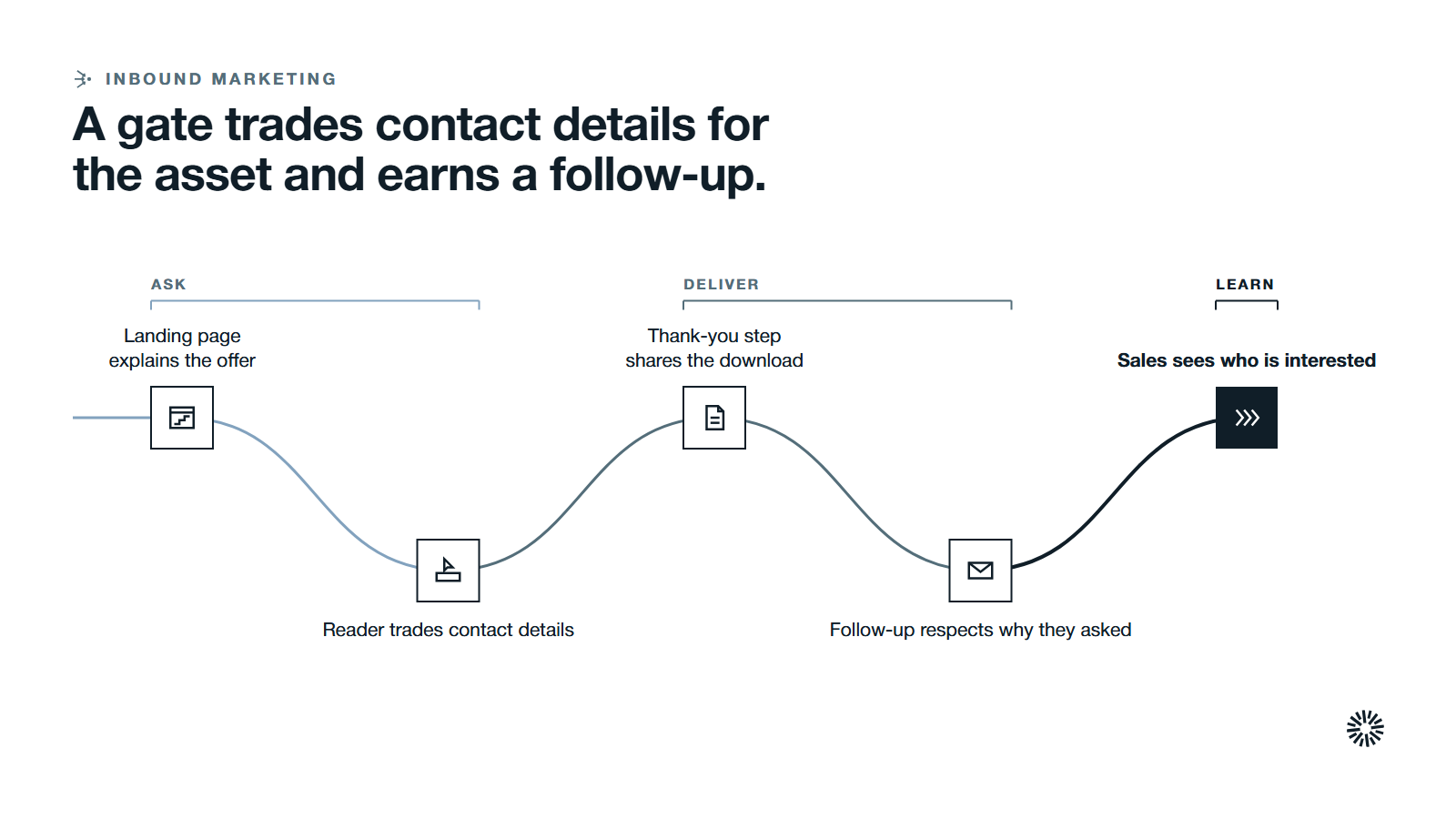
Gated content is an exchange. The visitor gives contact details, and in return the company delivers premium content it believes is worth that price. The gated asset might be a guide, a template, a benchmark report, a calculator or an on demand webinar.
The form is the visible part. Behind it sits the real work: a gated content landing page that explains what the reader gets, a thank-you step with the download link, and a follow-up that respects why the person asked. Teams usually call the asset a lead magnet when it is built mainly to capture leads.
Gated content has a clear upside for lead generation, or lead gen. You learn who the reader is, you can qualify leads, and sales can see which potential customers are interested. It is a lead capture tool, and the leads generated are easier to follow up. Every form fill is also a signal about a topic the reader cares about, and it improves lead quality when the offer is specific. For the full picture, read our complete guide to inbound lead generation.
It has a clear cost too. Every field you add reduces the number of people who finish. The reader who leaves at the form never sees the gated asset, never forms an opinion of your expertise and may not come back.
A gate changes who reads and why
When content sits behind a form, your target audience shrinks to the readers willing to trade their contact details. That can be the right filter for high value gated content. It can also hide your best thinking from the people who would have become paying customers.
Gartner's March 2026 survey of 646 B2B buyers found that 67% of B2B buyers prefer a rep-free experience. A form that promises a salesperson's call is a poor trade for a buyer who wants to research alone.
Gartner's June 2025 survey of 632 buyers adds a warning for the follow-up. It reports that 73% of B2B buyers actively avoid suppliers who send irrelevant outreach. Gated content that feeds a generic sales sequence turns every captured lead into a risk.
Ungated content earns reach, trust and search visibility
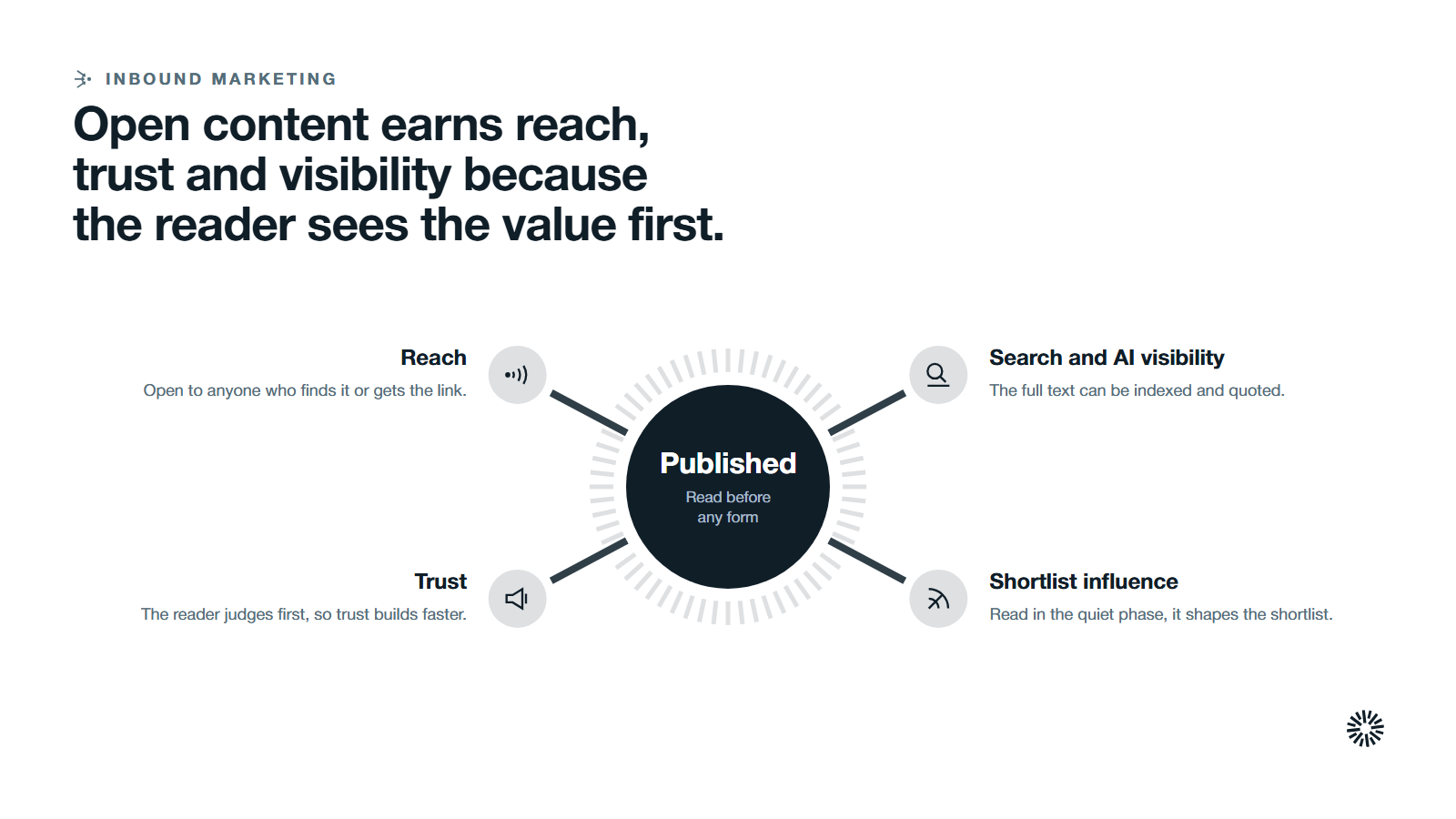
Ungated content is simply published, so it is the content that can drive organic traffic. Blog posts, a comparison page, a calculator that works without a login and a checklist with no form are all examples. The reader sees the value first and decides what to do next.
This is the content that search engines and AI answer engines can read. A crawler cannot complete a form. If your best explanation of a topic is hidden behind a form, the page that can be found is usually a thin landing page, and the substance is invisible to any system that cannot fill it in.
Ungated content also does the early work in the marketing funnel and in the B2B buyer journey. Buyers research alone, compare vendors quietly and form opinions before they contact anyone. Top of funnel content they can read in that quiet phase shapes the shortlist and helps you build brand awareness with a broader audience.
Valuable content that is ungated still pays back, because each page can feed future marketing efforts. The cost is that you do not know who read it. Ungated content produces visitors, subscribers and returning readers, but it does not produce more leads unless you add a way to ask. That is why open content needs a clear next step, such as a newsletter, a related guide or a call to action.
Open does not mean unmeasured
You can still learn a lot without a form. Track which pages bring visitors back, which pages visitors read before they request a conversation, and which topics earn organic traffic. Our guide to what content marketing is covers how a content program builds this evidence over time.
Gated content examples that earn the form
Gated content examples fall into a few families, and any plan to create gated content should start from one of them. Each one works because the reader can use it again and again, which gives it high perceived value.
- Ebooks, white papers and industry reports. In-depth insights on one subject, and original research the reader cannot get elsewhere.
- Templates and calculators. Working files, including free templates, that save time on the first use.
- Premium guides and playbooks. High value content: long, structured thought leadership that goes deeper than a blog post.
- Recorded workshops and an on demand webinar. Exclusive content that is expensive to produce.
- Benchmark tools and quizzes. Material that lets the reader compare their own numbers, and a quiz that engages them while it collects segmentation data.
A recycled blog post behind a form is the opposite. If the same text is freely accessible on your site, the gate has no value and readers will notice.
Gated and ungated content compared side by side
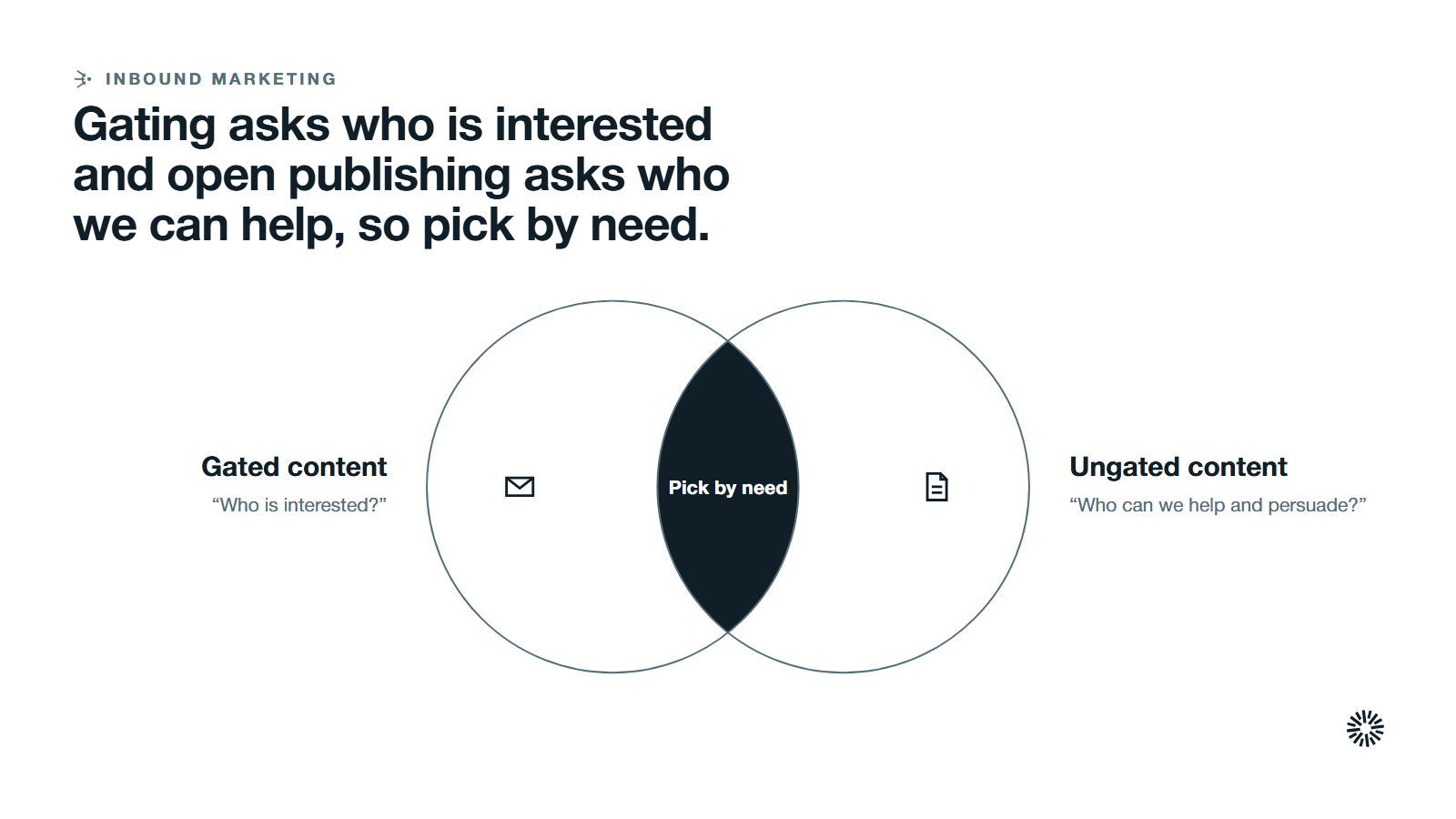
Gated content and ungated content answer different questions. Gating asks, "who is interested?" Open publishing asks, "who can we help and persuade?" This table compares them on the same criteria.
| Criterion | Gated content | Ungated content |
|---|---|---|
| Reach | Limited to readers who complete the form | Open to anyone who finds it or is sent the link |
| Lead capture | Named contact on every download | None unless you add a prompt |
| Intent signal | Strong signal on a specific topic, with some casual downloaders mixed in | Softer signal, read from behavior |
| Trust building | Slower, because the reader pays before judging | Faster, because the reader judges first |
| Search and AI visibility | Low for the gated asset itself, since crawlers cannot read it | High, since the full text can be indexed and quoted |
| Sales use | Gives sales a contact and a topic to open a conversation | Gives sales a link to share with a prospect |
| Best use | Deep, reusable, specific assets for readers close to a decision | Education, comparison, proof and anything meant to be found |
Read the table as our judgment, not a law. A gated report downloaded by a casual reader is a weak lead, and a read of a pricing or comparison page can be a strong sign of intent. The form does not create interest. It only records it.
Search engines can index gated content only if you tell them how
If you want gated content to appear in search, you cannot hide it and hope. Google's documentation on subscription and paywalled content markup explains how to use structured data to mark paywalled sections. It says the markup helps Google tell paywalled content apart from cloaking, which violates its spam policies.
The practical lesson is that gated content and a search presence can coexist, but you have to design for it. Publish gated content landing pages that describe the asset in enough detail to rank and to answer a question. Keep the substantive explanation open, and gate the file or the extra depth.
The same logic applies to AI search. A model can only quote what it can read. Put a clear summary, the key definitions and a few of the strongest findings on an open page, and the gated version becomes the longer reference for readers who want it.
How to decide: five rules by buyer's journey stage
Choose by the reader's stage in the buyer's journey and the asset's job, not by habit. Gated content aligns with a stage when the offer matches what the reader needs next. These rules are our reading and are meant to be argued with.
If the content teaches or builds trust, leave it ungated
In the awareness stage, buyers want answers, not forms. Explainers, comparisons, definitions and opinion belong in the open. They are how buyers find you and judge you early. Gating that content removes the one thing that can win a quiet shortlist.
If the asset took real work and the reader can reuse it, gate it
In the consideration stage, original research, a benchmark report, a template pack or a recorded workshop can justify a form. The test is simple: would a busy buyer feel the exchange was fair? If the answer is "not really," open it.
If the reader is close to a decision, ask for less
Late-stage readers already know you. A short form for a demo, an audit or a consultation is a request, not a toll. Late-stage assets such as case summaries and implementation guides often work best ungated, with a clear call to action beside them.
If the asset serves both stages, split it
Publish the key findings or the main argument as an open article. Gate the full report, the template or the data, and keep the gated content distinct from the open summary. This keeps search visibility and still gives interested readers a reason to share their details.
If you cannot follow up well, do not gate
A gated content campaign creates an obligation. If nobody will route, score or respond to the lead within a sensible time, the form collects names that go cold. Fix the follow-up first, then build the gate.
Gated content best practices for B2B teams
If an asset passes the tests above, build the gate with care. A clear gated content strategy and these gated content best practices keep a good asset from being wasted. Effective landing pages do most of the work.
- Lead with the value proposition. Name the benefit in the headline, in the reader's words, not the asset's title.
- Keep forms short. Ask only for what you will use in the first follow-up. A name and email address are often enough, and a job title helps routing.
- Use progressive profiling. Ask for one or two new fields on each return visit instead of everything at once.
- Show social proof near the form. A recognizable customer name or a short, approved quote builds confidence on a strong landing page.
- Create content that matches the promise. Create content for the gate first, then build the page around it.
- Promote across channels. Promote gated content in email, social and on related open pages, and test different call-to-action formats.
- Deliver at once. Send the asset on a thank-you page and by email.
- Follow up promptly, and by topic. Match follow-up to the content consumption you saw, not to a generic sales funnel. A cumbersome process frustrates readers.
A short form with a clear promise beats a long form with a vague one. You can always ask for more later, once the reader has seen the value.
Common mistakes that make a gate cost more than it earns
Most gating failures are policy failures, not form failures.
Gating everything. When every asset sits behind a form, the site becomes a wall. Readers who might have become customers leave before they learn anything. Gated content should be the exception, not the default.
Gating the wrong asset. A thin checklist behind a long form feels like a bad trade, and the reader remembers it.
Treating every download as a sales lead. A reader who downloaded one guide has shown curiosity, not purchase intent. Calling them straight away can be exactly the irrelevant outreach buyers avoid.
Hiding the answer. A landing page that only says "download now" tells search engines and AI systems nothing. Describe the content in the open.
Never reviewing the policy. Assets age, topics change and buyers' habits shift. Review what is gated at least once a quarter, and open anything that no longer earns its form. Track conversion rates by asset so the decision rests on evidence about your business goals.
What you gain when this is done properly
When each asset sits in the right place, ungated content builds the audience and gated content converts the readers who want more. Finding the right balance gives you a pipeline that is easier to trust and easier to explain.
Sales gets leads with a reason to talk
A contact who downloaded a specific, deep gated asset arrives with a topic. Sales can open the conversation with that topic, not with a script.
Marketing gets reach and capture from the same program
Marketing can publish ungated content freely to earn search and AI visibility, and still use gated content to collect the contacts who want depth. The gated content strategy becomes a policy it can test and improve, not a habit.
Customer success gets a better-educated customer
Open guides on setup and use help customers answer routine questions themselves. That frees customer success to spend time on accounts, not repeat questions.
Gate less, and make what you gate worth it
The real decision is not gated or ungated. It is which asset earns a form, and which earns trust by staying open. Start with the buyer's quiet research phase, keep it open, and ask for details only when you can offer something worth the exchange.
Propello designs and builds connected go-to-market systems on HubSpot for CEOs and revenue leaders at growing B2B companies. Propello is a HubSpot partner.
If you want a second opinion on which assets to gate and how the follow-up should work, an audit is the place to start. For the wider picture of how this fits an inbound program, see our guide to what inbound marketing is.