If you lead marketing or sales at a B2B company, you have probably watched a lead fill in a form, get a call, say "not right now" and disappear. Lead nurturing is the work that happens between that form and a real sales conversation: giving leads who are not ready to buy relevant, timely help until they are.
This article is for marketing leaders, sales leaders and founders. It explains what lead nurturing is, why leads are not ready at capture, the main tactics, how stage-based and behavior-based nurturing differ, and how nurturing connects to lead scoring and the buying group.
|
Lead Nurturing Lead nurturing is the process of building a relationship with leads who are not yet ready to buy, using relevant content and timely follow-up across channels until they are ready to talk to sales. |
Why leads are not ready when you capture them
Lead generation gets a person's details. It does not get their decision. Most people who download a guide or attend a webinar are researching, not buying, and they will take months to decide. For the full picture, read our complete guide to inbound lead generation.
Buying is also slower than it looks from the inside. Forrester's 2024 State of Business Buying found that 86% of B2B purchases stall during the buying process, and that on average 13 people in an organization are involved in the decision.
That second number matters for nurturing. The person who filled in your form is rarely the only person who decides. They need material they can share with colleagues who have never heard of you.
Without a nurturing process, these leads go quiet. Sales follows up once or twice, marks them as lost, and the marketing team starts hunting for new leads to replace them. The leads who were just early are the ones you paid to attract and then abandoned.
This is why successful lead nurturing matters. Effective lead nurturing fixes that by keeping you present and useful while the buyer does the slow part of the work. When the buyer is ready, you are already the supplier they know.
How lead nurturing works
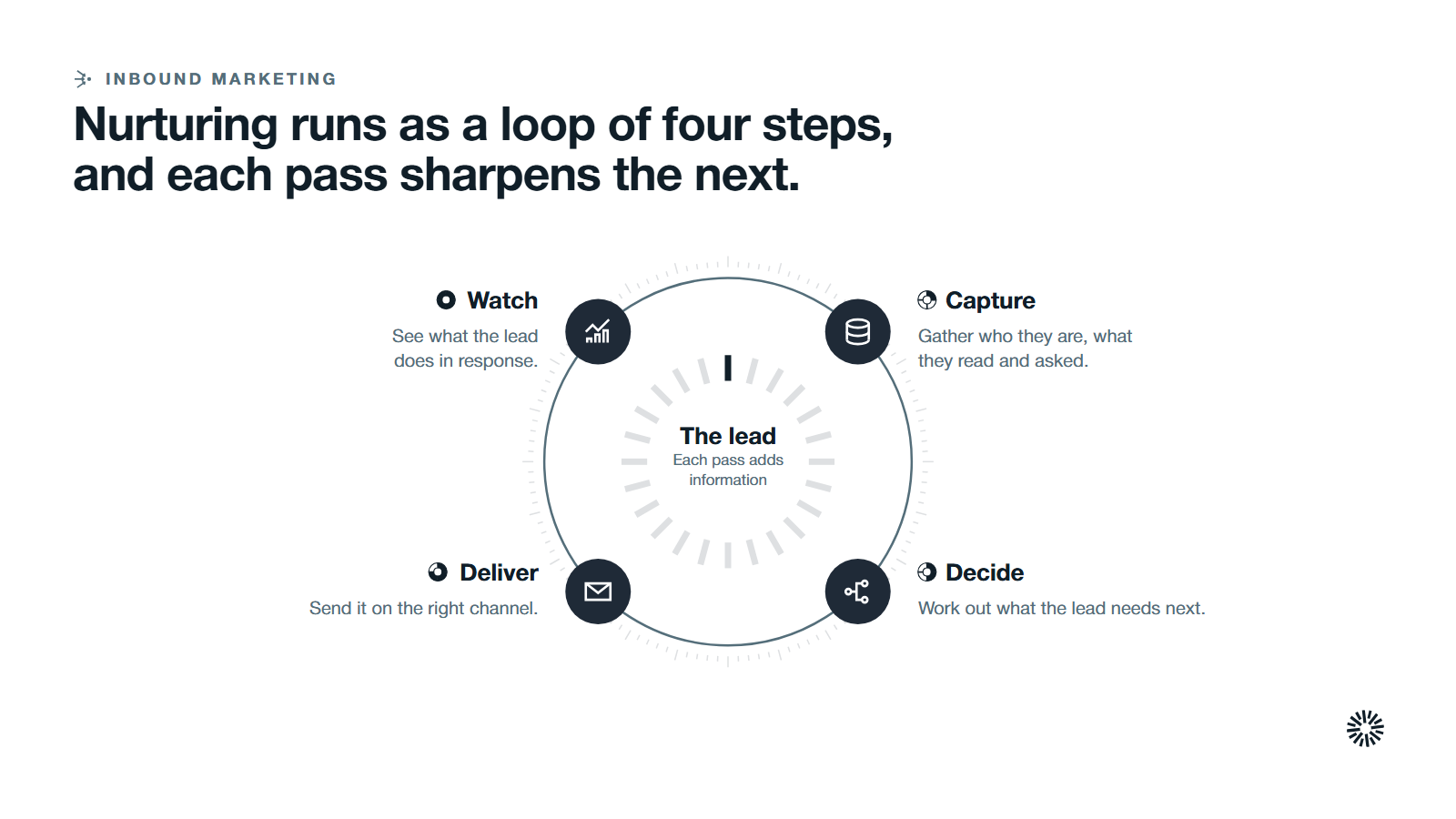
Lead nurturing works by moving a lead through a loop of four steps: capture what you know, decide what the lead needs next, deliver it on the right channel, and watch what the lead does in response. Each pass adds information, and the information shapes the next pass.
The lead nurturing process rests on three ingredients.
- Data. Who the person is, which company they work for, what they have read and what they have asked for. This is customer data held in one place, not scattered across tools.
- Content. Relevant content that answers the questions a lead has at their stage, in the format they prefer.
- Rules. The logic that decides who gets what and when, usually built in marketing automation, plus clear rules for when a person from the sales team steps in.
When any one of these is missing, the program turns into a stream of generic emails. The lead sees the same message as everyone else, and engaged leads learn to ignore you.
Why relevance beats volume
Buyers are less tolerant of noise than most teams assume. A Gartner survey of 632 B2B buyers, published in June 2025, found that 73% actively avoid suppliers who send irrelevant outreach.
The same survey found that 69% of buyers report inconsistencies between what a sales organization's website says and what its sellers say. Nurturing content and sales conversations need to tell the same story.
The main lead nurturing tactics
Effective lead nurturing uses several channels, because leads do not live in one inbox. The right mix depends on your audience, but the tactics below cover most B2B programs.
Lead nurturing emails
Email is the workhorse. A lead nurturing campaign sends a short sequence of messages triggered by an action, such as downloading a guide, and each message answers the question the previous one raised.
Good lead nurturing emails are short, specific to one problem and clear about the one next step. A sequence of three to five messages tied to a single topic is a sensible starting length, and it fits a campaign better than a monthly newsletter sent to everyone.
Content marketing
Content marketing supplies the material that makes the other tactics worth using. Guides, comparison pages, explainers and short case summaries let leads educate themselves and let the buying group share what they learn.
Match content to the buyer's journey. A lead in the awareness stage needs help naming the problem. A lead in the consideration stage needs help comparing approaches. A lead near a decision needs proof that you can deliver.
Webinars, chat and messaging
Webinars give leads an interactive way to learn, and the questions they ask show what they care about. Chatbots and live chat on your website answer simple questions in real time. SMS and messaging apps suit quick updates, such as a reminder for an event, where the lead has agreed to receive them.
Educational content like articles, webinars and case studies helps buyers make informed decisions. Testimonials add evidence from peers, which is useful when the buying group needs to convince colleagues.
Retargeting and social media
Retargeting shows relevant messages to people who have already visited your site, across other sites and social media. Social media posts from your company and your people keep you visible between emails without adding to the inbox.
Both work best when they use the same segments as your email program, so a lead who has read a pricing page does not keep seeing introductory messages.
Sales follow-up
Sales follow-up is nurturing too. A call, a personal email or a short message from a sales rep, sent at the moment a lead shows real interest, carries more weight than any automated message.
Timely follow-ups depend on a clear handoff. Some teams use a five-minute response target for people who ask to talk. That is a service standard to set for yourself, not a proven result.
Re-engagement for leads who went quiet
Leads who stopped responding are not lost. A short re-engagement sequence that offers something new, such as a fresh guide or a change in your product, gives them a reason to return. Leads who still do not respond can move to a low-frequency list rather than being deleted.
Segmentation and dynamic content
Segmentation is what makes relevance possible at scale. You group leads by demographics such as job title, company size and location, by interests, and by behavior such as past interactions and purchases. Then you tailor emails and campaigns to each segment.
Dynamic content goes a step further. It adapts a page or email to the individual's data, so two leads in the same program do not see the same message. Automated workflows then respond to lead actions with timely, relevant messages, and they track engagement such as open and click-through rates.
The best nurturing programs combine personalization with useful content. They listen to what prospects need and educate them without sales pressure.
Stage-based and behavior-based nurturing
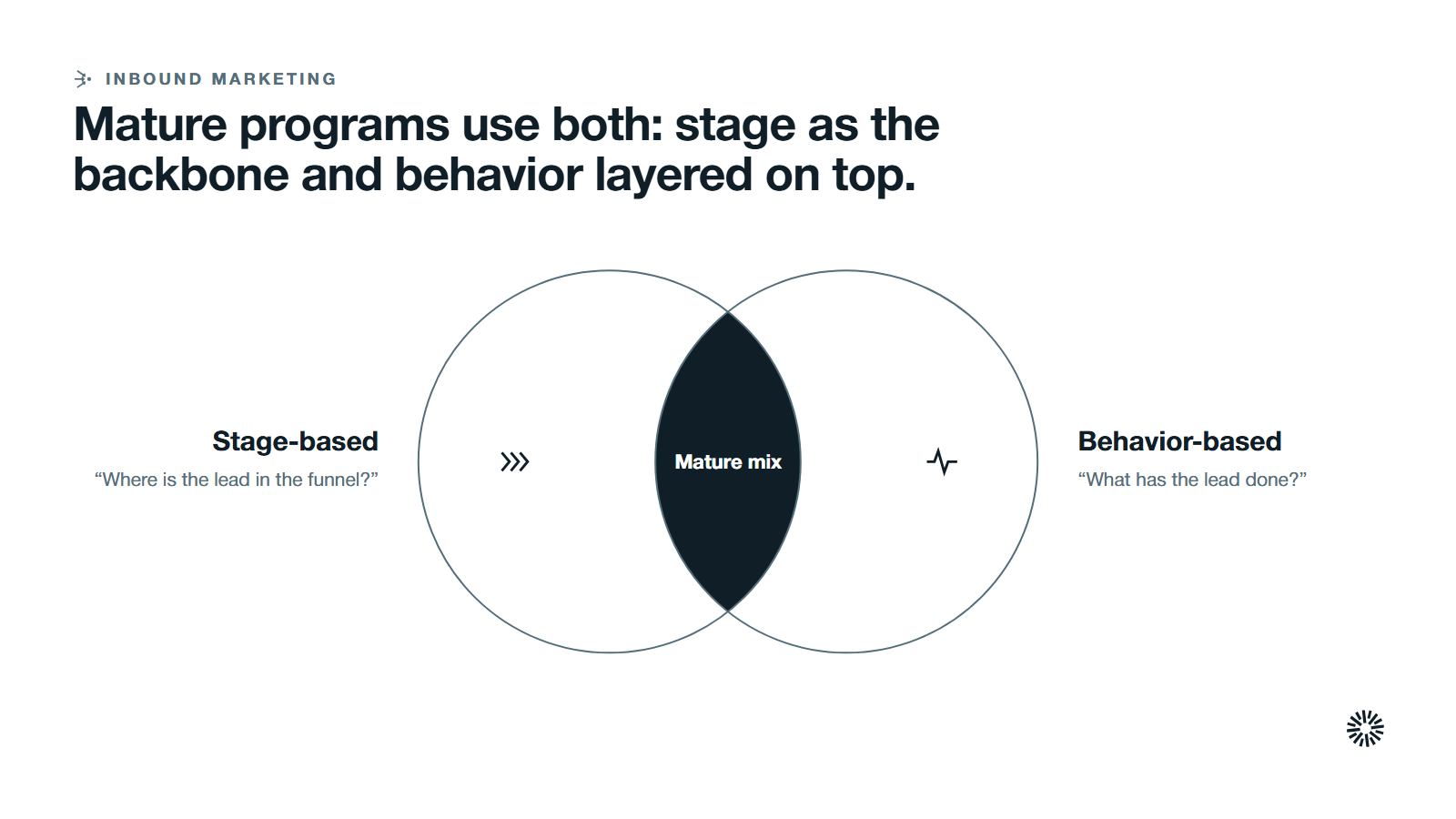
There are two ways to decide what a lead receives. Most mature programs use both.
Stage-based nurturing sends content based on where the lead sits in the sales funnel or sales cycle. A new lead gets educational material. A lead who has had a sales conversation gets proof and detail. The stage comes from a field in your CRM, such as lifecycle stage.
Behavior-based nurturing sends content based on what the lead has done: pages viewed, emails opened, events attended, questions asked. It responds to the lead's own actions, not to a label you applied.
| Stage-based | Behavior-based | |
|---|---|---|
| Trigger | Lifecycle stage or funnel position | An action by the lead |
| Strength | Simple to set up and explain | Timely and specific |
| Weakness | Treats every lead in a stage alike | Needs good tracking and clean data |
| Best use | The backbone of the program | Layered on top to react to interest |
Start with stage. Add behavior once your data is clean enough to trust. A behavior trigger built on bad tracking sends the wrong message at the wrong moment, which is worse than a plain stage email.
How lead nurturing connects to lead scoring
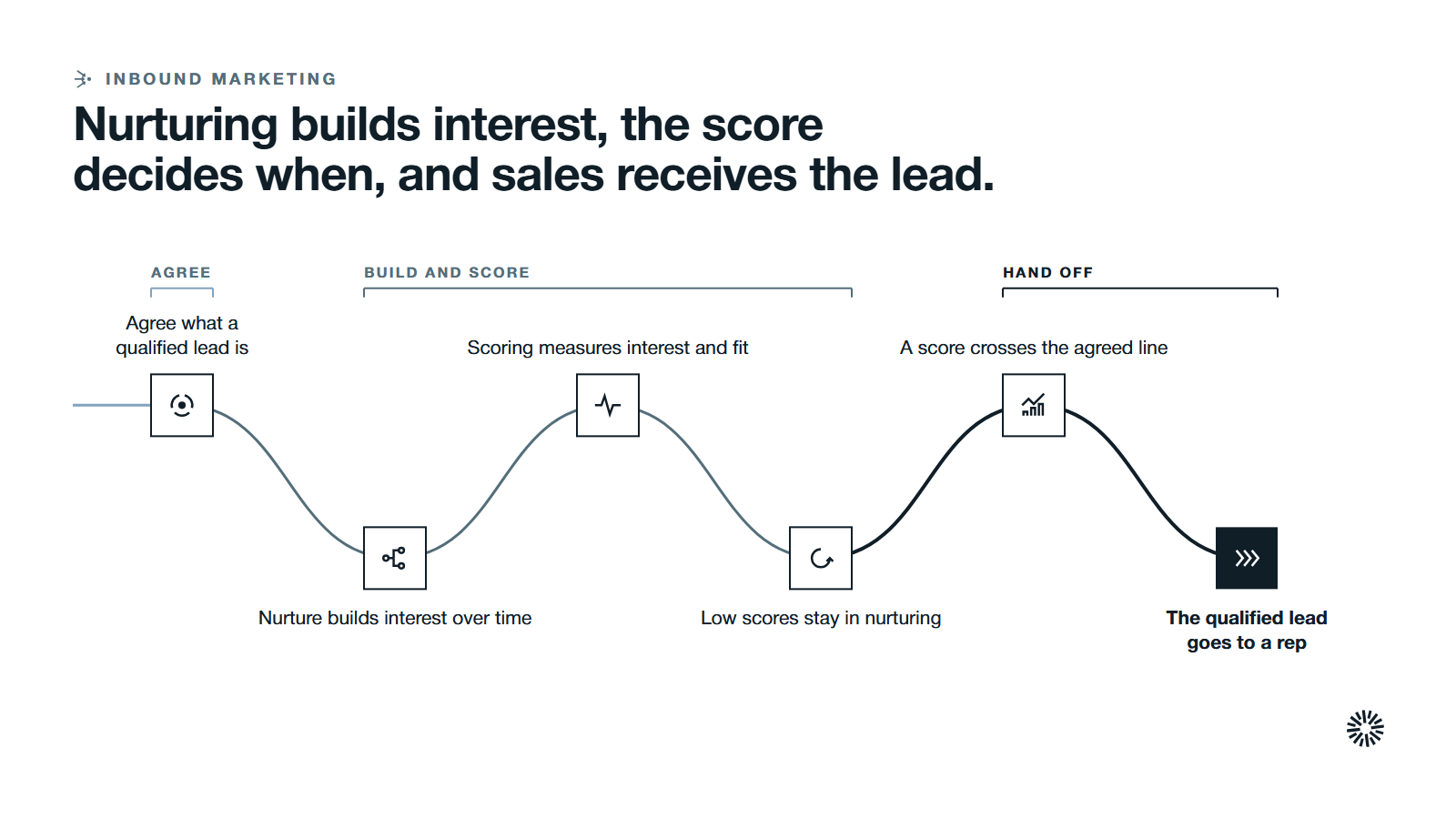
Nurturing and lead scoring solve opposite halves of the same problem. Nurturing builds interest over time. Lead scoring measures how much interest and fit a lead has shown, as a numerical value, so you know when to hand them over.
In a working system, the score drives the handoff. A lead with a low score stays in nurturing. A lead whose score crosses an agreed line becomes a qualified lead and goes to a sales rep. Automated lead scoring keeps this running without anyone checking a list by hand.
Lead scoring assigns numerical values to behavior, helps sales teams prioritize, and should be adjusted over time as you learn which behavior really predicts a sale.
The rules need to be agreed by both sides. If marketing passes leads sales does not want, sales stops trusting the score. If sales ignores leads marketing passes, the nurturing effort is wasted. This is why lead nurturing sits at the heart of sales and marketing alignment: the definition of a qualified lead is a shared contract.
Nurturing the whole buying group
The person you nurture is rarely the person who signs. Because 13 people on average are involved in a B2B decision, a program aimed only at the form-filler leaves most of the decision unaddressed.
Gartner's research on buying groups shows why this is hard. In a May 2025 survey of 632 B2B buyers, Gartner found that buying groups that reach consensus are 2.5 times more likely to report a high-quality deal.
It also found that content tailored to the buying group improved consensus by 20%, while content that spoke to individual-level concerns had a 59% negative impact on consensus.
For a nurturing program, that suggests writing for the group, not only the individual. Content that helps several roles agree on the problem and the next step is more useful than a message that flatters one reader.
In practice, this means tracking more than one contact per account, sending material a champion can forward, and making sure sales knows who else at the company has engaged.
Personalization has limits as well. The Content Marketing Institute's 2025 survey of 1,015 B2B marketers found that 89% say their organizations personalize, yet 59% describe their personalization as basic. Many teams already personalize a first name. Few personalize the content to the account's problem.
How lead nurturing differs from lead generation
Lead generation and lead nurturing are often lumped together, but they do different jobs.
- Lead generation finds and captures new people. Its output is a list of contacts.
- Lead nurturing develops the contacts you already have. Its output is readiness to buy.
- Lead management is the umbrella: capture, scoring, routing, nurturing and handoff.
Treat the two as separate budgets and separate metrics. Generating leads without nurturing them is how companies end up with large databases and small pipelines. Inbound marketing draws people in, and nurturing is what turns that attention into pipeline.
What a successful lead nurturing strategy needs
A lead nurturing strategy is the plan behind the campaigns. Successful lead nurturing starts with five decisions, made together by the sales and marketing teams.
- Who you nurture. Define your target audience and build buyer personas for each role in the buying group, with their pain points described in their own words.
- Where they are. Map the customer journey and the sales process, so each stage has a goal and an owner. Include the sales cycle length you see today, so you know how long a lead may need.
- What you say. Aim for timely and relevant communication that supports building relationships, not a push for a sale. Consistent communication matters more than clever copy.
- Where you say it. Use multiple channels, from email and social media marketing to retargeting and the phone. Choose the marketing channels and communication channels your buyers actually answer on.
- How it runs. Marketing automation platforms and other automation tools carry the repetitive sends. Sales reps handle the personal moments.
Teams that nurture leads effectively also agree on a few rules before launch. Marketing and sales teams decide which leads count as the most qualified leads. They decide how many leads one rep can follow up in a week, and what lead behavior triggers a call.
Treat this as a lead nurturing structure, not a one-off campaign. Targeted lead nurturing campaigns sit inside it, and every campaign has a goal, an audience and an end point. Sales and marketing strategies that share this structure align sales and marketing around the same buying journey.
The purpose is simple: turn potential customers into paying customers by being useful before they are ready. That is why lead nurturing is important even when the sales team is already busy. An effective lead nurturing program protects the marketing efforts you already paid for.
What to measure
You do not need a long dashboard. Four measures show whether lead nurturing success is real, and each one gives you valuable insights for the next round of lead nurturing efforts.
- Engagement. Are nurtured leads opening, clicking and returning to your site, or fading?
- Progression. What share of leads move from one lifecycle stage to the next, and how long does it take? Watch the sales cycle length for nurtured and non nurtured leads.
- Handoff quality. Do sales reps accept the leads you pass, and what happens to them?
- Pipeline from nurtured leads. How much qualified pipeline began with a lead who spent time in a nurturing program, compared with non nurtured leads?
Compare groups inside your own data. Your own history is a better benchmark than someone else's average.
What you gain when this is done properly
A well run lead nurturing program changes how marketing and sales work together. Each team gets something it does not have today.
Sales gains better conversations
Sales reps talk to people who already understand the problem and know your approach. The first call starts further along, and reps spend less time on leads who were never going to buy.
Marketing gains proof that its work reaches revenue
Marketing teams can show how leads move from first touch to qualified pipeline, not just how many were captured. That makes it easier to decide which marketing strategies deserve more budget.
Customer success gains a head start
Customers who were nurtured arrive knowing what they bought and why. The record of what each person read and asked gives customer success a place to start when it looks for upsell or cross-sell opportunities. The handoff to customer success carries history, so onboarding does not start with questions the buyer has already answered.
Build nurturing as part of one go-to-market system
Lead nurturing fails when it is bolted on: one tool for email, another for scoring, a CRM nobody updates. It works when data, content and rules sit in one connected system that sales and marketing both trust.
Propello designs and builds connected go-to-market systems on HubSpot. If you cannot yet say how many of your leads are being nurtured, or when a lead becomes sales ready, an audit is the place to start.