If you run account-based marketing for a B2B company, account tiering is how you decide which target accounts get a custom plan, which get a shared plan and which get an automated one. You tier by scoring each account on fit and signals, then giving each tier its own play, owner and review date.
This guide is for marketing and sales leaders who already have a list of target accounts and need to decide where their limited time goes. You get six numbered steps, each with a finish line, a plain tier table and the mistakes that make tiers fall apart within a quarter.
|
Account Tiering The practice of grouping target accounts into tiers by fit and potential value, so each tier gets a different level of effort, a different play and a named owner. |
By the end you will have a tiering model your teams will use
A tiering model is only useful if sales and marketing both follow it. At the end of this guide you will have:
- A scoring sheet that ranks every target account on fit and on signals of interest.
- Three written tier definitions, with the cutoff for each.
- A play and an owner for each tier.
- A review rhythm and clear rules for moving accounts between tiers.
What to have in place before you start
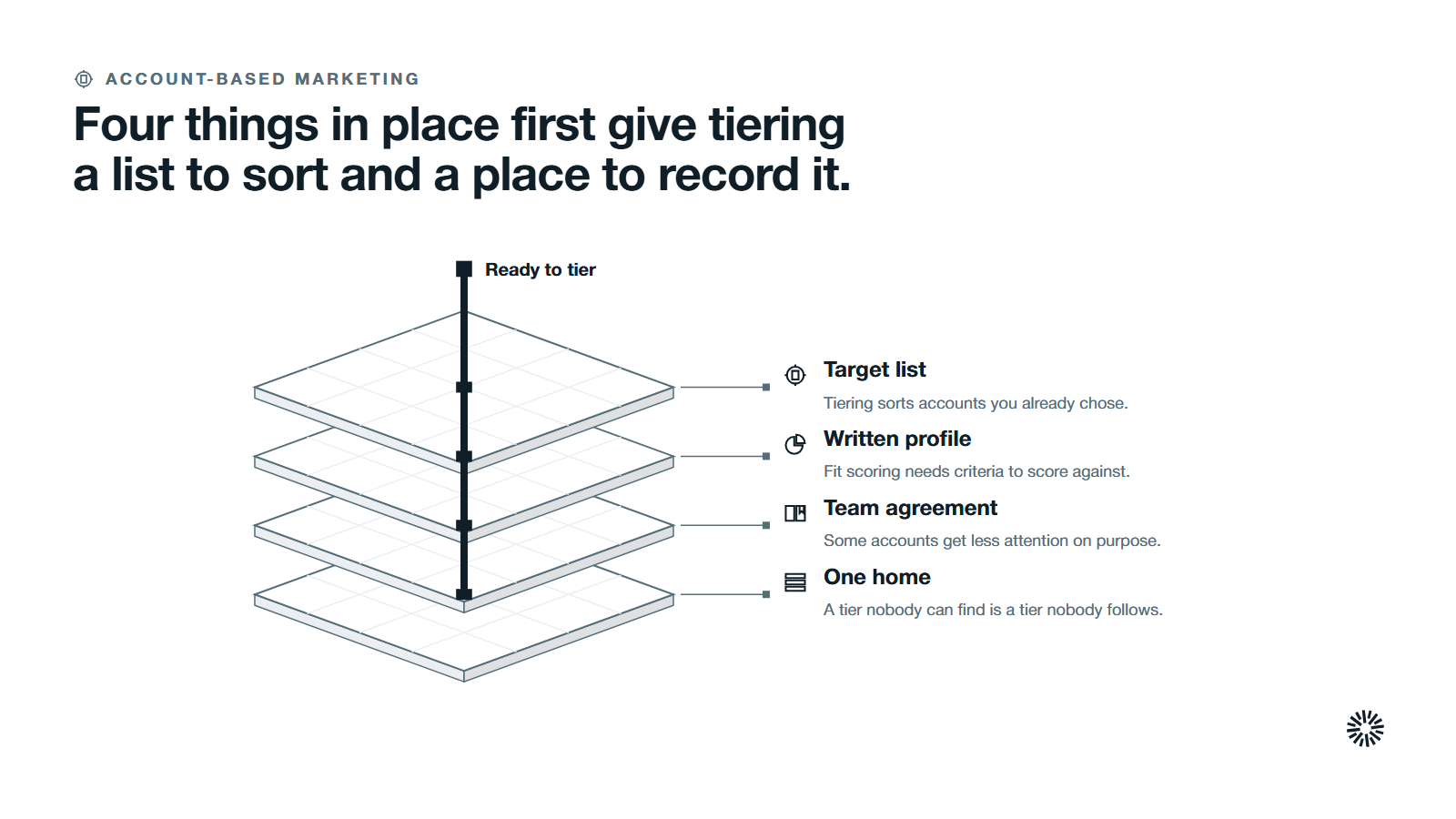
Effective account tiering is the backbone of an account based marketing strategy. It turns a flat list into focused resource allocation, so sales teams and marketing teams can prioritize accounts, allocate resources and segment accounts into different account tiers. High value accounts then get the most attention, and potential accounts get a lighter touch. For the full picture, read our complete guide to account based marketing strategy.
Before implementing account tiering, check these four things. Tiering sorts accounts you already chose. It does not choose them.
- A target account list. If you do not have one, build it first with the ultimate guide to ABM and come back.
- A written ideal customer profile. Fit scoring needs criteria to score against. The ideal customer profile template gives you the format.
- Agreement between sales and marketing. Both teams need to accept that not all accounts are created equal, and that some will get less attention on purpose.
- One place to store the tier. A tier that lives in a spreadsheet nobody opens is a tier nobody follows.
How tiering differs from lead scoring
Account tiering and lead scoring are close relatives, so they are often confused. Lead scoring rates individual people by their behavior. Tiering rates whole accounts by fit and potential value, then sets the level of effort. If you need the person-level method, read how lead scoring works. This guide covers accounts only.
Account tiering in six steps
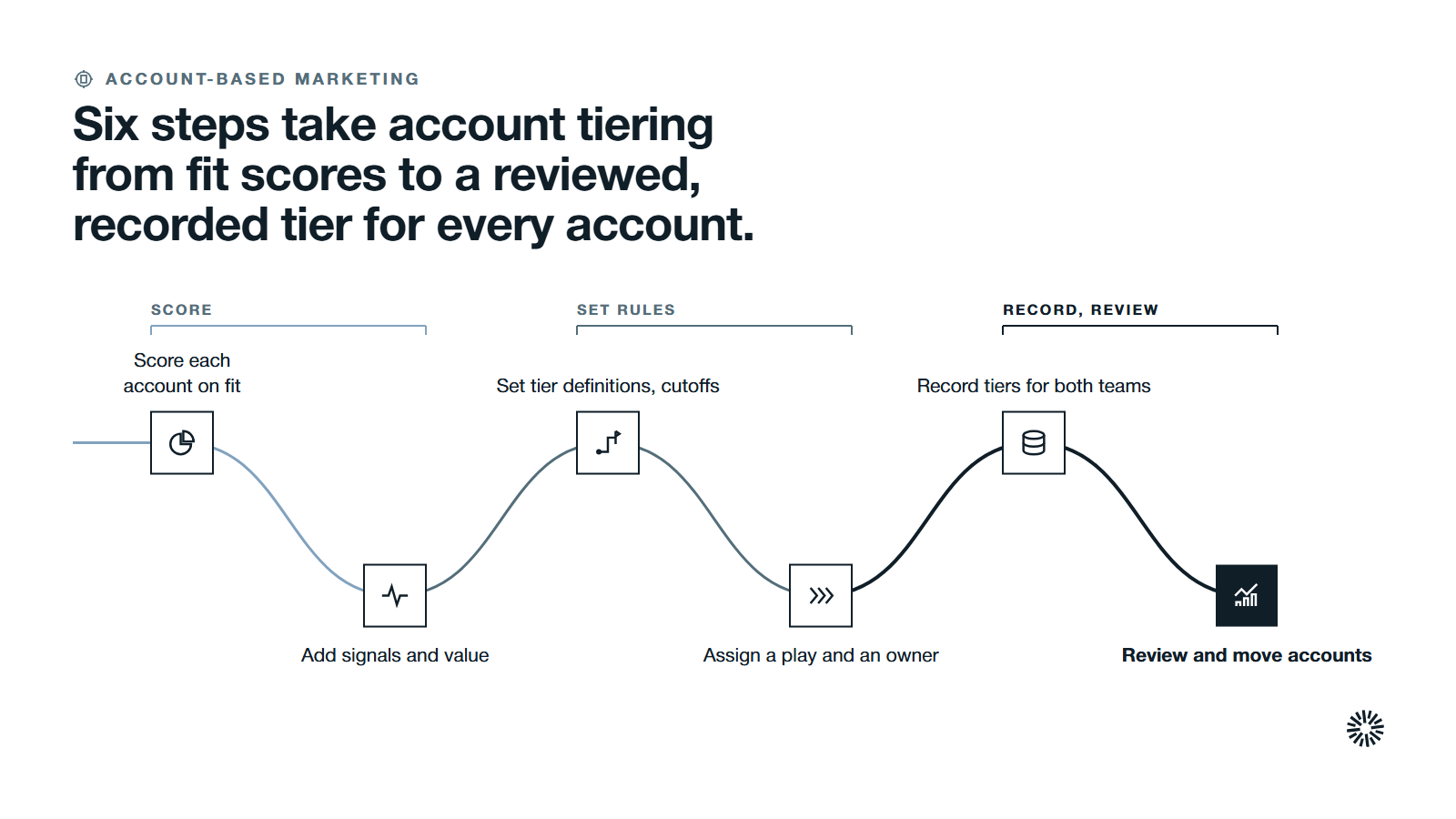
Work through the steps in order. Each ends with what done looks like, so you can tell when to move on.
1. Score each account on fit
Fit is how closely an account matches the customers you serve best. Use four to six key criteria drawn from your ideal customer profile, such as industry, company size, annual revenue, technology in use and the presence of the problem you solve.
This account scoring step is how you categorize accounts. Write the tiering criteria as specific criteria, not impressions, and give each criterion a weight. Then score every account from low to high. Keep the scoring system simple enough that a new sales rep could apply it in a few minutes. If the model needs a manual to explain, nobody will maintain it.
Score fit separately from interest. An account can be a perfect match and still not be ready to buy, and that difference matters in the next step.
You are done when every target account has a fit score and the criteria are written on one page.
2. Add signals of interest and potential value
Fit tells you who could buy. Signals tell you who may be buying now. Add a second score from engagement data and intent data: website visits, content downloads, replies to outreach and research activity from the account.
Add a view of potential value too: the revenue potential if you win the account, and the strategic value of the logo, such as a reference in a new market. For how to read and use these signals, see what intent data is and how to turn intent signals into sales action.
Look at account behavior and account health together, and fold in new data as it arrives. Accounts that could bring significant revenue deserve the closest watch. Keep signals as a separate column. When they are folded into the fit score, tiers swing from week to week and sellers stop trusting them.
You are done when each account carries a fit score, a signal score and a note on potential value.
3. Set tier definitions and cutoffs
Now turn the scores into tiers. Three tiers is the usual start: it is enough to separate effort levels and few enough that people remember them. Write each definition as a rule, for example high fit and high potential value for tier 1.
The tier table below shows how the three tiers usually line up with the three ABM models.
| Tier | ABM model | Who belongs here | Level of effort |
|---|---|---|---|
| Tier 1 | One-to-one | Your most valuable accounts, with high fit and large potential value | Custom proposals, one-on-one meetings, a dedicated team |
| Tier 2 | One-to-few | Strong-fit accounts that share a pain point with a small group | Shared plays for a cluster, partly tailored content |
| Tier 3 | One-to-many | Good-fit accounts with lower potential value | Automated campaigns, light personalization |
A clear tiering system also gives sales teams and marketing a shared way to focus efforts and strengthen marketing alignment. Set a cap on tier 1. A small number of accounts keeps the level of effort real. If every account is tier 1, none of them is.
You are done when each tier has a written rule, a cutoff and a cap on the number of accounts.
4. Assign a play and an owner to each tier
A tier only changes behavior when it comes with a play. Tailored strategies and engagement strategies for each tier are what make the difference in practice. For each tier, write what happens, who does it and how often.
- Tier 1: a researched plan for each account, targeted content for each buying role, direct outreach from a senior seller and a named marketing partner. See ABM examples for what these plans can look like.
- Tier 2: a shared play per cluster, such as a campaign for one industry, with sellers adding a personal note to the top accounts in each cluster.
- Tier 3: automated email campaigns and ads, with content matched to the account's segment and a trigger that raises the account when interest grows.
Forrester's 2024 research found that 13 people within an organization are involved in the average buying decision, and 89% of purchases involve two or more departments. That is why tier 1 plays name several roles in each account, not one contact.
Name one owner per tier or per account. Sales and marketing teams share the work, but one person answers for the result.
You are done when each tier has a written play, an owner and a weekly or monthly rhythm.
5. Record tiers where both teams work
Put the tier on the account record so sales reps, marketers and managers see the same answer. In HubSpot, a custom company property with a dropdown field type holds the tier, and a second one can hold the score. Reports and lists can then filter on it. CRM tools can automate data collection and scoring, so you leverage technology without adding another tool, and it keeps engagement scalable for lower tier accounts.
Show the tier in the places people already look: account views, reports and the fields sellers see before a call. Personalization at scale also depends on this, because content and sequences can then be matched to the tier. The B2B personalization guide covers that side.
You are done when every target account shows its tier and both teams can build a list by tier in minutes.
6. Review on a fixed schedule and move accounts up or down
Tiers are a working view of the account list, not a permanent label. Set the review rhythm now: a quick monthly look at signal changes and a fuller quarterly look at fit and potential value.
This is dynamic tiering: accounts progress as engagement signals change, and you reassess accounts quarterly against changing data. Some teams also use AI to read buying signals in real time, and the same movement rules apply.
Write the rules for movement. An account moves up when its signals rise, such as a surge in engagement or a new buying group joining. It moves down when it goes quiet for a defined period or a disqualifying fact appears. Keep a note of why each account moved.
Use a few key metrics, your key performance indicators for the model, to judge it: meetings and pipeline by tier, how often tier 1 accounts engage, and how long sales cycles run in each tier. If tier 1 does not outperform tier 3, the criteria need work.
You are done when the review dates are in calendars, the movement rules are written and the first review has been held.
Mistakes to avoid when tiering accounts
Most tiering models fail in the same few ways.
- Too many tiers. Four or five tiers blur the plays. Three is easier to run.
- Too many tier 1 accounts. Sellers cannot give one-on-one attention to dozens of accounts.
- Scoring on size alone. Large companies with weak fit waste the best effort.
- Mixing fit and signals. Combined scores hide why an account moved.
- No plays. A tier with no change in action is just a label.
- Set and forget. A static model drifts as markets and accounts change.
- Hiding the tier from sales. If reps cannot see it, they will use their own list.
- Ignoring the rest. Lower tier accounts still need a plan, even a light one.
What you gain when this is done properly
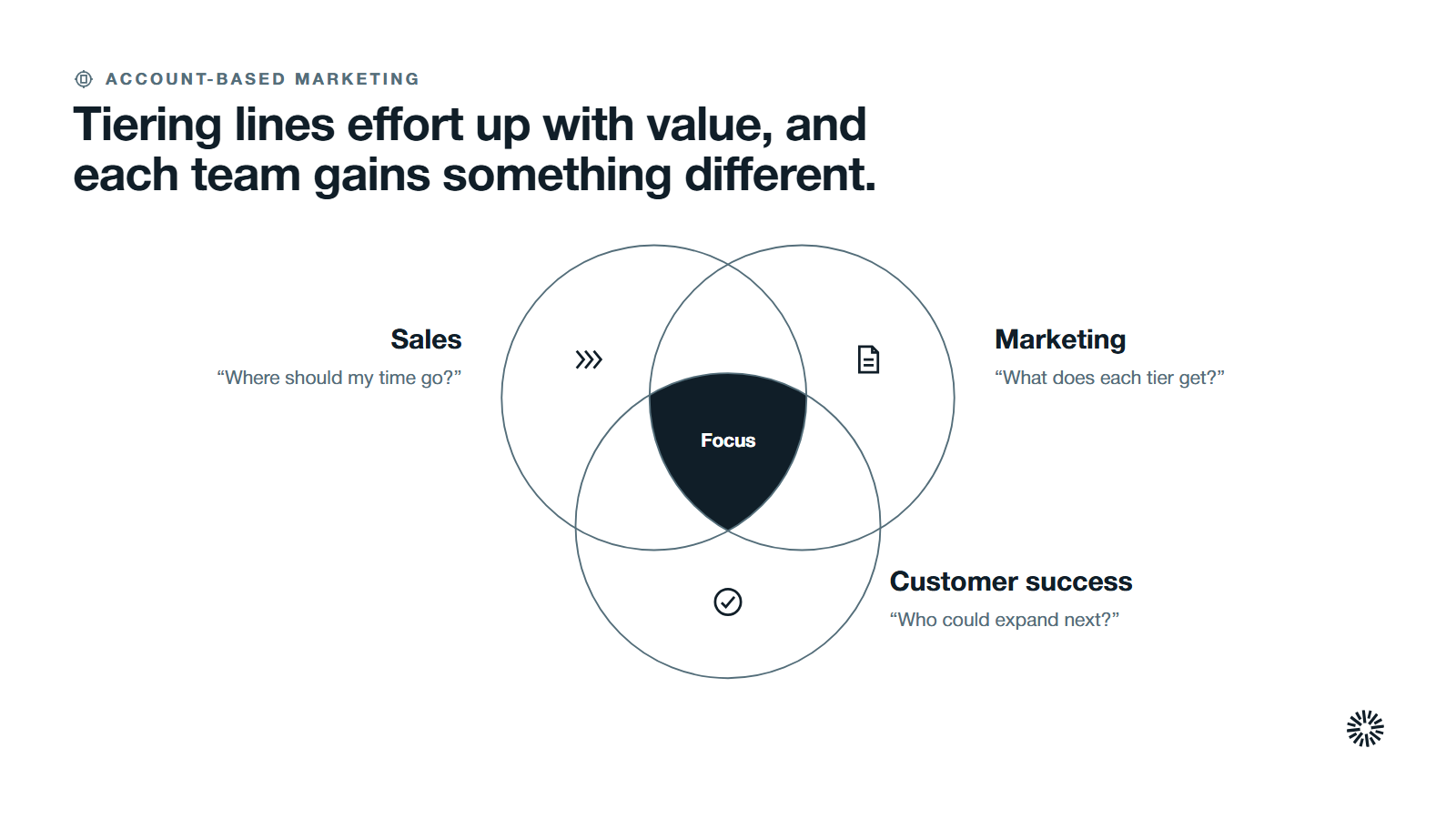
Tiering aligns effort with value. Each team feels it differently.
Sales spends time where it counts
Sales reps see a short list of strategic accounts, each with a plan, and a clear signal for when a lower tier account deserves a call.
Marketing builds focused programs
Marketing efforts match each tier: custom work for a few accounts, shared programs for clusters and automated tracks for the rest. Budget follows the tier definitions.
Customer success sees future opportunities early
Customer success can use the same tiers to spot accounts for expansion and protect the most valuable accounts after the sale.
Tier your accounts on evidence, then keep them current
Account tiering turns a long list of target accounts into a plan: score fit, add signals, set the tiers, assign plays, record them and review them. The model does not need to be clever. It needs to be written down and followed.
Propello designs and builds connected go-to-market systems on HubSpot. If you want your tiers, scoring and reporting built into one connected system, a GTM Audit is the place to start. Propello is a HubSpot partner.
For the wider method, read what account-based marketing is and how it connects to B2B demand generation and the B2B buyer journey.