If you run account-based marketing for a B2B company, ABM personalization is the work of shaping your message, content and outreach around the specific accounts you chose to win. Done well, it shows each account you understand its business, its buying group and its problem, without writing everything from scratch.
This guide is for marketing leaders, ABM managers and the sales leads who work target accounts with them. You get six numbered steps, each ending in what done looks like, plus the checks to make first and the mistakes that make personalized content feel creepy or thin. Together they form a content personalization strategy that marketing and sales teams can run on target accounts without losing accuracy. For the full picture, read our complete guide to account based marketing strategy.
|
ABM Personalization Tailoring messages, content, web experiences and outreach to a named target account and the people who buy there, at a depth that matches the value of that account. |
By the end you will have a personalization plan your team can run
A good plan is short enough to read in one sitting and specific enough for a new hire to use on Monday.
- A decision on how deep to personalize for each tier of target accounts.
- A one-page research brief for each account, naming the buying group and the pain points that matter.
- A set of personalized content, landing pages and outreach built from reusable parts.
- Rules for accuracy and data usage, so nothing wrong or invasive reaches a buyer.
- A review routine that tells you which personalization efforts earn their cost.
What to have in place before you start
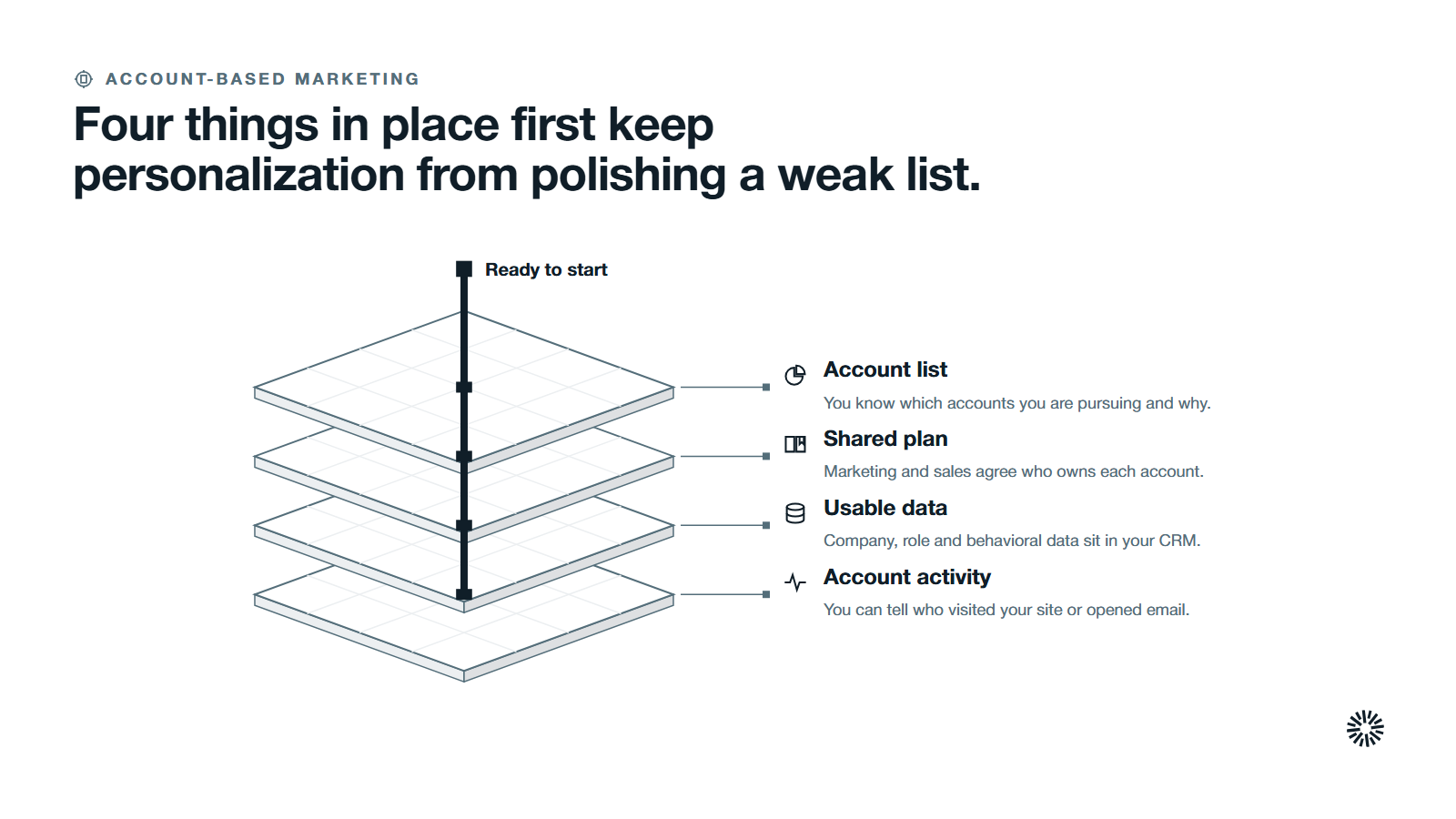
Personalization sits on top of account selection. If the base is shaky, personalized content only makes a weak list look polished. Close any gap here first.
- A target account list. You know which accounts you are pursuing and why. If not, start with the ideal customer profile template and the guide to defining ICP, messaging, channels and sales motion.
- A shared account plan with sales. Marketing and sales teams agree who owns each account and who contacts whom. If you need the basics first, read what account-based marketing is.
- Usable customer data. Company, role and behavioral data sit in your CRM, not in scattered spreadsheets.
- A way to see account activity. You can tell which accounts visited your site or opened your email, using first-party signals in your CRM and web analytics.
The same thinking applies to any audience, and our guide to B2B personalization covers the wider picture. This article stays on the account level.
ABM personalization in six steps
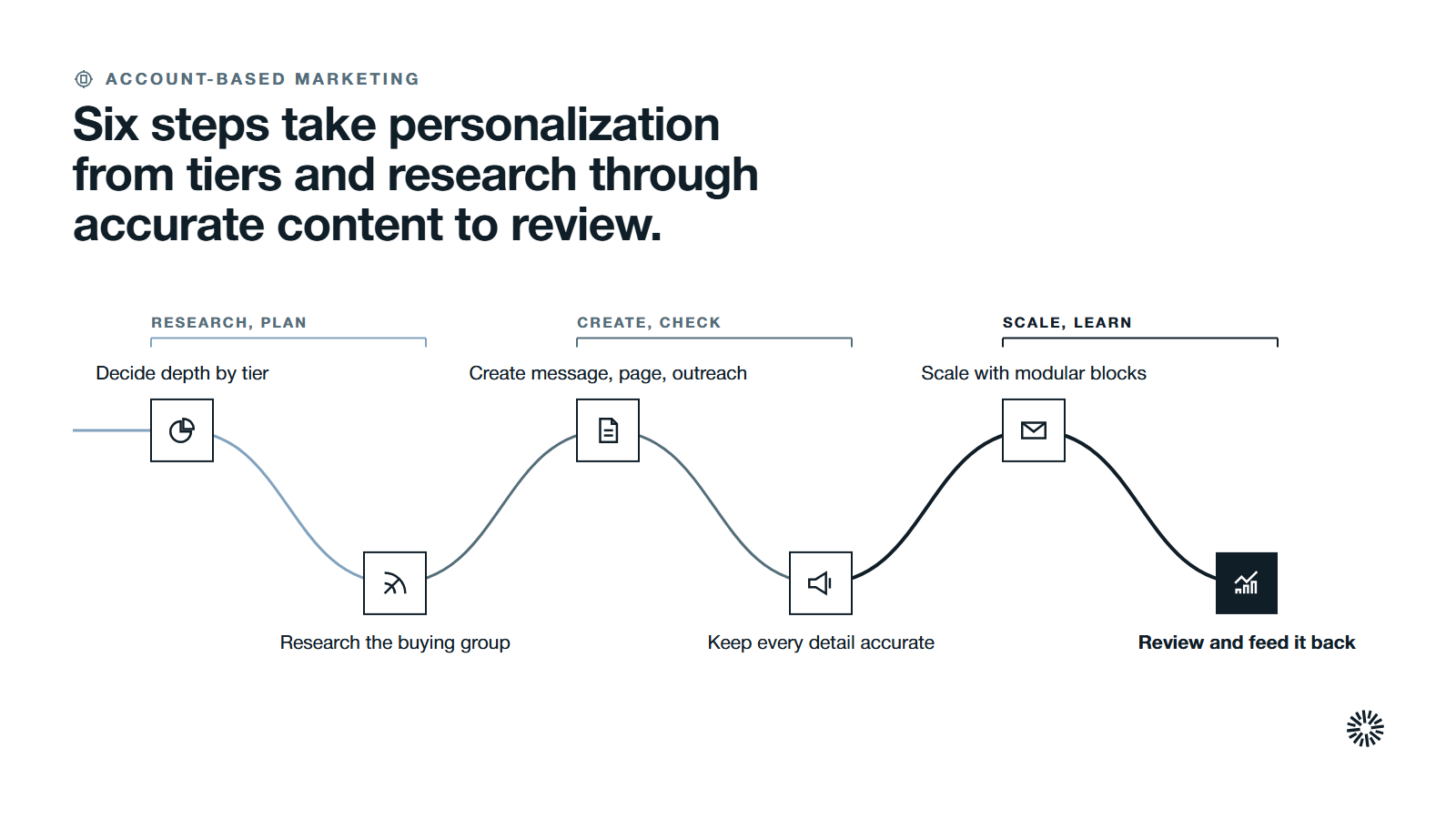
Work through the steps in order. Each one ends with a finish line, so you know when to move on.
1. Decide what to personalize for each tier of accounts
You cannot give every account the same depth, so sort them. A common model has three tiers, described in the ultimate guide to ABM.
| Tier | Accounts | What you personalize |
|---|---|---|
| One-to-one | A handful of strategic accounts | Message, content, landing page and outreach, built for that account |
| One-to-few | A cluster of similar accounts | Content and pages built for a shared industry or problem, with the account name and context added |
| One-to-many | A larger set of fit accounts | Content personalization by segment, using tokens and dynamic content |
Match depth to the value of the account and the size of the buying group. The more an account could be worth, the more manual work you can justify.
Your personalization strategies should say this in writing. Personalized content for a strategic account looks different from tailored content for a target audience segment, and your marketing efforts stay focused when each tier has its own rules.
Then decide which layers you will personalize: the message, the content, the web experience and the outreach. Most teams start with the message and landing pages. Group accounts by shared traits so a small cluster gets customized messaging, and let data and automation adjust messages for the broad set. Resource constraints are real, so plan the depth you can sustain. Define the target audience inside each account, then create personalized content and tailored content that can deliver relevant content to that target audience with the effort you have.
You are done when every target account has a tier and each tier has a written list of what gets personalized.
2. Use customer data to research the account and map the buying group
Personalization is only as good as what you know. Gather contextual data on each account: its goals, its recent news, its tools, its structure and the pain points of the roles you want to reach.
Then map the buying group. Forrester's The State Of Business Buying, 2024 reported that 13 people within an organization are involved in the buying decision on average, with 89% of purchases involving two or more departments. A message aimed at one contact misses most of the people who decide.
For each account, list the roles in play, what each one cares about and where they spend time. Analyze customer data you already own: CRM records, past conversations, website visits and browsing history on your own site. Behavioral data such as pages viewed and emails opened shows what each person cares about, and contextual data such as industry news explains why now.
For existing customers in a land-and-expand account, purchase history and past purchases show which needs are already met. Customer lifetime value helps you decide how much effort the account deserves.
Add public sources such as the company's site and press releases. Social media interactions can add context when the contact has chosen to share. Real time data, such as a visit to your pricing page, tells you when to act. Each of these data points is a clue, not a conclusion. Treat potential customers and existing customers differently, because what you know about each is different.
A customer data platform or a well-kept CRM can give a 360-degree view of each account by joining these sources, so sales and marketing work from unified account data and messaging.
Keep the brief to one page, so the people writing and selling can use it.
You are done when each tier-one and tier-two account has a one-page brief with the buying group, the pain points and the likely objections.
3. Create personalized content: message first, then the page, then the outreach
Start with the message because everything else repeats it. Write the problem in the account's own terms, name the outcome it wants and show proof that fits its situation. The aim is to deliver relevant content and create meaningful connections with the people in the buying group. Then carry that message through multiple touchpoints in order, so each one delivers personalized experiences that fit the last.
Relevant content means tailored content that answers the question this role is asking at this stage. It is not the same asset with a new logo on it.
Content personalization at this level is more than inserting a name. Personalized content builds trust by offering relevant insights instead of generic pitches, and it can change the example, the proof, the offer and the next step. Good content personalization and email personalization keep the message steady while the details fit the customer. A best practice is to build one template for each tier of target accounts and create variations from it, so personalized content stays consistent. Teams use personalized content to drive conversions on pages built for specific audience segments, which is why boosting conversion rates on those pages belongs on your review list.
Message. Build a core message and a short set of swappable parts: industry, role, pain point and proof. Combine them for each account instead of rewriting from zero.
Landing pages. Create dynamic landing pages, dynamic websites that adjust content based on user preferences and behavior, or account-specific pages that greet the visitor with the right context, such as the industry, the use case and the proof that matters. A landing page is where the visitor arrives with intent, so context there counts.
Outreach. Email personalization works best when it goes beyond a first name. Reference something real about the account in the first line, and use personalized subject lines that say why the message is for them. Write for individual recipients, one role at a time, so each customer in the buying group sees what matters to them. Sales teams can carry the same message into calls and direct messages, with tailored outreach through multiple channels that reinforces the same core value proposition.
Advertising and social. Retargeted ads and account-based ads can echo the same message to the people in the buying group, so they see consistent messaging in more than one place. Retargeted ads keep your brand top of mind for potential customers who have already visited. Social media is a useful channel for this, and a best practice is to create posts and ads that echo your landing pages. Choose the social media platforms where your buyers already spend time, and keep individual preferences in mind: some prefer email, others prefer a message on a professional network.
You are done when one account has a message, a page and an outreach sequence that say the same thing in the same words, and a second person can find all three.
4. Keep every personalized detail accurate
A wrong detail does more damage than a generic message. Gartner's June 2025 survey of 632 B2B buyers found that 73% actively avoid suppliers who send irrelevant outreach, and that 69% report inconsistencies between a seller's website and what sellers say.
Build checks into the work:
- Verify every account-specific fact against a source before it goes into a message.
- Check data integrity in your CRM so names, titles and company details are current, and review account settings in your tools so consent and privacy choices carry over.
- Keep the personalized message consistent with your website and with what sales says.
- Avoid anything that feels like surveillance. Reference public and first-party information, be transparent about data usage, and follow the privacy rules that apply to you, including consent where required.
If a detail would surprise the buyer to learn you know it, leave it out. Consumers expect transparency around data usage and data protection. Privacy concerns are real and can hinder an otherwise sound content personalization strategy, and data management systems help maintain data integrity and compliance. Also, ensuring compliance with the rules that apply to you is part of the work, not an afterthought.
You are done when each asset has a named reviewer, a source for every account-specific claim and a compliance check for the data it uses.
5. Scale personalized content and dynamic content delivery with modular blocks
Manual work stops at tier one. For everything else, build reusable parts and assemble them.
- Write content in blocks: an opening for each industry, a proof point for each role and a call to action for each stage.
- Store properties in your CRM that drive the personalization. In HubSpot, properties store information on records, so a custom property for account tier or industry can feed personalization and reporting.
- Use tokens and dynamic content delivery to fill in the account name, industry or role automatically.
- Add intent signals so your best effort goes to accounts that show interest. See intent data and how to turn intent signals into sales action.
- Use lead scoring to decide when an account is ready for a personal touch from sales.
Using AI can help automate repetitive tasks while maintaining the quality of personalization in ABM campaigns. Automation can draft and assemble, but a person should read anything that goes to a tier-one account. Keep a personal touch where the stakes are high.
Choose the right tools for the job, and keep them few. A CRM that holds your account data, a way to build dynamic landing pages and a way to send personalized recommendations to sellers cover most needs at a deeper level than a pile of separate apps.
You are done when a new account can move from list to first personalized campaign using the blocks and properties you already have, without a new writing project.
6. Review what works and feed it back
Personalization is a loop. Compare accounts by what they did after each touch, and keep the efforts that earn their cost.
Review a short set of performance metrics for each tier: engagement from the buying group, meetings booked, pipeline created and progress through the buyer journey. Look at response rates, click through rates and conversion rates on your landing pages, but give more weight to account engagement and business outcomes such as meetings and pipeline than to clicks and opens. Data driven insights like these show where the customer journey stalls and which customer experience needs work. Track customer engagement across the whole buying group, not only one contact, and look for an engaging experience at each step.
Ask three questions at each review: which personalization efforts moved accounts forward, which ones did not and what will we change in future campaigns?
Share findings with sales so the next round of research reflects what buyers said. Feedback loops between marketing and sales teams are what keep personalization from drifting into guesswork. The best practice is to write down what you learn and apply it to your ABM efforts before the next campaign, since customers expect relevance from a vendor that says it knows them.
You are done when a review is on the calendar, each tier has a short list of metrics and the findings change the next campaign.
Mistakes to avoid with ABM personalization and data usage
Most personalization problems come from a few repeated errors. Check your plan against this list.
- Personalizing before choosing accounts. Polished content for the wrong account is wasted effort.
- Stopping at the first name. A token in the greeting is the weakest form of personalization.
- Using unverified details. One wrong fact undermines the whole message.
- Writing everything by hand. Without modular content, the program stops at a few accounts.
- Ignoring the rest of the buying group. Writing only for the champion leaves the other deciders unconvinced.
- Crossing the line on data. Using information the buyer would not expect you to have damages trust.
- Letting channels disagree. Ads, pages and emails that tell different stories confuse the account.
- Skipping measurement. If you do not review results, you cannot tell which effort deserves more time.
What you gain when this is done properly
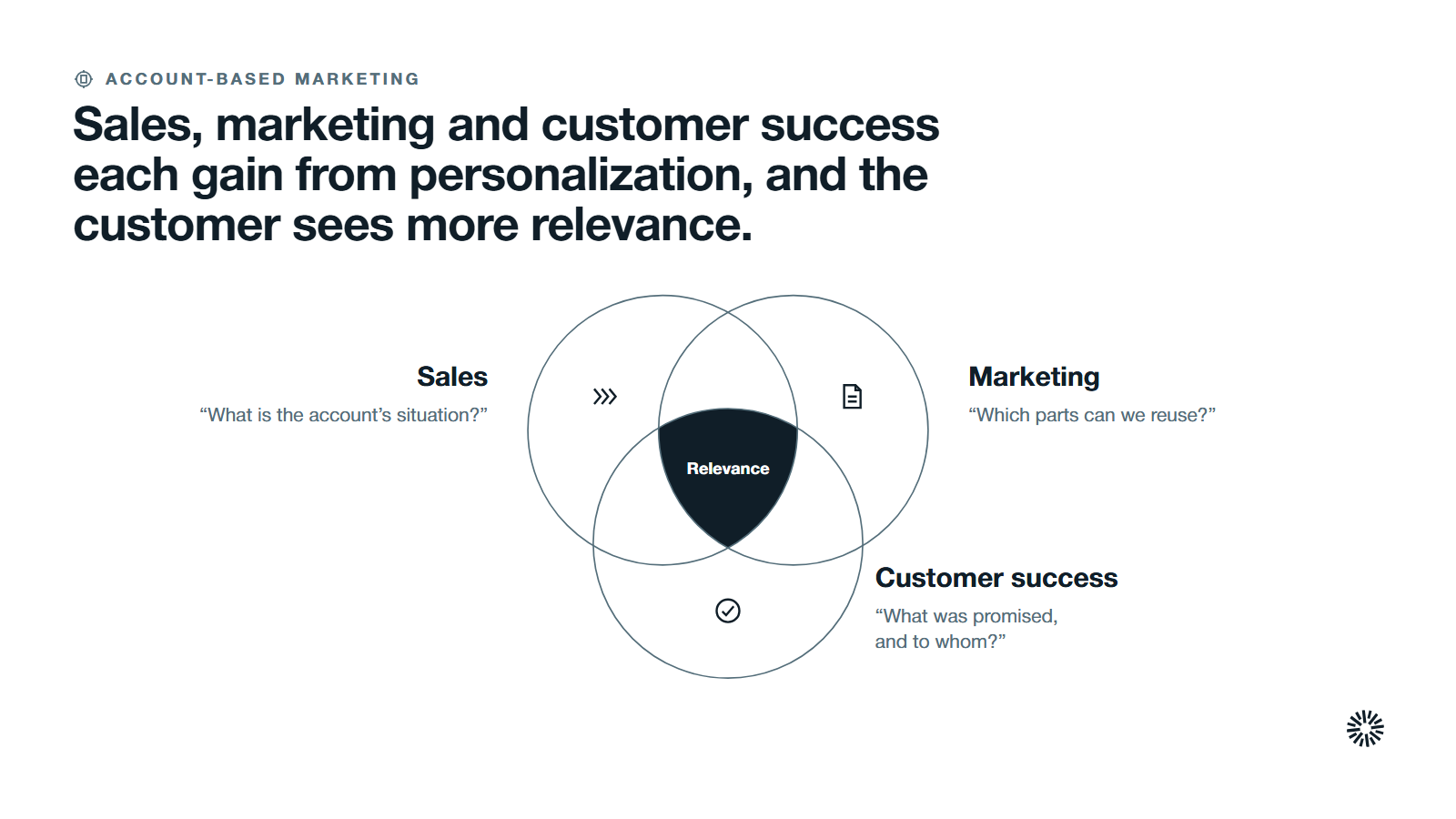
In modern marketing, data plays a critical role, and accurate, scalable personalization turns it into marketing strategies each team can use. Each team gains something concrete, and each customer sees a more relevant experience.
Sales gets context it can use
Sellers open conversations with a brief on the account, the buying group and the pain points. They spend less time researching and more time with buyers.
Marketing gets a repeatable system
Marketing builds personalized content from reusable parts, so each new account costs less to reach and each customer receives content personalization that fits. Reports show which personalization strategies are worth repeating.
Customer success gets a head start
Customer success inherits the account brief, the promises made and the people involved. That makes the first conversations after the sale more relevant.
Personalize for the accounts that matter, and keep it accurate
ABM personalization is a set of decisions: how deep to go, what to learn, what to say, how to stay accurate and how to scale. Make each in writing, start with a few accounts and let results decide where to go deeper.
Propello designs and builds connected go-to-market systems on HubSpot. If you want your account data, scoring and reporting set up so personalization can scale, an audit is the place to start.
For the wider program, see account-based marketing B2B examples and how ABM fits with B2B demand generation.