If you lead sales or revenue at a growing B2B company, account prioritization is how your sales team decides which accounts get attention this week. You do it by ranking target accounts on two questions: do they fit your ideal customer profile, and are they showing buying signals right now? For the full picture, read our complete guide to signal based selling.
This article is for CEOs, founders, CROs and sales leaders whose reps work long lists without knowing why one account ranks above another. Most teams know they should prioritize accounts but never write down how. You will get a tiering, the metrics that prove it works, and a routine.
|
Account Prioritization Account prioritization is the practice of ranking target accounts by fit and current buying signals, so a sales team spends its limited time on the accounts most likely to become revenue. |
What effective account prioritization looks like in practice
Good account prioritization is visible in a rep's Monday morning. Each sales rep opens a short list, sees why every account is on it, and knows the next action. Nobody keeps a private spreadsheet that contradicts the list.
Time is the reason this matters. Salesforce's 2026 State of Sales research, a survey of 4,050 sales professionals, found that the average seller spends 40% of their time selling. Every hour spent on the wrong accounts comes out of that share.
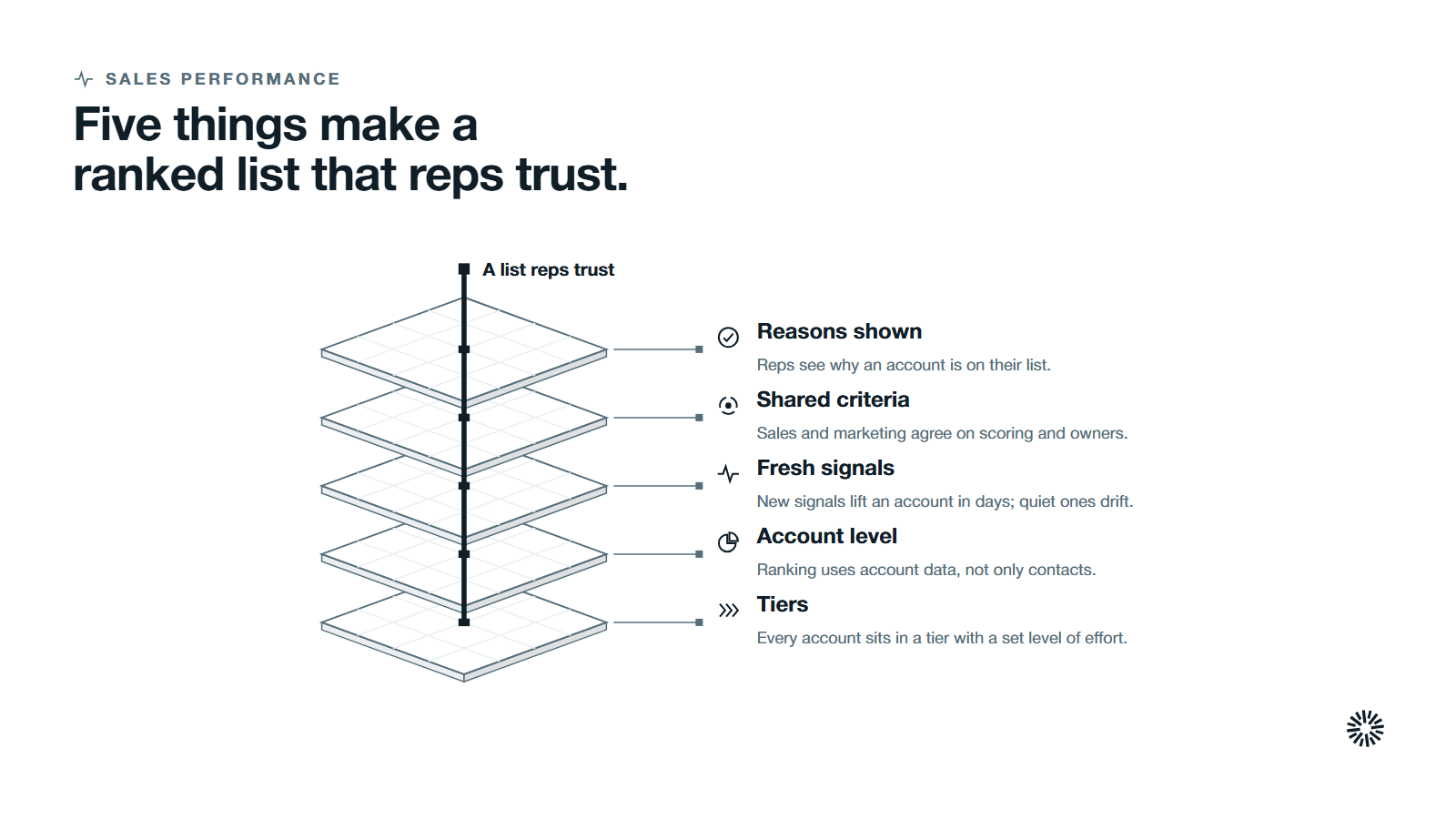
A team that has this working shows five things:
- Every account in the territory sits in a tier, and each tier has a defined level of effort.
- The ranking uses account level data, not only individual contacts.
- Fresh buying signals move an account up the list within days, and quiet ones let it drift down.
- Sales and marketing agree on the scoring criteria and on who owns each account, so marketing and sales activities point at the same high priority accounts.
- Reps are told why an account is on their list, so they trust it.
Rank at the account level, because buyers decide as a group
A contact is a person. An account is the company and the group of people who decide. Forrester's 2024 State of Business Buying report found that 13 people within an organization are involved in a buying decision on average, and 89% of purchases involve two or more departments.
That is why lead scoring alone misleads. A lead score rates one person's activity. Account scoring rates the whole company: how well it fits, what its people are doing, and whether several are active at once.
Scoring accounts at that level lets a team prioritize accounts by readiness, not by the loudest inbound request.
Get on the shortlist before the first conversation
Prioritization also fixes a timing problem. 6sense's 2025 B2B Buyer Experience Report found that 95% of the time, the winning vendor is already on the Day One shortlist. Buyers form a view before they speak to a rep.
So the goal is not to chase the loudest lead. It is to put sales efforts into high potential accounts early, while the shortlist is still forming. That is the account prioritization process in one line: find the right accounts, act while they are open to you, and leave the rest to nurture.
An account scoring model combines fit, timing and engagement
An account scoring model turns a pile of facts into one ranked list. Keep the scoring model small enough that a rep can explain it in a sentence, and build it from data your sales team already trusts.
Three layers are enough for most teams. Fit tells you which potential accounts deserve a place on the list at all. Timing and engagement tell you which of them deserve attention today.
Account scoring is also the backbone of account-based marketing: marketing targets a named list of accounts based on fit and intent, and the score decides which names go on it.
Fit: is this the right account?
Fit uses firmographic data that rarely changes: industry, company size, employee count, region and annual revenue. It also uses technology and business model, where they predict success. Company size alone is a weak guide, so test it against the accounts you actually won.
Define fit from your existing customers. Look at the valuable customers who stayed, expanded and referred others, and write down what they share. That becomes your ideal customer profile, a filter applied before any score. It also shows the potential value of a new account early.
The same filter screens net new accounts and prospect accounts before they reach a rep.
Timing: is something changing now?
Timing comes from buying signals, which are changes that suggest a company may be ready to act: a new leader, funding, a hiring push, a product launch, or repeat visits to your pricing page.
Our guide to intent data explains how first-party and third party intent sources feed this layer. Treat intent data as one input among several, and check it against what the account does on your own site.
Signals decay. A pricing page visit last week matters more than one last quarter, so give recent behavioral signals more weight and let old ones fade. Account behavior, read over days rather than minutes, tells you more about sales readiness than any single event.
Engagement: is the account responding?
Engagement data shows how the account interacts with you: email replies, meetings booked, content read, events attended, and how many people are involved. Several people from one account engaging in the same fortnight is a stronger sign than one person opening many emails.
Read it as part of the customer journey: a visitor who reads a case page, then a pricing page, then replies, is moving.
If you want the person-level version, see our guide to lead scoring.
Account intelligence comes from a few reliable data sources
Account intelligence is the combined picture of fit, signals and engagement for one company. Most of it already sits in tools you own: your CRM, your website analytics and your marketing automation platform. Start there before you buy anything.
List the data sources, say which field each one feeds, and name an owner for each. A scoring model that depends on a field nobody maintains will drift.
Account tiering turns the score into a decision
A score is not a decision until it changes what a rep does. Account tiering groups accounts by score and assigns a level of effort to each group.
| Tier | Who sits here | What the sales team does |
|---|---|---|
| Tier 1 | Strong fit with fresh buying signals | Personal research, multi-contact outreach, a named plan this week |
| Tier 2 | Strong fit, quiet signals | Light, relevant outreach and monitoring for new signals |
| Tier 3 | Weaker fit or no activity | Automated nurture, no rep time unless signals change |
Tier 1 is deliberately small, and account tiering is how sales and marketing teams agree on it. It holds your top tier accounts and key accounts, the ones with the greatest strategic value.
If it holds more accounts than a rep can work properly, it is a wish list. Set the cut-off by capacity: how many accounts can one rep work well in a week?
Because low-fit accounts drop to Tier 3, reps spend less time on low-probability opportunities and more on high value accounts.
High value accounts and high priority accounts are not always the same list. A large company with no signals is valuable on paper and low priority this month.
The metrics that show whether account prioritization works, with formulas
Measure account prioritization by outcomes per tier, not by how many accounts you scored. These are also the key measures of sales performance for a team that works from a ranked list. If the top tier does not outperform the bottom tier, the model is not ranking anything.
The arithmetic below uses invented numbers and is illustrative, not a benchmark: 40 Tier 1 accounts, 200 Tier 2 accounts and 760 Tier 3 accounts worked in one quarter.
Meeting rate by tier
Meeting rate by tier shows whether the ranking predicts engagement.
Formula: meeting rate = accounts with a meeting booked / accounts worked in that tier x 100
Illustrative arithmetic: 12 meetings from 40 Tier 1 accounts is 30%. 20 meetings from 200 Tier 2 accounts is 10%. If Tier 3 shows 2%, the tiers are doing their job.
Opportunity rate by tier
Meetings are easy to inflate. Track how many become real pipeline.
Formula: opportunity rate = accounts with an opportunity created / accounts worked in that tier x 100
Illustrative arithmetic: 6 opportunities from 40 Tier 1 accounts is 15%.
Top-tier win share
This tells you whether the best deals come from the accounts you ranked highest.
Formula: top-tier win share = closed-won deals from Tier 1 and Tier 2 / all closed-won deals x 100
Illustrative arithmetic: 9 of 12 closed-won deals from the top two tiers is 75%. A low share means the model is scoring the wrong things.
Signal-to-touch time
Prioritization only helps if reps act while the signal is fresh.
Formula: signal-to-touch time = time of first rep action - time the signal was recorded
Track the median in hours or days for Tier 1 accounts. A long delay means the list is not reaching reps, or reps do not trust it.
Top-tier coverage
Formula: top-tier coverage = Tier 1 accounts touched in the last 14 days / all Tier 1 accounts x 100
Illustrative arithmetic: 34 of 40 is 85%. Low coverage means your best accounts are waiting while reps work easier ones.
Rep adoption
A ranking nobody opens is wasted. Check the share of Tier 1 accounts that carry a logged next step. Pair it with sales cycle length and average deal size by tier, to see whether top-tier accounts also close faster or larger.
A weekly, monthly and quarterly routine keeps account prioritization current
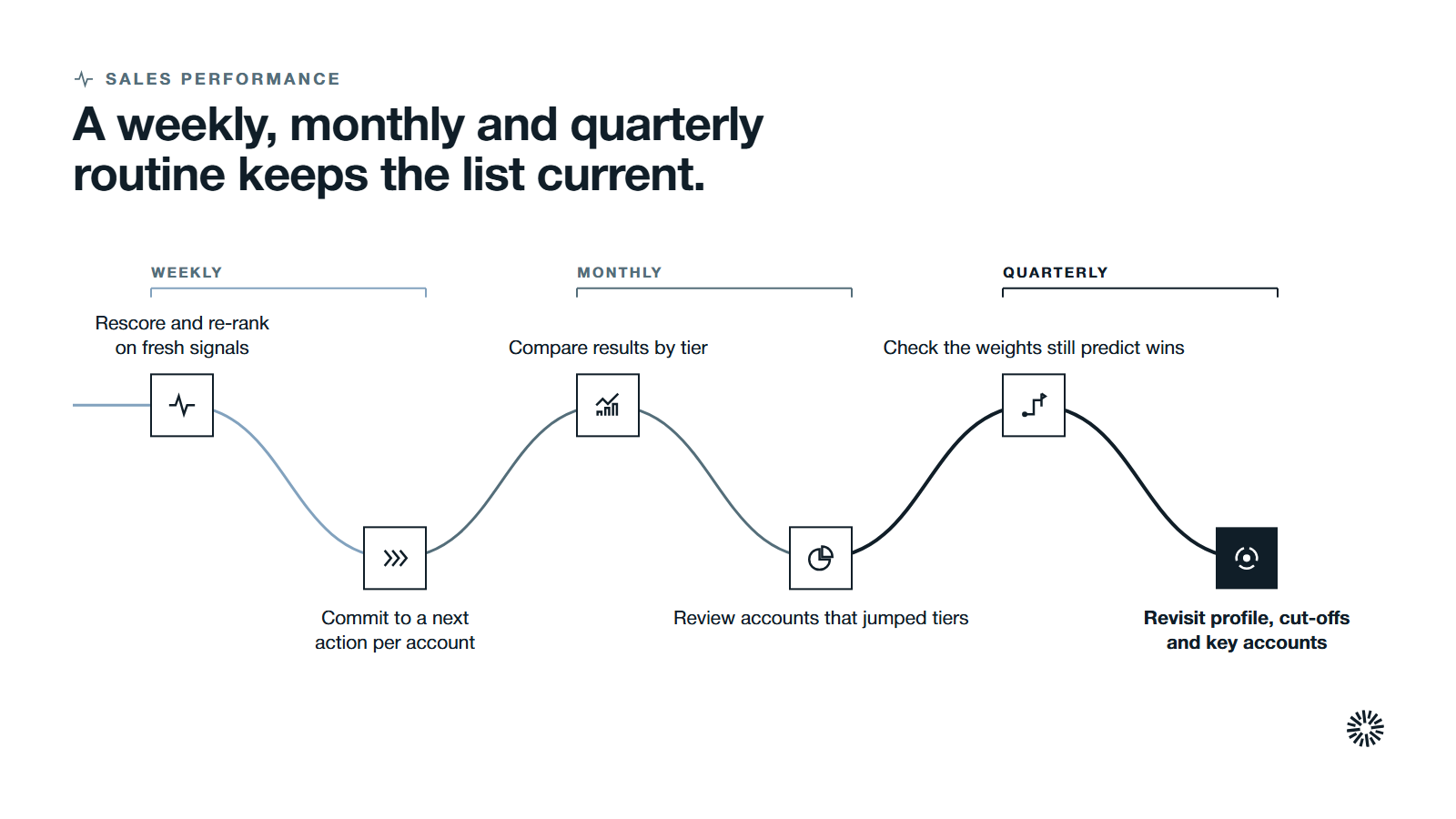
Account prioritization is an ongoing process, and it belongs in the normal sales process rather than in a side project. Regular review keeps the list responsive to market changes, and small reviews on a fixed schedule beat a big rebuild.
Weekly
Refresh the signals, rescore and re-rank, so the team can prioritize accounts for the week. Promote accounts that showed new buying signals, and demote those that went quiet. Each sales rep reviews their Tier 1 list in a short meeting and commits to a next action on every account.
Check signal-to-touch time. Anything over your agreed limit goes to the sales leader that day.
Monthly
Compare meeting rate, opportunity rate and top-tier coverage by tier. Look at accounts that closed and ask which tier they sat in a month earlier. Review accounts that rose from Tier 3 to Tier 1 in a month, and check whether the cause was a real signal or a data error.
Marketing reviews which campaigns warmed Tier 1 and Tier 2 accounts. Our guide to pipeline review shows how to turn this into decisions on live deals.
Quarterly
Hold a quarterly review of the model itself, led by the sales leader with marketing in the room. Check whether the weights still predict wins. Retire signals that never led anywhere.
Revisit the ideal customer profile, the tier cut-offs and the number of key accounts per rep, and tie the review back to your business objectives.
Compare top-tier win share with revenue goals, and bring the findings into your wider sales pipeline management rhythm so territories and targets move together.
Common account prioritization mistakes send your best reps to the wrong accounts
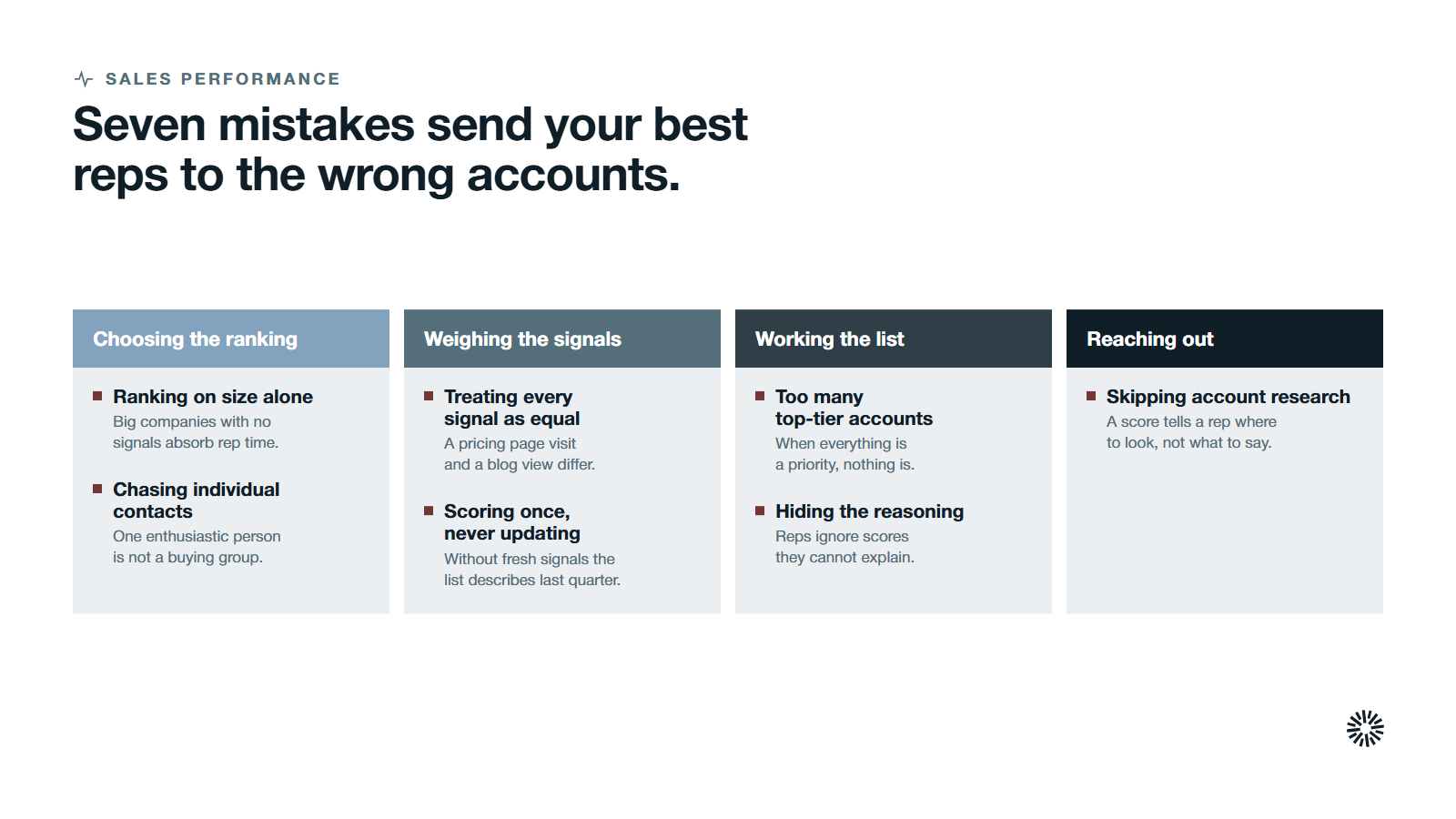
Most failures come from a short list of repeated mistakes.
- Ranking on size alone. Large companies with no buying signals absorb rep time and rarely move. Size is a fit input, not a priority.
- Scoring once and never updating. Static data goes stale quickly. Without fresh signals, the list describes last quarter.
- Too many Tier 1 accounts. When everything is a priority, nothing is. The top tier must match what a rep can actually work.
- Chasing individual contacts. One enthusiastic person is not a buying group. Look for several people from the same account.
- Hiding the reasoning. Reps ignore scores they cannot explain. Show which fit and signal factors put an account on the list.
- Treating every signal as equal. A visit to the pricing page and a blog view are different. Weight signals by how close they sit to a purchase.
- Skipping account research. A score tells a rep where to look, not what to say.
That last mistake is costly. Gartner's June 2025 release on a survey of 632 B2B buyers found that 73% actively avoid suppliers who send irrelevant outreach. Prioritizing the right accounts only works if the message fits.
What you gain when this is done properly
When account prioritization works, the debate about which accounts to chase turns into a review of numbers. Every team that touches the pipeline benefits.
Sales spends time where deals start
Reps stop splitting attention across hundreds of accounts. They work a short list with a reason attached, reach out while the signal is fresh, and cut wasted effort on accounts that were never going to buy.
Sales leaders can coach against a shared list instead of guessing, and sales leadership can see where the team's time goes.
Marketing aligns spend with the accounts sales wants
When sales and marketing teams share one ranking, campaigns, content and events point at the same target accounts. Marketing can see which activity moves accounts up the list.
Customer success sees which accounts to grow and protect
The same ranking works for existing customers. Strong fit plus rising engagement marks an expansion opportunity, and a drop in activity at a valuable customer is an early warning. Customer success also learns what the best-fit accounts share, which improves handoffs.
Make account prioritization part of your go-to-market system
Account prioritization is a small model, a clear tiering and a review habit, and it helps you align sales and marketing around one list. Once reps trust the list, every other part of the go-to-market system gets easier: outreach, forecasting and pipeline reviews all start from the same view of which accounts matter.
Propello designs and builds connected go-to-market systems on HubSpot for CEOs and revenue leaders at growing B2B companies, using revenue operations to join sales, marketing and customer success data. If you want help ranking your accounts, an audit is the place to start.