Most growing B2B companies do not need an ABM platform yet, and many ABM tools solve a problem they do not have.
If your customer relationship management system, your ads manager and your sales tools can already hold a named account list and show which accounts are moving, a new platform mostly adds setup work, ongoing cost and another login. Buy one when a specific gap, not a vague wish, is slowing you down.
This guide is for CEOs, founders, CROs and marketing and sales leaders at growing B2B companies who are weighing an ABM platform against what they already run. It helps your sales and marketing teams spend effort on the right accounts.
You will get what an ABM platform replaces, what it costs in kind, when your current tools are enough, what breaks if you buy too early, and a decision by company stage.
|
ABM Platform An ABM platform is software that identifies target accounts, tracks their engagement, scores them and coordinates marketing and sales activity against them from one shared account view. |
Buying an ABM platform is a timing decision before it is a software decision
The category of ABM software sells itself on speed, but the platform only speeds up an account-based marketing motion that already exists. It does not create one. If the motion is missing, the platform becomes an expensive way to look at accounts nobody has agreed to pursue.
A better framing is to ask what job is currently done badly. Account-based marketing (ABM) means treating a chosen set of high value accounts as markets of their own, with coordinated outreach from marketing and sales. How ABM runs day to day matters more than which software sits underneath it.
If you cannot yet say which accounts are on your list and what each team does about them, no tool fixes that.
The buying group is the reason account level work matters. Forrester's State of Business Buying, published on 4 December 2024, reports that on average 13 people within an organization are involved in the buying decision, and that 89% of purchases involve two or more departments. One contact is never the whole account.
For a fuller grounding in the method itself, read our guide on what account-based marketing is and the longer guide to ABM.
What ABM software and account based marketing tools actually do
ABM software, sold under names such as account based marketing tools or ABM tools, bundles several separate jobs into one product. Knowing the jobs lets you judge which ones you truly lack. The common ones are: For the full picture, read our complete guide to account based marketing strategy.
- Account identification. Matching anonymous website visitors and activity to the company behind them, so you can see which accounts are showing interest.
- Account intelligence. Gathering company details, contacts and buying group members into one view.
- Intent based targeting. Using outside and inside signals to decide which accounts to reach first.
- Predictive account scoring. Using predictive analytics to rank accounts by how closely they resemble your best customers.
- Multi channel campaigns. Running display advertising and LinkedIn campaigns against a list of accounts, with campaign management in one place.
- Engagement metrics and reporting. Showing account level engagement, revenue attribution and pipeline growth through advanced analytics.
- CRM integration. Writing what it learns back into CRM records so sales sees it.
Two inputs sit under most of these jobs. Account identification relies on firmographic and technographic data, meaning the size, industry and technology profile of a company. Intent data monitors web activity to show which accounts may be researching a purchase.
Measurement then follows the account rather than the lead: success is judged by account engagement, pipeline generation and closed-won deals, not by lead volume alone.
Every one of these jobs has a simpler version. Your own first party data, including form fills, email replies and website visitors seen in Google Analytics, already tells you a lot. The campaigns you already run in Google Ads add to the picture.
A CRM integration is only as good as the CRM data on the other side of it.
Where AI features fit, and what they still need
Many ABM tools now add AI features. These can automate account scoring from engagement data, help identify high value accounts, draft personalized content at scale and adjust how a campaign is delivered across channels. Automation of this kind speeds up decisions that a human already knows how to make.
It does not supply the judgment. An AI model scoring accounts still needs your ideal customer profile, reliable CRM data and a clear definition of engagement. Personalization helps deliver relevant experiences to targeted accounts, and ABM works best when it engages several decision-makers inside each account instead of one contact.
Sales and marketing alignment reduces silos, which is a people problem before it is a software problem.
What an ABM platform replaces and what it does not
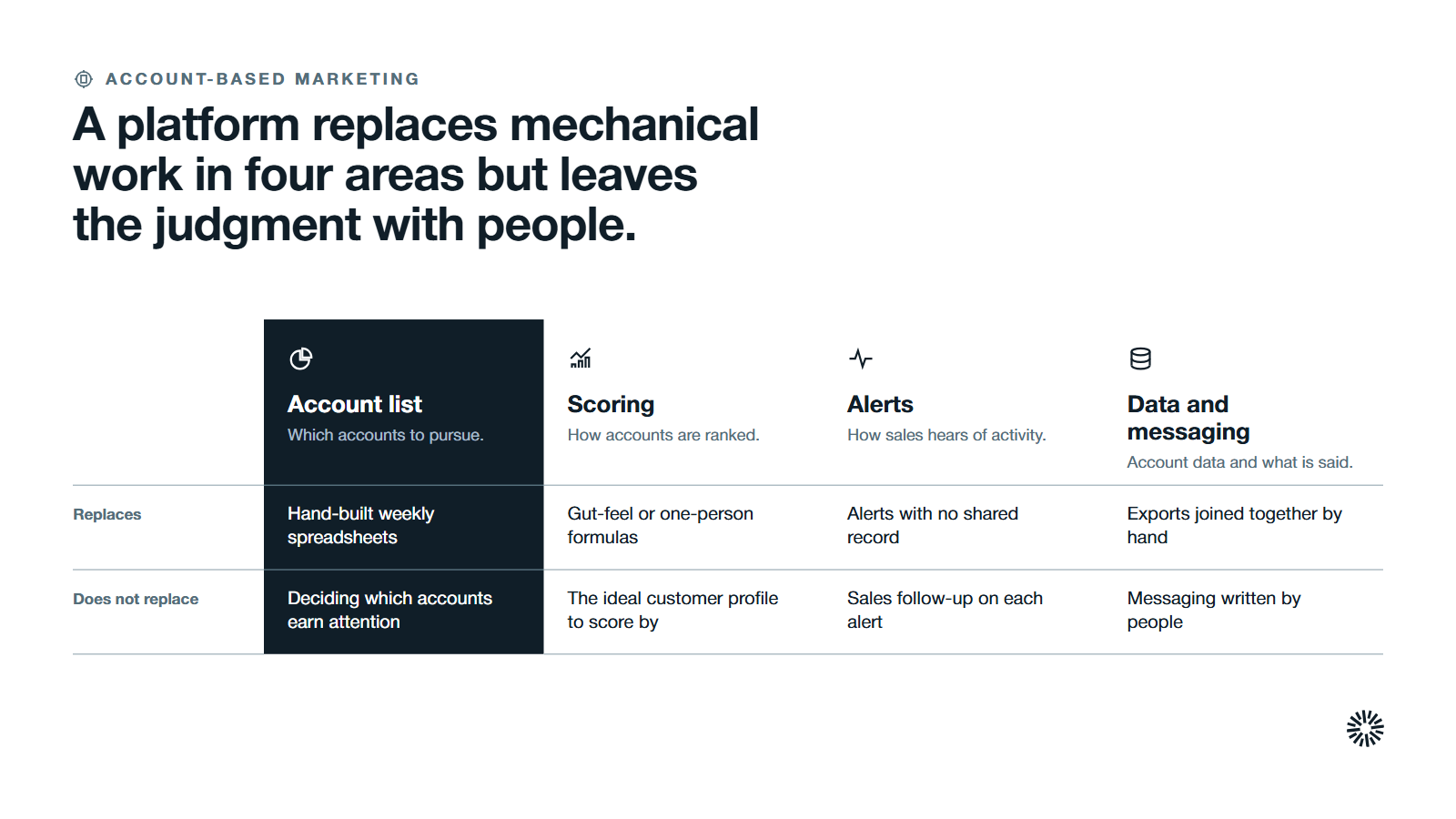
The cleanest way to decide is to list the work the platform would take over and the work it cannot touch. Software replaces mechanical effort. It does not replace judgment.
What it replaces
- Hand-built account lists. Spreadsheets of target accounts that someone updates every week.
- Stitched exports. Pulling account activity from several separate tools and joining it by hand.
- Manual account scoring. Ranking accounts by gut feel or by a formula kept in one person's head.
- Disconnected alerts. Emails that tell sales an account visited the website, with no shared record of what happened next.
What it does not replace
- The ideal customer profile. The platform scores against criteria you supply. Without them it scores noise. Our ideal customer profile template shows what to settle first.
- The account list. Someone still has to decide which accounts earn attention.
- Messaging. Personalized content comes from people who understand the buyer, not from a feature.
- Sales follow-up. An alert that nobody acts on is a notification, not a pipeline.
The cost in kind: what an ABM platform asks of your team
This guide quotes no prices, and a subscription fee is the smaller part of the decision anyway. The larger cost is what the platform demands from your people before it returns anything. Think of ABM tools as asking for four currencies.
Data. Account data and customer data have to be clean enough to trust. Duplicate company records, missing domains and stale contacts all feed straight into account scoring.
Process. Your marketing and sales teams must agree who owns an account, what counts as engagement, and what sales does when an account heats up.
People. A platform needs an owner who configures it, watches it and retires what does not work. In a small team that owner is usually also doing another job.
Change. Reps and marketers have to change how they work, which is the hardest cost to see on an invoice.
If you cannot name who pays each of those four, you are not ready to price the software.
When your CRM, ads manager and sales tools are enough
A strong starting point for your ABM efforts is the stack you already own. Your CRM holds company and contact records. Your ads manager can target a list of accounts. Your sales team's tools show who is working which deal. Together they cover a surprising amount of account-based marketing for a company with a short target list.
HubSpot's own ABM software page shows how far a connected CRM can go. It describes pinpointing potential targets through HubSpot's recommendations or by setting up automated workflows to find and score suitable accounts.
It also describes a centralized command center to manage key accounts, giving your team detailed insights into open deals, their value and the level of engagement from key stakeholders. The page also says the tools help you shorten your sales cycle by connecting with targets more meaningfully.
Those are descriptions of capability, not a promise of any result.
The same page says everyone can see how deals are progressing across different accounts from the target accounts index page, and that reporting can show target account engagement, deal pipeline progress and revenue attribution. It also describes launching LinkedIn campaigns that match your key account contacts.
These facts come from HubSpot's ABM software page, opened on 15 October 2026.
You are probably fine without a separate platform when most of these hold:
- Your target list is short enough to review by hand each week.
- Marketing and sales already agree on which accounts are on it.
- Your CRM records are reliable enough to filter and report on.
- Your ad campaigns can be pointed at an account list.
- Your sales team follows up on engagement without being chased.
If four or five of those are true, the next effort is better spent on fixing the weak one than on new software. Our guide on intent data explains when outside signals add enough to justify more tooling, and lead scoring covers the simplest way to rank before you automate it.
An ABM strategy tells you what to buy
An ABM strategy is the set of choices about who you pursue, what you say to them and how marketing and sales divide the work. Tools come after those choices, never before. Most disappointing ABM programs started with a purchase and tried to build the strategy around it.
ABM success comes from the choices, and the software only carries them out. A clear ABM strategy shapes every one of your ABM campaigns, because each campaign inherits the account list and the message. ABM tools that arrive first end up defining the ABM strategy for you.
Three questions make the strategy concrete. Which accounts are on the list, and why those? What does each account need to hear, and from whom? Which signals tell you to act, and who owns the response? Answer them and you can write a short requirements list, which is the only fair way to compare tools later.
Strategy also decides how sales and marketing teams work together, and how you align sales with the plays marketing builds. Marketing efforts and sales efforts have to aim at the same accounts, or you align marketing and sales on paper while two lists run in practice.
Sales enablement matters here too, because reps need the account context and the right content at the moment an account heats up.
Compared with traditional ABM, which relied on a short list and heavy manual work, newer tooling lets you run ABM campaigns across more accounts. That scale helps only when the basics hold. A tool lets you create campaigns faster, and it will do the same for poor ones.
Clear targeting reduces wasted effort, and targeted campaigns depend on knowing what each account cares about. Personalized campaigns and landing pages built for a named account help personalize engagement, but only when the account list behind them is right.
What breaks when you buy before the foundations exist
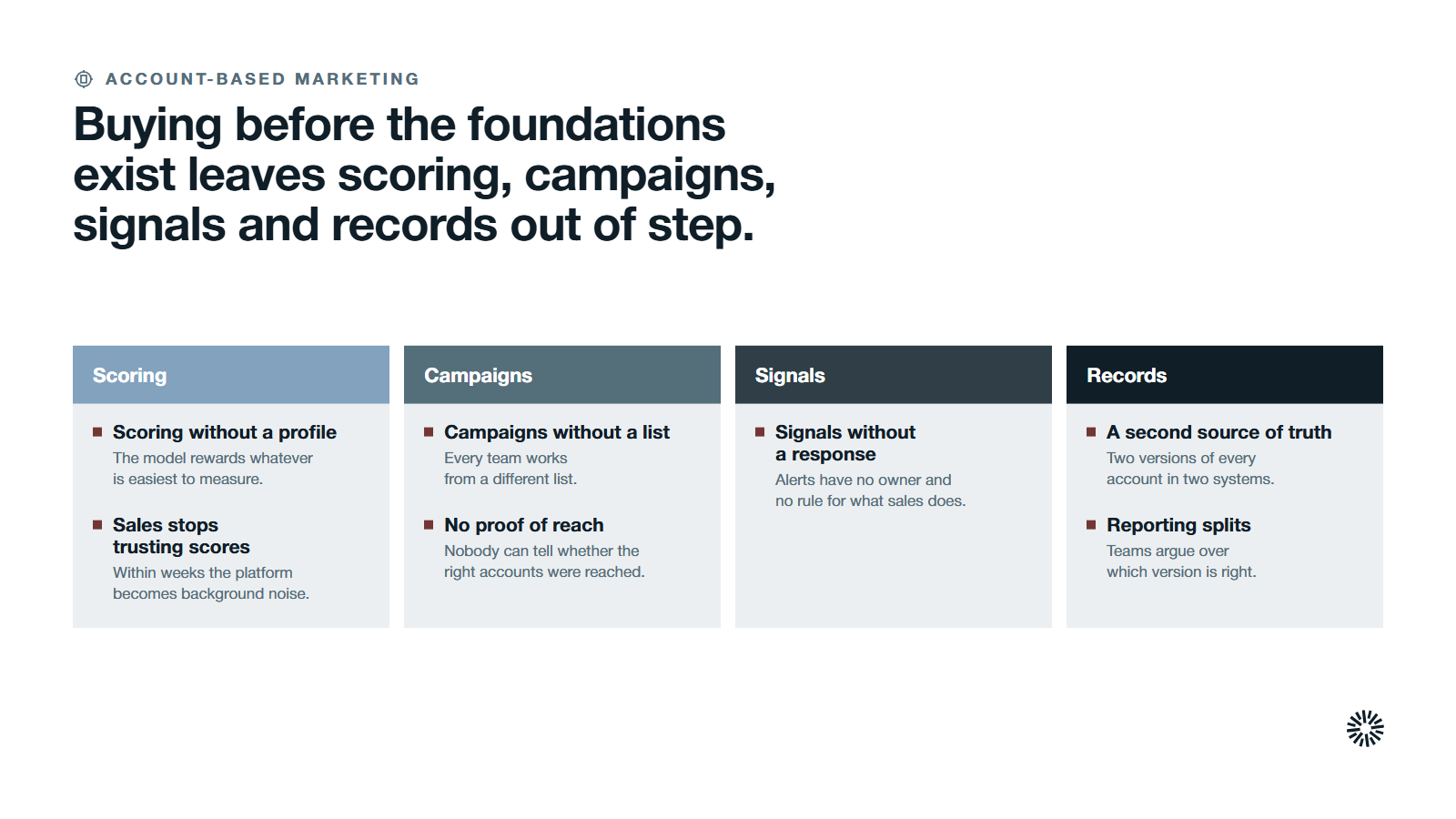
The cost of buying early rarely arrives as a line on an invoice. It arrives as dashboards nobody trusts and campaigns nobody can explain. Four failures repeat.
Scoring without an ideal customer profile
A platform that scores accounts needs a definition of a good one. Without a clear profile, the model rewards whatever is easiest to measure, such as website visitors, and flags the wrong accounts as hot. Sales stops believing the scores within weeks, and the platform becomes background noise.
Campaigns without an account list
If the target accounts are not agreed, every team uses a different list. Marketing teams run display advertising and LinkedIn ads against one set while sales teams work another, and nobody can tell whether the effort reached the right accounts. You pay for coordination tools and still lack coordination.
Signals without a response
Signals such as intent data, account activity and website visitors only matter if someone acts on them. Buying a platform before you have a rule for what sales does with a signal produces alerts with no owner. Our guide to turning intent signals into sales action shows the response rules to write first.
A second source of truth
Add a platform to a messy CRM and you now have two versions of every account. Teams argue about which one is right, reporting splits, and the cost of the argument exceeds the cost of the license.
Four things to have in place before you buy
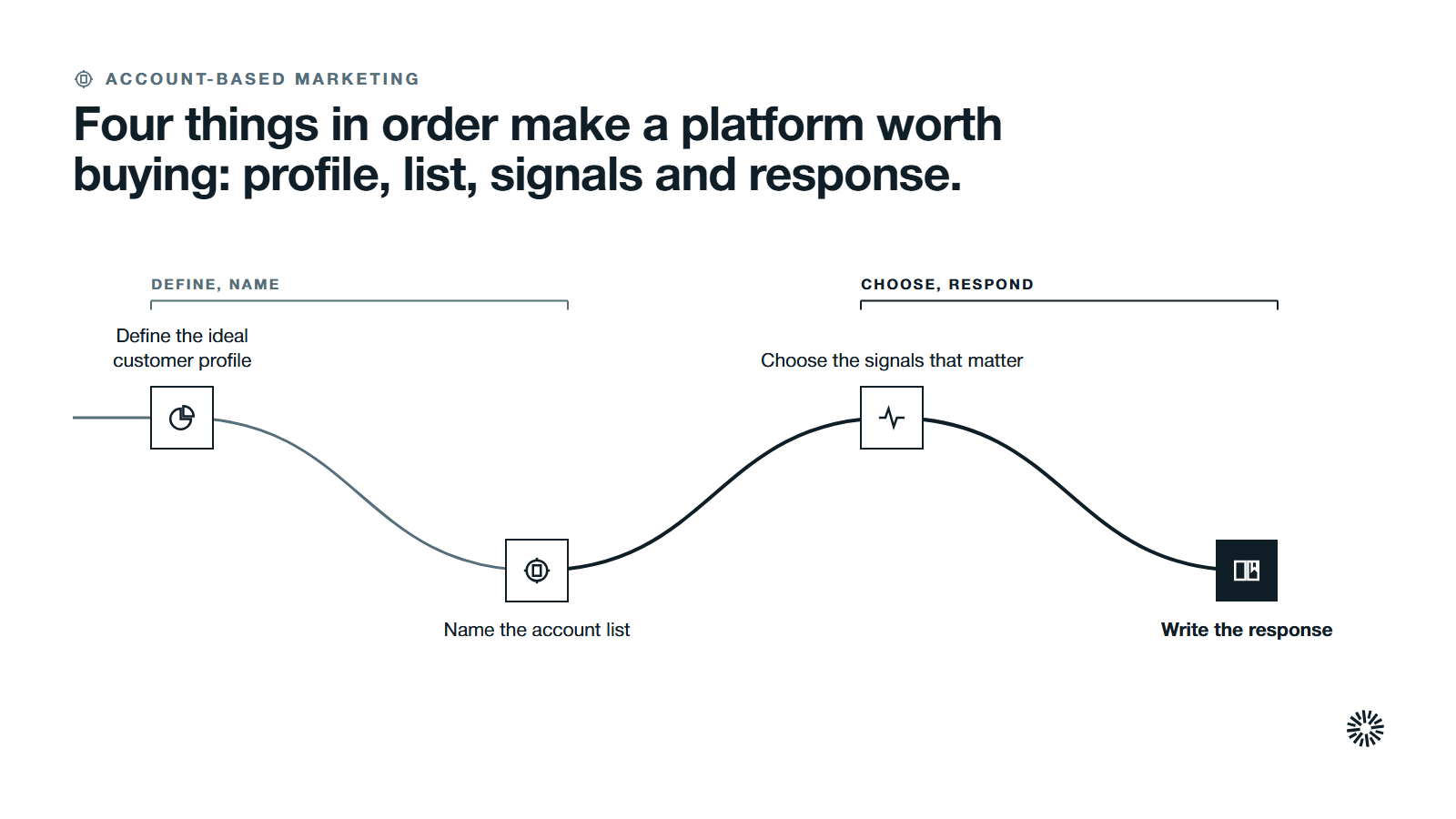
Settle these four in order. Each one makes the next cheaper, and together they decide whether any platform will earn its place.
- Define the ideal customer profile. Write the firmographic and behavioral traits of the accounts you win and keep, and agree them across sales and marketing. Done looks like a one-page profile both teams sign.
- Name the account list. Choose the high value accounts you will pursue this quarter and record them in the CRM. Done looks like a single list with an owner for every account.
- Choose the signals that matter. Pick the few behaviors that show an account is moving, such as repeat visits, pricing page views or replies. Done looks like a short list each rep can recite.
- Write the response. Decide what each signal triggers and who does it within what time. Done looks like a one-page play that a new hire could run.
If you can complete all four with the tools you own, you have learned what you actually need from a platform. If you cannot, you have found the real project. The pattern is the same one behind defining your ICP, messaging, channels and sales motion.
Decide by company stage
Company stage changes the answer, because it changes how many accounts you pursue, how long your sales cycles run and how many people must stay in step. Long sales cycles make shared account context more valuable, since the account passes through many hands before it buys.
Early stage with a small target list
Stay on your CRM, a shared account list and your ads manager. Name an owner for each account and review the list weekly. Hold back any purchase of ABM tools, and focus on how to target high value accounts by hand. The risk at this stage is complexity, not missing features.
Watch whether sales acts on account activity without a reminder.
Growth stage with several teams
This is where the question becomes real. If your team spends more time assembling account views than acting on them, or if you cannot see engagement across channels at the contact level, a platform may now pay its way. Fix data quality first, keep the response plays simple, and start your ABM campaigns with one segment of accounts.
Our guide to B2B personalization shows how much tailoring is worth doing by hand before you automate it.
Scale stage with many segments or regions
A platform becomes more likely to be justified, because manual coordination stops scaling. Even so, grow your ABM programs and ABM efforts around a named gap such as predictive account scoring across regions or revenue attribution, and keep a dedicated owner.
Treat the platform as the layer that enforces a process your sales and marketing teams already run, and let ABM campaigns scale across regions only after one region works.
What you gain when this is done properly
Making the decision on evidence, in the right order, pays back across the revenue team rather than only in the tool budget.
Sales works the accounts that matter
When the account list and the signals are agreed, reps spend their time on accounts that fit the profile, and customer requests that arrive from those accounts reach the right owner. Sales cycles are easier to manage because everyone sees the same account activity, and follow-up has an owner.
Marketing aims every campaign at a named account
Campaigns, landing pages and ads point at the same list sales is working, so you engage high value accounts through multi channel advertising and email with one message. Marketing teams can see which target accounts engaged, tie that engagement to pipeline growth, and stop spending on audiences that were never going to buy.
Customer success sees the whole account
Service teams work from the same account record, so they know who was promised what and which stakeholders matter. That supports renewal and expansion conversations, which is where an account-based approach earns its keep over time.
Choose the stage first, then the software
The honest answer to whether you need an ABM platform now is that it depends on what you can already describe. If you can name the ideal customer profile, the account list, the signals and the response, your current tools probably cover you until a specific gap appears.
If you cannot, a platform will only make the gap more expensive. Read our B2B buyer journey and demand generation guides to see where account-based work fits in the wider system.
Propello designs and builds connected go-to-market systems on HubSpot, and Propello is a HubSpot partner. If you want help deciding what to fix before you buy anything, an audit is the place to start. See what the Propello GTM Audit covers and how to prepare.