
If you lead marketing or revenue at a B2B company with a defined list of target accounts, broad paid media probably feels wasteful. Most of the people who see an ad will never buy from you, and the few companies that matter are lost in the crowd.
Account-based advertising is paid media aimed at those companies on purpose.
This article is written for marketing leaders, demand generation managers and founders. It explains how account-based advertising works, what it needs before launch, where it stops working, and how it differs from account-based marketing and your wider ABM strategy, so you can decide whether your target accounts justify a campaign of their own.
|
Account-Based Advertising Account-based advertising is paid media shown only to people at a named list of target accounts, using matched audiences and firmographic targeting, with creative written for those accounts. |
How account-based advertising works
Standard paid media starts with a keyword or a broad profile and hopes the right company shows up. Account-based advertising reverses that order. You decide which high value accounts you want to reach, then you build the audience to fit them.
Your marketing efforts go to priority accounts instead of a general crowd, and the work happens at the account level instead of the level of the individual lead.
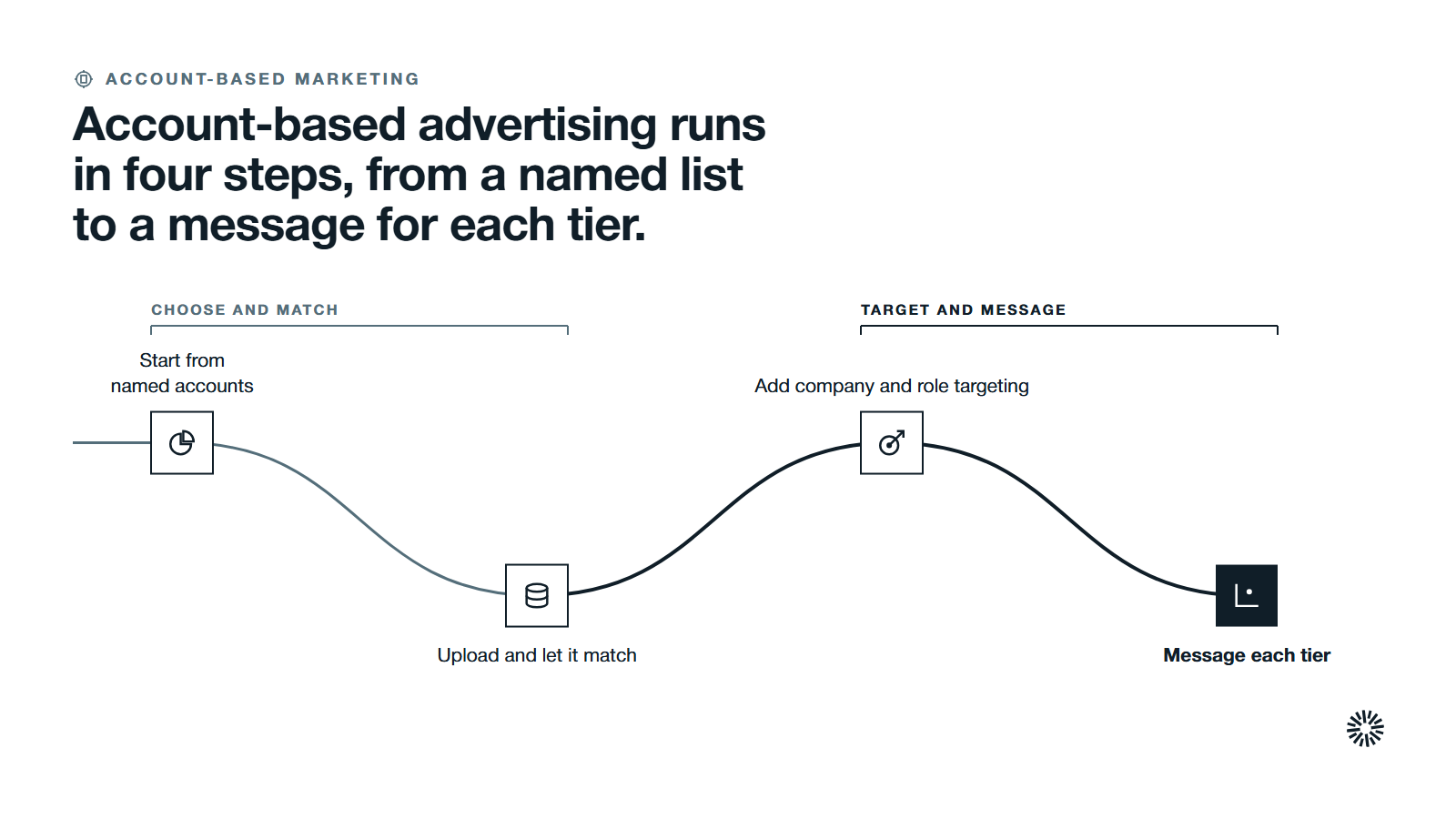
The mechanics are simple even when the setup is not. You supply a list, the ad platform matches it to its own members or users, and your ads run only to the people it can match.
The steps below follow that path, and each one asks sales and marketing teams to agree on the same list.
Start from a list of named accounts
The list is the foundation. It comes from your ideal customer profile, your sales team's priorities and the accounts already in your CRM. If you do not have a profile yet, our ideal customer profile template is the place to begin.
Identify target accounts with your sales team, then tier the list before you load it. Key accounts and high value target accounts belong in the top tier. A short top tier gets its own creative and a close eye. A longer lower tier gets broader messages.
One list for everyone is the first sign the program will be thin. Resource allocation should follow the tiers, so the accounts with the most revenue potential get the most attention and marketing investment.
Upload it and let the platform match it
Each ad platform matches in its own way, and the official help pages describe the rules. LinkedIn's audience targeting guidance lists contact or company lists among the data sources you can use to build an audience.
Google's Customer Match page says it lets you use your online and offline data to reach and re-engage with your customers across Search, the Shopping tab, Gmail, YouTube, and Display.
Intent data can help you decide which accounts to move up a tier, and our guide to intent data explains what it can and cannot tell you.
Matching is never complete. Only people the platform can recognize are reachable, and some of them will be signed out or use a different email address.
Add firmographic and role targeting
A list tells the platform which companies. Targeting attributes tell it which people inside them. LinkedIn's help pages recommend combining job functions with job seniorities to reach decision-makers with specific expertise.
This matters because a company rarely buys on one person's say. Forrester's research on business buying found that on average 13 people within an organization are involved in the buying decision, with 89% of purchases involving two or more departments. One title is not the account.
A buying committee includes key decision makers, key stakeholders and people who simply shape the shortlist, so your campaigns should reach several roles at each account. Our guide to the B2B buyer journey shows how those roles move through a decision.
Show each tier a message written for it
Personalized messaging is the step teams skip. If every account sees the same banner, you have bought a smaller audience, not an account-based program. Top-tier accounts should see messages that name their industry, their problem and the next step.
Lower tiers can share a message by segment. Personalized content and creative assets for each tier keep the work manageable, and personalized campaigns stay relevant to the sales cycle each account is in.
Keep the ad and the page it lands on consistent. A promise in the ad that the page does not repeat wastes the click you paid for.
What account-based advertising needs before launch
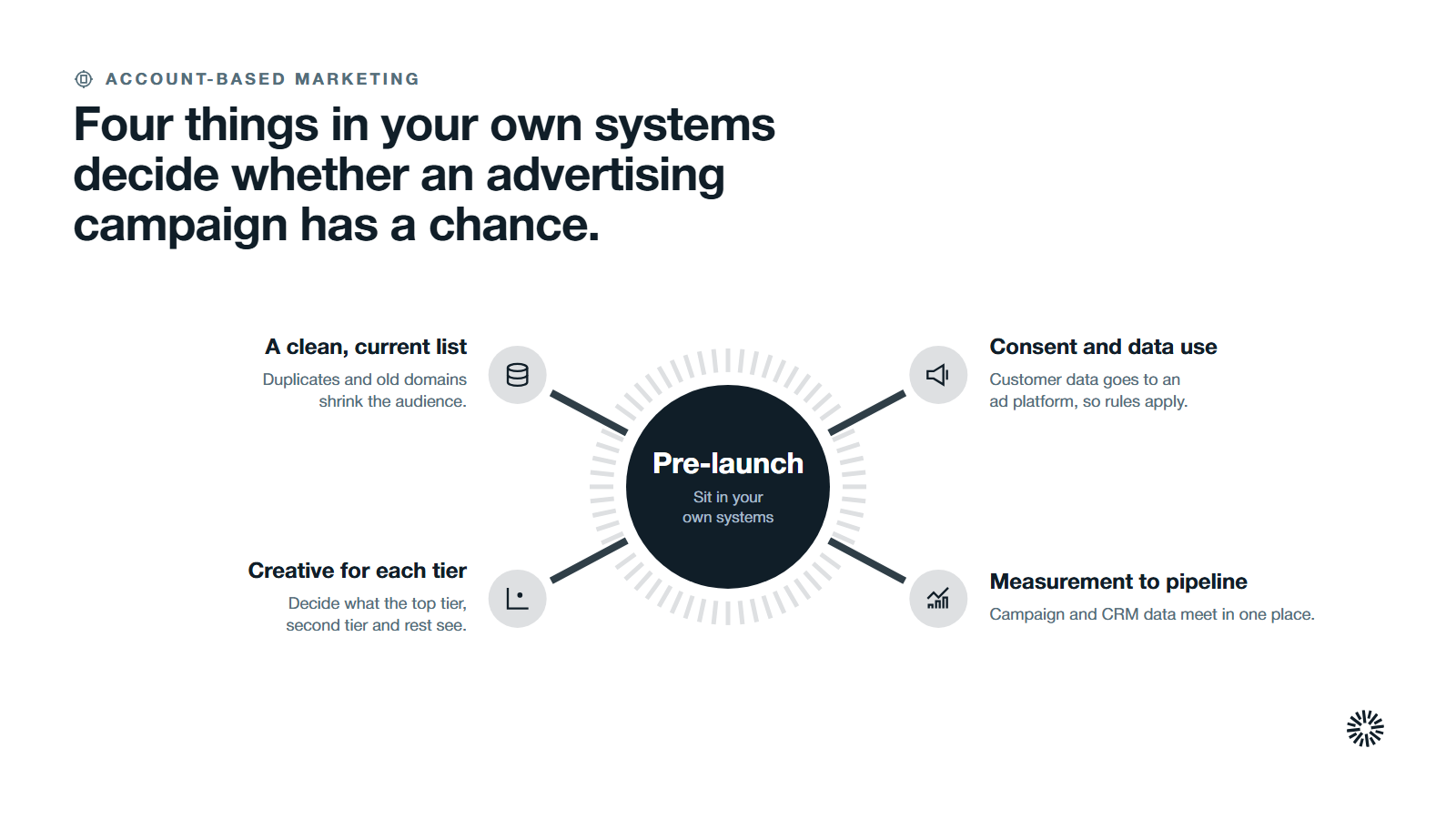
The platform is the easy part. Four things decide whether the campaign has a chance, and each one sits in your own systems rather than in the ad account.
A clean, current account list
Names, domains and contacts must be accurate, or matching fails quietly. A list that looks complete in a spreadsheet can still match poorly once the platform checks it against its own records. Duplicate companies, old domains and contacts who have left all shrink the audience.
Clean the list in your customer relationship management system first, then export. Our lead scoring guide shows how to rank the accounts that deserve the top tier.
Creative for each tier
Plan the messages before you build the audience. Creative is where an account-based program earns its name. Decide what the top tier sees, what the second tier sees and what the rest see.
Relevant content for each tier matters more than the number of ad variations. Our guide to B2B personalization covers how far to take it without writing a hundred ads.
Consent and data handling
You are sending customer or prospect data to an ad platform, so consent and privacy rules apply. Google's help page says that if you use a partner to upload data for users in the European Economic Area, you need to work with that partner to pass the required consent signals to Google.
Check what applies to the markets you sell into before the first upload.
Measurement that reaches the pipeline
Clicks and impressions are not the goal. You want to know whether target accounts moved: visited, engaged, entered the pipeline, advanced a stage. That means campaign data and CRM data have to meet in one place, so account engagement can be read next to revenue outcomes and the sales process.
Our guide on intent signals to sales action shows how to turn account activity into follow-up your sales team will actually do.
How account-based advertising differs from account-based marketing
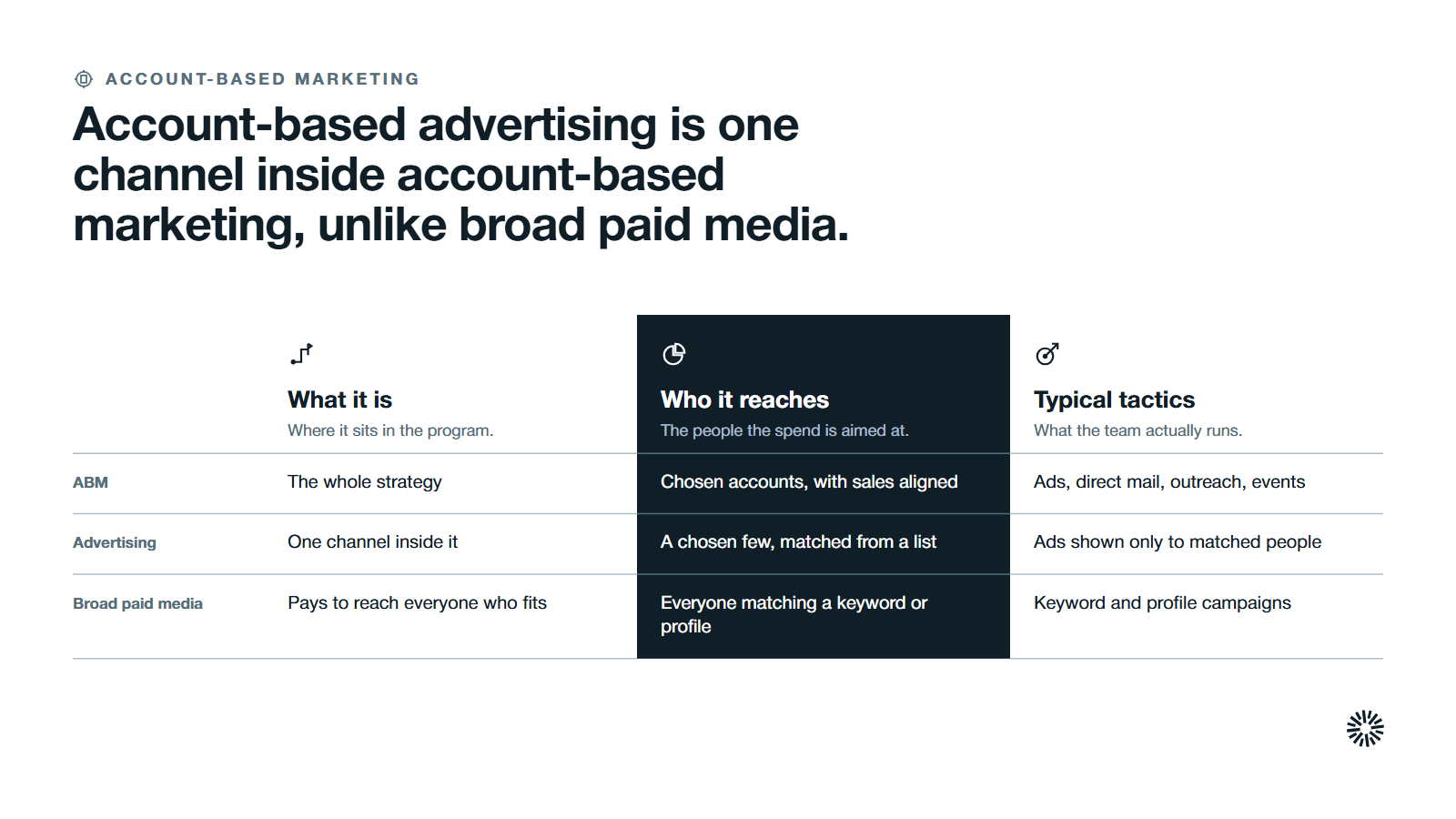
The two terms are often used as if they meant the same thing. They do not. Account-based marketing is the whole strategy: choosing accounts, aligning sales and marketing, and running coordinated plays. Account-based advertising is one channel inside it.
Your account based marketing strategy decides which accounts matter, and advertising is one of the tactics that reaches them. Other account based marketing tactics include direct mail, sales outreach and events. For the full picture, read our complete guide to account based marketing strategy.
Most account based marketing efforts also lean on shared account based marketing tools, such as a CRM and an ad platform, so choose account based marketing software only after the plan is clear.
Account based marketing abm programs succeed when marketing and sales efforts point at the same accounts, and ABM success depends far more on that agreement than on any one tool.
Our explainer on what account-based marketing is covers the strategy, and the ultimate guide to ABM goes deeper. To see how programs look in practice, read these account-based marketing examples.
Account-based advertising also differs from the paid media most teams already run. Broad campaigns, like traditional marketing and inbound marketing programs, pay to reach everyone who fits a keyword or profile. Account-based campaigns pay to reach a chosen few, at a smaller scale and often a higher cost per person reached.
Marketing campaigns that target key customers in this way suit companies with a limited number of high value customers, where each win is large. Specific high value accounts justify personalized marketing campaigns, direct mail campaigns and a named sales rep.
Marketing resources are finite, so spend them where one account can change the year.
The two approaches work together, because inbound content builds awareness while ABM campaigns focus effort on specific accounts.
Where account-based advertising runs out of room
The approach has real limits, and a good plan names them up front. Knowing them early keeps you from promising sales or finance more than a small, targeted audience can deliver.
Match rates and audience size
Not every account can be matched, and platforms set minimum sizes. LinkedIn's help page on targeting options states that the minimum audience size required to run an ad set is 300 member accounts.
A tight top tier of a few dozen companies may not reach that on its own, so you may need to combine tiers or widen the targeting.
Google adds its own rules. Its Customer Match memberships expire after 540 days, and to keep a list eligible you need at least 100 members added or updated within that window. Refresh lists on a schedule instead of uploading once.
Small audiences wear out
A small audience sees the same ad many times. Rotate creative, set frequency limits where the platform allows it, and watch for the point where the same people are simply being annoyed.
Ads alone rarely close an account
Advertising builds familiarity. It does not replace a conversation. Pair the ads with sales outreach, content and follow-up, and measure them as part of one program instead of on their own.
What you gain when this is done properly
When the list, the creative, the consent rules and the measurement are all in place, each team gets something it cannot get from broad campaigns.
Sales gains warmer conversations
Marketing and sales teams work from one list, which supports sales alignment and marketing alignment. That shared ABM approach lets a sales rep engage accounts moments after the ads have warmed them.
Sales efforts start with people who have already seen the company's name and message, which can shorten the sales cycle for the accounts that matter.
Because the audience is the account list the team chose, advertising supports the accounts sales actually cares about, not a general crowd.
Marketing gains a way to spend where it counts
Marketing can show that paid spend went to the correct accounts and report what those accounts did next. Over time, relationship building with those accounts becomes visible in the data, so ABM efforts are easier to defend and the business can expand with the accounts that respond.
That replaces a broad reach number with a view of progress against a list.
It also makes budget decisions easier to defend and ties marketing efforts to revenue growth and business growth instead of reach alone.
Customer success gains a view of existing accounts
The same approach works for accounts you already serve, and it helps customer success protect the key customers who matter most. Understanding the buyer journey of an existing account shows when an expansion message fits.
Customer success can use matched audiences, aimed at existing customer accounts, to support adoption, expansion and renewal messages for the accounts they own, using lists they already maintain.
Make account-based advertising part of one system
Account-based advertising works when the list, the audience and the pipeline sit in connected systems, and when ABM programs treat advertising as one part of a larger plan.
When they sit in separate tools, the ads run without anyone knowing what happened to the accounts. Our guide to B2B demand generation covers that wider view.
Propello designs and builds connected go-to-market systems on HubSpot. If you cannot yet say which of your target accounts are engaging and which have gone quiet, an audit is the place to start.

/the-ultimate-guide-to-abm-share-1200x630-v2.png)