

If you lead marketing or revenue at a B2B company, an SEO competitor analysis, a kind of competitor analysis built for search, shows you who is winning the searches your buyers run, why they are winning them and which of those searches you can realistically win next. It is a form of competitive analysis that replaces guesswork about what to publish with competitor intelligence taken from search results, so your SEO efforts go where search engine rankings are open to you.
This guide is for marketing leads, content owners and the revenue leaders who fund them. You get six steps, each ending with what done looks like, plus the checks to make first and the mistakes that waste a quarter.
|
SEO Competitor Analysis The practice of studying the sites that rank for your target searches, including their keywords, content, links and technical setup, to find gaps and opportunities for your own SEO strategy. The same method is also called competitor SEO analysis or SEO competitive analysis. |
By the end you will have a competitor-informed plan
A competitor analysis is not a spreadsheet of rival metrics. It is a short list of decisions you can act on, backed by what competitors rank for and how they earned it. The SEO competitor analysis process below gives you valuable insights.
- A confirmed list of the main competitors you actually meet in search results.
- A map of competitor keyword coverage against yours, with the keyword gaps and content gaps marked.
- A view of the page types and search intent that win each target query.
- A high-level read of competitors' backlink profiles and brand mentions.
- A ranked plan of gaps to close and wins to protect, with an owner for each.
What to have in place before you start
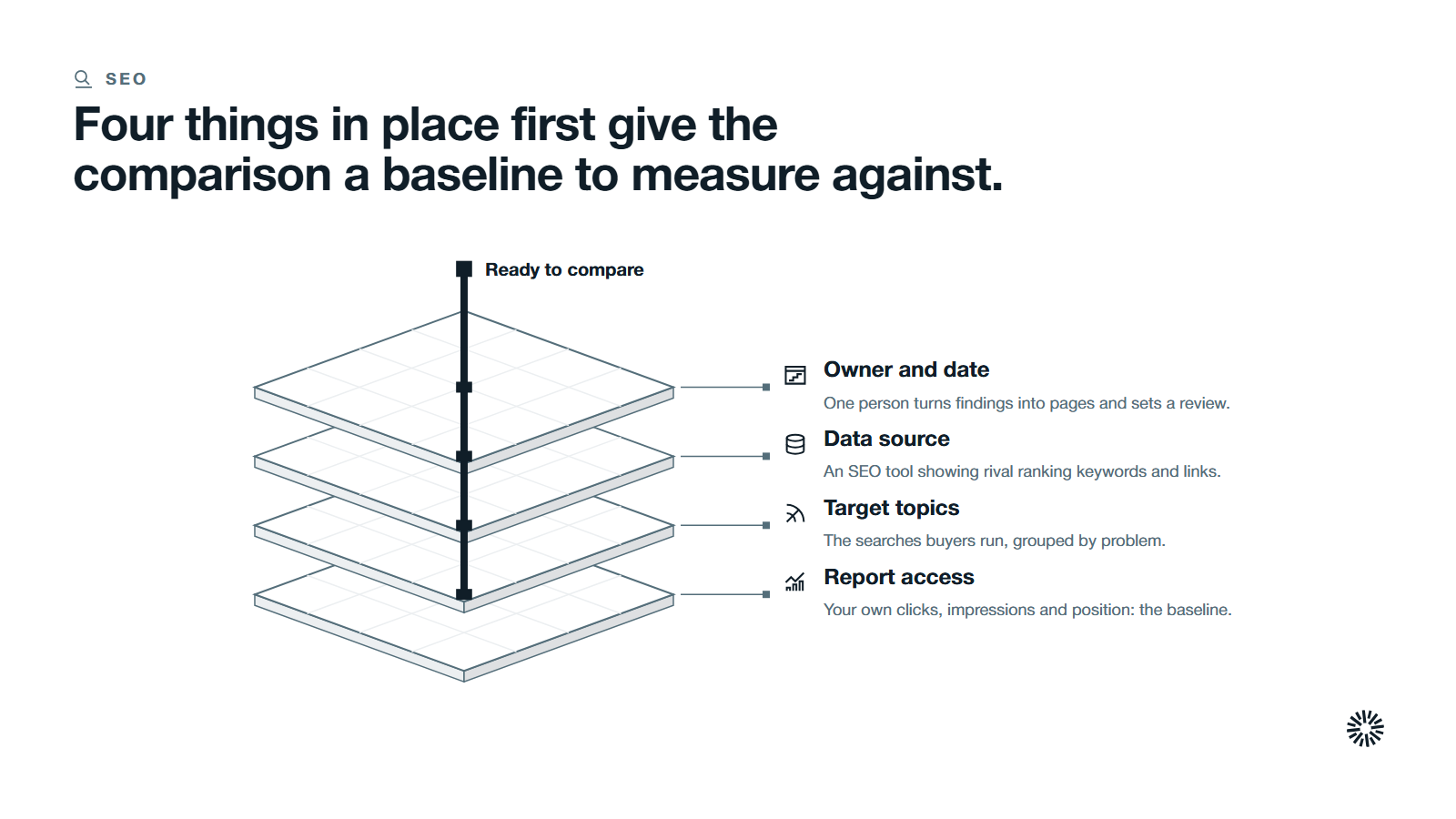
Competitor research is only useful when it is compared with something. Gather these first.
- Access to Google Search Console. Its Performance report shows your clicks, impressions, click-through rate and average position, which is your baseline.
- A list of your target topics. Write the searches your buyers run, grouped by the problem they are solving. Your keyword research and target keywords belong here, along with the landing pages that serve them. If your keyword research is thin, extend it before you compare, so the competitor lists have target keywords to be checked against.
- A competitor data source. Propello uses Semrush for this work. Any of the many competitor analysis tools that show ranking keywords and linking domains for another domain will do.
- An owner and a review date. Name the person who will turn findings into pages and the date you will check results.
If you do not yet have a plan to feed the findings into, read how to build an SEO strategy first. For the groundwork on how search engines find and rank pages, see what SEO is and how it works.
What counts as a competitor in search
Your direct business competitors are the companies that sell what you sell. Your SEO competitors are the sites that appear for the same search queries, and they often include publishers, software review sites and associations that sell nothing. Both matter, but they teach different lessons. Search engine optimization is the practice of earning visibility in search results, so the SEO competitors are the ones that matter most here. Looking at multiple competitors, not one, keeps you from copying a single rival.
SEO competitor analysis in six steps
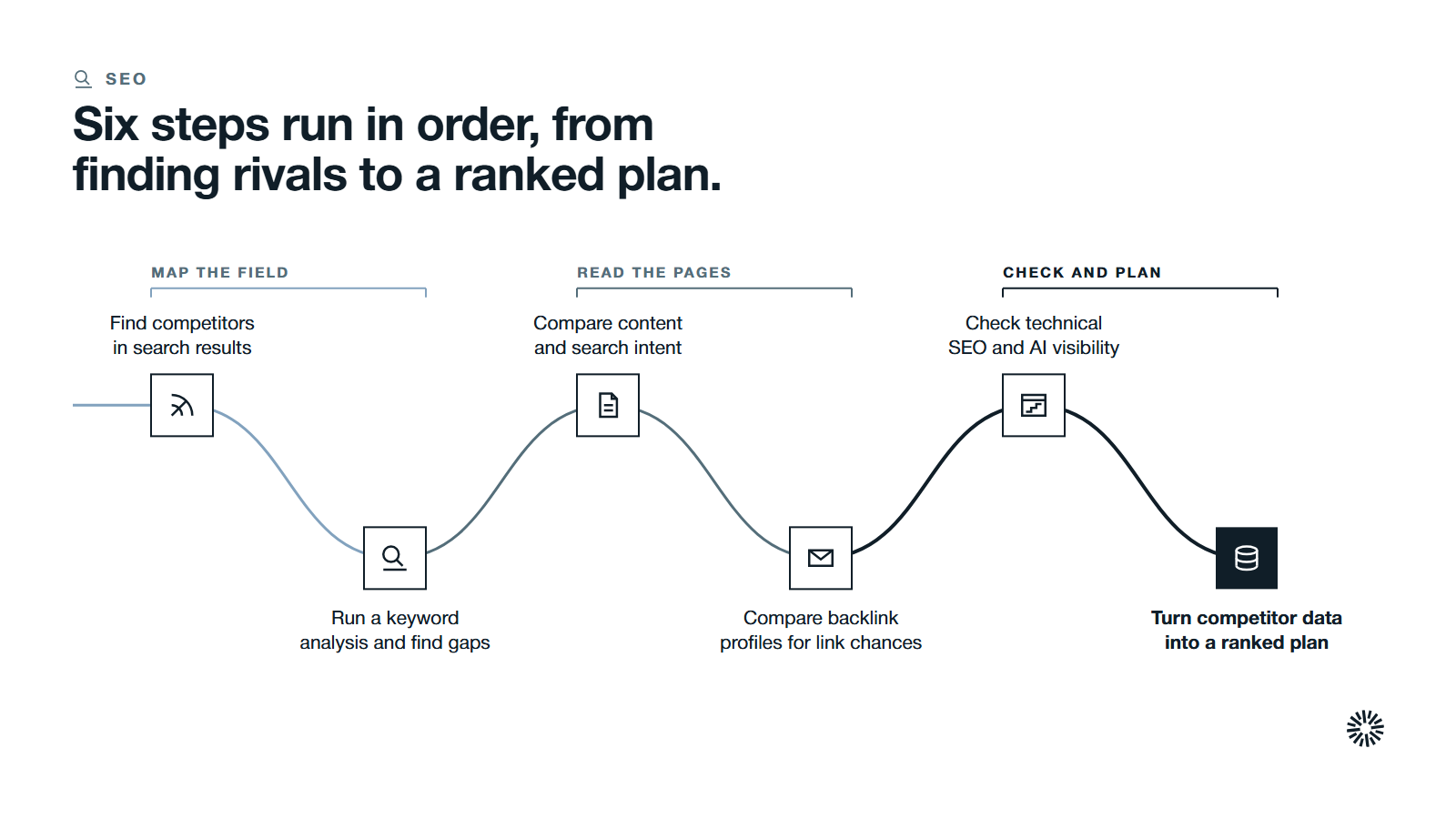
Work through the steps in order, because each uses the output of the one before. Keep notes in one shared document so the plan in step six traces back to evidence.
1. Find competitors in search results
Start with the list you already have of direct business competitors. Then add the sites that actually show up when you search your most important queries. Search each target topic in a private browser window and record every domain on the first page of search results.
Count how often each domain appears across your topics. The domains that appear most are your main competitors in search, whether or not your sales team ever meets them. These competing sites share your audience and your organic search demand. A tool can also list domains with overlapping keywords, which is a quick way to find competitors you missed. Open each of your competitors' websites and note what it sells and who it targets. A domain overview in your tool gives a quick snapshot of each competitor's search visibility. Some tools add a competitor dashboard that shows search visibility trends over time for a competitor's site, which helps you see who is gaining ground. Compare the core features of tools before you choose one. Add every SEO competitor you find to the shared list.
Cut the list to a handful. A small set of relevant competitors beats a long list you never study. Keep two or three direct rivals, two or three search competitors and one site that is a strong example of the content you want to match.
You are done when you have a short list of named domains, each tagged as a direct competitor, a search competitor or a model to learn from.
2. Run a competitor keyword analysis and find keyword gaps
Now compare what each competitor ranks for with what you rank for. A competitor keyword analysis pulls the keywords a competitor's domain ranks for, so you can see where their search visibility comes from. Use your tool's organic research view for each competitor's domain, then compare the lists with your own domain. Your tool may also show a competitor's ad history in paid search, which hints at the terms it values. Check historical data where your tool offers it, so you see whether a competitor's keyword rankings are rising or falling.
The comparison gives you three groups. Keywords you share with competitors show the contested ground. Keywords only they rank for are your keyword gaps. Keywords only you rank for are strengths to protect. This keyword gap analysis is the core of the SEO competitor analysis process, so take your time over it. It is how you find keyword gaps and identify keyword opportunities your content strategy has missed. The results also feed back into keyword research, so add every new target keyword you discover.
Filter before you celebrate. Remove branded terms, irrelevant topics and anything your buyers would never search. Then sort the remaining keyword opportunities by how closely they match what you sell, not only by how many people search for them. Mark high converting keywords, the ones that bring buyers rather than readers, first. Note which rivals attract the most traffic to which pages, and how much effort they put into each topic through the number of pages and how often they update them. Pages with the most traffic deserve the closest look. Look closely at long-tail keywords, the longer and more specific searches, because they show precise buyer needs. Keyword difficulty, as your tool estimates it, helps you judge which of these you can rank higher for, but treat it as a rough guide.
Use Google Search Console to check your own side of the comparison. Its Performance report groups your data by query and page, so you can see which of your pages already hold part of a topic and what your organic traffic from search looks like today.
You are done when you have a filtered list of keyword gaps, each tied to a topic your buyers care about.
3. Compare competitors' content and the search intent behind it
A keyword gap tells you what a competitor ranks for. It does not tell you why. For each priority query, open the pages that rank and read your competitors websites as a buyer would, from search result to conversion page.
Note the page type: a guide, a comparison, a product page, a glossary entry or a tool. That tells you the search intent, also called user intent, that Google is rewarding. If every top result is a how-to guide and you only have a sales page, you do not have a ranking problem. You have an intent mismatch.
Then read the competitors' content in full. Content evaluation means judging the quality, depth, format and user engagement of each page. Compare structure, examples, how current it is and whether it answers the question in the first screen. Google's guidance on helpful content asks you to avoid "search engine-first content" and to ask whether you are mainly summarizing what others say without adding value. Use that as the test. Copying a competitor's outline gives you a worse copy of it. Treat what you learn as competitive intelligence for your whole content team, and list the content gaps it exposes.
Look at the SERP features too. Featured snippets, video results and AI answers show which formats searchers get, and your existing content may already fit one of them. Our piece on AEO vs SEO explains how answer engines read the same pages.
You are done when each priority query has a note on the winning page type, the intent and what your page would add.
4. Compare backlink profiles and find link building opportunities
Links and mentions from other sites are a signal that other people consider a page worth citing. At this stage you want the pattern, not a forensic audit. Check which domains link to your competitors' backlink profiles and best pages and whether those same sources would plausibly link to yours. A competitor's backlinks can inform your own link strategy.
Look for link building opportunities that come from the content itself: original research, tools, templates and guides that others reference. Look also for the kinds of sites that mention competitors, such as industry associations, publications and partner directories. If the same site covers several competitors and not you, that is a gap.
Treat links as evidence of quality, not as a shopping list, and as one signal among many in search rankings. Google's spam policies define link spam as "creating links to or from a site primarily for the purpose of manipulating search rankings". Plan to earn links with content worth citing. For the wider picture, see brand mentions vs backlinks.
You are done when you can name the types of sites that link to or mention competitors, the pages they cite and the two or three you could realistically earn.
5. Check technical SEO and AI search visibility
Technical SEO explains why some competitors win. They are easier for search engines to crawl, load quickly and make clear who they are and what they cover. A technical assessment checks site architecture, mobile responsiveness and page speed on each priority competitor. Add clean URLs, structured data, Core Web Vitals and how their topic pages link to each other, because together they show a competitor's technical health.
Then check entity clarity. Look at how consistently a competitor names its products, people and concepts across its site, and whether its pages cover a topic from several angles. Our guide to entity authority and the knowledge graph explains why that consistency helps.
Add a short AI search check of competitor visibility, sometimes called AI visibility. Ask a few of your target questions in the AI tools your buyers use and note which competitors are cited. Google states that the best practices for SEO remain relevant for its AI features and that there are no additional requirements to appear in them. Study the pages that AI answers cite in the same way as any ranking page. Tools can also benchmark competitor visibility in AI search over time.
You are done when each priority competitor has a one-line note on technical strength and a note on whether AI answers cite them.
6. Turn competitor data into a ranked plan
Analysis without a plan is a report nobody reads. Pull your competitor data into one table with a row per opportunity, so your SEO strategy rests on evidence and your content strategy has a ranked backlog. Your own strategy should name the topics where you can rank higher, and say why. Give each row the query, the gap, the evidence, the page to create or improve and an owner.
Sort the rows by two questions. How close is the topic to what you sell? How realistic is it to match the quality of the pages already ranking? Start with the topics where both answers are strong. This is how an SEO strategy becomes specific. Competitive analysis is only as good as the plan it feeds. Mark quick wins, such as improving a page that already ranks, apart from larger bets, such as a new content cluster.
Record the wins too. Where you already outrank competitors, note what the page does well so the next page copies your own standard. Then set a review date and compare clicks, impressions and position in Search Console against your baseline to track whether your search rankings and SEO performance move.
You are done when the plan lists a ranked set of pages to create or improve, each with an owner, a target query and a review date.
Mistakes to avoid in an SEO competitor analysis
Most weak analyses repeat a handful of errors. Check yours against this list.
- Focusing solely on direct business competitors. The sites that take your search traffic may sell nothing.
- Chasing every keyword gap. Many gaps are irrelevant to your buyers. Filter first.
- Copying structure instead of adding value. A near copy of a ranking page has no reason to outrank it.
- Ignoring search intent. A keyword with the wrong page type is hard to rank however well you write.
- Treating tool metrics as facts. Every tool estimates traffic and difficulty, and no single tool score is a major ranking factor. Use them to compare, then check against your own Search Console data.
- Buying links to match a rival. Manufactured links carry risk. Earn them.
- Running it once. Competitors publish every week. A one-off report ages quickly.
What you gain when this is done properly
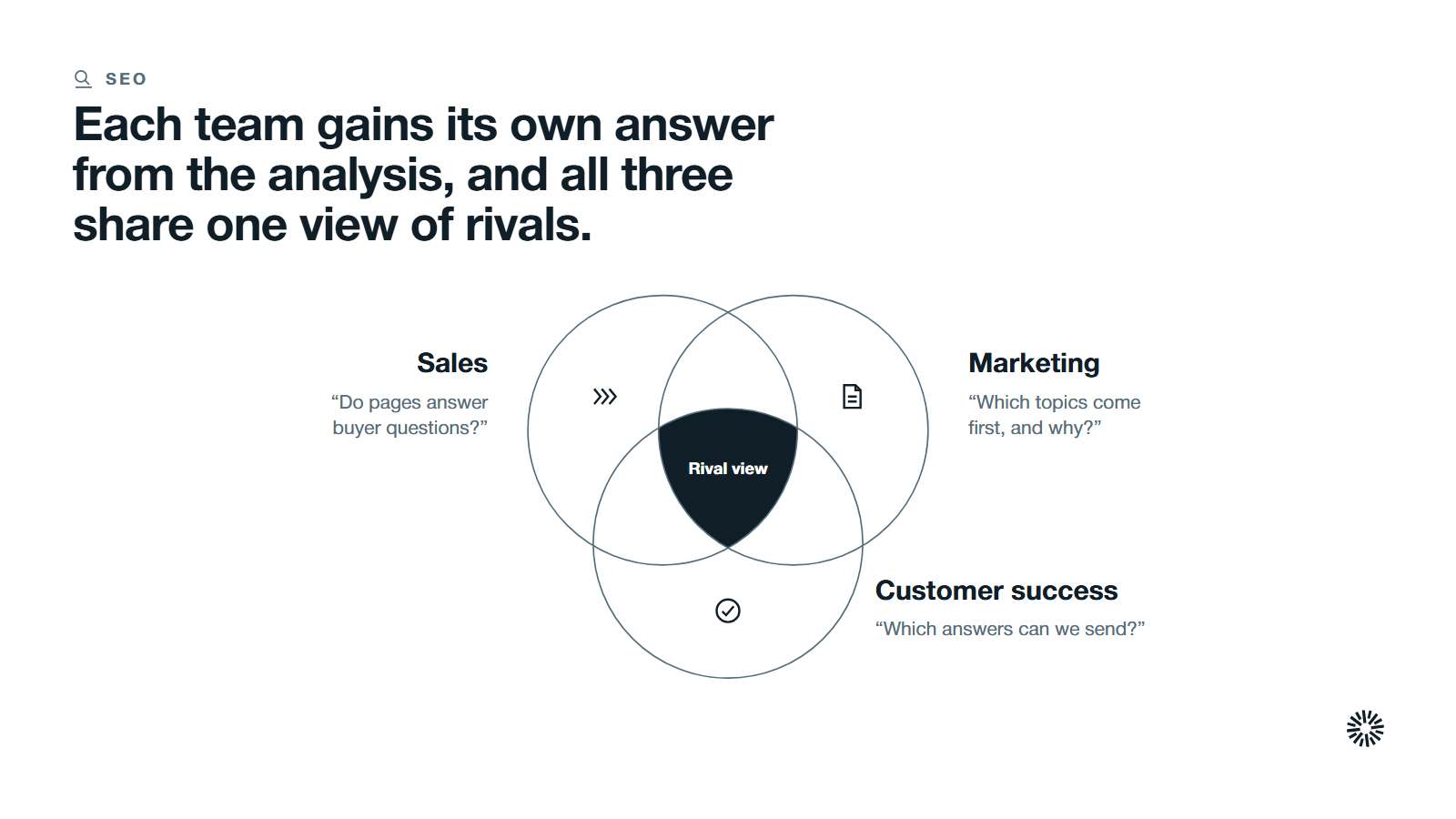
A shared view of the competition changes how three teams work.
Sales gets content that answers the questions buyers bring
When pages match the questions buyers ask, prospects arrive already informed. Sellers spend less time explaining basics and more time on fit.
Marketing gets a plan built on evidence
The analysis replaces opinion with a ranked list of pages, owners and review dates. Editors know which topics to prioritize and why, and the team can see which of its own pages are strengths worth protecting.
Customer success gets clearer answers to publish
The gaps in competitor content often match questions customers also ask. Filling them gives customer success pages to send, so common questions are answered without a ticket.
Keep the analysis current
Repeat the SEO competitor analysis on a set schedule, such as every quarter, and check the main competitors' new pages between reviews. Search results, paid search listings, competitors and AI answers all change, so the plan should adapt. Regular competitor analysis, with ongoing performance measurement against competitors, keeps it honest. Aim the work at searches that bring qualified leads.
Propello designs and builds connected go-to-market systems on HubSpot. If you want your search findings connected to tracking and reporting so SEO work links to pipeline, an audit is the place to start.
