If you lead sales at a growing B2B company, a sales playbook is the document that tells your reps who to sell to, what to say at each stage and what to do when a deal stalls. A good one turns what your best sellers do into something the whole sales team can repeat.
This guide is for CEOs, founders, CROs and sales managers, and the marketing and customer success leads who contribute. You get nine steps with a finish line each, a plain template outline to copy, the checks to make first and the mistakes to avoid.
|
Sales Playbook A living document that records your sales process, your ideal customers, the plays reps run at each stage and the words that work, so every seller handles a deal the same proven way. |
By the end you will have a sales playbook your reps open every week
A useful playbook is short enough to scan before a call and specific enough that a new hire can act on it in the first week.
- One written ideal customer profile and a set of buyer personas, with the problem each persona wants solved.
- Sales stages with entry and exit rules, and lead qualification criteria that decide who moves forward.
- A small set of sales plays, each with a trigger, steps, talk tracks and the content that supports it.
- Answers to the objections reps meet most, and clear handoffs between teams.
- A review rhythm that keeps the document current and shows whether it works.
What to have in place before you start
Most playbooks fail before a word is written, because nobody agreed what the document is for or who owns it. Settle these five things first.
- A sales process you can describe. If every seller closes deals in a different way, you need to write down the best version before you can teach it.
- A clear sales team structure. Know which roles sell, which support and who manages them, so each page names the right team members.
- One owner. A sales leader or sales operations lead is accountable for the playbook, even when many people contribute.
- Access to your best sellers and your deal data. The playbook records what works, so you need real calls, real emails and the closed-won and closed-lost history in your CRM.
- A short list of the goals it serves. For example faster onboarding, steadier conversion or fewer stalled deals. One or two goals keep the document focused.
A playbook is not the same as a company-wide plan. Your go-to-market playbook sets direction across marketing, sales and service. A sales playbook sits beneath it and covers how reps run deals day to day.
It is also one of the core assets of sales enablement, the discipline that equips sellers to do their work well.
A sales playbook in nine steps
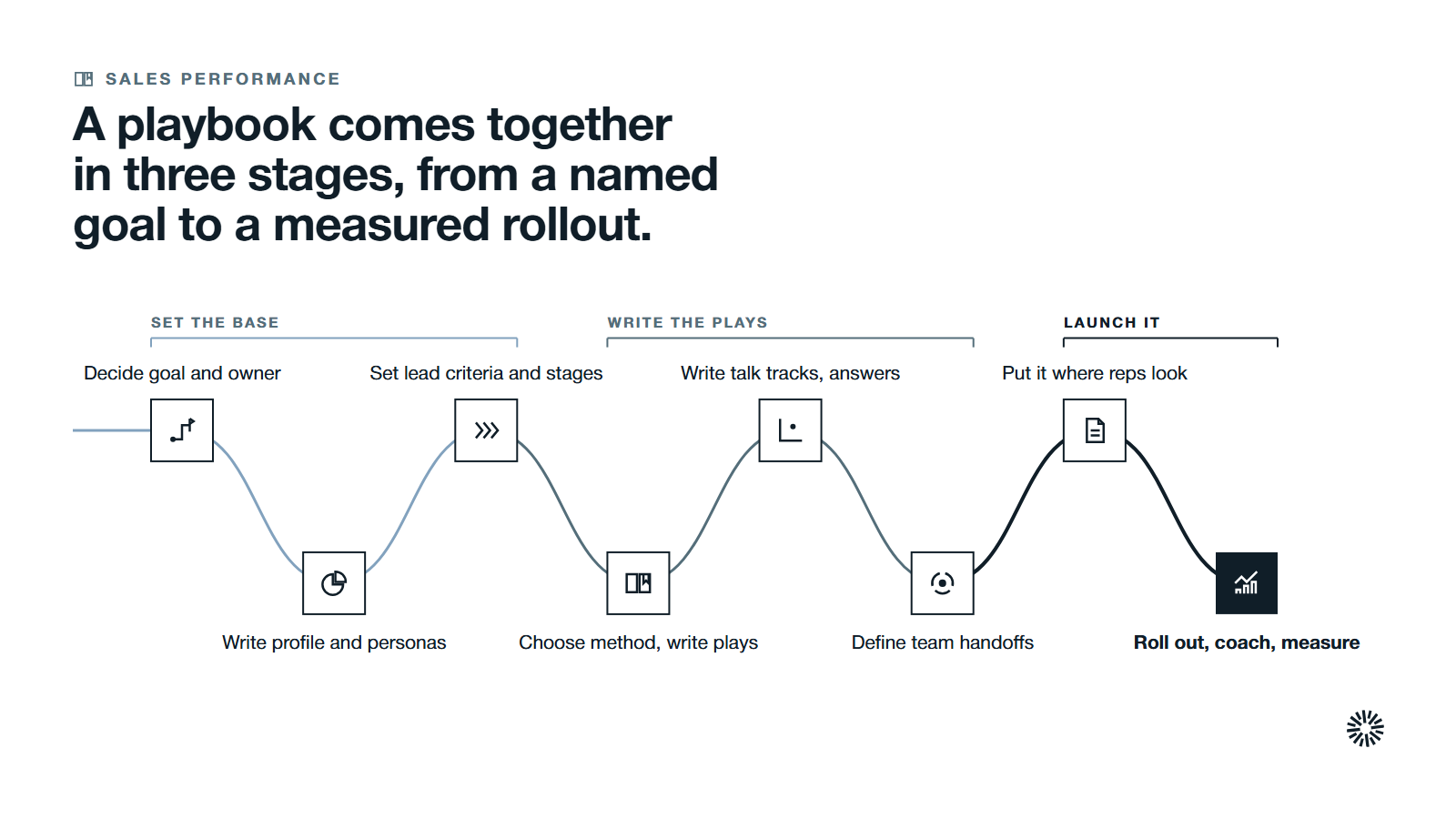
Work through the steps in order, because each one depends on the one before. Every step ends with what done looks like. Plan on a first working version in a few weeks, not a polished manual.
1. Decide what the playbook must change and who owns it
Start with the problem. A sales playbook can speed up onboarding, lift conversion from one stage to the next, shorten the sales cycle, or make forecasts more reliable.
Pick the one or two that matter most this year, then tie them to sales targets your team already tracks and to your wider sales strategy and company strategy. A well crafted sales playbook gets the entire team pulling in the same direction.
Name the people who will build it. Include sales managers, two or three top reps, someone from marketing who owns messaging, and a customer success lead who knows what happens after the sale.
Reps who helped write it are far more likely to use it, and their feedback keeps the content grounded in what happens on real calls.
Finally, set the review date. A playbook with no scheduled review goes stale within a quarter.
You are done when one page states the goals, the owner, the contributors and the first review date.
2. Write down your ideal customer profile and buyer personas
Every other page rests on knowing who you sell to. Your ideal customer profile describes the kind of company that gets the most value from your product and stays longest. Buyer personas describe the people inside those companies.
Start with your best customers, not your hopes. Look at the accounts that closed fast, grew and renewed. Note their size, industry, tools and the trigger that made them buy.
This tells you which target customers to chase and which potential customers to leave alone. If you have not written this down, use the ideal customer profile template first.
For each persona, record the role, the goals, the pain points, the questions they ask and who else sits on the buying group.
The target audience for your messaging is the persona, not the company. Good personas also describe the target market in human terms, which helps reps understand customer challenges before the first call.
You are done when each persona fits on half a page and a rep can say in one sentence what problem that person wants solved.
3. Set lead qualification criteria and define your sales stages
Reps need a shared answer to two questions: who is worth pursuing, and where is this deal right now. The first is your lead qualification criteria. The second is your sales process, written as stages.
Lead qualification criteria are the short list of facts that mark a good fit: company profile, a confirmed problem, a role with authority or influence, budget and timing.
Write them as yes or no checks so two reps reach the same answer. Clear criteria help reps qualify leads quickly and stop time going to accounts that will never buy.
Then define each stage of the sales cycle. For every stage, write what the buyer is trying to do, what the rep must do, and the exit rule that lets a deal move on.
The article on sales pipeline stages shows how to name and order them. Stages also describe the sales funnel in terms a rep can act on, which helps with moving deals forward.
In HubSpot, you can mirror these stages in your deal pipeline so the CRM and the document agree. Marketing should see the same definitions, because they decide which leads marketing passes to sales.
You are done when a new rep can read any deal record and say which stage it is in and what must happen next.
4. Choose a sales methodology and write your sales plays
A sales methodology is the way your team qualifies, discovers and closes. Many teams use a recognized framework; others write their own from what top reps do.
Either works, as long as it is applied the same way in each conversation and written in plain words. Detailed methodologies and processes are the backbone of an effective sales playbook.
Next, write your sales plays. A sales play is a repeatable set of actions for one situation, such as a first meeting with a new inbound lead, a renewal conversation, entering a new vertical or responding to a competitor's move.
Keep each play to a single page. Give it a trigger, the goal, the steps in order, the people involved and the content to use.
Start with the three situations that happen most often or cost the most when handled badly. Sales plays also spread best practices from your strongest reps to everyone else.
You are done when you have a small set of sales plays, each with a trigger and an owner, and each one fits a page.
5. Write talk tracks, call scripts and email templates
This is where the playbook helps a rep in the moment. A talk track is the set of key points and questions for a conversation. It is a guide to the order and the ideas, not a script to read aloud.
Take the words from real sales calls. Listen to recordings of your best sales conversations and note how top reps open, how they ask about the problem and how they explain the value proposition in the buyer's language.
Add talking points for each persona, plus the key points reps must not skip, since a finance leader and an operations leader care about different outcomes.
Include call scripts for the moments that are hard to improvise, such as the first call to a cold lead, and email templates for follow-up after meetings. Mark the lines you want repeated exactly and the ones reps should put in their own voice.
You are done when a rep can open the document before a call and find the questions to ask, the points to make and a follow-up email to send.
6. Prepare answers to the objections and competitor questions
Every team hears the same objections: the price is high, the timing is wrong, a competitor is already in place, or the buyer needs to talk to someone else. Collect them from your CRM notes, lost-deal reasons and recorded calls.
For each objection, write what the buyer usually means, a question that finds the real concern, and a response that has worked. Add the proof that supports it, such as a customer story you are allowed to share. Do not invent proof.
Add a short section on competitors: how buyers see them, where you fit better and where you do not. Honest guidance builds trust with reps and buyers alike.
You are done when the most common objections each have a meaning, a question, a response and a supporting asset.
7. Define the handoffs between teams
Deals stall at the edges between teams. Marketing hands a lead to sales, sales hands a closed deal to customer success, and each handoff loses information when nobody wrote down what must move across.
For every handoff, list what the receiving team needs to know and by when. For a marketing-to-sales handoff, that may be the lead source, the pages the buyer viewed and the problem they named.
For a sales-to-customer-success handoff, it is the goals the buyer expects, the people involved and any promises made during the sale.
Set response times and decide where the information lives. Keep it in the CRM, not in a private notes file. Clean sales data also lets you see where handoffs break.
Gartner's March 2026 survey of 646 B2B buyers found that 67% prefer a rep-free experience, so buyers often arrive well informed. Your handoff must carry what they already told you.
You are done when each handoff has a written checklist, a response time and one place where the information is stored.
8. Assemble the pages and sales tools into one playbook your team members can find
Now bring the pieces together into a step by step guide a rep can follow. Keep the structure simple, because a long manual nobody can navigate defeats the purpose.
Here is a plain sales playbook template outline you can copy, with the key components in the order a rep needs them.
- Purpose and goals. What the document is for, who owns it and the sales targets it supports.
- Company overview and value proposition. Who you are, what you sell, the problem you solve and the key benefits, in your customers' words.
- Ideal customer profile and buyer personas. The pages from step two.
- Sales process and stages. Lead qualification criteria, stage definitions and exit rules from step three.
- Sales methodology and sales plays. The framework you follow and one page per play.
- Talk tracks, call scripts and email templates. The words from step five.
- Objections and competitors. The answers from step six.
- Product and pricing details. What each offer includes, how it is priced and the rules for discounts.
- Sales tools and sales collateral. The sales enablement materials reps use: where each asset lives, which tool does what, and which content fits which stage.
- Handoffs and team structure. Who does what, and what moves between teams.
- Metrics and review. The key performance indicators (KPIs) you track and when the document is reviewed.
Put the document where reps already work. HubSpot's own documentation describes playbooks as interactive content cards displayed on contact, company, deal and ticket records, so a rep can see the guidance while speaking with a prospect.
A shared page or wiki works too, if reps can reach it in two clicks.
You are done when every rep can find any play, script or objection answer in under a minute.
9. Roll it out, coach to it and measure what changes
Launching is where most playbooks die. Treat the rollout as a change, not a file share. Walk the sales team through the document, role-play two or three plays and show where to find everything.
Build the playbook into sales training and the onboarding process so new reps learn from it from day one.
Managers matter most. They should use the playbook in deal reviews and coaching, asking which play the rep is running and what the stage rules say. Reps follow what managers inspect.
Measure with a small set of sales metrics tied to your goals from step one: conversion between stages, sales cycle length, average deal size, win rate and the time a new rep takes to reach full productivity.
Add one adoption measure, such as how often plays are used. Customer satisfaction scores can show whether better sales performance is also a better experience for buyers.
Salesforce's State of Sales report for 2026, a survey of 4,050 sales professionals, found that the average seller spends 40% of their time selling. A playbook that saves search time and guesswork helps give some of the rest back.
If the numbers show where deals stall, fix those bottlenecks first, so the playbook improves the parts of the sales organization that hold results back.
Review on schedule, and at least every quarter. Track usage data to find gaps: ask reps which pages they never open and which are missing, and audit the content against your current strategy.
Update the pages that changed, retire the ones that did not help and record the changes. A living document earns trust because it keeps pace with your product, pricing and market.
You are done when the rollout has happened, managers coach to it, the measures are on a dashboard and the next review is on the calendar.
Mistakes that leave a sales playbook unused
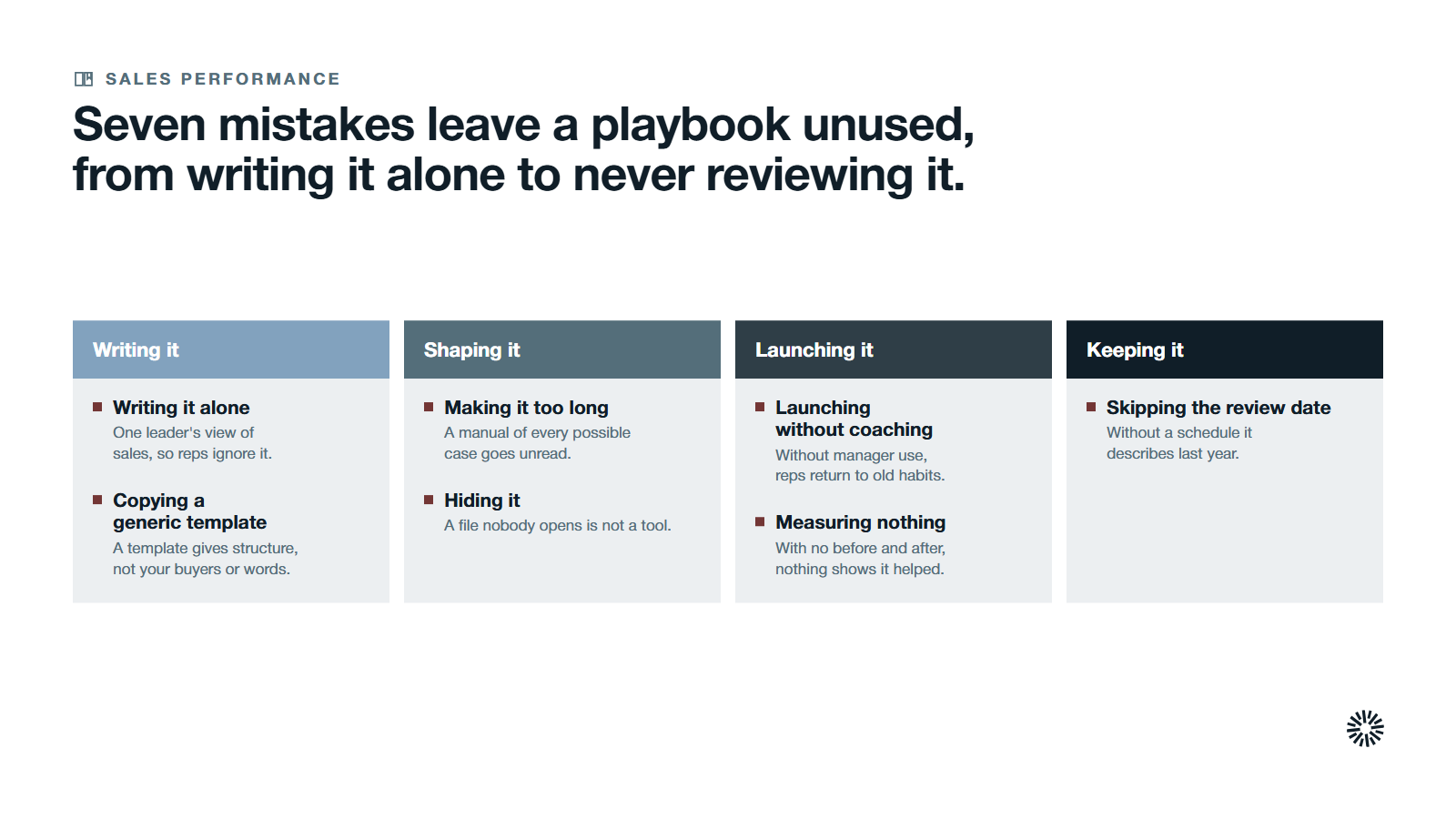
Most failed playbooks repeat the same errors. Check yours against this list before you launch.
- Writing it alone. A document written by one leader describes how they think sales works. Involve top reps and managers, or reps will ignore it.
- Making it too long. A manual of every possible case goes unread. Start with the plays that matter most and add later.
- Copying a generic template. Templates give you a structure, not your customers, your buyers or your words. Fill every section with your own material.
- Skipping the review date. Products, buyers and competitors change. Without a schedule, the playbook describes last year.
- Launching without coaching. If managers do not use it in deal reviews, reps return to old habits within weeks.
- Hiding it. A file in a folder nobody opens is not a tool. Put it inside the CRM or the place reps already work.
- Measuring nothing. Without a before and after, you cannot show whether it helped or which pages need work.
What you gain when this is done properly
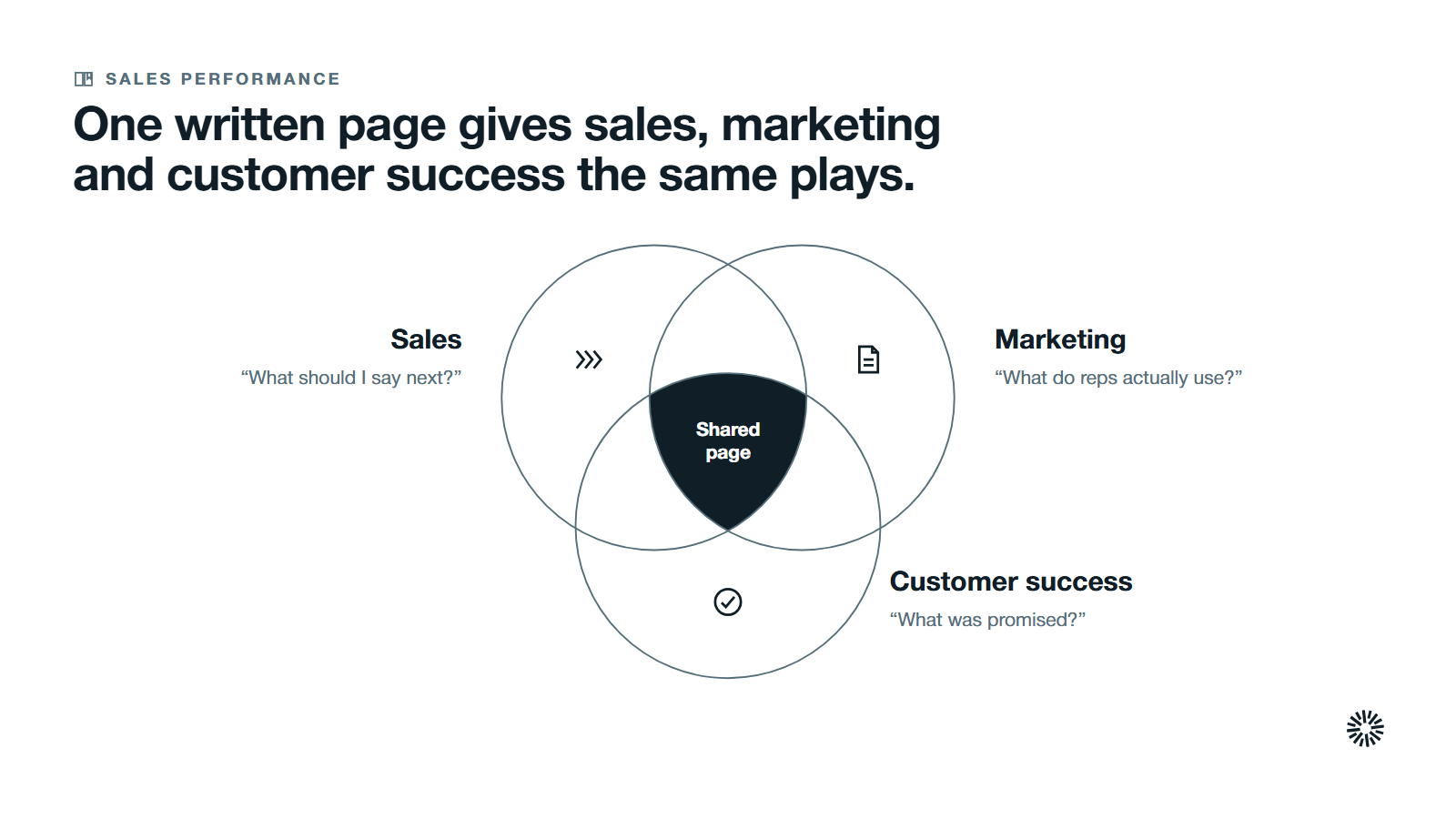
A sales playbook that is current and trusted changes how each team works. The gains are practical and show up quickly.
Sales gets faster onboarding and steadier deals
New reps learn from the documented best practices instead of guessing, so onboarding moves faster and they become productive sooner.
Managers coach to a shared standard, and reps spend less time hunting for the right asset before a call. A written process also helps shorten the sales cycle, because fewer deals stall for lack of a next step.
Marketing gets a clear view of what sales needs
The marketing team sees which personas, messages and proof reps use in real conversations. That guides marketing messaging and the sales enablement content it builds, so the materials it produces support the plays reps actually run and stay useful to the whole sales department. For the full picture, read our complete guide to sales enablement strategy.
Customer success gets a cleaner start with every customer
Because the handoff is written down, customer success starts each account knowing the goals, the people and the promises. That protects existing customers and makes later conversations about renewal and growth easier. Buyers also get a better experience, because the solution is tailored to what they already said.
Turn your sales strategy into a document your whole team can use
A sales playbook is a decision made once and shared often: who you sell to, how a deal moves, what to say and who does what.
Build the first version quickly with your top reps, put it where they work and improve it on a schedule. Your own playbook will be better than any template because it holds your buyers and your words.
Propello designs and builds connected GTM systems on HubSpot. If you want your sales stages, handoffs and reporting set up so a playbook stays in step with your CRM, an audit is the place to start.