If you lead customer success, marketing or revenue at a B2B company, a customer referral program is a repeatable way to turn satisfied customers into introductions to buyers like them. It works when the offer, the ask, the tracking and the reward are written down before the first request goes out.
This guide is for the revenue, marketing and customer success leads who will run the program. You get six steps, each with a finish line, the checks to make first and the mistakes that stall referral programs in their first quarter.
|
Customer Referral Program A structured process that invites existing customers to introduce new prospects to your company, then tracks each introduction and rewards the customer when it becomes a qualified opportunity or a closed deal. |
By the end you will have an effective referral program you can launch next month
A well designed referral program is small enough to explain in one minute and specific enough for any account manager to run.
- One written offer that says what both the referrer and the referred company receive.
- A definition of a qualified referral that sales and customer success both accept.
- A short, simple referral process for a customer who wants to make an introduction.
- Tracking in your CRM, so every referral can be traced from the first mention to the closed deal.
- Referral rewards, a payout routine and a review date to decide what to keep.
What to have in place before you start
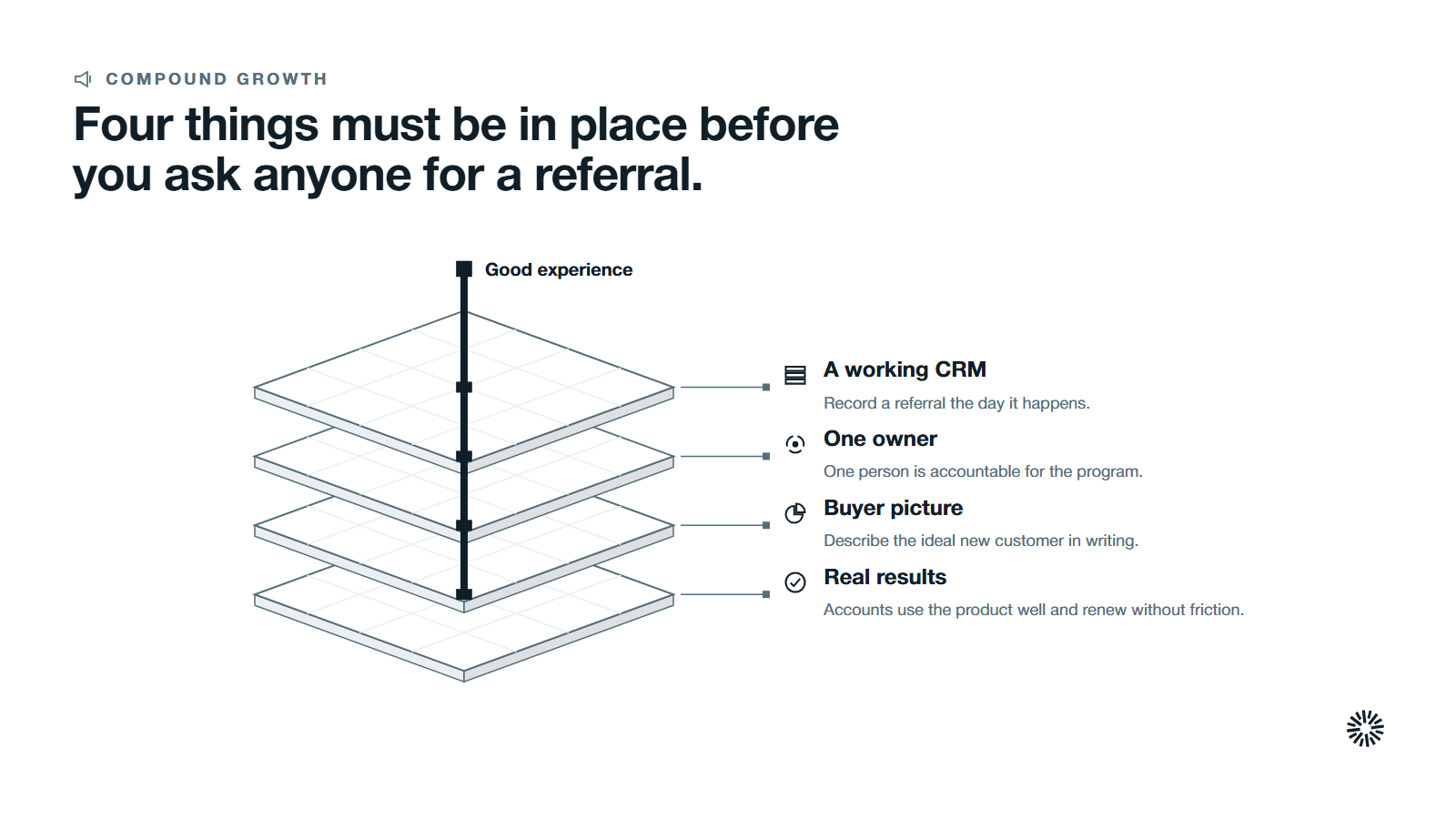
Referrals only follow good experiences. Close these gaps before you ask anyone for anything.
- Customers who are getting results. Pick the accounts that use your product well, renew without friction and answer your messages. Your customer success data shows these satisfied customers and loyal customers.
- A clear picture of the buyer you want. If you cannot describe the ideal new customer, referral programs will bring you the wrong ones. Use the ideal customer profile template to write it down.
- One owner. Name one person accountable for the program, even when sales, marketing and customer success all take part.
- A working CRM. You need a place where a referral can be recorded the day it happens, with your customer data in the same system.
Where referral programs sit in your plan
Referral marketing is one part of customer marketing, the work of growing revenue from your existing customers. It also feeds your wider go-to-market work and customer acquisition, because referred leads arrive with a trusted introduction instead of a cold first contact.
Referral program or referral traffic?
Analytics tools also use "referral" for visits that arrive from links on other websites. That is referral traffic, a web measure. This guide is about people introducing people.
Why customer referrals carry weight
Word of mouth marketing works because buyers lean on people they trust. A SurveyMonkey and Reddit survey of 1,202 US business decision-makers, fielded from December 2025 to January 2026, found that 73% trust peer insights above vendor websites at 55%.
Referral programs matter because a customer referral puts your company in front of a buyer through exactly that kind of peer. Referral programs deliver new customers and sustained growth without replacing your marketing. They give happy customers a way to do part of it. For the full picture, read our complete guide to growth model.
A customer referral program in six steps
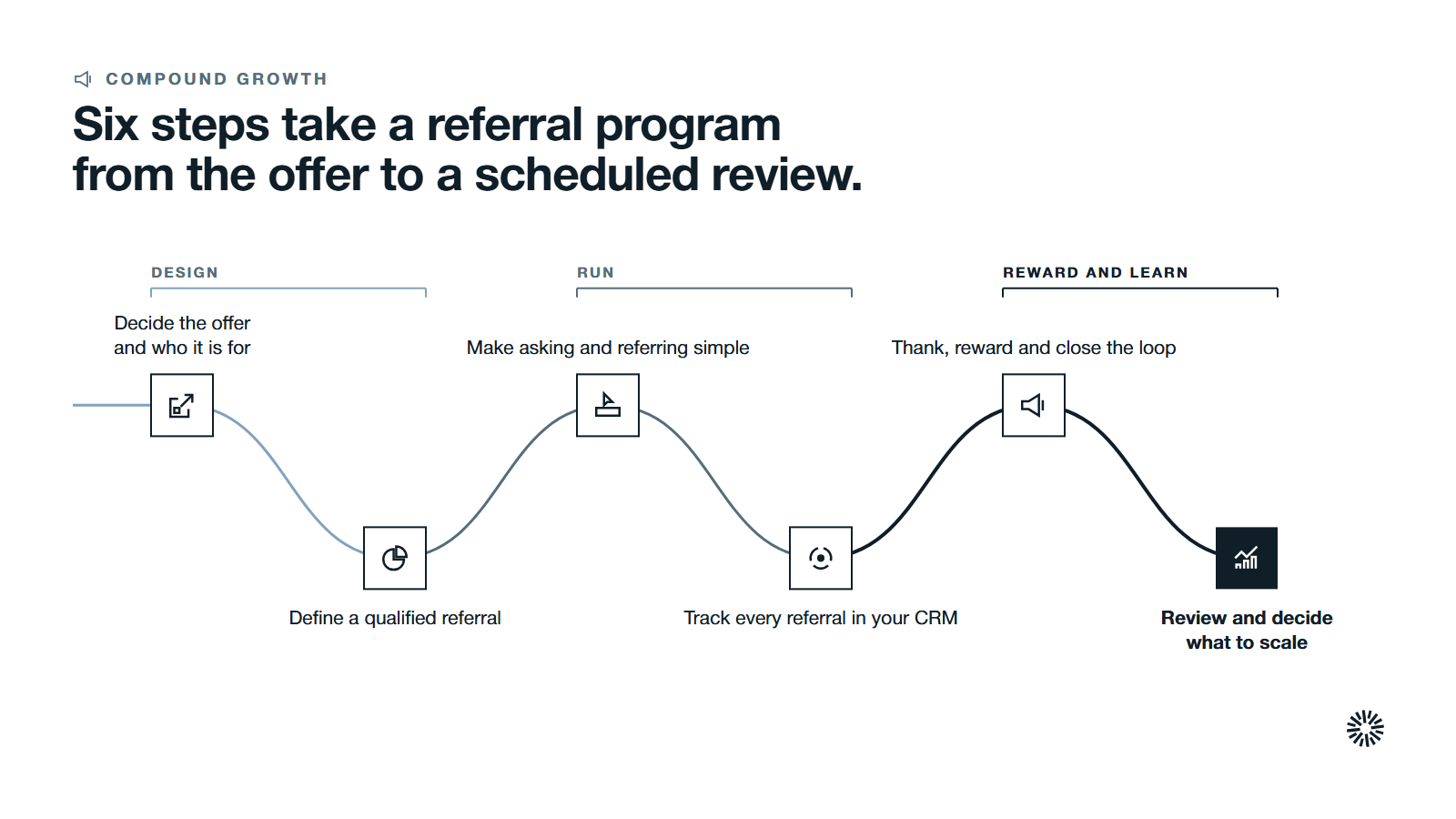
Each step ends with what done looks like. Work in order, because later steps depend on earlier answers. The most successful referral programs are the ones whose owners finish each step before starting the next.
1. Decide the offer and who it is for
Start with what you are asking and what you give back. The offer should feel like a win win situation: the referring customer receives something, and the referred customer receives something, if anything.
Match referral incentives to your buyers. Some B2B customers are not allowed to accept gifts under their own purchasing rules, so check first and consider account credit, extended services, a donation in their name, early access, exclusive access to a beta, exclusive perks or exclusive events.
Meaningful incentives matter more than large ones. Ask three customers which right incentive they would actually want.
A two-sided offer, where both the referrer and the referee benefit, is the usual design. A one-sided or milestone-based reward is the alternative, and tiered rewards can recognize customers who make multiple referrals over time.
Some referrals arrive without any incentive, simply because a customer is satisfied. Incentivized referrals add a reward for the introduction. Plan to thank both kinds.
The referred company may also receive a welcome offer on a first purchase, if your own pricing rules allow it.
Decide which customers you will invite first. Enrollment usually follows a purchase or a renewal, when a satisfied customer is invited to join. A short list of your strongest accounts, drawn from your customer base, beats a mass email to everyone.
You are done when one page states the offer for both sides, the invited accounts and the person who owns the program.
2. Define a qualified referral
Without a definition, sales and customer success will argue about whether a referral counts. Write one rule that both teams sign. Set clear terms and conditions, because transparent rules about what qualifies as a successful referral help prevent confusion.
A successful referral usually has three parts: a named contact at a company that fits your ideal customer profile, a customer who has agreed to the introduction, and a first conversation held. Allow multiple referrals from one customer. Decide whether the referred customer must be new to you, and what happens if the company is already in your pipeline.
Set the point at which the referring customer earns rewards. Rewarding at the introduction invites low-quality names. Rewarding at a closed deal is slow. A common design rewards at a qualified opportunity and again at close, so rewards earned match real new business.
You are done when a one-sentence definition and a reward trigger are written down and both teams have approved them.
3. Make asking and referring simple
Most customers are willing to help but will not do much work to do it. Encouraging customers means removing steps.
Choose the key moments to ask, because timing the request after a positive experience makes it easier for the customer to say yes. Good moments follow a visible win in the customer journey: a successful onboarding, a renewal, a positive customer satisfaction response or a milestone the customer celebrates.
Ask in person or in a short personal email from the person the customer knows.
Give the customer two easy ways to refer a friend or colleague: reply with a name, or use a short form, unique referral codes or referral links that capture the contact, the company and a line on why they should talk.
Email campaigns to your best accounts can carry the ask. Offer a pre-filled message or a drafted introduction email so the customer only has to approve it.
Most programs run as an automated loop. The customer shares a link or code, the referred person uses it, the system records the match and the reward follows. Frictionless sharing, with pre-filled messages, keeps that loop easy for the customer.
Promote the program across more than one channel, such as account reviews, email and your customer portal.
Never contact a referred person before the customer has agreed to it.
You are done when a customer can make a referral in a couple of minutes and your team has an ask script for each moment.
4. Track every referral in your CRM
If a referral is not recorded, it cannot be rewarded, reported or improved. Set this up before launch, not after the first introduction.
In HubSpot, properties are fields that store information on records, and you can create custom properties for data unique to your business. Create a dropdown property such as "Referral status" on the contact or deal, with options that match your definition: introduced, contacted, qualified, won, lost.
Record who made the introduction. HubSpot lets you associate records and set labels that describe the relationship, so the referred contact or deal can be linked to the referring customer's record with a clear label. That gives you your referral sources in one report, and the same records support tracking, reward payouts and conversion analysis.
Then automate the handoffs. HubSpot lets you create workflows to automate your processes, for example to notify the account owner when a referral deal is created or to prompt a thank-you task when its status changes.
You are done when a new referral can be logged in one place, linked to the referring customer, and counted in a report by status.
5. Thank, reward and close the loop
Respond fast. Thank the customer the same day for the introduction, whatever happens next.
Then keep them informed. Tell the customer when you have spoken to the person, and when it becomes an opportunity or a customer. People make more referrals when they see that the first one was handled well.
Pay out referral rewards when your definition says they are earned, and do it promptly. Offering rewards late undermines trust. A delayed or disputed reward does more damage than no reward.
Treat the referred buyer with care too. Mention who introduced you, keep the first conversation about their problem and do not pressure them because a colleague made the introduction. Strong referral experiences build customer loyalty on both sides.
You are done when every referral gets a same-day thank-you, a status update to the customer and a reward decision on the date you promised.
6. Review, learn and decide what to scale
Set a review date before you launch, for example at the end of the first quarter. Monitor program performance by what the program did, not by how busy it felt.
Review these measures, each from your CRM, with your own numbers:
- Customers invited and customers who made at least one referral.
- Referrals made, referred leads that met your definition and customers acquired.
- The referral conversion rate: referrals won divided by referrals made.
- Time from introduction to first conversation, and from introduction to close.
- Reward cost compared with the revenue from referred deals.
- How a referred customer compares with other new customers on renewal.
Ask what stopped customers from referring, because those customer insights improve the next version. Common answers are an unclear ask, a reward that did not suit them and a slow response from your team. Change one thing at a time so you can see what worked.
You are done when the review is held, the decision to continue, change or stop is recorded and the next quarter has an owner.
Mistakes to avoid with referral programs
Not all referral programs succeed, and most weak ones repeat a few errors. Check yours against this list.
- Asking before the customer has results. A referral from an unhappy customer is a risk, not a gift.
- Rewarding the wrong event. A reward for any name produces long lists and few real buyers.
- Making the form long. Every extra field costs you referrals.
- Launching without tracking. If you cannot see the source, you cannot judge the program.
- Going quiet after the introduction. Customers who hear nothing do not refer again.
- Ignoring the rules your customers work under. Check that your reward does not break their policies.
- Treating it as a campaign. A program is a routine, with an owner and a review date.
What you gain when this is done properly
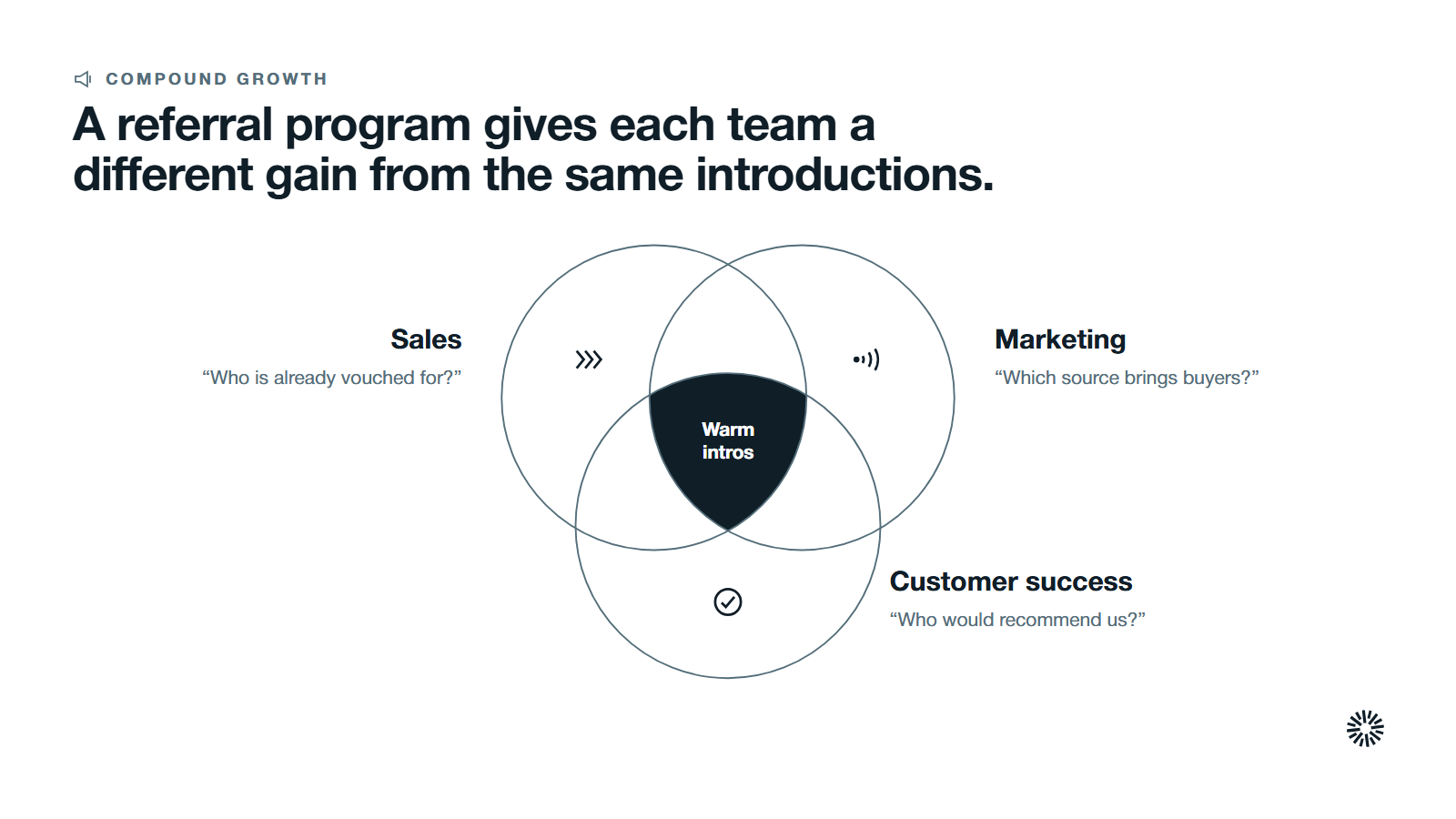
Referral programs turn goodwill into a process. Each team gains in a different way.
Sales gets warmer introductions
Your sales team starts conversations with a named contact and a reason to talk, because a customer has already vouched for the company. Sellers spend less time on cold outreach and more time on qualified conversations.
Marketing gets proof and a new source to measure
Marketing gets a source of new customer acquisition it can report on, a list of advocates and stories to turn into case studies, with permission. The referral property in your CRM shows which source brings the best buyers.
Customer success gets a reason to stay close
Customer success has a positive reason to contact customers and a view of who is most engaged. The team learns what makes the product worth recommending and which accounts are ready to speak for it.
Build the program on a system you can measure
A referral program is a small set of decisions: who to ask, what to offer, what counts, how to track and when to review. Write each down and run it for a quarter before you widen it.
Propello designs and builds connected go-to-market systems on HubSpot. If you want referral tracking, reporting and handoffs set up properly before you invite your first customer, an audit is the place to start.