If marketing, sales and finance each bring a different number to the Monday meeting, you do not have a reporting problem. You have a single source of truth problem. This article is for revenue leaders at growing B2B companies who want to know what the term means and how to get there.
A single source of truth for revenue data means every team reads the same customer and deal facts from one agreed place. You will learn how it works, what it is made of, how it differs from a data warehouse, and how your HubSpot CRM can serve as that place.
|
Single Source of Truth A single source of truth is one agreed, authoritative location where each piece of business data is created and kept, so every team and system reads the same version. |
Why data silos leave revenue data in competing versions
Nobody sets out to build five versions of a customer. It happens one tool at a time. Marketing adds a form tool, sales adds a sequencing tool, support adds a ticketing tool, and finance keeps the invoices and other financial records in its own system.
Each tool holds a slice of the customer. Over time the slices disagree about who the contact is, which company they belong to and what stage the deal is in. Those siloed systems are what people mean by data silos.
The scale is large. Salesforce's 2025 MuleSoft Connectivity Benchmark found that the average enterprise manages 897 applications and only 29% are integrated. In the same research, 90% of organizations reported business obstacles caused by data silos.
The cost shows up in decision making. When a number is disputed, the meeting becomes an argument about whose spreadsheet is right. Salesforce's 2024 State of Sales research found that only 35% of sales professionals completely trust the accuracy of their organization's data.
A team that does not trust its data re-checks it by hand, which is slow and prone to human error. Without reliable data and accurate data, no one can make data driven decisions with confidence.
A common example: one customer, four versions
Picture a mid-sized B2B company. A buyer fills in a form, a rep logs a call, support opens a ticket, and finance raises an invoice. Each system stores its own version of the buyer's name, company and status.
When the renewal conversation starts, nobody can say which version is current. The account owner is wrong in one place, the billing contact is out of date in another, and marketing is still emailing a person who left. That is what multiple systems with no agreed owner cost you.
How a single source of truth works for revenue data
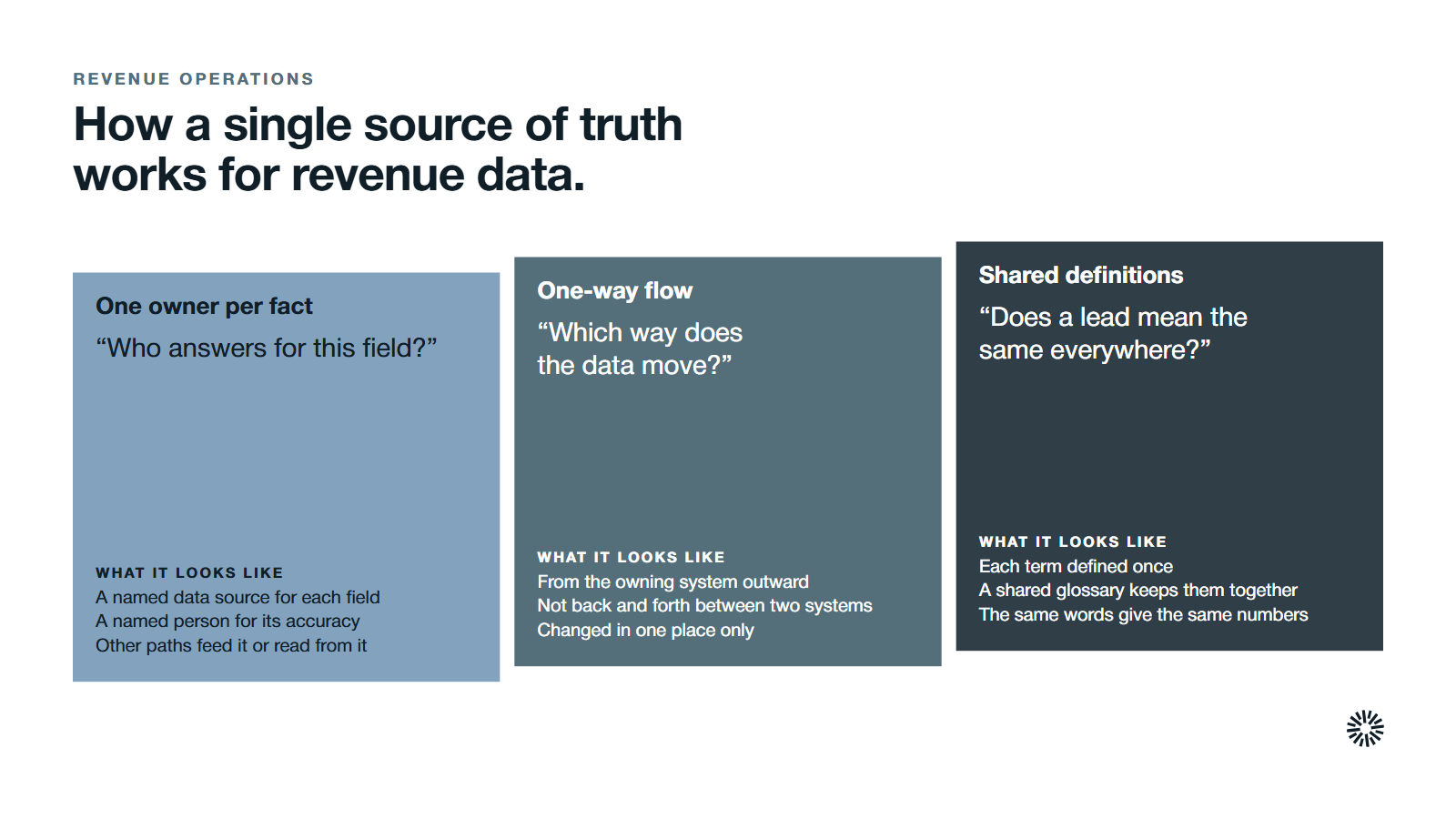
The idea is simple: for every important fact, one data source is the authority. Other systems may display that fact, but they do not own it. When the fact changes, it changes in one place, and the other systems pick up the data updates.
Take a simple example, a contact's job title. It can be typed into a form, edited by a rep, enriched by a data provider and imported from an event list. Without a rule, the last write wins and nobody can say why the title changed.
With a rule, one source system owns the title, and every other path either feeds it or reads from it. Everyone works from the same data, and the record stays up to date.
Three things make this work in practice:
- One owner per fact. Each field has a named data source and a named person who answers for its accuracy.
- One-way flow where possible. Data moves from the owning system outward, not back and forth between two systems that each think they are right.
- Shared definitions. Everyone agrees what a lead, an opportunity or a closed deal means, so the same words produce the same numbers. A shared business glossary keeps those definitions in one place.
A single source of truth is not necessarily one physical database. The data can sit in several systems, as long as every data point is edited in only one location. That is the single version of the facts that sales, marketing and customer success can rely on.
The parts of a single source of truth
A working setup has five parts that depend on each other. If one is missing, the others slowly stop working.
A central repository for the core records
Your customer records, deals and activities need a home. For most B2B companies that is the CRM, because the CRM is where revenue teams already work every day. A central repository is the one location where those records are created, updated and read, so critical information is never more than one click away.
A data model and data architecture that every team understands
The data model lists the objects, fields and relationships: contacts, companies, deals, tickets and how they connect. Your data architecture is how those pieces and the systems around them fit together.
If marketing and sales use one field for different things, the model is the problem. A written data dictionary fixes that. Our guide to CRM architecture for modern go-to-market teams covers how to lay one out.
Rules for data governance, data quality and data accuracy
Data governance is the set of rules for who can create, change and delete data. Data quality is the ongoing work of keeping records complete, consistent and free of duplicates. Data accuracy is the result: a record that matches reality. Our post on CRM data quality shows the warning signs and how to fix them.
Without all three, you get a single source of mess. See how to write the rules in CRM governance for go-to-market workflows.
Connections to the other systems
Billing, support, product usage and marketing tools still exist, and each supports its own business processes. The single source of truth decides which direction data flows between them and which system wins when two disagree.
When you integrate data, do it carefully: pulling data from multiple sources into one place only helps if each field still has one owner. Legacy systems that cannot be retired yet can stay, as long as they read from the owner and never write back over it.
Access and business rules
Not everyone should be able to edit everything. Role based access limits who can change a field, and business rules set what is allowed, for example which stage a deal can move to next. Those controls protect the source of truth from well-meaning shortcuts, and business users still see what they need.
How a single source of truth differs from a system of record and a data warehouse
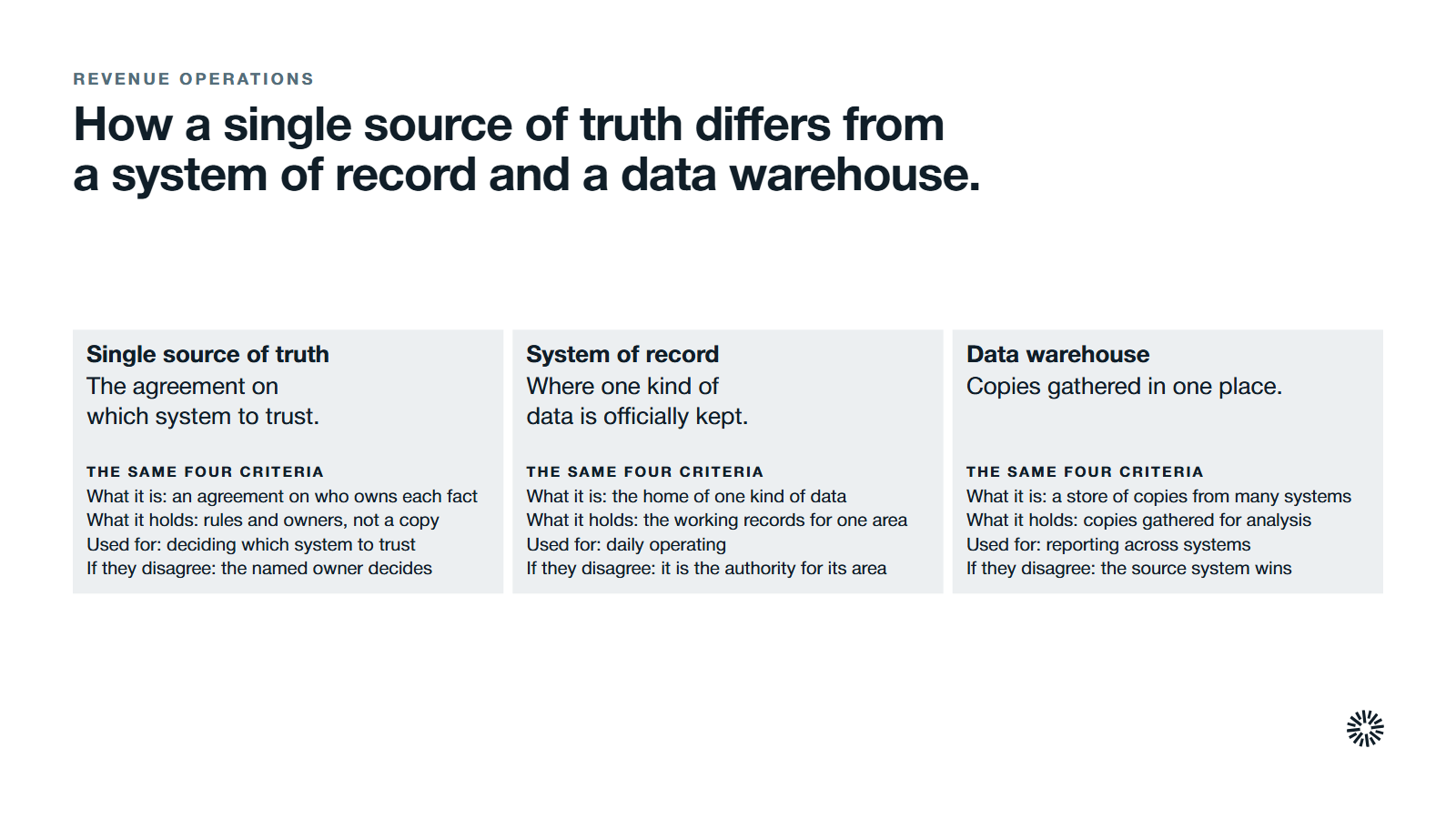
These three terms are often used as if they meant the same thing. They do not, and mixing them up leads to expensive buying decisions.
A system of record is the system where a given kind of data is officially created and maintained. A CRM is the system of record for customer and deal data. An invoicing tool is the one for what was billed.
Each usually covers a single domain, and common examples are CRM and ERP software. You will have several systems of record.
A single source of truth is the agreement and the SSOT architecture that tells everyone which system of record to trust for each fact. It is the layer of ownership above the individual systems.
A data warehouse is a place where copies of data from many source systems are stored together for analysis. It helps you report across systems, but it holds copies. If the copy disagrees with the CRM, the CRM is the authority.
Some teams treat the warehouse as a de facto source of truth for reporting, which works for analysis but not for daily operating.
Master data management is the formal discipline of keeping core records such as customers and products consistent across an enterprise. Master data management systems often serve as the single source of truth in large organizations, and the discipline sits within wider data management.
The practical rule: the warehouse is for analysis, the systems of record are for operating, and the single source of truth is the decision about which is which.
How HubSpot CRM can serve as your single source of truth
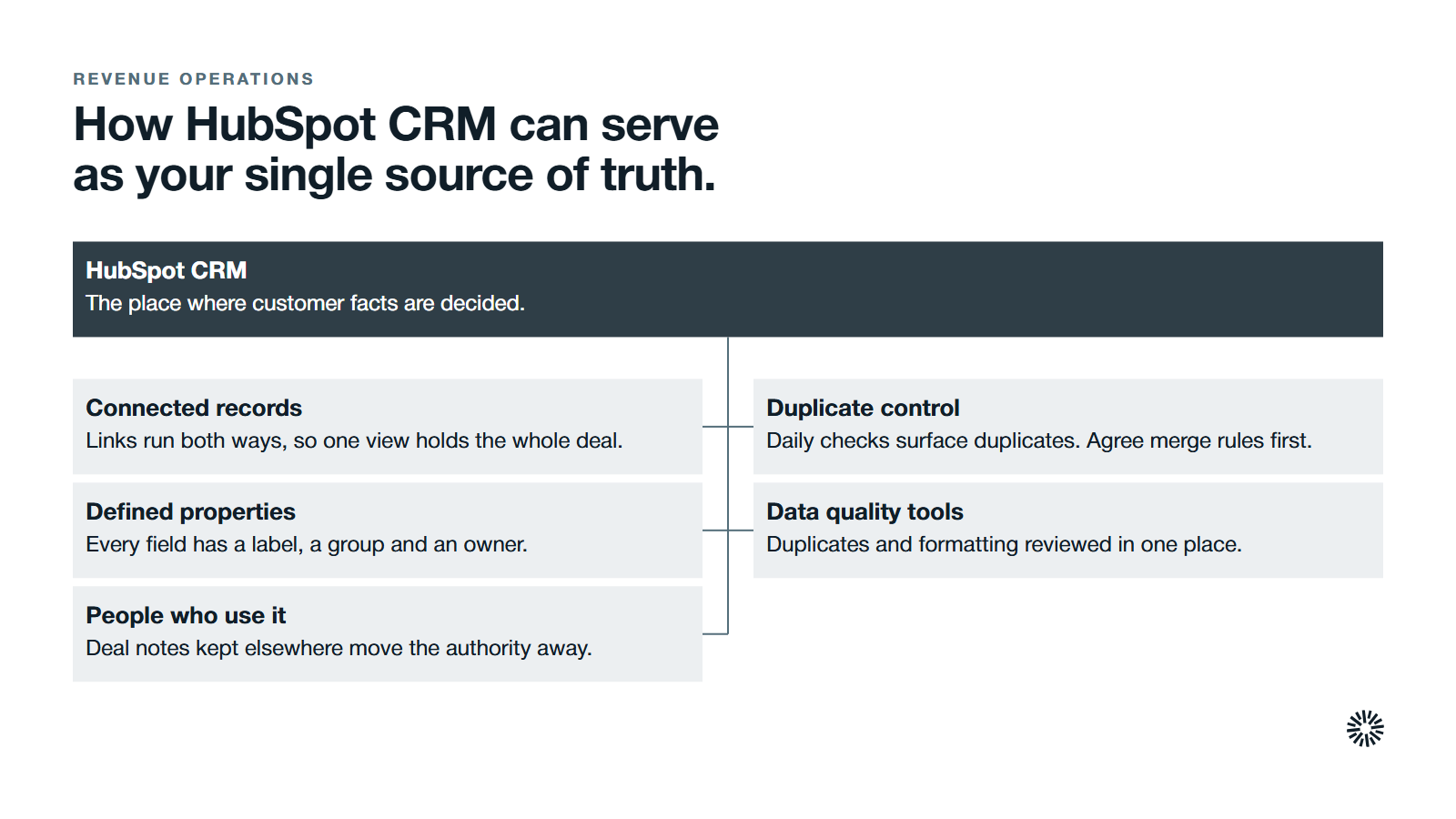
For a B2B revenue team, the CRM is the natural center. It already holds the contact, the company, the deal and the history of every touch. Making it the authoritative source means treating it as the place where customer facts are decided, not just a place where they are copied.
HubSpot supports this in a few concrete ways, all documented on its knowledge base.
Connected records. In HubSpot, associations are always two-way. A deal linked to three contacts and their company shows up on all four records, so the complete view sits in one place. For a fuller look at how the CRM holds a unified view of each customer, read about HubSpot CRM features for a unified customer record.
Duplicate control. Duplicates are the fastest way to lose trust in customer information. HubSpot compares record property values daily to surface potential duplicates, and merged records cannot be reverted. That second point is a reason to agree merge rules before anyone starts merging.
Defined properties. Properties are the fields on each record. Giving each one a clear label, a group and an owner is how you standardize data in the CRM, so a "lifecycle stage" or "lead source" means the same thing to every user. For example, if "lead source" is a free-text field, no report on it can be trusted.
Data quality tools. HubSpot's data quality tools bring duplicates, formatting issues and property usage into one place so someone can review them on a routine.
The CRM holds authoritative data only when people use it that way, and it becomes the single source of truth only then. If reps keep deal notes in a spreadsheet, or marketing keeps a separate contact list, the authority has already moved.
A single source of truth takes both cultural and technical effort
Most failures are not about software. Resistance to change is the common one: a team that likes its own spreadsheet will keep it unless the shared record is easier to use. Training, and leaders who stop accepting side-sheet numbers, matter as much as the build.
Integrating systems is the main technical challenge. Each connection needs a direction and a rule for conflicts, and each one needs monitoring, because fields drift when someone changes a form or a process. Treat the setup as continuous improvement, not a project with an end date.
The effort pays back. One governed record simplifies compliance and security, because you know where personal data lives and who can see it. It also scales: a new region, product line or tool plugs into the same rules instead of creating a new version of the truth.
How to assign ownership and start this quarter
You do not need a data project that takes a year. Start with the fields that cause the most arguments.
- List the five numbers your leadership meeting disputes most. Pipeline value, new leads, conversion rate, customer count and renewal date are common examples.
- Trace each number to its source systems. Write down where each input is created, edited and read.
- Name one authoritative data source and one owner per input. Assign ownership to a person, not a team, so questions have somewhere to land.
- Fix the flow. Remove the second place where that fact is typed, or make it read-only there.
- Review on a routine. Check duplicates and empty required fields every week, and re-check the data dictionary every quarter.
Keep the scope small enough to finish. Five fields everyone trusts beat a grand design nobody finishes.
What you gain when this is done properly
Clean ownership of revenue data supports business operations across business units and saves time for every team that used to reconcile numbers by hand.
It cuts errors from duplication and manual entry, and it builds trust in reports because disputes over the numbers fade. Cross-functional teams argue about what to do, which means better collaboration and sharper decision accuracy.
Sales
Reps open one record and see the whole account: who the contacts are, what marketing sent, what support logged and where the deal stands. They stop re-asking questions the company already knows the answer to. Forecast calls move from defending numbers to deciding what to do about them.
Marketing
Marketing can report on the same customers and deals that sales sees, so campaign results connect to revenue instead of stopping at lead counts. Segments and lists draw on trusted customer data, which means fewer wrong sends and cleaner attribution.
Customer success
Customer success sees the sales history, the products bought and the open tickets in one view. Renewals and expansion conversations start from facts, not from a hunt through other teams' tools. Handoffs from sales stop losing the context the customer already gave.
A single source of truth is a decision about ownership first
The technology is the easy part. The hard part is agreeing who owns each fact and holding to it when a team finds a shortcut. Revenue leaders who make that decision once, and write it down, spend far less time arguing about numbers.
Propello designs and builds connected go-to-market (GTM) systems on HubSpot, and is a HubSpot partner (see about Propello). If your teams still disagree about the numbers, an audit is the place to start. For the wider picture, see our explainer on what revenue operations is.