If you lead a B2B revenue team, you have probably watched your marketing department add campaigns, tools and reports faster than anyone can keep them consistent. Marketing operations is the function that makes all of that work as one system, and it is why strong marketing teams can grow without chaos. This article is for CEOs, CROs and marketing leaders deciding whether they need it.
In short, marketing operations is the team and set of practices that run the technology, data, processes and measurement behind marketing, so campaigns launch on time and results can be trusted. You will learn what it covers, who does the work, how it differs from nearby functions, and where to start.
|
Marketing Operations Marketing operations is the function that manages the systems, data, processes and reporting behind marketing, so the marketing team can plan, launch and measure campaigns reliably and tie them to business goals. |
How marketing operations works inside a revenue team
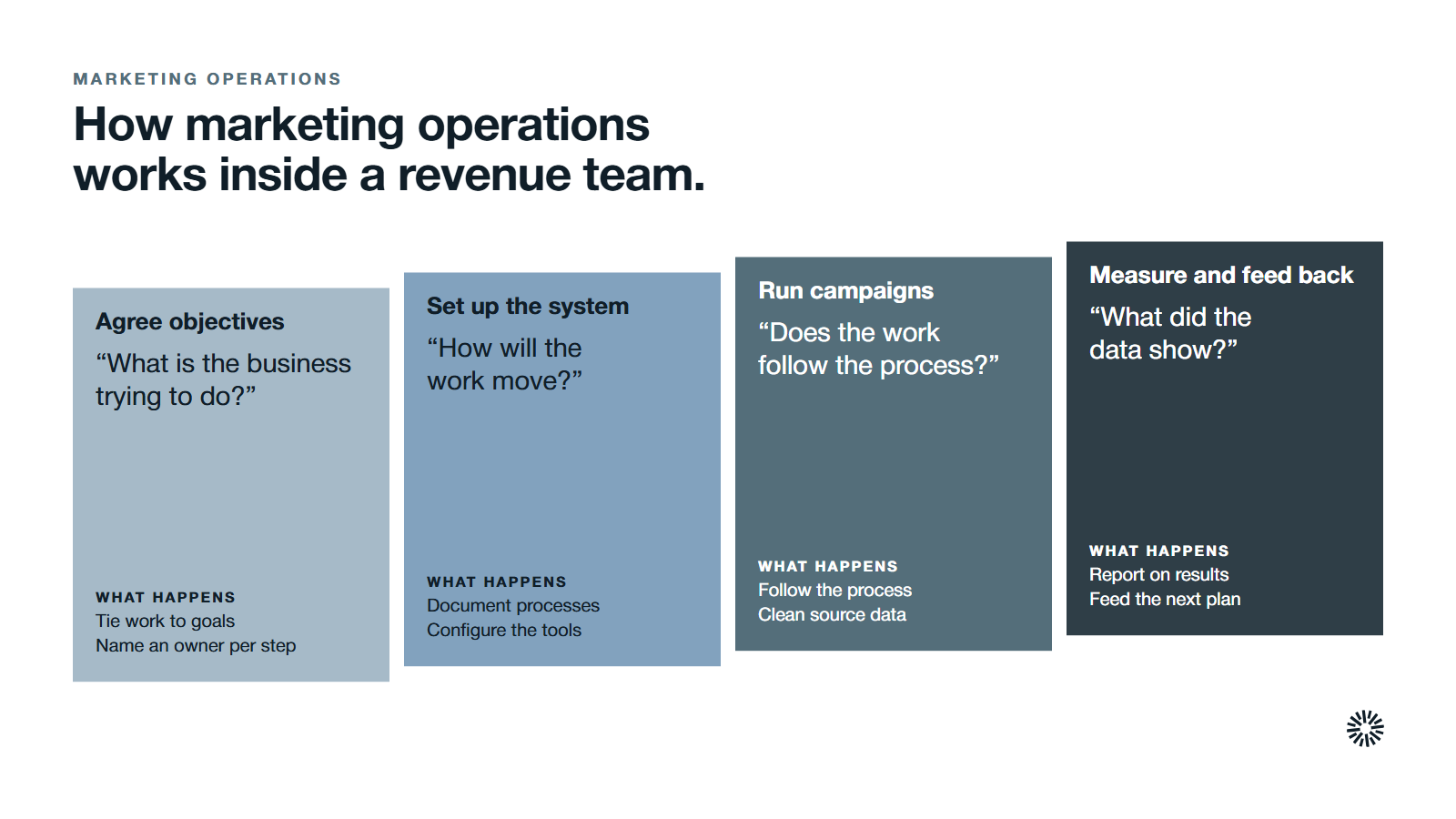
Think of marketing operations as the engine room behind the campaigns your audience sees. Marketers decide what to say and who to say it to. The marketing operations team decides how that work moves through your systems, who owns each step, and how you know it worked.
In practice, that means a repeating loop. The team agrees on business objectives, sets up the processes and tools to pursue them, runs marketing campaigns through documented marketing processes, and measures marketing performance. What the data shows then feeds the next round of planning.
The loop matters because marketing sits at the front of your revenue process. A form fill, a campaign source or a lifecycle stage set wrongly at this point is repeated in every report that follows. Marketing operations keeps that first link accurate so sales and customer success inherit clean information.
The four parts of effective marketing operations
Teams divide the work in different ways, but the same four parts show up again and again. You do not need a separate person for each. A small company may have one person covering all four.
Platform operations
Platform operations looks after the marketing technology your team depends on: the CRM, the email and automation platform, the website forms and the connections between them. Marketing automation, forms and reporting all depend on this layer being consistent. It covers setup, permissions, integrations and cleanup, which is the technology management that keeps marketing operations running.
The scale of the tool market explains why this needs an owner. Chiefmartec's 2025 marketing technology landscape counted 15,384 martech solutions, up 9% from 14,106 the year before.
Without an owner, every tool gets its own settings and its own version of a contact. Integrating technologies on purpose is how marketing operations avoids that. A shared stack, as described in how a martech stack becomes a GTM system, needs someone accountable for how the pieces connect.
Campaign operations
Campaign operations turns an approved idea into a live campaign. It builds the audience lists, emails, landing pages and tracking, checks them before launch, and keeps a calendar so marketing activities do not collide. Marketing automation workflows, such as nurture emails and lead alerts, are built and tested here before they reach real contacts. Automating repeated steps cuts manual tasks, and lead management and nurturing programs keep prospects engaged until sales is ready.
This part of marketing operations also protects speed. When requests follow one intake process with clear templates, marketers spend their time on the message instead of rebuilding the same email layout. Social media marketing and paid advertising campaigns get the same naming and tracking rules, which keeps the data comparable later.
Marketing intelligence
Marketing intelligence is the reporting and analysis side of marketing operations. It defines the metrics, builds the dashboards, and checks that marketing data is complete before anyone draws conclusions from it.
Marketing analytics pulls performance data from each channel into one view. Good intelligence work answers questions leaders actually ask: which channels produce pipeline, what a customer costs to win, and where leads stall. It is how a team can analyze marketing data and reach data-driven decision making without arguing about whose spreadsheet is right.
Planning, budgets and process development
The fourth part is the least visible: marketing development. It covers annual planning, the marketing strategy for the year, marketing budgets, vendor choices, a yearly review of marketing technology, documentation, training for new team members and regular reviews of how work flows.
This is where continuous improvement lives. Each quarter the team looks at what slowed campaigns down, removes the worst bottleneck and writes down the new way of working, so the gain does not depend on one person's memory.
What a marketing operations manager does
A marketing operations manager is the person accountable for those four parts of marketing operations. The title varies. You will see marketing ops manager, marketing technologist and director of marketing operations, depending on the size of the company and how much of the work sits with one person.
The marketing operations manager's responsibilities usually include:
- Owning the CRM and marketing platform configuration, including fields, lifecycle stages and permissions.
- Running the intake and approval process for campaigns, with templates and a shared calendar.
- Defining metrics and building the reports leadership uses to judge marketing performance.
- Managing data quality, from duplicate records to source tracking and compliance with data protection rules such as GDPR and CCPA.
- Training marketing team members and documenting how each process works.
- Working with sales, customer success and IT on handoffs, integrations and shared definitions.
Skills that matter in marketing operations roles
The strongest marketing operations professionals combine three kinds of skill. The first is technical: comfort with a CRM, data analytics and automation tools. The second is project management, including prioritizing requests and keeping many campaigns on schedule.
The third is communication. A marketing operations manager spends much of the week agreeing definitions with other departments, so written communication skills and patience with disagreement count as much as tool knowledge. Marketing operations managers who do well also learn the business, because a marketing ops team that cannot explain its work to finance or sales rarely keeps its budget.
How the team grows
In a small company, one person may hold the whole function. As the business scales, a marketing operations team usually splits by part: a platform specialist, a campaign builder and an analyst, led by a manager. Marketing ops roles then sit alongside sales operations and customer success operations, ideally under shared revenue leadership. Our comparison of revenue operations vs sales operations explains how the roles divide.
How marketing operations differs from marketing automation, sales operations and RevOps
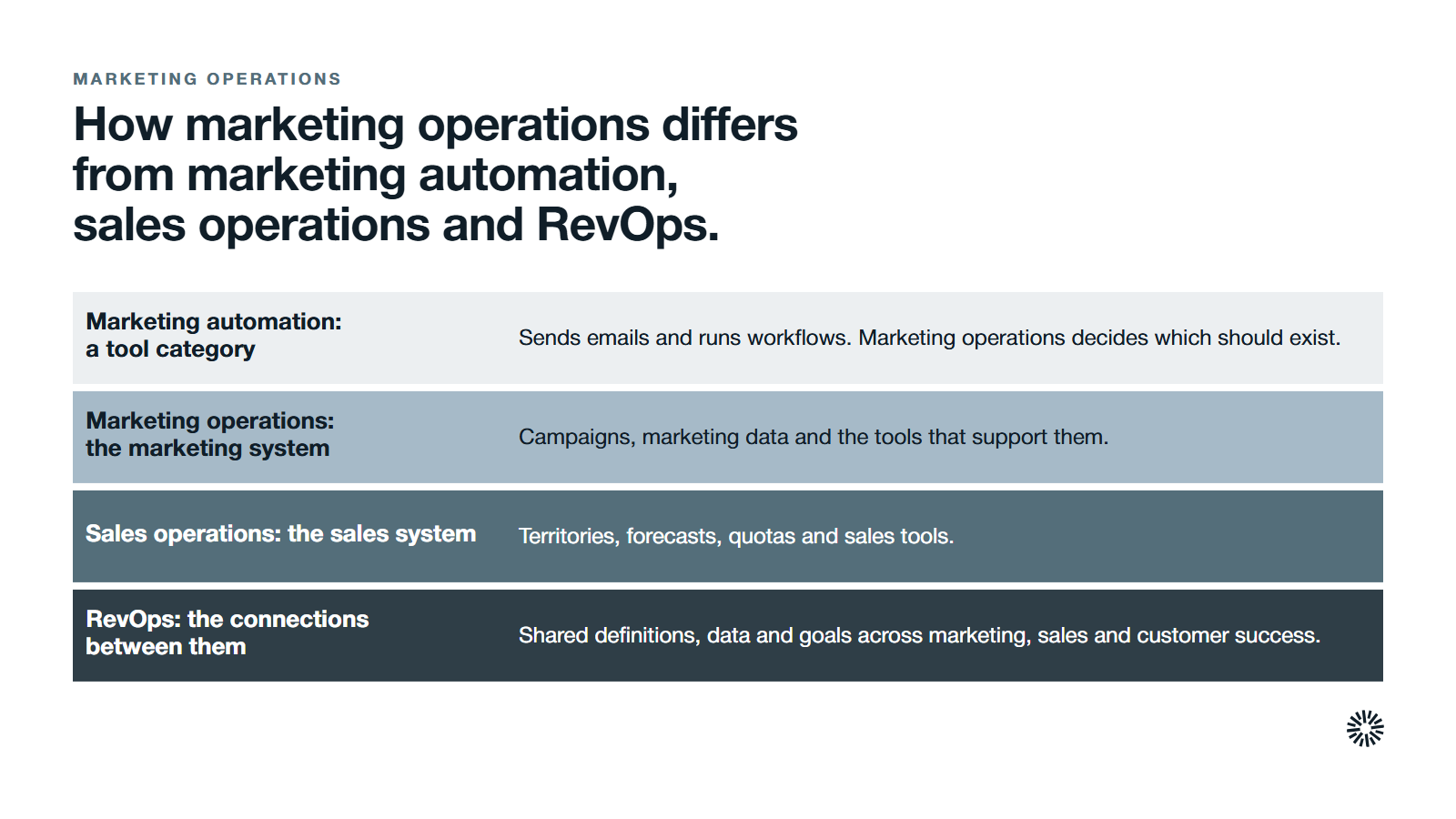
These terms overlap, which is why teams confuse them. The simplest way to separate them is to ask what each one owns.
Marketing automation is a tool category. Marketing automation software sends emails and runs workflows. Marketing operations decides which workflows should exist, how they are built, and how their results are measured. Automation is one thing marketing operations manages, not marketing operations itself.
Sales operations does the same job for the sales team: territories, quotas, pipeline stages and sales tooling. Revenue operations goes a level up and aligns marketing, sales and customer success operations around one set of data, definitions and goals.
Where each function stops
- Marketing operations owns the marketing system: campaigns, marketing data, and the tools that support them.
- Sales operations owns the sales system: territories, forecasts, quotas and sales tools.
- Customer success operations owns the post-sale system: onboarding, health scoring and renewals.
- RevOps owns the connections between all three and the shared definitions they rely on.
The practical difference shows up at handoffs. When the marketing and sales teams disagree about whether a contact is qualified, neither function alone can fix it. That is a RevOps question, answered with input from marketing operations, which sets standard lead definitions and a shared handoff process so marketing and sales stay aligned.
The problem is common. In HubSpot's 2026 State of Marketing survey of more than 1,500 marketers, 27.6% named sales-marketing alignment among their top challenges.
How to build a marketing operations strategy
A marketing operations strategy starts with the business, not with the tools. Begin with the business objectives your leadership has already set, then decide what marketing operations must put in place so the marketing department can pursue them.
Tie marketing operations to business goals
Ask which business goals marketing is expected to move this year, such as entering a new segment or lowering customer acquisition cost. A marketing strategy without operations support stays a document. Write the goals beside the strategy so every marketing initiative has a reason to exist.
Market research belongs here too. Customer interviews and a review of competitors show which segments deserve attention, and they tell marketing operations which strategic initiatives need new data or new processes before launch.
Set the rules for data management
Data management is the base layer of the strategy. Decide which fields are required, how sources are recorded and who resolves duplicates. Your customer relationship management system is only as useful as these rules allow.
Clean records make data-driven marketing possible. Once leaders trust the numbers, the team can analyze data without first debating it, and share data-driven insights that people act on.
Build processes before you buy tools
Map the process first, then choose software. A short written workflow for each repeated task helps the team streamline processes before anything is automated.
When a process is stable, pick automation tools, analytics tools and content management systems that fit it. Web analytics such as Google Analytics is a common choice for site data. Fewer tools keep marketing efforts easy to track.
Agree how you will measure success
Choose a few performance metrics before launch and record how each is calculated. Performance measurement only helps when the same definitions are used every quarter.
Signs your marketing team needs marketing operations
You do not need a department on day one. You need marketing operations once the work outgrows informal habits. Several signs show up early, and most leaders recognize at least three.
- Campaign launches slip because the person who knows the system is busy or away.
- Marketing and sales report different numbers for the same quarter.
- Nobody can say which fields in the CRM are required, or why.
- Leads sit unassigned because routing rules are unclear or broken.
- New team members take weeks to learn how work gets done.
If these sound familiar, the first hire or assignment is rarely a tool. It is an owner. The hiring process then follows the gap: a marketing operations manager who is a generalist and can manage a platform and a report suits most growing companies, while larger teams add specialists.
How to measure marketing operations
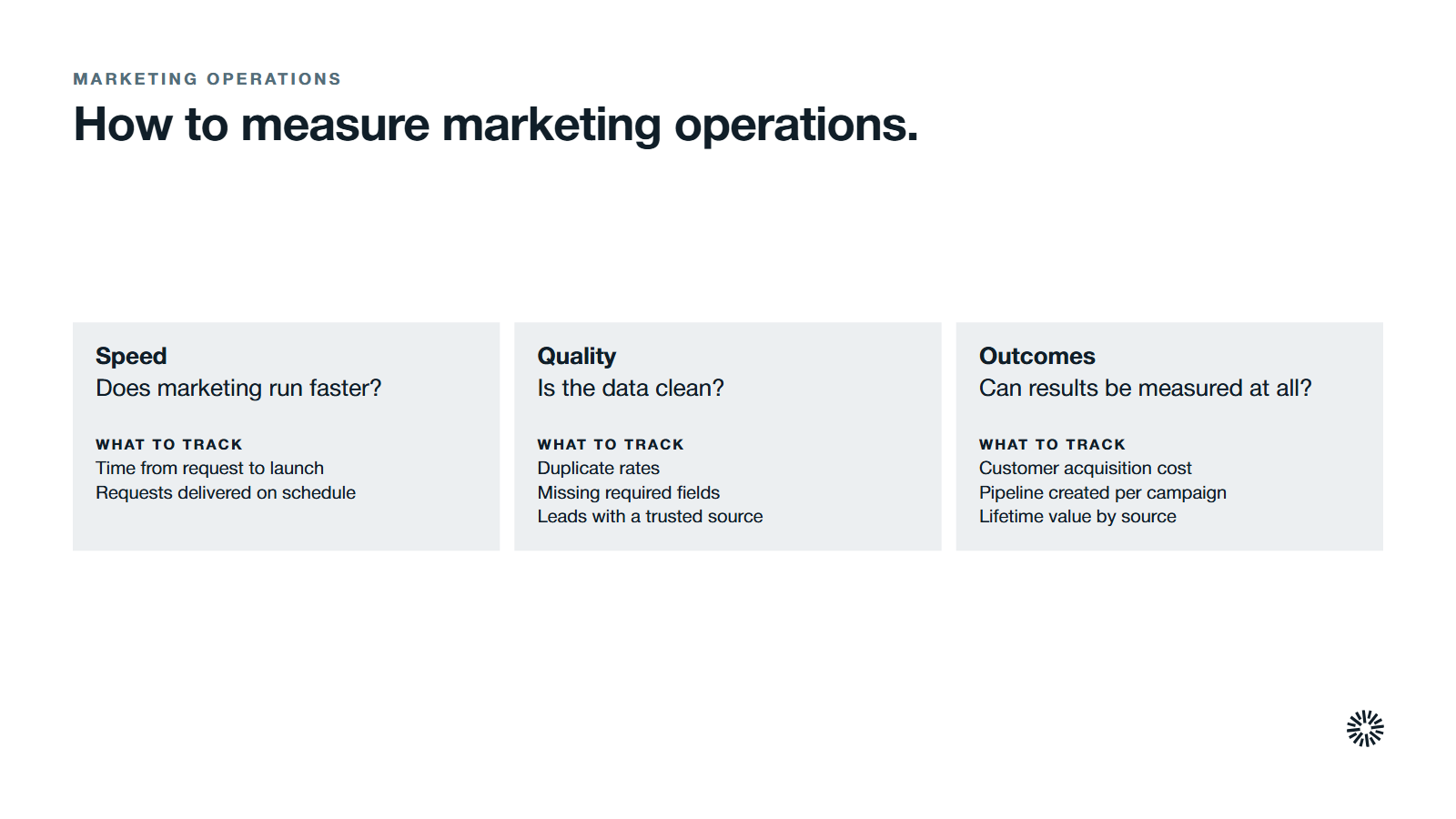
Marketing operations does not generate leads by itself, so judge it by what it makes possible. The question is whether marketing runs faster, with cleaner data and more reliable results.
Useful measures fall into three groups:
- Speed: the time from campaign request to launch, and the share of requests delivered on schedule.
- Quality: duplicate rates, missing required fields, and the share of leads with a trusted source.
- Outcomes: customer acquisition cost, pipeline created per campaign, and customer lifetime value by source.
Marketing operations can improve the third group only indirectly, but it controls whether that group can be measured at all. Marketing operations also tracks performance metrics and return on investment, so budget follows the activities that work. Without clean source data you cannot compare channels or work out customer acquisition cost with any confidence.
Why measurement is the hard part
Measuring return is a common struggle. In the same HubSpot survey, 33% of marketers named measuring the ROI of marketing activities as a top challenge, the most cited item on the list. That is a data and process problem as much as a skills problem, which is why marketing operations matters.
Our guide to marketing tracking and reporting covers how to build the reporting layer once the data foundations are in place.
What you gain when this is done properly
When marketing operations is run well, the benefits reach every team that touches a customer.
Sales
Reps receive leads that are routed quickly, carry reliable source information and arrive with the right context in the CRM. Routing logic is covered in the first GTM workflow to build.
Marketing
The marketing team launches campaigns faster, repeats what worked, and stops rebuilding the same assets. Cleaner handoffs also improve operational efficiency across marketing and sales. Leaders get a single view of marketing efficiency, so budget conversations rest on evidence instead of opinion.
Customer success
Customer success inherits accurate records of what a customer bought, why they bought it and which campaigns they engaged with. That supports customer engagement after the sale and makes onboarding smoother and expansion outreach better timed. Shared definitions also stop customers receiving a prospecting email a week after signing.
Start with one process your marketing team repeats every week
You do not need a reorganization to begin. Pick one process that your marketing team repeats every week, such as campaign requests or lead handoff. Write down each step, name one owner, and agree on the fields and definitions the process depends on.
Then check that the owner has the access and the time to run it. CRM governance for GTM workflows shows what to put in writing.
Propello designs and builds connected GTM systems on HubSpot, and is a HubSpot partner. If you want an outside view of how your marketing operations connects to sales and customer success, a GTM audit is the place to start.