Your revenue operations strategy worked when the team was small. Everyone knew every deal, handoffs happened in chat, and the founder could recite the pipeline from memory. Then you added a second way of selling, hired more reps and entered a new segment. The informal coordination that got you here began to break.
If you are a CEO, founder or CRO at a growing B2B company, this article is for you. A revenue operations strategy holds as you scale only when someone builds it into your systems, which is the work of GTM Engineering. You will see what breaks at each stage and what to build.
|
Revenue Operations Strategy A revenue operations strategy is the plan for how people, process, data and technology work together across marketing, sales and customer success to produce revenue predictably. |
What a revenue operations strategy covers
Revenue operations brings marketing, sales and customer success under one operating framework. The strategy is the written decision behind it. It says how the lifecycle works, who owns each stage, and which numbers everyone trusts. It also ties revenue goals, business goals and business growth to the way teams work.
The key elements are simple to list. You need shared definitions for stages and qualification, and clear ownership of each handoff. You need one agreed view of customer data across your CRM systems, plus key performance indicators and performance metrics that leadership can act on.
Decision making improves when every team reads the same record, because there are fewer errors to argue about. Revenue operations aligns marketing teams, sales and customer service around one path, and standardized workflows cover the whole buyer journey.
Alignment is also what sustainable growth and steady revenue growth rest on. When Forrester announced its 2019 acquisition of SiriusDecisions, a firm that helps B2B companies align sales, marketing and product, it said SiriusDecisions clients grow 19% faster and are 15% more profitable than their peers.
How revenue operations differs from sales operations
Sales operations supports the sales team: territories, quotas, tools and reporting. Revenue operations covers the same ground and extends it to marketing and customer success. How that function differs from the build side of the work is explained in GTM engineering vs RevOps. The sales process becomes one stage in a longer lifecycle that you measure end to end, so revenue growth is owned by all three teams.
Why complexity grows faster than headcount
Adding a person adds one more worker. Adding a segment, a product or a new way of selling adds a web of relationships between teams, tools and data. Each one multiplies the handoffs, scoring rules and reports that have to agree. Your revenue generating functions stop sharing one picture of the customer journey.
Tools follow the same pattern. Chiefmartec's 2025 marketing technology supergraphic counted 15,384 solutions, up 9% from 14,106 a year earlier. Every team can find a product for its local problem, from marketing automation to analytics platforms. Each one adds another place where revenue data can drift.
Salesforce's 2025 MuleSoft Connectivity Benchmark Report found that the average enterprise manages 897 applications, yet only 29% are integrated.
The cost lands on the people closest to customers. In its 2026 State of Sales research, a survey of 4,050 sales professionals, Salesforce found the average seller spends 40% of their time selling. The rest goes to work around the sale, which leaves sales reps less time for potential customers.
What a GTM motion is, and why each one needs its own design
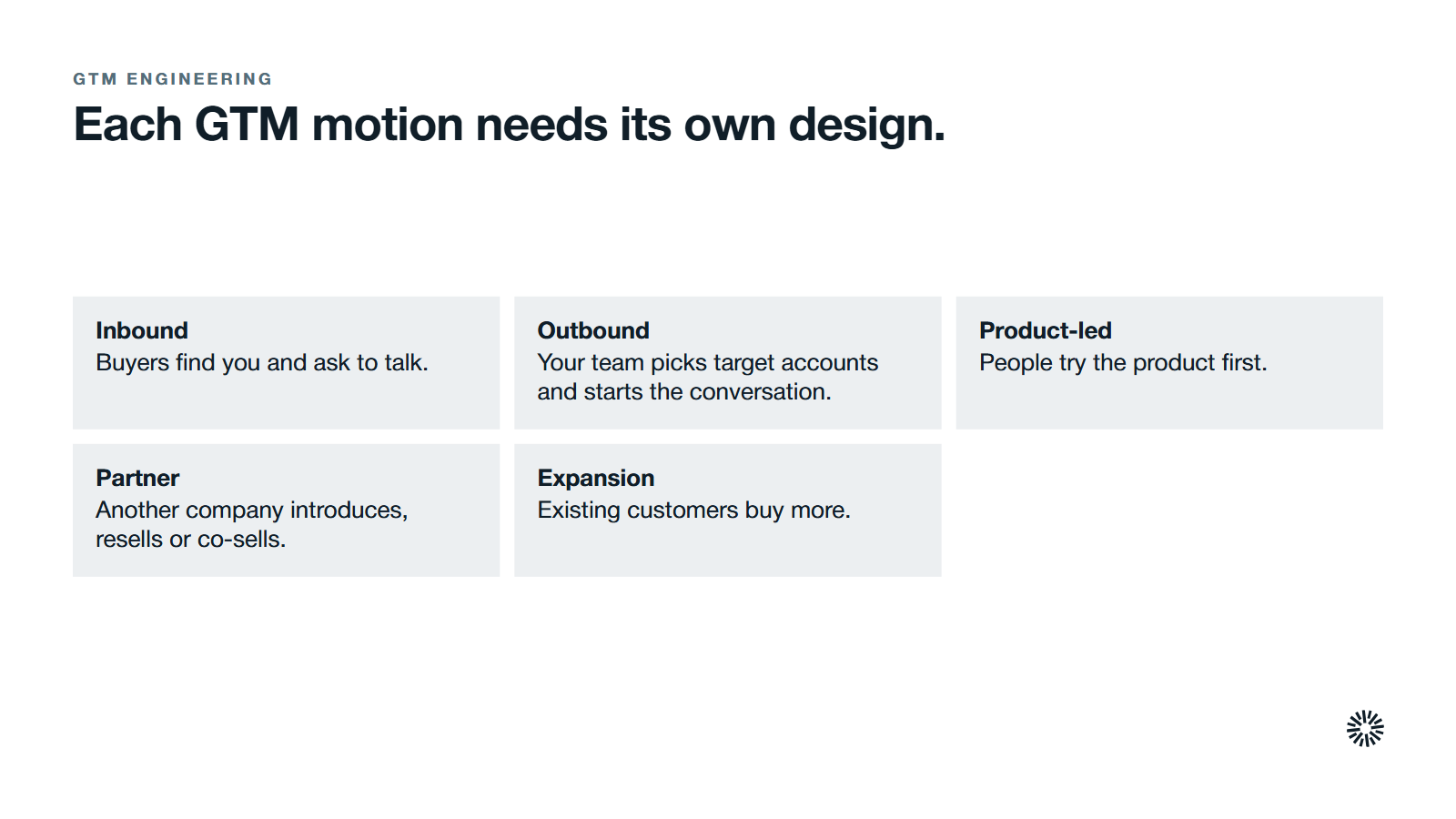
A GTM motion is the repeatable way your company finds, wins and grows a type of customer. A sales motion defines how you engage prospects, and a sales methodology guides your team through the conversation.
Every go-to-market motion shapes the sales journey differently. A sales process runs through stages from prospecting to onboarding, and each motion may define those stages in its own way. Strong motions streamline the path from lead to close.
Common examples include these:
- Inbound: buyers find you through content, search or referrals and ask to talk.
- Outbound: your team picks target accounts and starts the conversation.
- Product-led: people try the product first, and usage patterns and customer behavior show who is ready for a sales conversation.
- Partner: another company introduces, resells or co-sells, so credit and data must cross company lines.
- Expansion: existing customers buy more, which depends on usage, health and renewal timing.
Each motion has its own entry signal, qualification rule, owner and definition of success. Run them all through one generic lifecycle and the definitions blur. Even collaborative selling, where the buyer takes an active part, needs its own steps and signals.
What breaks at each stage of growth
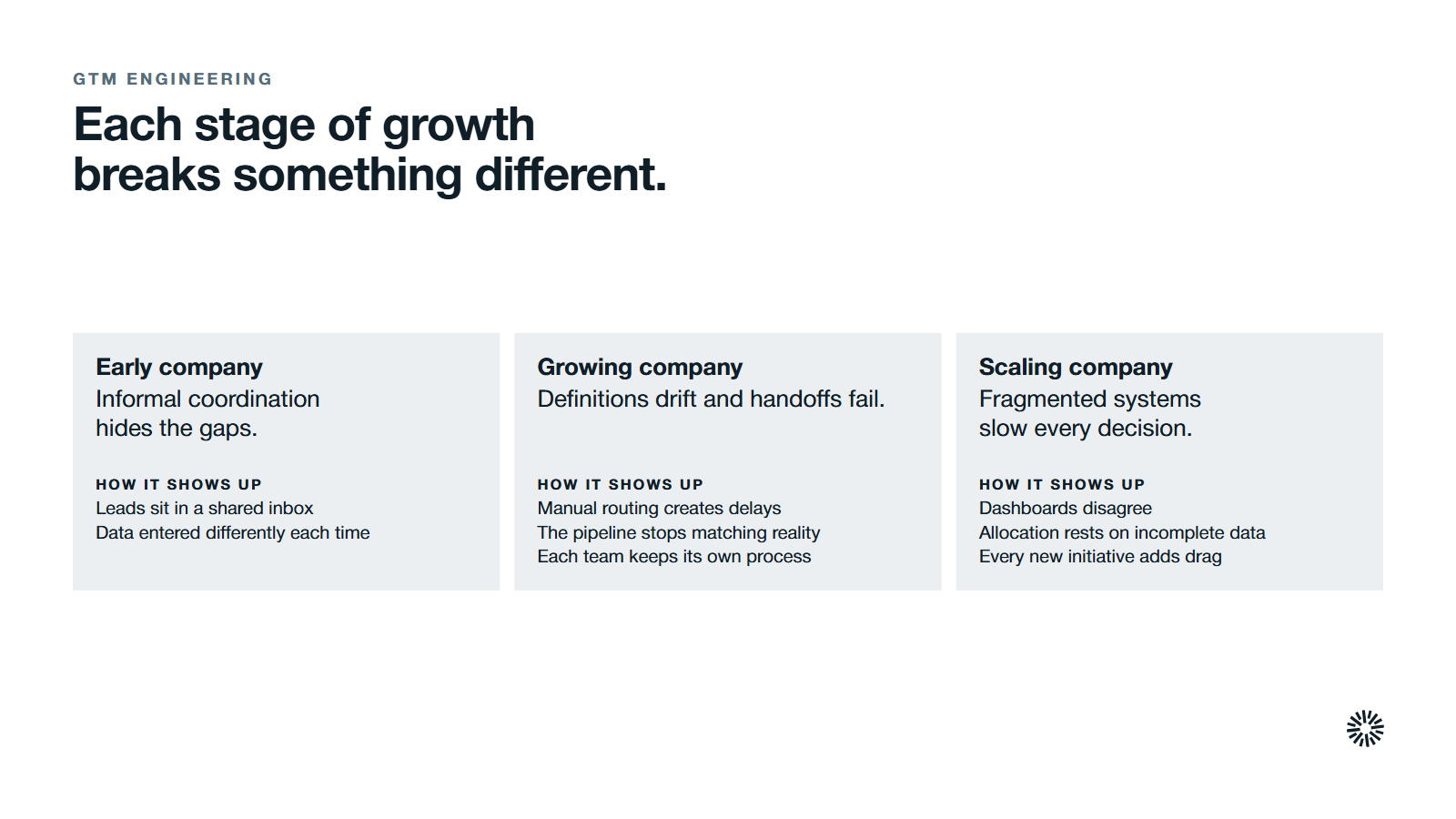
Early company: informal coordination hides the gaps
Founders sell most deals, the team is small, and the sales process lives in habits and a spreadsheet. Nothing is formally wrong, because everyone sees everything and customer interactions are tracked by memory. The gaps show up as leads that sit in a shared inbox and data entered differently each time.
Growing company: definitions drift and handoffs fail
You now have a sales team, campaigns, first customer success hires and several segments. Marketing, sales and success each define "qualified" or "healthy" differently, and each keeps its own version of the sales process. Manual routing creates delays, and the sales pipeline stops matching reality.
Every handoff becomes a place where context disappears. Sales performance becomes hard to compare, because each team measures it differently, and each sales team builds its own spreadsheet to cope.
Scaling company: fragmented systems slow every decision
Several motions run in parallel, often across regions or verticals. Each team has tuned its own tools and data model. Dashboards disagree, resource allocation rests on incomplete data, and every new initiative adds drag.
Leaders spend meetings reconciling numbers rather than making strategic business decisions. Decision making slows, the customer experience varies by region, and revenue performance gets judged on opinion.
KPMG's 2025 report RevOps Redefined, based on a survey of 286 respondents in technology, media and telecommunications, found that 51% of those organizations face data silos that block a unified view of the customer.
Why a strategy on paper fails without someone to build it
Most businesses can write the strategy. They document their ideal customer profile, stages, buyer personas and playbooks. Then the document sits in a shared drive while the CRM keeps running on the old rules.
A strategy only changes behavior when the systems enforce it. If routing, scoring, lifecycle stages and reports still reflect last year's thinking, reps follow the system, not the slide. The gap between what leadership expects and what execution delivers widens every quarter.
Handing the job to a busy operations manager rarely closes that gap. Administration, reporting and daily fixes fill the week.
Nobody has the mandate and the time to redesign how data flows between motions, or to give every user comprehensive training on the new rules. This is why GTM teams need GTM Engineering: someone has to build the strategy into the machinery.
How GTM Engineering makes the strategy executable
GTM Engineering is the discipline that designs, builds and operates the systems behind your revenue operations strategy. It turns commercial rules into working infrastructure: data models, routing logic, automation, scorecards and feedback loops, in HubSpot or whichever system is your record of revenue. Why that differs from the tools you buy is covered in GTM software versus infrastructure.
Revenue operations sets the strategy, governance and rules. GTM Engineering builds the systems that carry them out. The GTM engineer is the specialist who does this work day to day, mapping edge cases with each team and improving workflows as results come in.
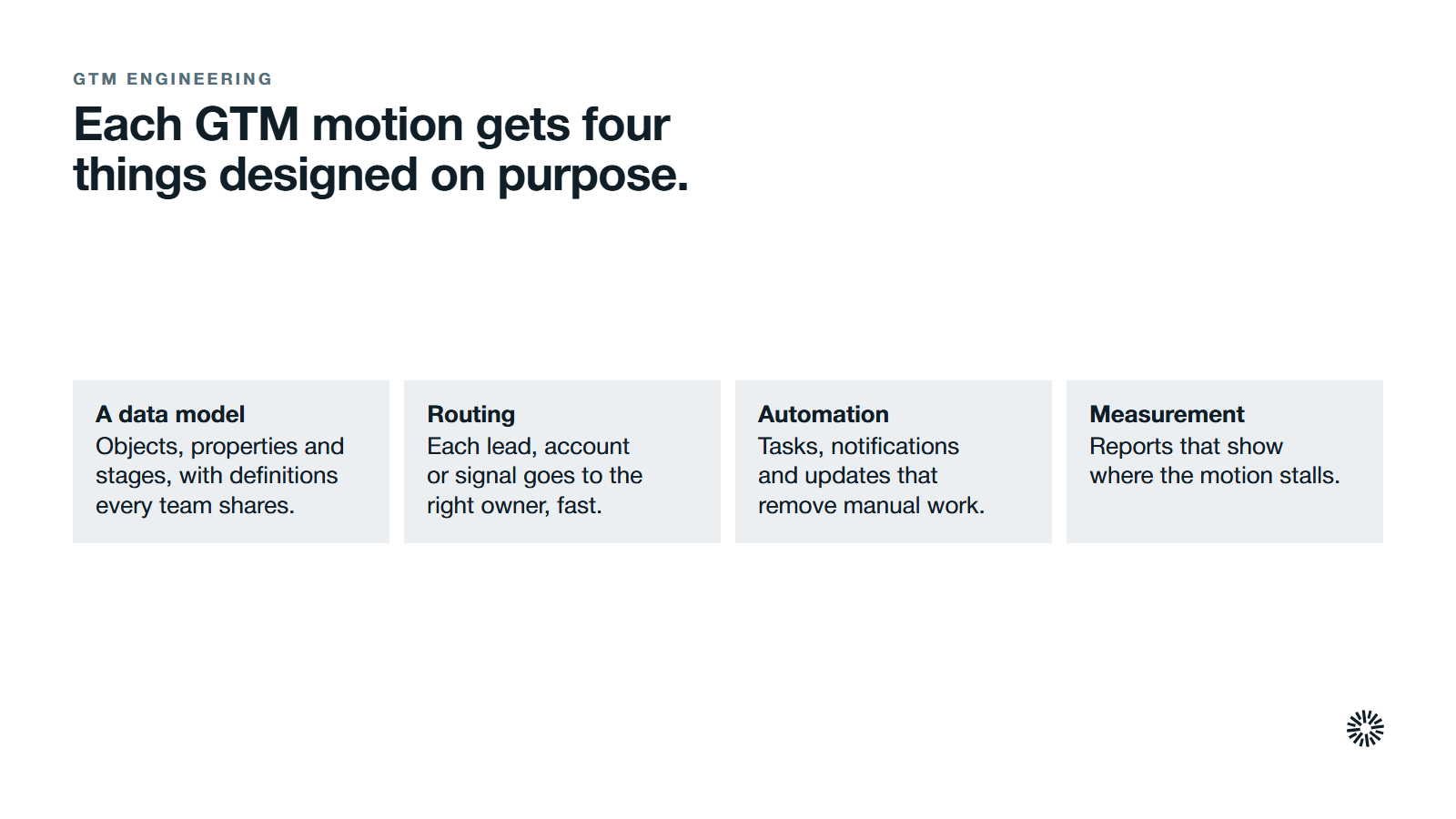
In practice, each GTM motion gets four things designed on purpose:
- A data model: the objects, properties and stages that describe that motion, with definitions every team shares.
- Routing: rules that send each lead, account or signal to the right owner, fast, with a fallback when nobody picks it up.
- Automation: the tasks, notifications and updates that remove manual work, from marketing automation to alerts when customer needs change.
- Measurement: reports and data analysis that show where that motion stalls and what it does to drive revenue.
Because the work is design, it survives change, whether the trigger is new market trends, a new product roadmap or new product offerings. When you add a segment, you extend a model that already exists rather than patching one-off fixes.
A customer centric, data driven revenue engine
A customer centric design starts from the customer journey and works backward to the systems. The customer journey crosses every team, so each handoff is built to keep the customer experience smooth, even when several go-to-market teams touch one account.
Data driven decision making then becomes routine. Shared definitions give leaders actionable insights they can trust, and the goal is a better flow of work between teams, not another dashboard.
What to build at each stage
Early company: get the basics of your revenue system right
- Define one lifecycle and one set of deal stages that the whole team understands and uses.
- Standardize the contact, company and deal properties you need for reporting. Remove fields nobody uses.
- Automate only the essentials: form capture, basic assignment and new lead notifications.
- Hold one weekly pipeline review with shared definitions. It is your first data driven habit.
Growing company: connect the motions and clean the data
- Write routing rules for each motion, with clear ownership and response expectations.
- Build scoring that combines fit with customer engagement signals, and make scores visible to reps.
- Document the handoffs between marketing, sales and customer success, and build them into workflows.
- Consolidate overlapping tools so that customer data lives in one place.
Scaling company: engineer the full revenue engine
- Design a coherent data model, with custom objects where products, subscriptions, usage or partners need them.
- Build a designed journey for every motion, from first signal to renewal, with routing, automation and measurement.
- Create scorecards at segment and motion level, so leadership sees where revenue slows.
- Keep a visible backlog of system changes with named owners. It keeps growth strategies tied to sustainable growth.
Know when to hold off
Do not build ahead of your decisions. When you are ready to build, weigh a GTM agency against an in-house engineer before choosing a route. If founders still sell every deal and the product is unproven, keep things simple. Companies with thin profit margins in particular should not overbuild.
Systems encode choices. If your ideal customer, segments or motions are still shifting, heavy systems harden confusion. Larger companies face the opposite risk: too many tools and no owner. Either way, a revenue operations strategy pays off only when someone owns it.
What you gain when this is done properly
Once the strategy and the systems line up, each team feels the difference in its own way.
Sales gets cleaner pipeline and fewer dead ends
Sales representatives receive well-routed leads and accounts instead of random names. Sales leaders can align sales effort with the best segments. Stages reflect real buyer engagement, so the pipeline tells the truth. Fewer manual updates leave more time for selling, which lifts sales productivity and makes sales targets easier to plan.
Leaders gain insights into where deals slow down and can act on data insights instead of anecdotes.
Forecasts become data driven, and buyers get a better customer experience at first contact. Coaching uses real performance metrics and deal closure patterns. When segmentation is wired into routing and scoring, your sales strategies get tested against evidence, and customer lifetime value by segment becomes visible.
Marketing sees which motions create revenue
With joined-up data models and attribution, marketing can see which campaigns and channels produce real opportunities and customers. Segmentation allows tailored messages for different customer groups, and customer feedback from sales and customer success sharpens targeting.
You spend less time debating sourced versus influenced revenue and more time moving budget toward the motions that work. Marketing efforts connect to increased revenue, and marketing teams get customer insights instead of click counts. That is how marketing helps drive revenue, with data driven budget decisions behind it.
Customer success gets predictable renewal and expansion
Health scores, product usage and commercial data sit in one view, not scattered across spreadsheets. They follow the customer journey from onboarding to renewal. Playbooks start from signals such as falling usage or adoption of a second product, so customer behavior and customer insights turn pain points into proactive outreach rather than surprises.
Better retention and expansion strengthen customer relationships and customer satisfaction. A net promoter score is easier to act on beside usage and renewal data, and customer expectations become part of the routine. That keeps the company customer centric, with KPIs based on customer value.
Customer feedback flows back to product, and the customer experience gets easier to improve.
Strategy becomes revenue when it is built into systems
The core shift is from a plan on a slide to motions that run on designed systems. A clear revops strategy gives you something repeatable to build on.
When acquisition, retention and expansion share the same data and logic, each stage feeds the next. That is what supports sustained revenue growth and long term value.
Propello designs and builds connected GTM systems on HubSpot. If your revenue operations strategy needs to move from slides into systems, an audit is the place to start.