RevOps and GTM Engineering answer different questions inside your revenue engine. RevOps governs how your sales, marketing and customer success teams operate together. GTM Engineering builds the technical systems those teams operate on. They overlap, but they are not the same job renamed.
This article compares them on purpose, work, skills, outputs and cadence, then covers where they overlap, how they cooperate and which one you need first. If you run a revenue operations team today, it will help you decide whether to hire a process leader, a GTM engineer, or both.
|
RevOps RevOps is the operating function that governs definitions, processes, forecasting and data quality so revenue teams work from the same information toward the same goals. |
RevOps runs the revenue engine, GTM Engineering builds it
Revenue operations runs and governs the revenue engine day to day. It owns shared definitions, the sales process, forecasting, data quality and cross functional alignment across sales, marketing and customer success, so processes stay consistent across the revenue lifecycle.
GTM Engineering designs and builds the systems that execute your go-to-market strategy: data pipelines, lead routing, enrichment, automation and integrations. The blueprint those systems follow is described in revenue architecture, from strategy down to infrastructure. GTM engineers automate lead identification, scoring and routing.
If you can fund only one, start with RevOps when your definitions, reporting and data governance are unreliable. Start with a GTM engineer when your processes are clear but your tech stack cannot execute them. At scale, you need both.
What RevOps is and how customer relationship management fits
RevOps in simple terms
Revenue operations is the operating function that aligns sales, marketing and customer success around shared definitions, consistent business processes, forecasting and reporting. It designs and governs the operational model for revenue teams, aiming for a unified customer journey from lead to sale.
The payoff is efficiency and predictability, which is how a revenue operations team supports revenue growth.
It settles what counts as a qualified lead, what the pipeline stages are, what service levels govern handoffs and how accurate the forecast is.
Revenue operations teams typically report to the chief revenue officer or COO and need executive sponsorship, because the remit crosses functions. Your customer relationship management (CRM) system is the central operating system for revenue operations work, and a RevOps team keeps its records trustworthy.
RevOps vs sales operations
Sales operations supports the sales team alone, and business operations looks across the whole company, while RevOps spans the revenue lifecycle. That reach is the main difference between RevOps and sales ops.
What GTM Engineering is
GTM Engineering is the discipline that designs and builds the technical GTM system. It focuses on technical systems for revenue execution: data pipelines, routing rules, enrichment, automation workflows, integrating systems and AI agents.
GTM engineers often work with APIs and automation tools. The role emerged because modern tools let smaller teams ship complex plays without a full engineering department.
Where RevOps defines the standard, GTM Engineering ships the capability. It is the builder arm, with RevOps as the strategic conductor, and it builds minimum viable versions of new motions so you can test them quickly.
Demand for the work is rising. Bloomberry's 2025 analysis of job posting data found 205% more new GTM Engineering and RevOps roles from January through September 2025 than in the same months of 2024.
How RevOps and GTM Engineering compare in practice
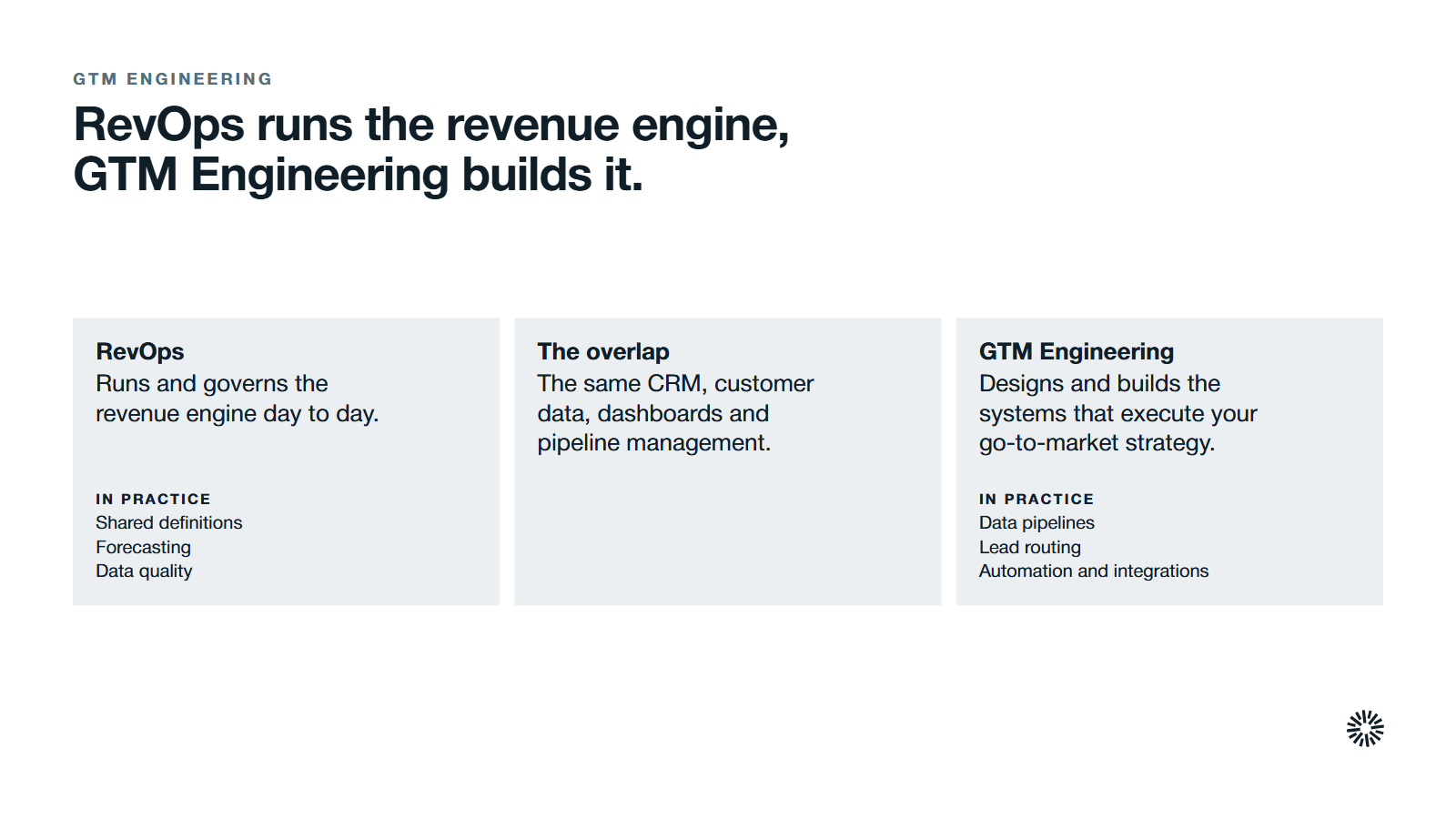
The difference lives in the center of gravity: whether accountability leans toward process governance or technical execution.
Comparison by purpose, work and cadence
| Criterion | RevOps | GTM Engineering |
|---|---|---|
| Purpose | Keep the revenue engine reliable: consistent definitions, clean data, accurate forecasts, governed handoffs. | Build new capability: automation, enrichment, lead routing, outbound engines, scoring models. |
| Typical work | Process design, metrics, dashboards, forecasting, data governance, tool selection. | Scripts, API integrations, enrichment pipelines, automation workflows, intelligence layer creation. |
| Skills | Process thinking, data analytics, change management, CRM fluency, strategic planning. | SQL or scripting, APIs, automation platforms, data modeling. Strong technical depth. |
| Outputs | Governed definitions, scorecards, accurate forecasts, clean data, dashboards leadership trusts. | Working workflows, integrations, pipelines, new signals, automations that handle repetitive tasks. |
| Cadence | Quarterly or monthly: planning cycles, forecast reviews, hygiene audits, process governance. | Weekly or biweekly sprints: new automations, system fixes, experimental builds. |
| Where it sits | Reports to the CRO or COO. Sits across sales, marketing and customer success. | Often under marketing, RevOps or a GTM systems leader. |
| Overlap | The same CRM, customer data, dashboards and pipeline management. | The same CRM, data pipelines and dashboards, plus the same view of GTM motions. |
What you gain when this is done properly
The key benefits appear when both functions are present and coordinated, because their relationship is cooperative and complementary.
Impact on sales
Clear operating rules from RevOps plus reliable systems from GTM Engineering change a rep's day. Leads route immediately based on signals, territories stay balanced, and automations handle follow ups so the sales team can automate repetitive tasks instead of doing them by hand.
Salesforce's 2026 State of Sales report found that the average seller spends 40% of their time selling.
Auto enrichment of account data lets reps spend more of that time selling instead of researching, and sales engagement improves because reps work from clean records. Signal based routing puts high intent accounts and high value accounts in front of the right rep fast.
Sales velocity, how quickly deals move through the pipeline, becomes dependable once stages and definitions are standardized.
Impact on the marketing team and marketing automation
Shared definitions and reporting standards make sales and marketing measurement credible, because the marketing team and sales team work from the same information. GTM Engineering builds the scoring models, audience syncs and multi touch attribution workflows that put those definitions to work.
You get sharper targeting of target accounts, quicker campaign iteration and clearer feedback loops. Marketing automation governed by RevOps removes guesswork from lead qualification, and the marketing SLA becomes enforceable because the data layer and routing rules work.
Impact on customer success and the customer journey
Revenue operations defines the lifecycle stages after the sale: onboarding, expansion, renewal and advocacy. It governs renewal SLAs, expansion models and the customer journey from first contract to cross sell opportunities.
GTM Engineering builds health score pipelines, renewal triggers and play automation in HubSpot. RevOps then tracks whether retention efforts work, using customer satisfaction score, which shows how loyal and engaged customers feel, and adoption rate, which compares new users with the total user base. Both help customer success teams spot product adoption problems early.
Where the two functions overlap
The two roles overlap most in data and system automation. Both work in the same CRM record structures, data pipelines and dashboards, and both need a firm grasp of lead routing, funnel stages and lead quality.
The overlap shows in hiring too. Bloomberry found that nine of the ten most common responsibilities in GTM engineer job postings also appear in RevOps postings. RevOps postings lead with CRM ownership, and 76% mention forecast accuracy, while GTM engineer postings lead with automation and integration.
Bloomberry's own verdict was that GTM Engineering and RevOps jobs are "essentially the same." What separates them is who is accountable for governing the engine and who is accountable for building it.
In smaller firms, one person often carries both, configuring workflows while also defining processes. That works until scale pushes operational demand and build demand apart. When the same person cannot govern and build at the pace the business needs, the roles must separate.
GTM engineers still need business context: RevOps must define what problem a new feature solves and what a qualified lead means. The line is not rigid, but knowing where accountability sits prevents operational problems.
How RevOps and GTM Engineering work together
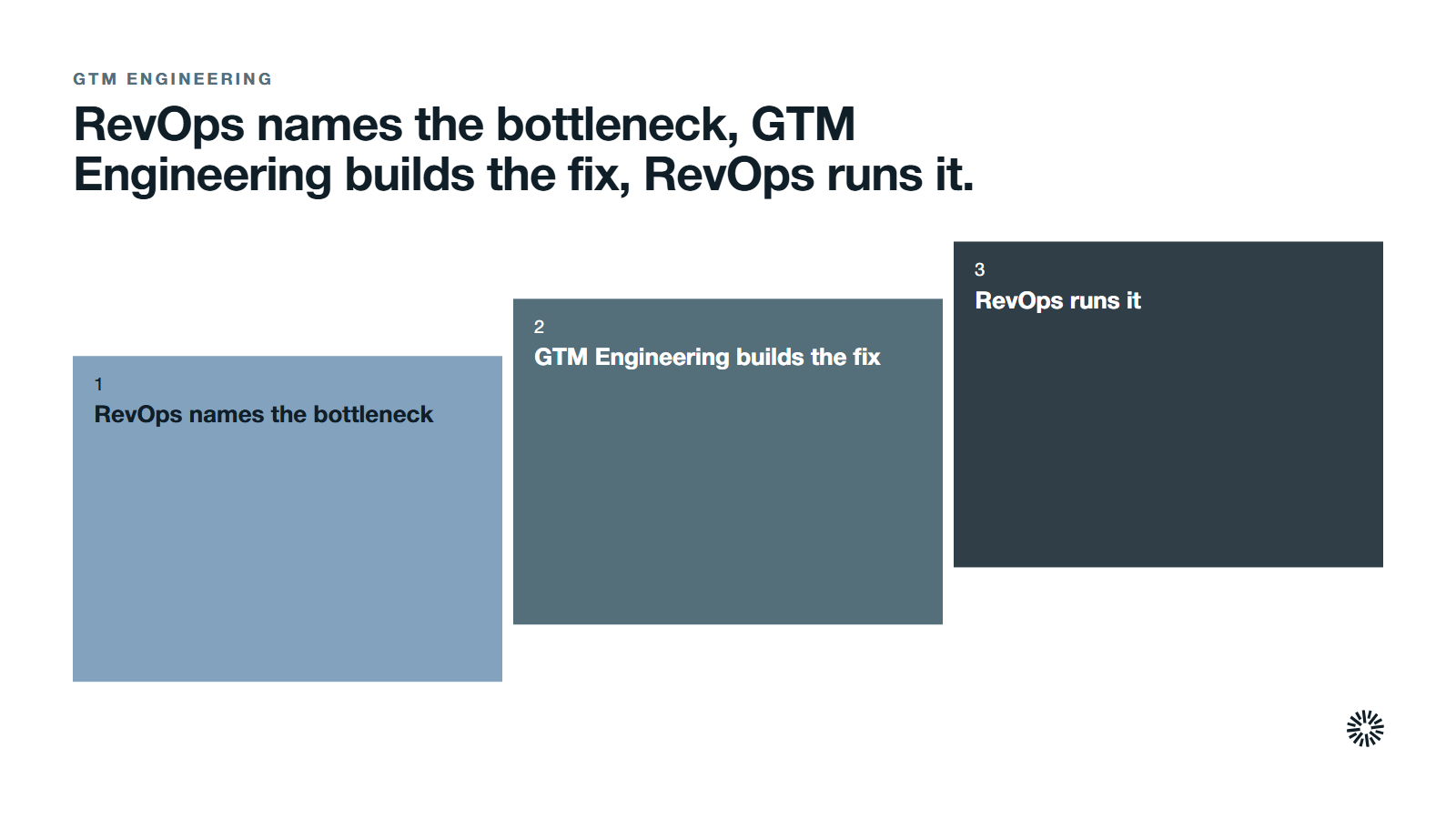
RevOps names the bottleneck and owns the standard, including the sales process rules. GTM Engineering builds the fix. RevOps runs it. That split is why GTM teams need GTM Engineering alongside operations. Take slow inbound lead response as an example.
- Diagnose. RevOps notices leads take too long from submission to contact. Service level breaches show up in reporting and inbound conversion suffers.
- Set the standard. RevOps defines the rule: leads above one score go to one team, the rest to another, every lead carries the enrichment fields routing needs, and contact happens inside an agreed response window.
- Build the change. GTM Engineering builds an enrichment pipeline that appends company and firmographic data, sets up CRM routing based on it, automates task creation and adds alerts for breaches.
- Test and roll out. Pilot with one inbound source, train frontline teams and adjust edge cases.
- Run and improve. The RevOps team monitors compliance and conversion. GTM Engineering fixes breakages and tunes routing logic or enrichment thresholds.
Which one you usually need first
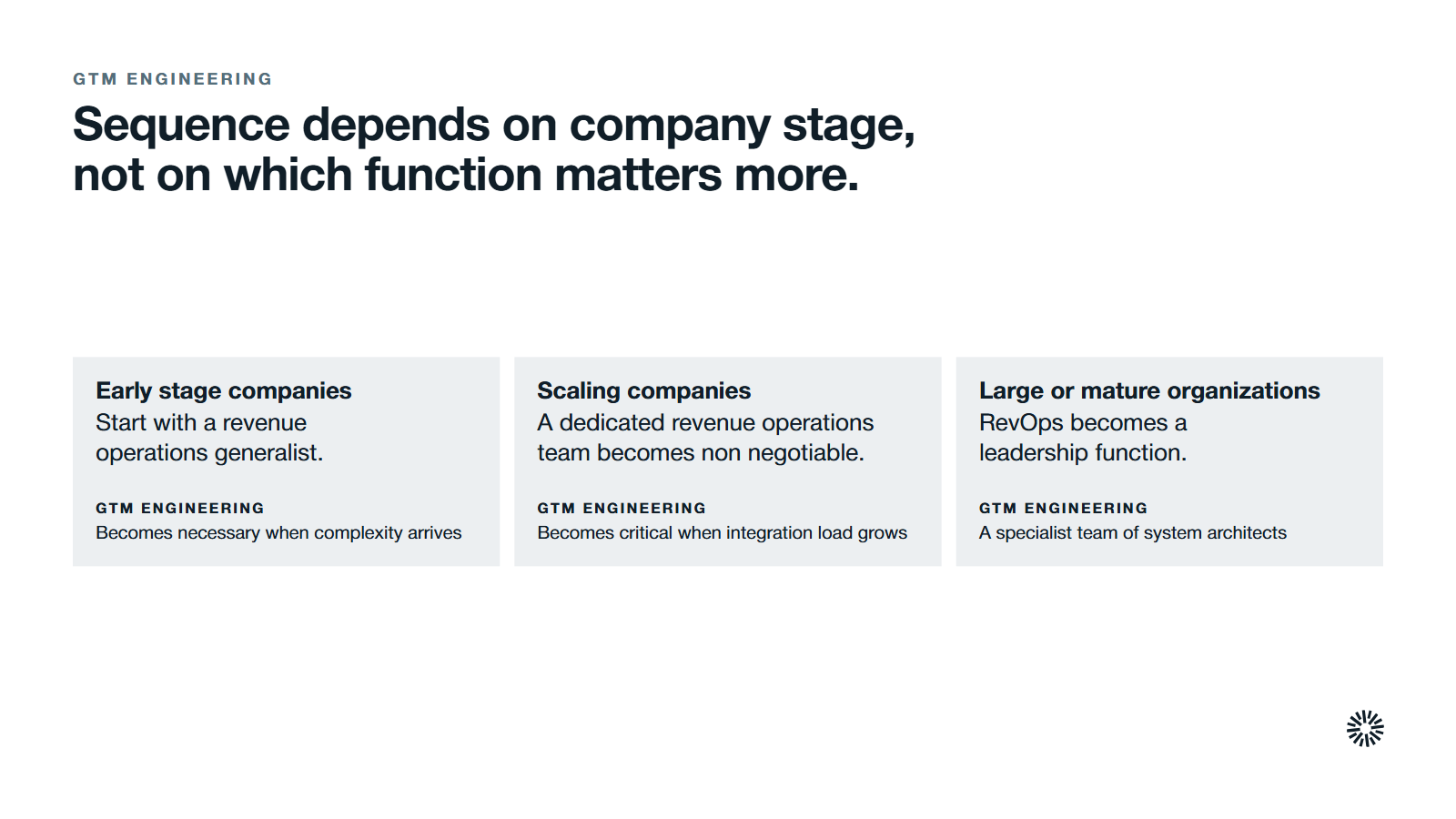
Sequence depends on company stage and complexity, not on which function matters more.
Early stage companies and new GTM motions
At an early stage you typically have founder led sales, a simple funnel, a light tech stack on HubSpot and low data volume. Start with a revenue operations generalist who owns the sales process, basic CRM setup, revenue data definitions and reporting.
RevOps needs a single source of truth for data, and automation built before one exists is fragile. The first GTM engineer usually becomes necessary when complexity arrives: multiple data sources, advanced routing, AI outbound or systems that must connect across channels.
Scaling companies need cross functional alignment and a RevOps team
Multiple teams, products, regions and higher deal volume call for a dedicated revenue operations team. RevOps becomes non negotiable for maintaining standards, unifying data and holding cross functional alignment. Without it, different metrics multiply and the RevOps framework and RevOps strategy fall apart. Keeping that discipline intact as you grow is the subject of revenue operations strategy at scale.
GTM Engineering capacity becomes critical when integration load grows, scoring models need custom data flows, signal based selling needs real time enrichment, or point solutions must join a unified platform. The tech stack outgrows manual upkeep, so GTM Engineering builds and tests custom technical systems aimed at revenue growth.
Revenue operations tools connect GTM data, teams and workflows, and use historical data to predict future revenue.
Large or mature revenue organizations
At scale, RevOps becomes a leadership function and GTM Engineering a specialist team of system architects and automation engineers. RevOps sets the metrics and forecasting models, and GTM Engineering ships the systems that make those decisions executable.
Signs you have RevOps but lack GTM Engineering capacity
Many revenue operations teams get stuck here. Processes are clear and governance is solid, but the systems are brittle. Good RevOps teams continuously analyze customer interaction data, yet cannot act on what they learn fast enough.
Disconnected tools are a common cause. Salesforce's 2025 MuleSoft Connectivity Benchmark found that the average enterprise manages 897 applications and only 29% are integrated.
- Automation backlog. Requests to automate repetitive tasks pile up and reps still do the work by hand. Your RevOps team can design the automation, but someone has to build it.
- Manual data fixes. Enrichment happens sporadically and fields for customer engagement or account data sit empty. Clean data exists in policy, not in practice.
- Integration failures. Tools do not sync reliably and revenue data lives in disconnected systems, so where data lives becomes a recurring question.
- Reporting gaps. Leadership trusts the RevOps team's definitions but cannot get useful alerts, because sourcing and transforming data takes engineering.
- GTM plays that never ship. RevOps designs outbound motions or signal based sequences, but nobody can build them, so the revenue cycle stalls.
Each of these costs you rep time, slows strategic decisions and leaves more revenue on the table.
Signs you have engineering but lack RevOps
The opposite problem is strong builders and no governance. Teams disagree on what a qualified lead means, automations are live but undocumented, and nobody is accountable for errors. RevOps ensures data quality and builds cross functional reporting dashboards, and without that operating model even well built systems produce unreliable results.
How to scope your next hire or mandate
Map your pain points into two lists, operating issues and build issues. If reporting is unreliable, definitions shift between teams and the forecast is guesswork, hire a RevOps leader first, since RevOps roles prioritize governance and operational consistency.
If processes are clear but execution is slow or brittle, hire a GTM engineer to ship what RevOps designs. If outside help suits you better than a hire, compare revenue operations consulting with engineering before you decide.
Write a charter for each function before you hire, covering scope, accountability and the handoff between governing and building, so business processes have one owner and neither role ends up doing the same job.
The decision comes back to your bottleneck
The choice between revenue operations and GTM Engineering is about your primary constraint. If your GTM teams struggle with clarity, alignment and trustworthy data, you need stronger RevOps. If your processes are defined but your systems cannot keep pace, you need GTM Engineering capacity.
Ask whether your revenue engine is stuck because you do not agree on how to operate, or because you cannot build what you have already agreed on. The answer tells you which function to invest in next.
Propello designs and builds connected GTM systems on HubSpot. If you need clarity on where your revenue engine is stuck, an audit is the place to start.