
Customer marketing is the work of marketing to people who have already bought from you, so they adopt your product, stay, advocate and buy more. This guide is for CEOs, founders, CROs and marketing leaders at B2B companies who want growth that does not depend on finding a new buyer every time.
You will see how customer marketing works across the customer lifecycle, the core strategies and programs, how it differs from acquisition marketing, product marketing and customer success, how to measure it, and where it sits in the Evolve stage of Loop Marketing.
|
Customer Marketing Customer marketing is the practice of marketing to existing customers to drive adoption, retention, advocacy and expansion, using what you know about each account to keep delivering ongoing value. |
Why customer marketing is important for B2B growth
Winning a customer is expensive, and the sale is only the start of what that customer is worth. Customer marketing focuses on the part of the relationship that follows, where existing customers decide whether to renew, expand and recommend you. For a SaaS company with subscription revenue, that decision comes round every year.
When it works, revenue growth comes from accounts you already have: repeat business, larger deals and referrals from people who trust you. It also shows how many customers are truly engaged, as opposed to merely under contract. Without it, marketing efforts stay pointed at new buyers while the existing customer base drifts.
It is also a customer-driven marketing strategy. You choose what to say from customer needs and customer interests, not from what is easiest to publish. Customer marketers use usage, feedback and account history to pick the message for each part of your target market.
How customer marketing works across the customer lifecycle and journey
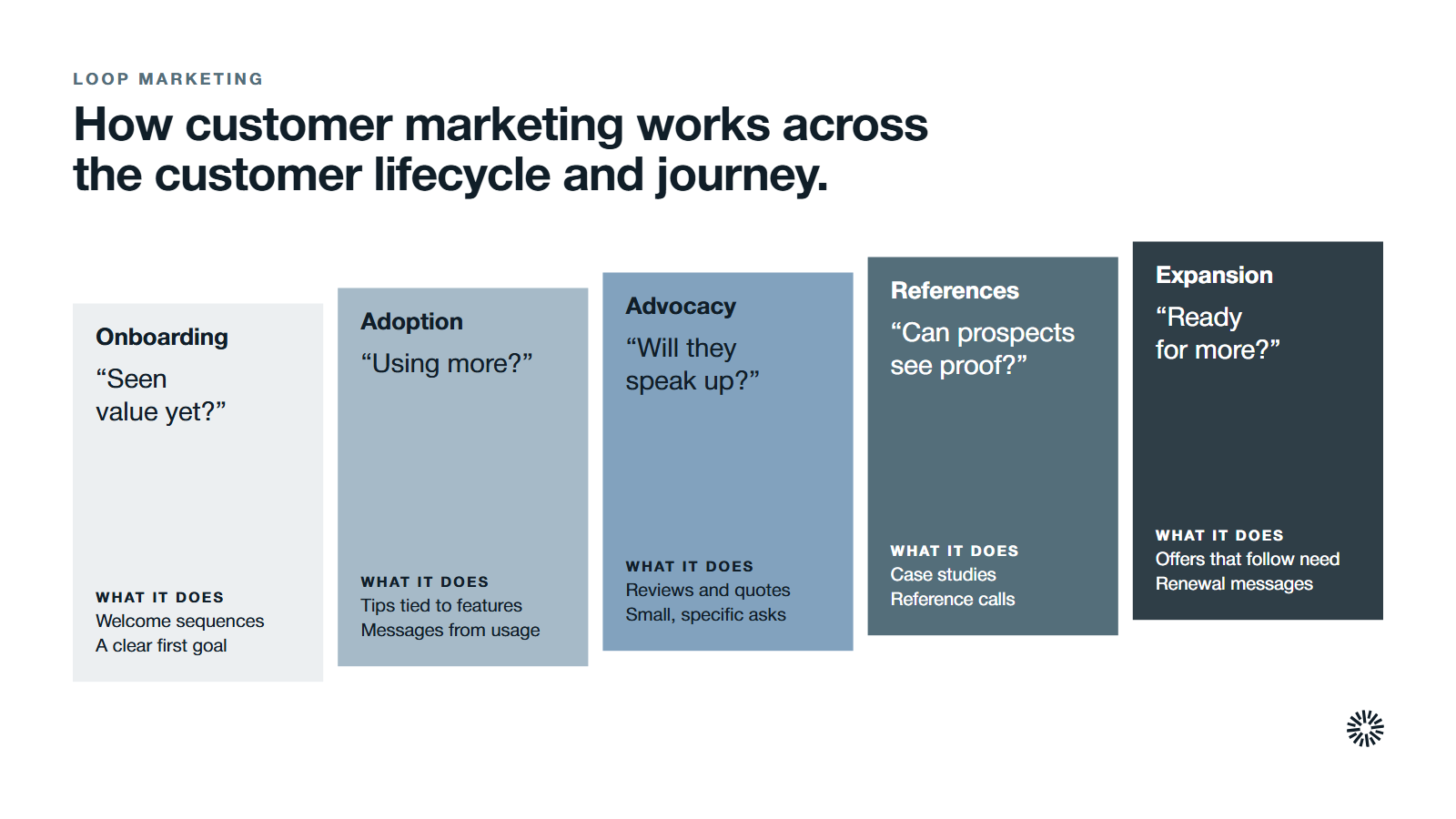
Most marketing teams spend their effort before the sale. Customer marketing picks up where that effort ends. The deal closes, and a second set of marketing efforts begins: help the new customer get value quickly, keep them engaged, invite them to speak for you, and offer more when they are ready.
It works because your customer base holds the best information you have. You know what each account bought, how they use it and what they asked for.
HubSpot's State of Sales in 2026 reports that customer retention and expansion was the top challenge of 42% of sales leaders, and that the average company's largest revenue stream is recurring customer revenue.
That points to a simple view of the customer lifecycle in five moments:
- Onboarding. Get the new customer to a first result.
- Adoption. Help them use more of what they bought.
- Advocacy. Turn satisfied customers into people who recommend you.
- References. Give prospects proof from customers like them.
- Expansion. Offer the next product, seat or service at the right time.
Each moment needs a different message, which is why customer marketing runs on customer data and the customer journey rather than a single newsletter.
Every customer touchpoint, from a support reply to a renewal notice, shapes customer loyalty, so treat these customer interactions as part of your marketing messages and map them before you plan campaigns.
Our guide to first-party data and unified customer data covers the record that makes this possible.
Customer marketing strategies that earn loyalty
These are the practices customer marketing teams rely on first. An effective customer marketing strategy mixes a few programs, each built for one moment, and it sits inside your wider marketing strategy rather than beside it.
You do not need all of them at once. Start with the moment where you lose the most customers or leave the most value unclaimed.
Onboarding and education that get customers to value fast
The first weeks decide whether a customer sticks. Welcome sequences, short how-to content, in-app messaging and a clear first goal help new accounts see results before doubt sets in.
Keep it specific to the product they bought. A guide on the one feature that matters most beats a tour of everything. Ongoing education keeps engagement up and gives customers fewer reasons to leave.
Adoption campaigns that deepen engagement
Once a customer is using the basics, show them what else fits their needs. Trigger a message when usage changes, share a tip tied to a feature they have not tried, and invite engaged customers to a webinar or a customer community.
Segment customers by role, product and usage so each group gets guidance that fits its needs. The aim is engaged customers, meaning people who use the product often and know how to get more from it.
Loyalty programs and customer communities
Loyalty programs reward behavior you want to repeat, such as renewing early, completing training or sharing feedback. Customer communities give people a place to ask questions and learn from peers, including social media groups or a private forum.
Both foster loyalty by making customers feel valued, not just billed. Building customer loyalty takes more than discounts: programs that boost customer loyalty reward real behavior, and community engagement shows brand loyalty in practice, as customers connect with one another and with your team.
Customer advocacy, referral programs and success stories
Customer advocacy turns happy customers into brand advocates. A good customer advocacy program asks for specific, small actions: a review, a reference call, a quote, a case study or a referral.
Referral programs add a structured way to introduce your brand to similar companies. Satisfied customers already give organic word-of-mouth referrals and reviews, and a program makes that easier. Success stories work because prospects trust peers more than your own claims.
Your most active advocates can become brand ambassadors who speak at events or join a customer advisory group.
Brand advocacy works when you make the ask small and recognize the effort. Always get written approval before you publish a customer story.
Customer feedback and the insights it gives you
Nurturing existing customers includes listening. Surveys, support conversations and reviews turn customer feedback into valuable insights about industry trends, product gaps and shifting needs. Share what you learn with product and sales, and tell customers what changed because they spoke up.
That turns customer marketing into an actionable feedback loop, where each answer improves the product and the next message.
Expansion and renewal messaging
Expansion offers should follow need, not the sales calendar. Use behavioral data such as usage growth, new teams joining or a question about a related feature, and send personalized communication when the signal appears.
Renewal messaging should start well before the date and remind customers of the value they have already received.
How customer marketing differs from acquisition, product marketing and customer success
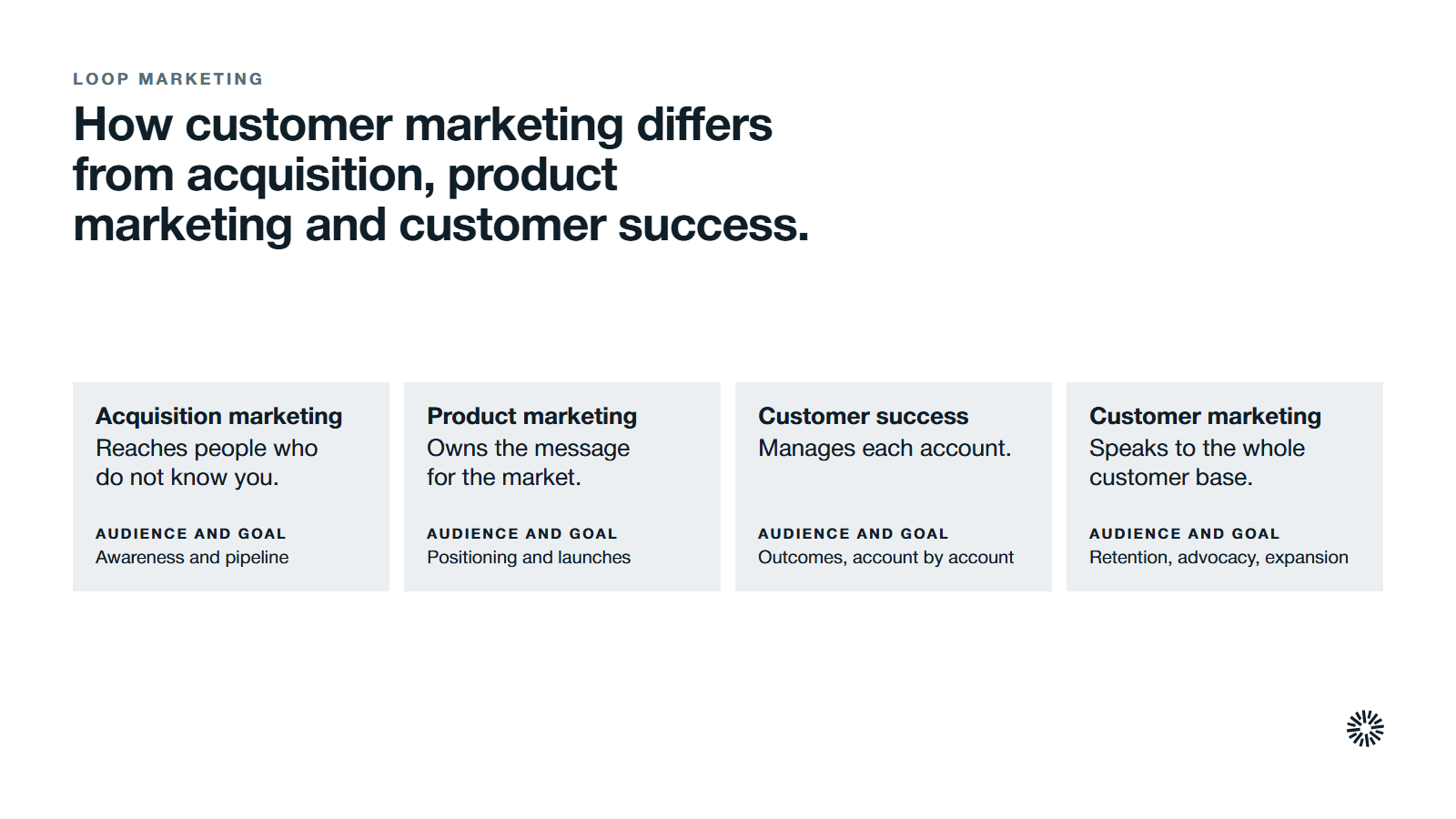
The term is easy to confuse with its neighbors, so it helps to separate them by the audience and the goal.
Traditional marketing, built around acquiring new customers, aims at people who do not know you yet. Its goal is awareness and pipeline. Customer marketing focuses on existing customers, and its goal is to retain customers, grow their value and bring in referrals.
Where acquisition chases new customers, this work protects and grows the existing customer base.
Product marketing owns positioning, launches and the message for the market. Customer marketing takes that message and adapts it for people already using the product. The two often share a team in smaller companies. Aligning marketing with customer success improves retention and engagement, because both teams then work from the same account history.
Customer success manages the relationship and outcomes account by account. Customer marketing scales communication across the whole base, and the two feed each other. Our guide to customer success operations shows how the service side is run, and what customer success is explains the role in plain terms.
A customer marketing manager sits between them. This person plans programs, works with customer success on accounts, and brings customer stories to marketing and sales.
Where customer marketing sits in the Evolve stage of Loop Marketing
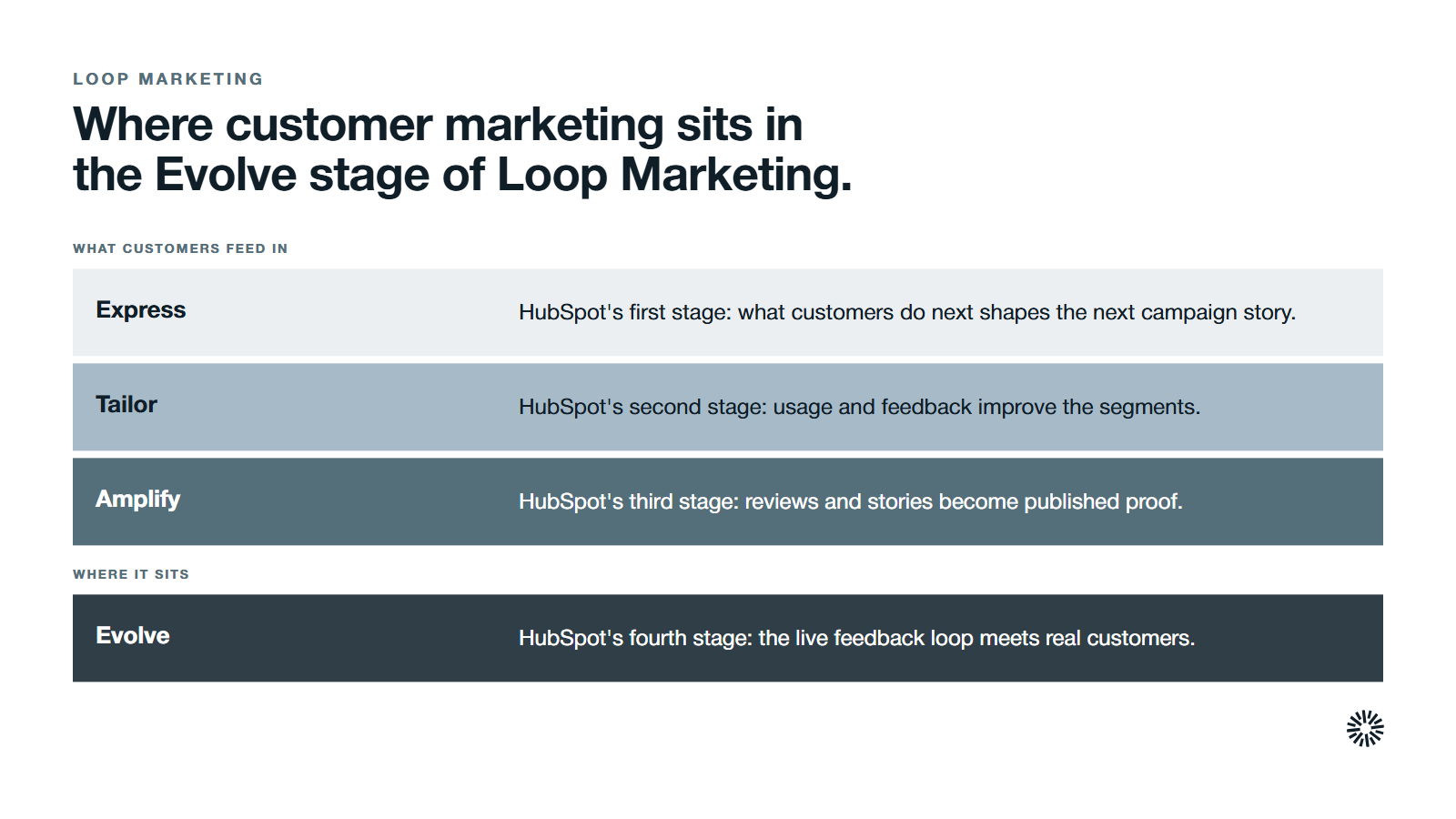
Loop Marketing is HubSpot's four-stage framework for growing in the AI era: Express, Tailor, Amplify and Evolve. HubSpot describes Evolve as a live feedback loop that monitors performance, runs rapid experiments and applies each learning to the next campaign.
Customer marketing is where that loop meets real customers. After a campaign wins a customer, what they do next is the most useful signal you will get. Do they adopt? Do they renew? Do they refer someone? Those answers go straight back into Express, where the next campaign story is written.
Treat it as part of your overall marketing strategy, not a side project.
It also touches the other stages. A customer's usage and feedback improve the segments you build in Tailor. Their reviews and stories give you proof to publish in Amplify. HubSpot's scorecard measures Evolve through regeneration, the speed of your loop and the share of improvement in learnings and outcomes.
For the method of collecting what customers say, see our guide to the customer feedback loop. It goes deep on the research side; this guide covers the wider customer marketing program around it.
How to measure customer marketing success
Pick a few key metrics for each moment and review them together. Judge your customer marketing efforts by what customers do next, not by how many messages went out. A short list works better than a dashboard nobody reads.
- Customer retention rate. The share of customers who stay over a period.
- Customer lifetime value. What an account is worth across its whole relationship with you.
- Repeat purchases and expansion revenue. How often existing accounts buy again, and the income from upsells and cross-sells.
- Net promoter score (NPS). How likely customers are to recommend you, and a good prompt for follow-up.
- Engagement metrics. Product usage, email replies, event attendance and community activity.
Customer satisfaction scores help too, but read them alongside behavior. A satisfied customer who never uses the product may still leave.
Poor service is a real risk: in Salesforce's State of the AI Connected Customer report (seventh edition, 2024, about 16,500 respondents), poor customer service was the second most common reason customers stopped buying from a brand, cited by 43% of respondents.
Set a baseline before you launch, change one program at a time, and compare against the baseline.
Who owns customer marketing and what customer marketers do
In a small company the founder or marketing lead owns customer marketing, with customer success supplying the account context. As the company grows, a customer marketing manager and a small customer marketing team take over programs, community and advocacy.
Customer marketers plan the programs, write the messages and work with customer success on account context.
Whoever owns the work needs a shared view of the customer. Marketing, sales and service should see the same record, and they should agree on who may contact which account and when. Our guide on aligning sales, marketing and customer service covers those agreements.
What you gain when this is done properly
Customer marketing pays off across the revenue team when each program has an owner and a clear purpose.
Sales: warmer expansion conversations and better references
Sales reps get proof from customers in their buyers' industry and a clear signal of when an existing account is ready to talk. Expansion conversations start from usage and results, not a cold pitch.
Marketing: a steadier base to build on
Marketing gains customer stories, quotes and feedback that sharpen messaging, plus a loyal customer base that responds to campaigns. Acquisition work gets easier when your best customers vouch for you.
Customer success: customers who get more from the product
Customer success gets scaled programs that support accounts it cannot reach one by one. Customers receive guidance when they need it, and early signs of a problem reach the team sooner.
Start with one customer moment
You do not need a full program to begin. Build your customer marketing strategy one step at a time. Choose the moment where current customers drift or value goes unclaimed, such as the first thirty days or the renewal window. Write the goal, name an owner, pick one metric and run a single campaign.
Then review what customers did next and use it in your next round of planning. That review is the Evolve habit in practice.
Propello is a HubSpot partner and designs and builds connected GTM systems on HubSpot (see about Propello). If you want to see where your customer data and handoffs hold back customer marketing, an audit is the place to start.
