This guide is for CEOs, founders, CROs and revenue leaders at growing B2B companies. Sales and marketing alignment holds only when customer service sits in the same loop, working from shared definitions, one customer record in HubSpot and a regular meeting with the other two teams.
You will get six steps, from shared definitions through a three-way service level agreement to the handoffs in both directions, plus the mistakes that undo them. It builds on Loop Marketing, which HubSpot describes as a four-stage framework for growing in the AI era.
|
Sales and Marketing Alignment A shared system of goals, definitions, processes and data that connects sales, marketing and customer service around the full customer journey. |
Why alignment between two teams leaves a gap
Most companies put their alignment effort into the marketing and sales departments. It matters: in HubSpot's 2026 State of Marketing survey, 27.6% of marketers named sales-marketing alignment among their top challenges.
Yet your buyers do not experience two teams. Forrester's Buyers' Journey Survey 2025, reported on its blog, found that 73% of purchases involve three or more departments. After the sale, customer service becomes the team that hears what the customer actually thinks.
Customers notice when those teams do not talk. Salesforce's customer engagement research says 79% of customers expect consistent interactions across departments, yet 56% say they often have to repeat or re-explain information to different representatives.
Some teams call this pairing smarketing: marketing's lead generation and sales' closing expertise, working from shared goals and open communication. It is a good start for sales and marketing departments, but two departments agreeing is still only part of the picture.
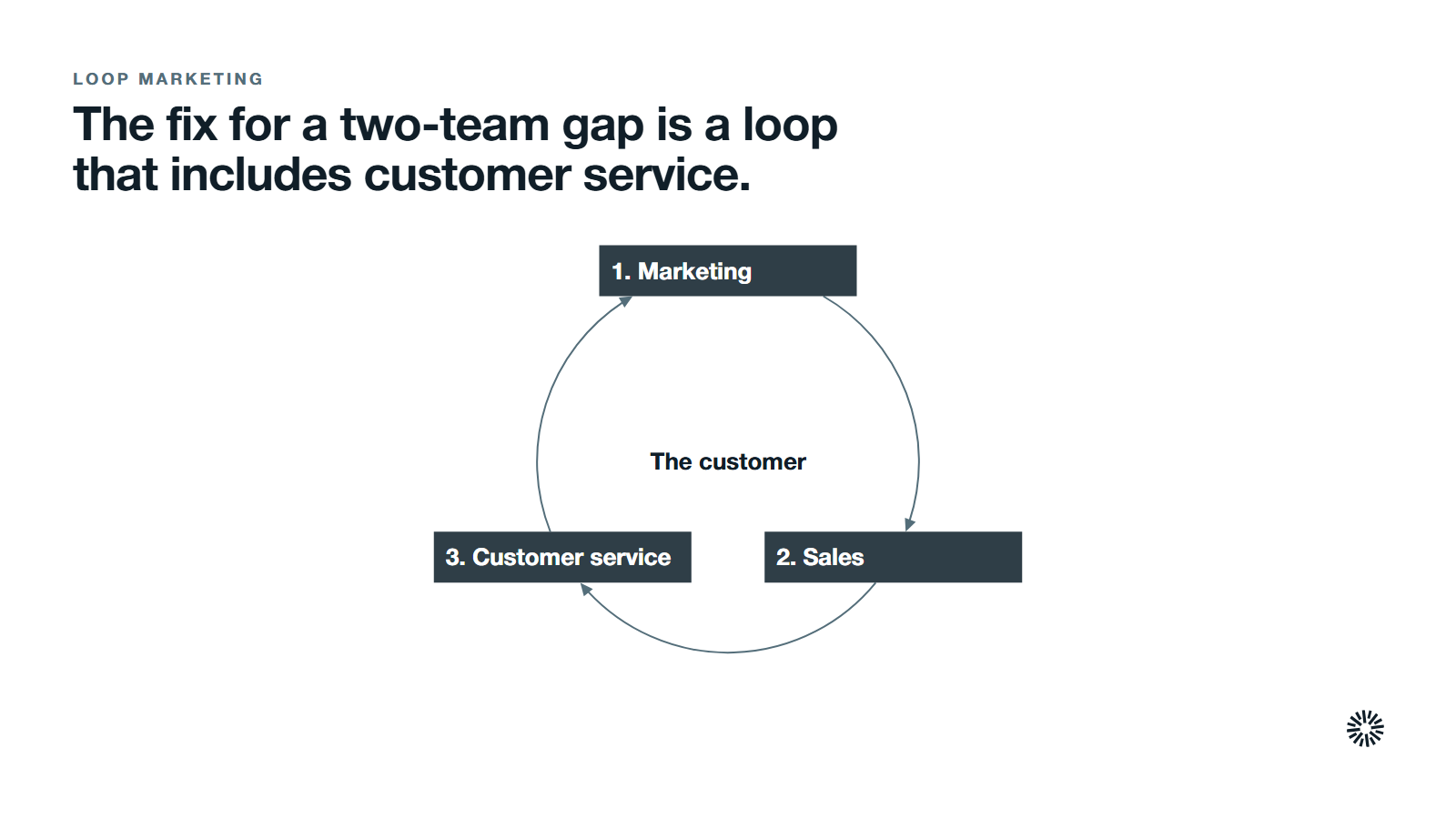
The fix is a loop. What marketing learns shapes what sales says. What sales learns shapes how customer success onboards. What customer service learns goes back to marketing and sales, and shapes the next campaign and the next expansion conversation.
What you need before you start
A three-team loop needs a few decisions before any workshop. Without them, the handoff process becomes a debate about whose problem it is.
- A clear ideal customer profile and offers, so the three teams are not aligning around different customers.
- One shared HubSpot instance with clean company, contact and deal records, owned by RevOps or a similar function.
- Customer service data in the same CRM, not in a ticketing tool with no connection. Data silos block the visibility the loop depends on.
- One accountable leader, often the CRO or a VP Revenue, who can make trade-offs.
Map one shared customer journey across marketing, sales and service
Draw the full buyer journey from first signal to renewal on one timeline. Marketing, sales and customer service all belong on it. Run the workshop with leaders from all three teams and someone who knows HubSpot well.
- Name concrete stages: first visit, lead, MQL, SQL, opportunity, closed-won, onboarding, adoption, renewal and expansion.
- Mirror the stages as lifecycle stages or deal stages in HubSpot, so the system reflects what you agreed.
- Check that every stage has an owner and a named partner. Onboarding, for example, needs the rep handing over context and customer success picking it up.
Agree shared definitions for leads, opportunities and customers
When sales and marketing teams use different words for the same thing, lead quality becomes a constant argument. A shared definition of a good lead is the most important agreement you will make.
Agree what counts as marketing qualified leads before anyone routes them, and base each definition on data you can see in HubSpot, not opinion. That makes lead qualification a check, not an argument.
- ICP account: a company matching your target criteria for industry, size, geography and revenue potential.
- MQL: a lead that meets agreed behavior or fit thresholds and is ready for sales to evaluate.
- SQL: a contact at an ICP company that has asked for a demo and meets budget and authority criteria.
- Opportunity: a qualified deal with identified scope, decision-makers and an expected close date.
- Customer: a person or organization that has bought and entered onboarding.
- Expansion signal: a customer showing interest in more of what you sell, or willingness to refer.
- Churn risk: a customer showing warning signs such as falling usage or unresolved issues.
The last two are the ones most teams forget, and they are where customer service speaks. Write all of them down and teach them to every new hire in all three teams. Shared criteria also cut wasted effort, because sales reps stop working prospects that were never a fit.
Design a three-way service level agreement
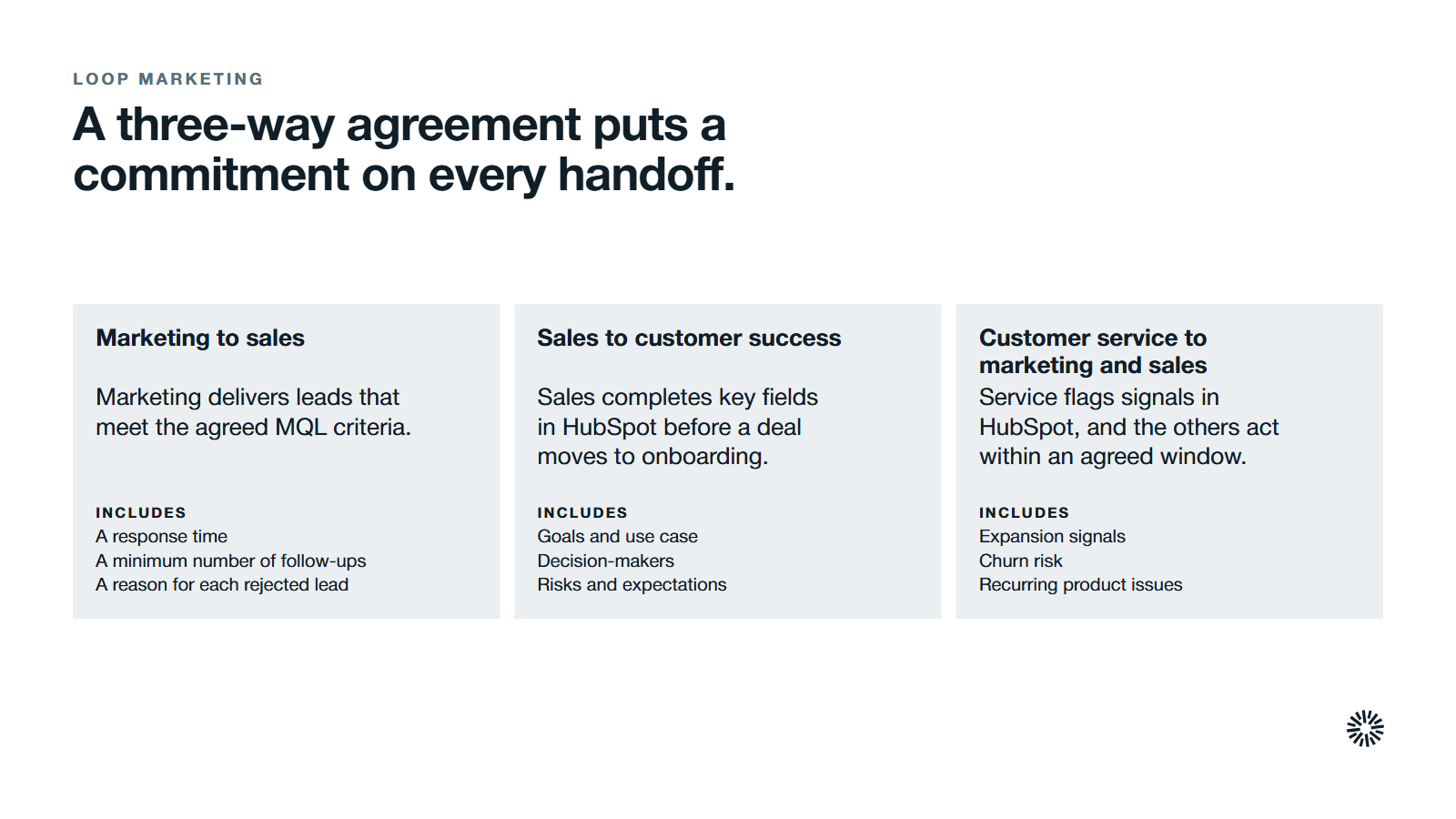
Most companies stop at a marketing-to-sales agreement. That covers one handoff out of three. A three-way service level agreement spells out what each team commits to deliver, and how quickly, at each point where work changes hands. It also keeps feedback loops running both ways, so each team hears what the others learn.
- Marketing to sales: marketing delivers leads that meet the agreed MQL criteria. Sales teams commit to a response time and a minimum number of follow-ups, and give a reason when they reject a lead.
- Sales to customer success: sales completes key fields in HubSpot before a deal moves to onboarding: goals, use case, decision-makers, risks and the expectations set during the sale.
- Customer service to marketing and sales: service flags expansion signals, churn risk and recurring product issues in HubSpot. Marketing and sales commit to acting on those flags within an agreed window.
Review it every quarter, together with the handoff process it governs, because an agreement nobody revisits turns into a document nobody follows.
Add a few shared KPIs, such as pipeline sourced from customer referrals and renewals that marketing content influenced. Shared KPIs point goals and compensation at the same revenue targets.
Build the shared customer record in HubSpot
One record per customer is what lets the loop run without anyone retyping a story. In HubSpot you can associate records such as contacts, companies, deals and tickets, and see the associations in each record's right sidebar. That is the technical heart of the shared record. Building that record is explained in first-party data marketing and unified customer data.
Then add the properties and habits that make it useful:
- Create or refine properties for ICP fit, buying role, lifecycle stage, primary use case, key pains and customer goals.
- Have customer service log tickets in HubSpot with properties for issue type, sentiment and product area.
- Give marketing teams access to support tickets and notes, so they can spot patterns in objections.
- Build one report that follows a customer across the full loop, from campaign to renewal.
Artificial intelligence tools can only summarize what your records contain, so a complete shared record is also what makes any AI feature useful.
Define the handoffs in both directions
A handoff is where customer experience tends to break, and the aim is a consistent customer experience from first touch to renewal. If a handoff is vague, each team blames the other.
Every handoff process needs a trigger, an owner and a deadline. Make each one explicit, started by a change in HubSpot.
Marketing to sales: from signal to live conversation
When a prospect meets your MQL or SQL criteria, a HubSpot workflow can assign the record and create a task for the rep.
A qualified lead should arrive with its context, and the first message should refer to the content or action that triggered the handoff, so prospects get the right message at the right moment, not a generic pitch. Sales teams that see what marketing saw can open with a relevant question instead of a script.
Speed matters too. A 2011 Harvard Business Review study, The Short Life of Online Sales Leads, found that firms contacting potential customers within an hour were nearly seven times as likely to qualify the lead as those that tried an hour later. Set in your agreement how quickly sales responds to a qualified lead.
Build campaigns together too. When sales reps share what they hear on calls, marketing content answers real objections, and prospects feel one continuous buying experience.
Sales to customer success: from closed deal to onboarding
Define in HubSpot the moment the handoff process passes a deal to customer success, rather than assuming it. For the wider portal setup, see Loop Marketing setup in HubSpot and the workflows behind it. Before the handoff, the rep completes the fields for go-live date, success definition, stakeholders, risks and promised outcomes.
When those fields are empty, customer success starts onboarding blind. The customer repeats their story, trust drops and the sales experience feels disconnected from what follows.
Customer service back to marketing and sales: from insight to action
This is the direction most companies skip. Support hears customer conversations that marketing never sees, and valuable insights go unused. A routine for capturing that input is covered in customer feedback loops for retention.
Set triggers so that a ticket or a survey comment creates a task or a flag for the account owner. Service tags accounts with expansion potential or case study potential, and marketing and sales teams act on the tag.
Marketing can also subscribe to a view of common issues and objections. That keeps campaign messaging and qualification criteria tied to what customers and prospects really say, and it gives reps real-world insight to feed back into content.
Set a simple meeting rhythm around the loop
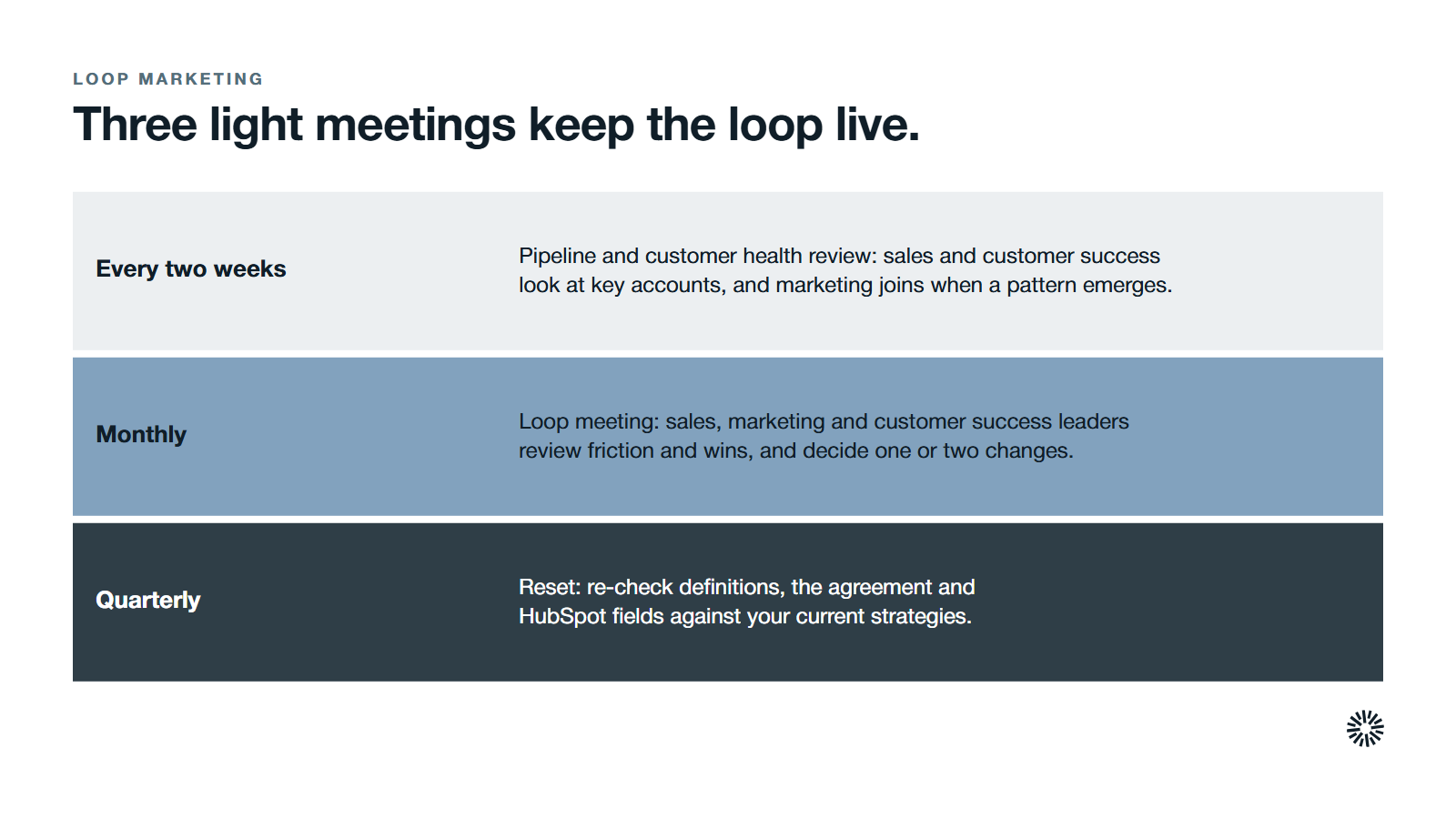
Agreements on paper do not create aligned teams. Regular meetings produce better collaboration than any dashboard, and they turn a static system into a live loop. Keep the rhythm light.
- Monthly loop meeting: sales, marketing and customer success leaders review recent friction and wins, and decide one or two changes so sales and marketing efforts pull the same way.
- Pipeline and customer health review every two weeks: sales teams and customer success look at key accounts, with marketing teams joining when a pattern emerges.
- Quarterly reset: re-check definitions, the agreement and HubSpot fields against your current sales and marketing strategies, and update them if your customer profile, pricing or sales motion has changed.
Every meeting needs a tight agenda and ends with owners and due dates in a shared document.
What you gain when this is done properly
The benefits look different for each team, but they come from the same loop. Shared definitions and data give revenue growth and customer retention a common footing: all three teams work from the same picture of the customer.
Sales gets cleaner pipeline and warmer conversations
Sales teams work fewer, better-qualified opportunities because the definitions fit reality, and conversion rates mean the same thing in every report. Before an expansion call they can see service history in HubSpot, so the conversation starts from what the customer has already told you.
Prospects arrive already educated by content that marketing wrote from real customer questions, so the sales cycle spends less time on basics.
Sales teams can forecast with more confidence because everyone counts a qualified deal the same way, and aligned teams can shorten the sales cycle by cutting repeated discovery. Deal reviews trace back to campaigns and service insights, so coaching rests on real journeys.
Marketing teams work from real customer signals
Marketers can see which campaigns brought in buyers who stayed and expanded, not just leads, so campaigns can generate leads that look like your best customers.
Salesforce says only 56% of marketing teams currently have full access to sales data, and a shared record gives marketing that view.
Support issues and objections shape content priorities and marketing strategies, so marketing efforts stop producing assets that sales ignores.
Customer success is treated as part of revenue
Customer success stops being a cost center that handles problems after the sale, and can tie its work to the business outcomes and value customers were promised, which is how service contributes to business growth. Expansion and risk signals reach sales and marketing with context, at the moment they can act.
How to tell it is working
Watch behavior across all three teams rather than one isolated number.
- Sales teams complain less about lead quality and give specific feedback about edge cases that definitions or campaigns can fix.
- The marketing department briefs campaigns from customer and ticket data, not only from market research or product marketing input.
- Renewals hold fewer surprises, because risk is visible early.
- Sales and marketing teams stop optimizing separately and compare conversion rates across the full journey.
Mistakes that undo the work
Most failures come from partial adoption, or from drifting back to silos.
You align sales and marketing but leave service out
Leaving customer success out keeps the loop open, and sales departments never hear how deals turned out. Service holds the best evidence on value, friction and expansion. Without it, learning stops at the first sale and long term success is left to chance.
You write definitions and agreements that nobody follows
Teams agree on MQL and SQL on paper, but lifecycle stages and properties drift. Long agreements with many exceptions are ignored. Keep commitments simple, measurable and tied to HubSpot fields.
You report by team, not by customer journey
Separate dashboards for sales and marketing teams reward local optimization. Review reports that follow the customer from first touch to renewal.
Build the loop your three teams can run
Sales and marketing alignment lasts when service is in the loop, definitions live in HubSpot, the agreement runs three ways and the meetings keep learning moving. Your team can usually map the journey, draft the agreement and settle definitions on its own.
Designing the HubSpot properties, workflows and reports behind the loop is system work, and it is where most efforts stall. For the wider case on how alignment connects to business growth, read how GTM alignment drives growth and ROI.
Propello designs and builds connected GTM systems on HubSpot. If your handoffs break between teams, an audit is the place to start.