Most small teams do not need a content operations function yet. If one person can see every piece of content, who owns it and when it ships, a spreadsheet and a content calendar are enough. Add structure only when work starts colliding: missed handoffs, duplicate work, inconsistent content and nobody sure which version is approved.
This article is for CEOs, founders and marketing and revenue leaders at growing B2B companies. It covers what content operations is, what it replaces, what it costs in kind, when a calendar is enough, what breaks when you add process or tools too early, and a decision by stage. It quotes no return figures.
|
Content Operations Content operations is the behind the scenes system of people, process and tools that plans, produces, approves, publishes, measures and retires content consistently, so that content strategy turns into content that actually ships. For the full picture, read our complete guide to content strategy. |
Content operations replaces ad hoc production with a repeatable system
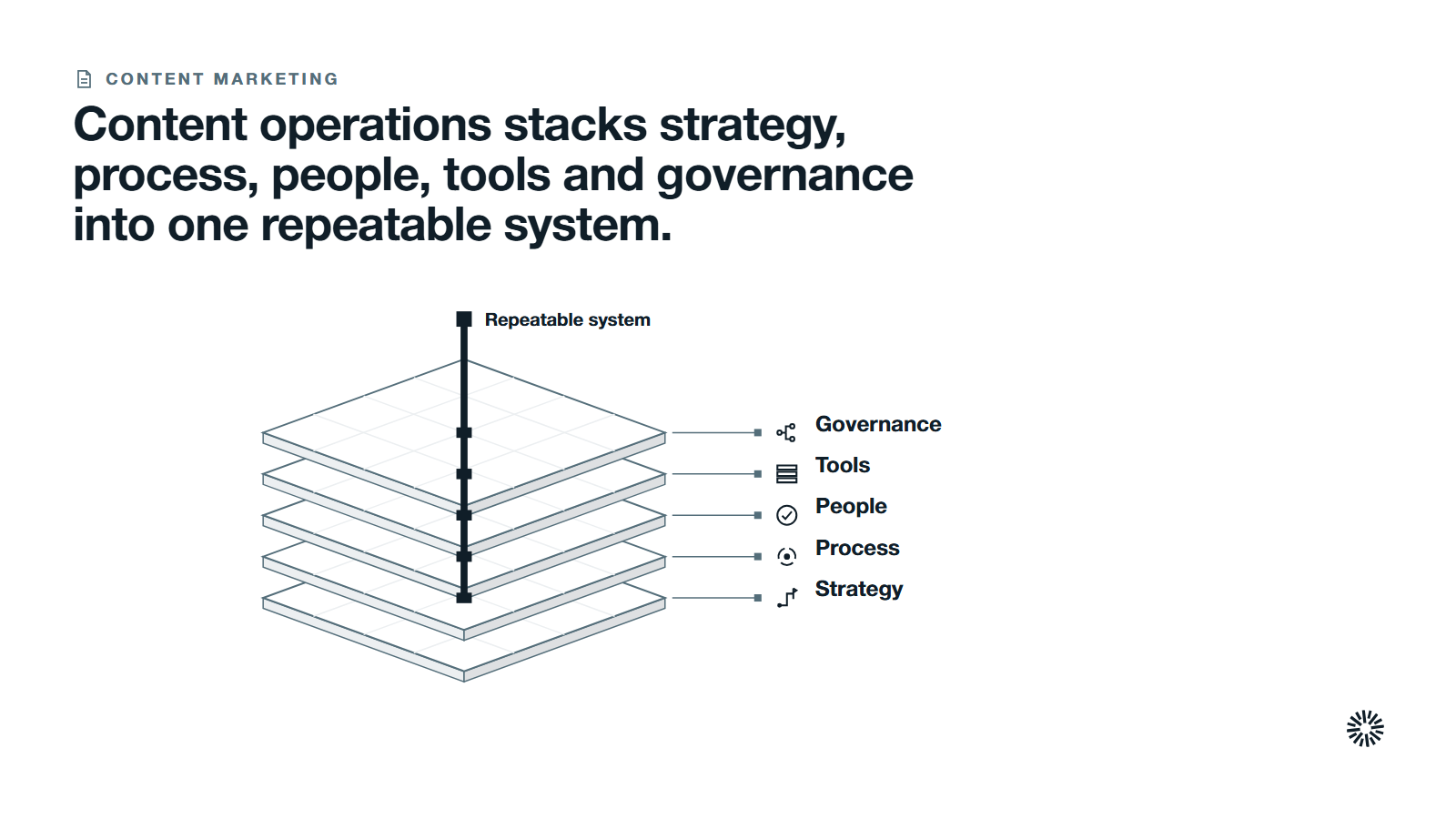
Content strategy decides what you say, to whom and why. Content operations decides how that content gets made and managed, again and again, without heroics. It is the operational layer between a plan and a published page.
Without it, content creation depends on whoever is available. A brief lives in one person's head, a draft sits in a chat thread and an approved version is whichever file was saved last. Work is ad hoc, and quality depends on the person rather than the process.
It also differs from nearby terms. Content marketing is the practice of using content to attract and keep an audience, which our guide to what content marketing is covers. Content management means storing and publishing content, usually through content management systems. Project management tracks tasks and deadlines for any kind of work.
Content operations sits across all three. It borrows project management for deadlines, uses content management systems for publishing and serves the content strategy by keeping the work repeatable.
Content operations includes workflow and collaboration processes, and it involves processes, people and technology. It aligns content with business objectives, so every piece of content supports a business objective or it does not belong in the plan.
The phrase has a second meaning in some job ads, where it describes a role that moderates user posts. This article uses it in the marketing sense only.
A spreadsheet and a content calendar are enough for longer than most teams think
A tracking sheet and content calendars handle a surprising amount of work. If a single owner can answer four questions at a glance, you do not have an operations problem.
- What is in progress, and who is writing it?
- What is approved and when does it publish?
- Where is the final version of each asset?
- What did we publish last month, and did anyone use it?
A small team with one or two people creating content, one channel and one approver rarely needs more. Adding a platform here creates a second job: maintaining the platform. The cost of process is real, and it is paid in the same hours your team would spend on content creation.
Stay with a calendar while three things stay true. The same people make and approve the work. Content goals fit on one page. Nothing is published twice by accident.
If you are still setting up the basics, start with how to get started with content marketing before you design any system around it.
Signs a calendar is no longer enough
Work usually outgrows a calendar in a visible way. These are the signals worth watching.
- Duplicated efforts. Two people brief the same topic, or a case page and a blog post say different things about the same offer.
- Approval bottlenecks. Drafts wait for a reviewer nobody can name.
- Lost assets. Approved digital assets are hard to find, so teams recreate them.
- Inconsistent content. Brand voice, brand guidelines and terminology drift between writers and channels.
- Nobody learns from performance. Performance data exists in analytics tools but never changes what gets planned.
Two or three of these at once means the work has become a system, and systems need an owner. One signal on its own usually needs a fix, not a function.
The parts of a content operations framework
A content operations framework has five core components. You do not need all five at full strength. You need the one that is failing. Implementing content operations well means strengthening components in the order your failures appear.
The framework covers strategy, creation, management and distribution. Content distribution determines the channels for publishing content, and multi-channel delivery keeps the experience seamless for the reader.
Strategy and planning
Strategy ties content efforts to business objectives and target audiences. Planning turns that into content calendars, briefs, keyword research and resource allocation. Without this layer, the rest only makes the wrong content faster.
Content workflow and ownership
A content workflow defines the steps from idea to published piece, who does each step and who approves it. Assign ownership to a person for every stage, not to a team. Clear stages reduce handoff errors and make workflow efficiency something you can see. Standardized procedures run from ideation to review, approval, publishing and archiving.
Documenting workflows means team members know their responsibilities in content creation, and regular workflow audits can highlight delays in content production.
Content governance
Content governance is the set of rules that keeps content consistent: brand and regulatory standards, naming, version control, review rules and who may publish. It is what lets more people create content without lowering quality standards. Governance ensures compliance with brand guidelines and legal standards.
A single source of truth for brand guidelines prevents duplicate work, and brand consistency rests on centralized asset libraries and shared style guides.
Asset management
Digital asset management is where approved files, templates and finished content assets live, with metadata tagging so people can find them. A shared folder with disciplined names is asset management at small scale. A dedicated system only earns its place when volume makes folders unreliable.
At that point a digital asset management system helps keep files findable and limits duplicate work, and modular content models allow repurposing of content across platforms.
Measurement and the content lifecycle
The content lifecycle runs from idea to creation, publication, performance analysis, update or retirement. Performance measurement closes the loop: choose a few key metrics tied to business goals, review them on a schedule and feed what you learn back into planning. Our guides to content repurposing and content decay show two jobs this loop should include.
Performance monitoring identifies areas for content improvement. Performance audits help identify underperforming content, so you stop spending resources on ineffective assets. Content feedback loops refine the experience based on insights, which is how operations connect the production pipeline with analytics.
How content operations governs the content lifecycle
Content operations governs the content lifecycle from the first request to the final retirement. It is behind the scenes work that readers never see, yet it decides whether high quality content reaches them on time.
Content strategists set priorities and audience preferences. Project managers keep dates. Content teams and creative teams do the content development. The operating model is the agreement on who does what, in what order, with what checks.
Involving stakeholders ensures alignment. Stakeholders can define content goals and messaging together, and cross-functional collaboration across marketing, sales and product teams provides insights that inform content strategy decisions.
Good content processes protect content quality and content consistency without adding meetings. They also support brand consistency, because every piece passes through the same standards. Knowledge sharing matters here too: a short playbook means new writers do not learn the rules by making mistakes.
What content operations costs in kind
This article quotes no price ranges, because they depend on your tools and your team. The honest cost is in kind: time, attention and ownership.
- A person's time. Someone has to run the process. In a small company that is a part of a marketing lead's week; in a larger one it becomes a content operations manager role.
- Process overhead. Every step you add is a step someone must follow and maintain. Intake forms, approval stages and naming rules all cost minutes per piece.
- Tool upkeep. Each system needs setup, permissions, training and clean-up, and disconnected systems add the cost of moving information between them.
- Change management. Creative teams adopt a process only when it removes more friction than it adds.
HubSpot's own materials show the tool side of this. Its Content Hub page describes managing content as being able to "Organize, update, and distribute content in one place." Its knowledge base says the campaigns tool is for creating, managing and reporting on "a single marketing campaign with multiple assets in one place."
Those describe what the software can hold. They do not decide who owns the work, which is why ownership comes before the tool.
What breaks when you add process before strategy or tools before process
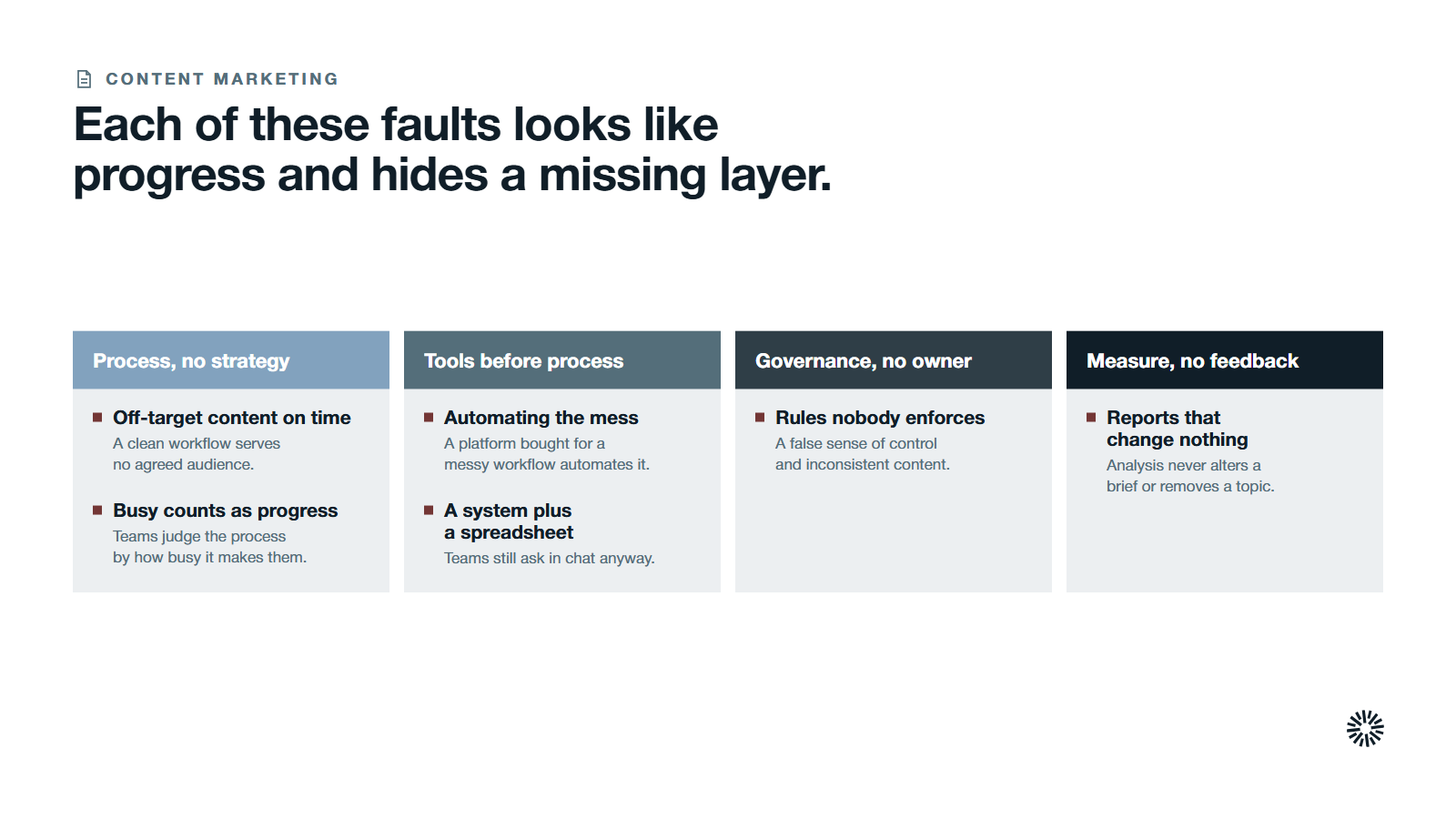
Both mistakes look like progress. Each one hides a missing layer.
Process before strategy
If nobody has agreed which audiences and business outcomes the content serves, a clean workflow just produces off-target content on time. Teams then judge the process by how busy it makes them, not by what it delivers. Fix the strategy first, even if it fits on one page.
Tools before process
A platform bought to fix a messy workflow automates the mess. Workflow automation can route a draft to an approver, but it cannot decide who the approver should be. Use tools to automate tasks that are already routine tasks, such as reminders and status updates, and only after the steps are agreed.
That is how you build a scalable system rather than a pile of licenses. Without that order, teams end up with a licensed system, a spreadsheet beside it and a habit of asking in chat anyway.
Governance with no owner
Rules that nobody enforces create inconsistent content with a false sense of control. Style guides, brand voice notes and review checklists go stale without a named owner.
Measurement with no feedback loop
Dashboards that nobody uses to change the plan are overhead. If performance analysis never alters a brief, removes a topic or triggers an update, the measurement step is decoration.
Skipping the basics
A lack of a clear strategy leads to inconsistent messaging. Poor content planning results in disorganized workflows and missed deadlines. Ignoring audience needs can lead to disengagement and poor performance. Neglecting content governance can result in inconsistencies and compliance issues. Underestimating resource needs can lead to burnout and inefficiencies.
Scaling content operations too early
Building for a large enterprise team before you have one adds roles and review gates that slow a small team down. Build the next layer you need, not the one a larger company has. To streamline content operations, remove a step before you add a tool.
Drafting tools built on natural language generation can produce first drafts and personalized content, and someone still has to check each piece against brand guidelines and quality standards. They add a review job; they do not remove the need for an owner.
Where AI and technology fit
Content operations relies on a technology stack, and the stack should follow the process. AI can automate content creation using natural language generation, and AI tools can optimize content for specific audiences and platforms.
AI algorithms can personalize content experiences based on user behavior, and AI-driven analytics provide insights into content performance metrics. AI agents can automate compliance checks against brand and regulatory standards.
All of this assumes the workflow, ownership and governance already exist. Technology supports a defined process; it does not define one.
Match the answer to your company stage
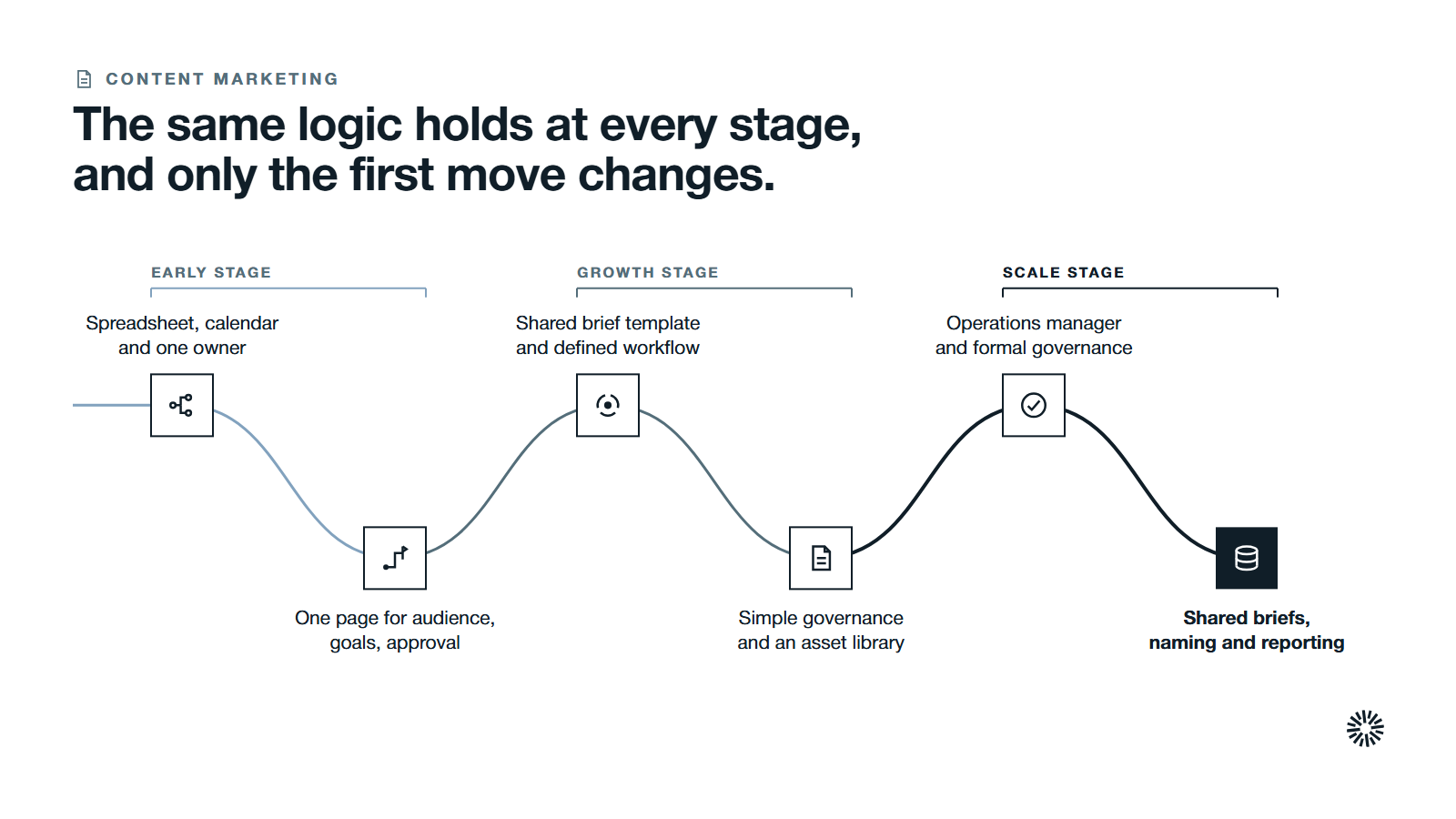
The same logic holds at every stage. Only the first move changes.
Early stage with a small team
Use a spreadsheet, a content calendar and one named owner. Write down the audience, the goals and the approval path on one page. Hold back platforms, extra review stages and any content operations manager hire. Watch whether anyone can say in ten seconds what ships next week.
Growth stage with several contributors
This is where a light framework starts to pay for itself. Add a shared brief template, a defined content workflow, simple governance and an asset library with consistent names. Give one person responsibility for the whole process.
Connect the system to how your content is distributed; our guide to content distribution strategy is the natural next read. Watch whether handoffs work without a meeting.
Scale stage with several teams, products or regions
Now a content operations manager, formal content governance and a proper asset management system become reasonable. Standardize briefs, naming, metadata tagging and reporting across teams, and connect content data to the CRM so content performance links to pipeline. Keep the strategy owner and the operations owner distinct, because one sets direction and the other keeps the machine running.
Questions to settle before you add anything
A decision needs a brief. Answer these four questions before you buy a tool or hire a role.
- Which business goals and target audiences must the content serve this year?
- Where exactly does work stall today: planning, creation, review, publishing or measurement?
- Who owns each stage after launch, and who may approve a piece?
- What is the smallest change that removes the stall?
If the answer to the fourth question is a calendar column, a template or a named reviewer, do that first. Content that earns attention in AI search also needs clear structure and ownership; see how to optimize content for AI search for that angle.
What you gain when this is done properly
Content operations pays back across the revenue team, not only inside marketing.
Sales finds and trusts approved content
When approved digital assets are easy to find and current, sales teams stop sending outdated decks and unofficial one-pagers. Reps can match the right asset to the right conversation, and the message stays consistent with what marketing publishes.
Marketing ships on a rhythm and learns from it
A clear content workflow lets creative teams plan with fewer surprises. Performance data flows back into the plan, so content efforts improve with each cycle instead of resetting. Agree a few key performance indicators, watch market trends and audience preferences, and use content optimization to optimize strategies through continuous improvement.
For ideas on what to produce once the system works, see content marketing examples.
Customer success gives customers consistent answers
Help articles, onboarding content and renewal material stay accurate when someone owns their lifecycle. Customers see the same terms and the same promises across the experience, which supports customer experience at every stage.
Decide by evidence, then add one layer at a time
The right answer to whether you need content operations depends on where your work stalls, not on how big your company looks. Keep the calendar while it works. Fix strategy before process, and process before tools. Add governance, asset management and measurement when a specific failure calls for it, and name one owner for each.
Propello designs and builds connected go-to-market systems on HubSpot, and Propello is a HubSpot partner. If you want help finding where your content work stalls, an audit is the place to start. See what the Propello GTM Audit covers and how to prepare.