
For most growing businesses, the right answer is a mix. Keep an owner in-house, hire a HubSpot consultant for a narrow, well-defined fix or build, and bring in a HubSpot solutions partner when the work spans several hubs, systems and teams. Match the person to the scope, not to the lowest quote.
This article is for CEOs, founders, CROs and revenue leaders at growing B2B companies deciding who should implement and run their HubSpot account. You will get what each option is good at, what each costs in kind, when each fails, what breaks when the wrong one runs the work, and a decision rule by company stage. It quotes no third-party price ranges; the only dollar figures are HubSpot's own published fees, checked on 15 October 2026.
|
HubSpot Consultant A HubSpot consultant is an individual specialist who advises on, builds or repairs parts of a HubSpot account, usually for a defined project or a monthly retainer, without a larger delivery team behind them. |
Who runs your HubSpot changes what you pay and what you risk
The total HubSpot investment has three layers: the subscription, the implementation project and the cost of running the CRM afterward. Buyers compare the monthly subscription price because it is public, and it depends on which hubs you choose. On 15 October 2026 HubSpot's catalog listed Sales Hub Starter as "Starts at $20 /month per Core Seat," Marketing Hub Professional as "Starts at $890 /month" and Marketing Hub Enterprise as "Starts at $3,600 /month (billed annually)," with additional seats priced per seat. HubSpot's products page lists six: Marketing Hub, Sales Hub, Service Hub, Content Hub, Data Hub and Revenue Hub. HubSpot is used for customer relationship management, marketing automation and sales, and each hub adds its own setup work. Content Hub is described as all-in-one, AI-powered content marketing software, which adds AI powered automation to configure, and Data Hub as data management software that breaks down data silos. HubSpot's catalog says, for example, that "Sales Hub is available in three editions": the Starter tier, the Professional tier and the Enterprise tiers differ in advanced features and, as below, in onboarding. HubSpot implementation costs and the running costs decide whether the account earns its keep, and they depend on who does the work.
Onboarding is the part of the price that surprises buyers. HubSpot's product and services catalog lists it as a separate row marked "(Fee is an additional cost)." Checked on 15 October 2026, it shows "$3,000 one-time required onboarding" for Marketing Hub Professional and "$7,000" for Enterprise, and "$1,500" for Professional and "$3,500" for Enterprise on both Sales Hub and Service Hub.
HubSpot's Starter page says its Professional and Enterprise plans include required onboarding, while Starter lets you get up and running without it. These are fees for HubSpot's own onboarding. They do not buy the data work, integrations, workflows and training that a full implementation needs, and that is where a consultant, a partner or your own team comes in.
HubSpot onboarding is the piece people confuse with all of this. HubSpot onboarding is guidance from HubSpot on how to use what you bought, while a full HubSpot implementation is the build. A partner can run its own onboarding process on top of the build, and the two should be priced and scheduled separately.
Scope, not job title, sets what your HubSpot costs
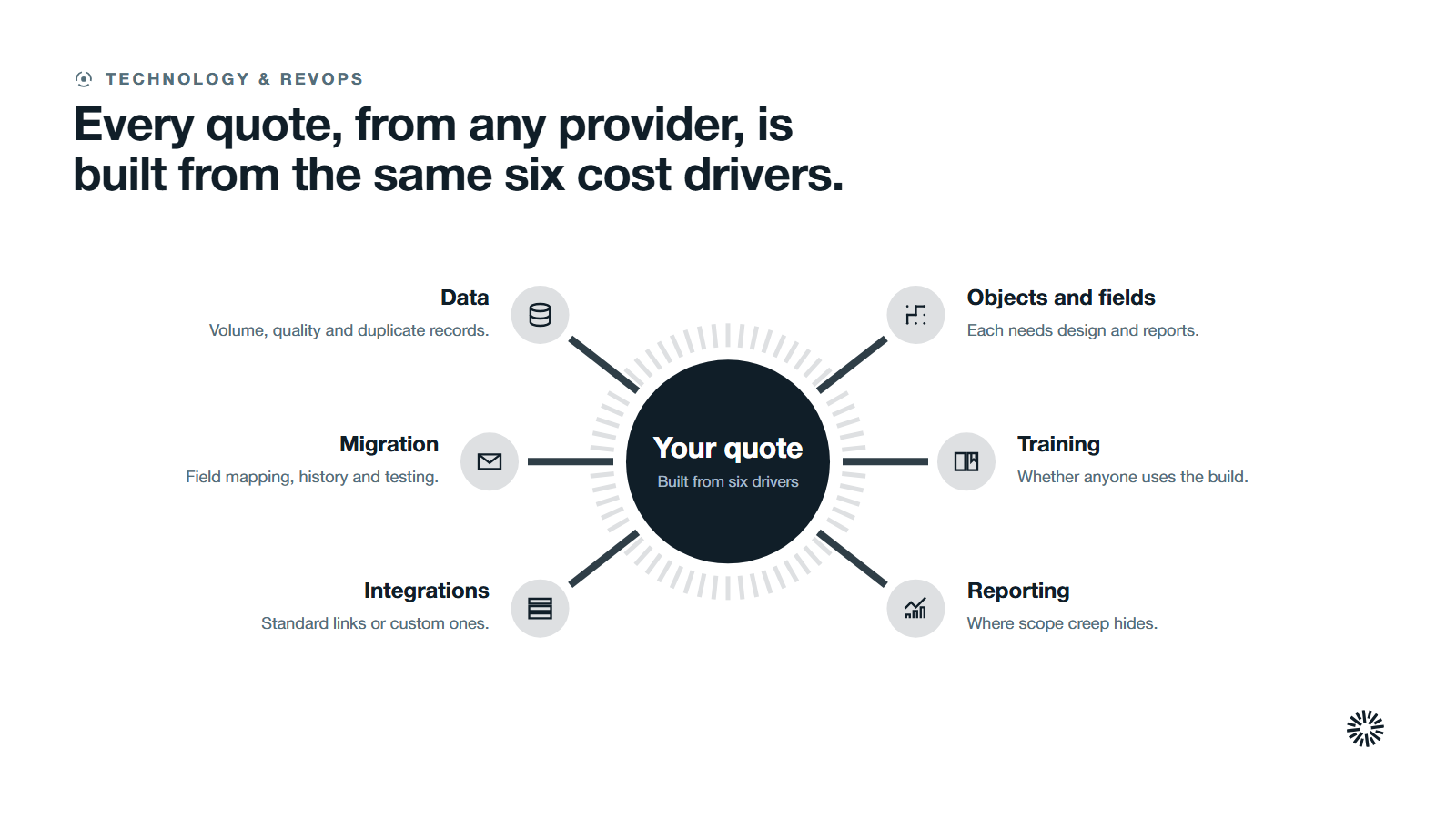
Several factors set the number, and every quote, whichever kind of provider it comes from, is built from six cost drivers. If you can describe each one, you can compare a freelance quote with a firm's proposal and with the cost of your own time.
- Data. Volume, data quality and duplicate records decide how much cleanup comes before the data can be trusted.
- Migration. Moving from spreadsheets or other CRM systems adds field mapping, history decisions and testing.
- Integrations. A standard connection is a small task; custom integrations and complex integrations need rules, testing and monitoring.
- Objects and customization. Custom objects and extra properties each need design, associations and reports.
- Training and adoption. Comprehensive training for key users decides whether anyone uses the build.
- Reporting and governance. Custom reporting is where scope creep hides.
A quote that leaves out migration or integration work is incomplete, and the total cost is easy to underestimate when only the license is priced. Our guide to CRM migration without losing revenue data covers the heaviest driver in detail.
Cost factors differ by option, even when the HubSpot cost looks the same
Two proposals can show the same monthly subscription price and still produce very different HubSpot implementation costs, because each option charges in a different currency.
A consultant charges in hours or a fixed project fee. The consulting fees are easy to see, and the risk is a scope that grows past what one person can deliver.
A solutions partner charges for implementation services across a project: discovery, professional services for migration and integrations, training and a handover. The total cost is higher in kind, but it buys capacity, testing and continuity.
An in-house admin charges in salary time and a learning curve. There are no consulting fees, yet the maintenance costs, user support and ongoing optimization still have to be done by someone who is no longer doing their main job.
Evaluating HubSpot on subscription alone hides all of this. A fair comparison puts implementation services, ongoing support and maintenance costs next to the subscription, so the total HubSpot investment is visible before you sign.
A HubSpot consultant fits a narrow scope with a clear finish line
HubSpot itself uses the word. Its technical consulting page describes a project led by a dedicated HubSpot consultant, with example projects in workflow automation, reporting customization and setting up a custom object. On 15 October 2026 the page read "Duration: Standard offering starts at 8 hours." The shape is a bounded piece of expert help with an end.
An independent consultant works the same way. You hire one person for a specific outcome, such as rebuilding lead routing, cleaning lifecycle stages, building a dashboard or untangling a workflow that fires twice.
In practice a good consultant, who may serve many clients, optimizes the CRM platform for your marketing and sales goals and your revenue goals. That can mean tailoring a data migration from a legacy CRM into HubSpot, redesigning deal stages to match how your buyers really buy, refining lead capture and attribution, automating workflows and training your team in the process that results. The best act as a strategic partner who links what the software can do to business growth.
What a consultant is good at
- Speed on a defined problem. One senior person, no handoffs, a short path from question to fix.
- Depth in one area. Many consultants specialize in a hub, a workflow type or reporting.
- Flexible commitment. Cost in kind means you pay for hours, a fixed project or a small retainer, and you stop when the work stops.
How to test a consultant before you sign
The essential capabilities are scoping, hands-on build skill and clear communication.
- Agree the measures first. Success metrics might include lead-to-customer conversion and sales cycle length, agreed before any strategy is implemented.
- Ask for scope and pricing in writing. A transparent engagement states what is included, in phases: discovery, solution design, implementation and optimization.
- Check relevant expertise. Look for experience in the hubs you use and for HubSpot accreditations, which reflect knowledge of implementation and integration.
- Ask about failure. A credible consultant can explain how they handled a failed integration or inconsistent data.
When a consultant fails
- The scope spans many systems. One person cannot cover migration, integrations, training and reporting at once.
- Nobody owns the account afterward. A consultant who builds and leaves hands a system to a team that cannot maintain it.
- Continuity. A single person can be busy or gone, and your documentation is the only memory.
A HubSpot solutions partner fits a HubSpot implementation that spans hubs, data and teams
HubSpot describes its solutions partners as firms you can browse and contact in a directory, where profiles are ranked by review count as well as tier. HubSpot also says it accredits partners in six areas: CRM implementation, onboarding, platform enablement, custom integration, data migration and solutions architecture design. HubSpot's accreditations page says accredited partners have proven experience delivering large scale, complex implementations, including multi-hub setups and ERP or data warehouse integrations, and recommends that customers with complex needs work with an accredited solutions partner. The directory showed "3,636 results for Solutions Partners" on 15 October 2026, well over three thousand five hundred firms.
Integrations with finance or ERP systems are a common reason to need one. A partner brings a team and a repeatable method: a discovery phase, a data model, migration, integrations, training and a handover. HubSpot says its solutions partners can work with you to reach your goals using HubSpot, and a partner offers hands-on implementation support, expertise in custom execution and complex migrations, and help joining several hubs together.
What a partner is good at
- Multi hub implementations. Sales Hub, Marketing Hub and Service Hub share data, and a team can sequence the work across them.
- Complex integrations and migration. Professional services of this kind need testing, rollback plans and several skills at once.
- Capacity and continuity. If one person leaves the firm, the project continues.
When a partner fails
- The scope is vague. Without a written statement of work, cost expands with every new request. A good statement of work lists the data migration scope, each integration, the training formats, what is excluded and the handover.
- The project is tiny. A team's overhead is wasted on a three-hour fix.
- Nobody inside owns the result. A partner that builds without an internal owner leaves you dependent on consulting fees for every change.
For a selection checklist, see how to choose a HubSpot partner.
An in-house admin fits ongoing ownership, not a first big HubSpot implementation
An in-house build draws on internal capabilities and internal teams who know your sales process. There are no consulting fees, but the work takes their time from other jobs, and a first-time admin meets common pitfalls that an experienced one avoids. The cost in kind is hours and focus.
What in-house is good at
- Knowing the business. Your admin knows why a stage exists and who owns a field.
- Daily upkeep. User support, permissions, small workflow changes and data upkeep.
When in-house fails
- A big build lands on one person. Migration plus integrations plus training is too much for a part-time owner.
- Skills are missing. An admin who has never run a migration will learn on your data.
- Single point of failure. If the owner leaves, the knowledge leaves with them.
HubSpot's own guidance backs the ownership point. Its CRM implementation guide says processes and data cleanliness should be evaluated annually, which is routine work for someone inside the company. Our guide to cleaning a HubSpot CRM and keeping it clean covers that routine.
What breaks when the wrong option runs your HubSpot
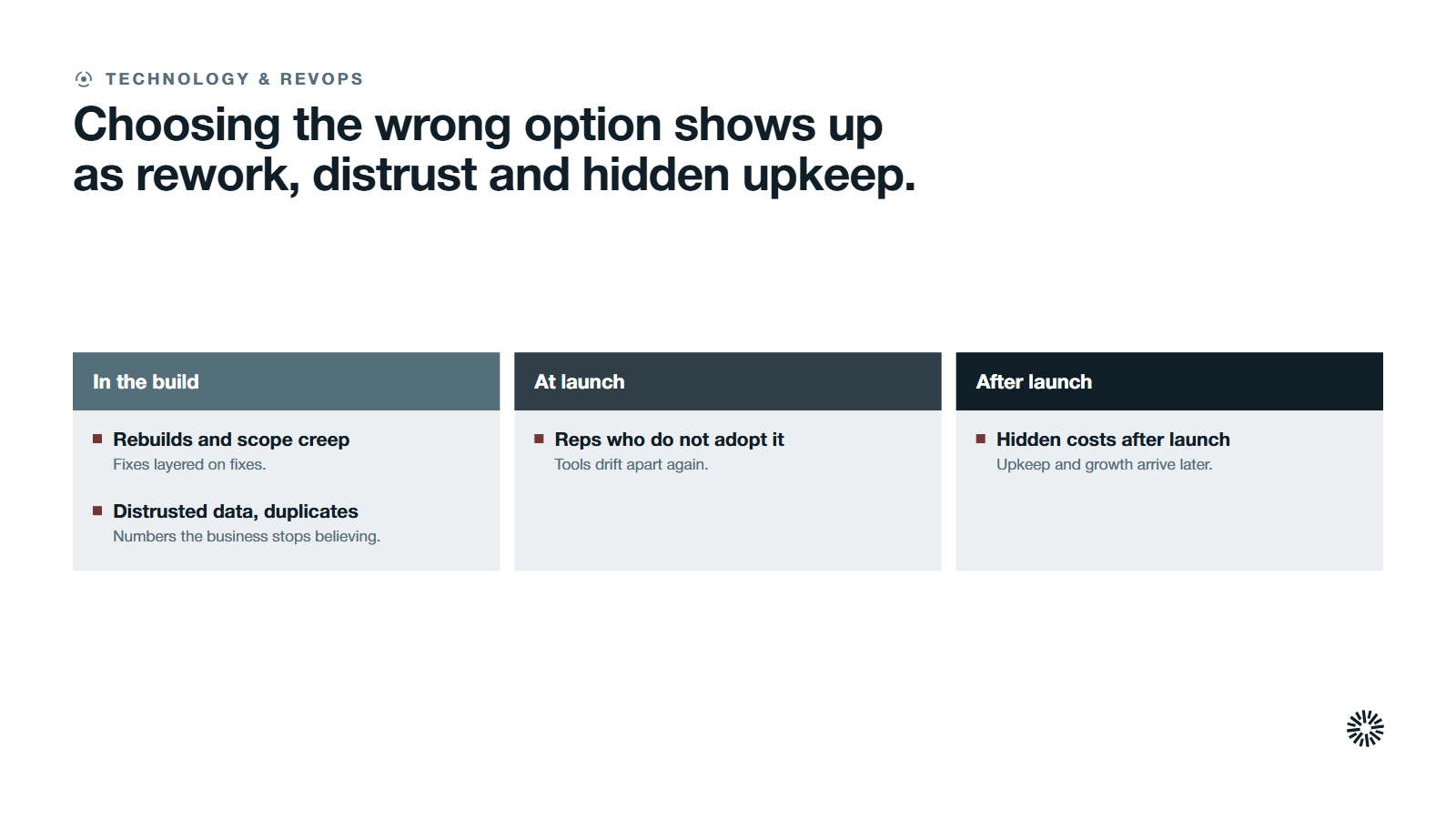
The cost of choosing badly rarely appears as a line on an invoice. It appears as work your team does twice and numbers your business stops believing.
Distrusted data and duplicate records
Salesforce's 2024 State of Sales report, a survey of 5,500 sales professionals, found that only 35% completely trust the accuracy of their organization's data. Duplicate records and unclear ownership are common reasons. People then keep private spreadsheets, and you pay for the platform and the workaround.
Reps who do not adopt it
HubSpot's CRM implementation guide calls sales force adoption often the biggest hurdle for companies adopting a new CRM. A build nobody was trained to use becomes disconnected tools again within months, and low user adoption shows up as stale pipeline stages.
Rebuilds and scope creep
A consultant given a partner-sized scope, or an in-house admin given a migration, produces fixes layered on fixes. Properties added without a plan and workflows stacked on workflows create disconnected systems that someone must untangle, and that costs more than the discovery phase that would have prevented it.
Hidden costs after launch
Administration, data upkeep, new features, reporting requests and integration maintenance arrive after the build. HubSpot's catalog also says that if you exceed your marketing contacts tier you will be billed immediately, so a growing database changes the running cost. A periodic HubSpot audit catches drift early.
Match the option to your company stage
Company size changes who should run the work. The same logic holds at each stage, but the first move differs.
Early-stage company with a small team
Use a HubSpot consultant for a short setup of a clean data model, one hub that matches your sales process, and training for daily users, and name an internal owner from day one. Basic contact management, one pipeline and a clean import cover most of what is needed. Hold back a large partner engagement, custom objects and complex integrations. Watch whether reps log activity without being chased.
Growth stage with several teams
Use a partner for the project that connects sales, marketing and service, with an in-house admin who owns the account afterward. Use a consultant for specialist add-ons such as reporting or a single integration. Hold back customization that only one team asked for. Watch whether handoffs between teams work without a meeting.
Scale stage with several products or regions
Use a partner for governance, a RevOps strategy that sets who owns each part of revenue operations, consistent data across products and regions, and multi hub implementations. Keep a dedicated in-house owner and treat consultants as surge capacity. HubSpot's Premium Support page says it is "designed for customers using HubSpot's Enterprise products." Checked on 15 October 2026, it describes a technical account manager providing proactive health checks and continuous optimization, priority access to specialists and "a 1-hour premium response or 30-minute response for business-critical issues," plus onboarding services with a customized plan. It is a backstop, not a replacement for an owner. Watch for records that look different by region. Our comparison of implementation and GTM Engineering shows where the build ends and engineering begins.
Four questions to settle before you hire anyone
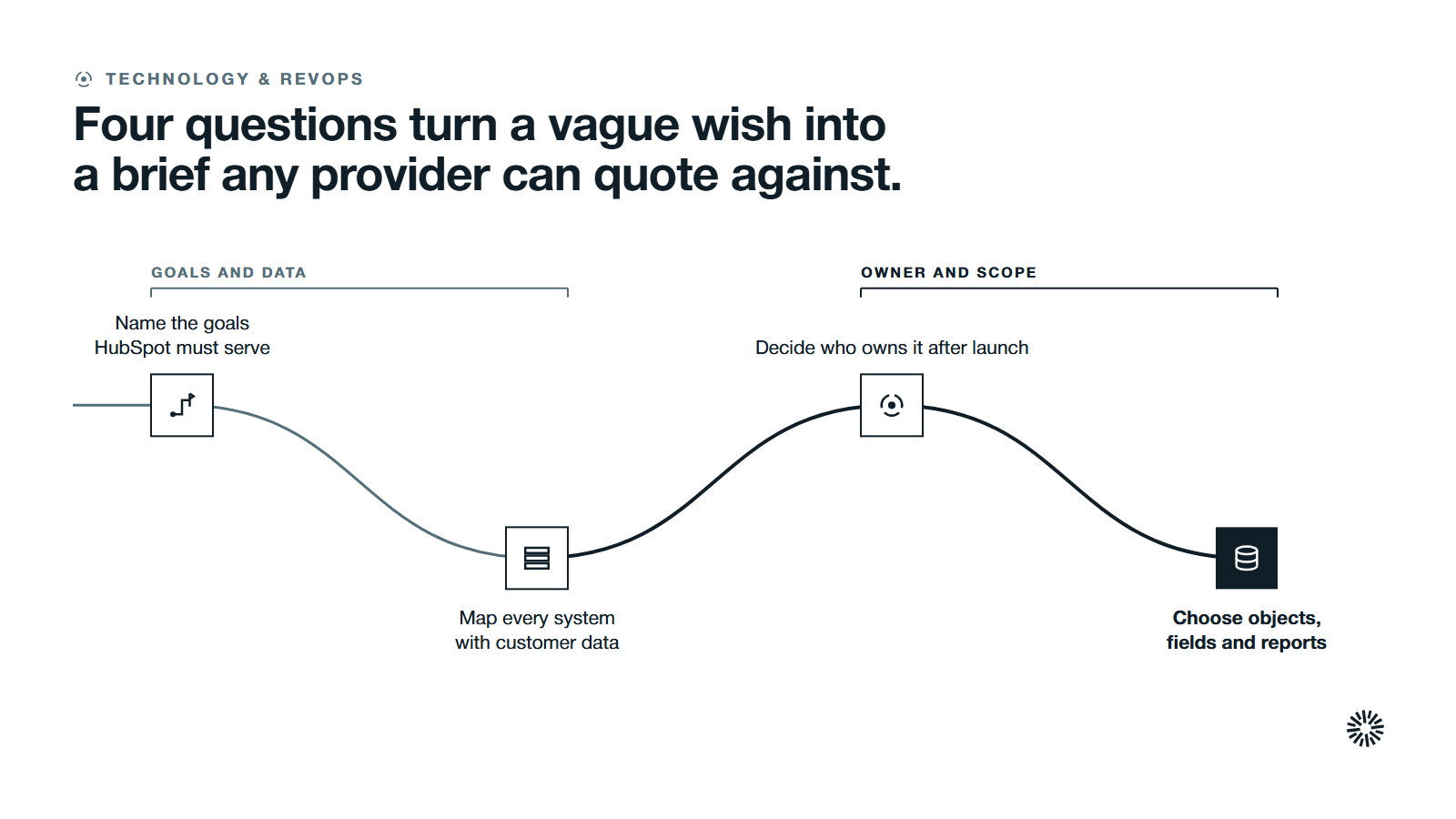
A quote is only as good as the brief behind it. Settle these four questions first and proposals from a consultant, a partner and your own team become comparable.
- Name the three or four growth goals HubSpot must serve, such as faster follow-up or a forecast leadership trusts.
- List every system that holds customer data today, and mark what moves, what connects and what retires.
- Decide who owns the account after launch, and which tasks they can handle.
- Choose the objects, fields and reports that run the business, and defer the rest.
Ask each candidate to price against the same brief, and to separate the one-off project from the running cost.
What you gain when this is done properly
The right person on the right scope pays back across the revenue team, not just in the admin's workload.
Sales works from one trusted record
When data is clean and ownership is clear, reps see the history before the call and managers forecast from the same stages. Lead management improves, fewer missed opportunities slip through, and more deals reach the right person at the right time.
Marketing can show what its work produced
Agreed definitions and connected systems let marketing tie campaigns to pipeline instead of to form fills. Marketing automation runs on trusted data, teams streamline workflows, operational efficiency improves, and the total cost of HubSpot becomes easier to defend because the results are visible.
Customer success sees the whole account
Service teams and sales teams work from the same record, so they know what was promised. Tickets, renewals and expansion signals sit next to the deal history, which supports customer retention as the business grows.
Choose by scope, then name one owner
The challenge is long term success, not launch day. A focus on compound growth ties customer acquisition, retention and advocacy to strategy, and whoever runs HubSpot should be able to show that link. The honest answer to who should run your HubSpot is that it depends on the scope you can describe before anyone quotes. Use a consultant for a bounded fix, a partner for a build that spans teams and systems, and an in-house owner for everything after launch.
Propello designs and builds connected go-to-market systems on HubSpot, and Propello is a HubSpot partner. If you want help scoping the work before you hire anyone, an audit is the place to start. See what the Propello GTM Audit covers and how to prepare.
