
ChatGPT SEO means making sure ChatGPT can reach your site, understand your business and find a clear, sourced answer worth citing. You open your site to OpenAI's search crawler, write answer-first content and check results monthly. This guide is for CEOs, founders, CROs and marketing leaders at B2B companies.
You get a seven-step plan for a marketer or GTM Engineering team, the crawler settings OpenAI documents, a list of costly mistakes and a plain statement of what nobody can promise. For the method that applies to every AI engine, read how to optimize content for AI search.
|
ChatGPT SEO ChatGPT SEO is the practice of making your website crawlable, clear and credible enough that ChatGPT can find your pages and cite them as sources when it answers a question. |
By the end you will have a ChatGPT visibility plan you can run
When you finish the steps below you will have:
- A confirmed access setup, so OpenAI's search crawler can fetch the URLs you want cited.
- A short list of buyer questions, each matched to one URL that answers it.
- Rewritten key content that leads with the answer and names its references.
- A clear description of your business that every profile and web page repeats.
- A monthly test that records which sources ChatGPT cites for your questions.
What to have in place before you start
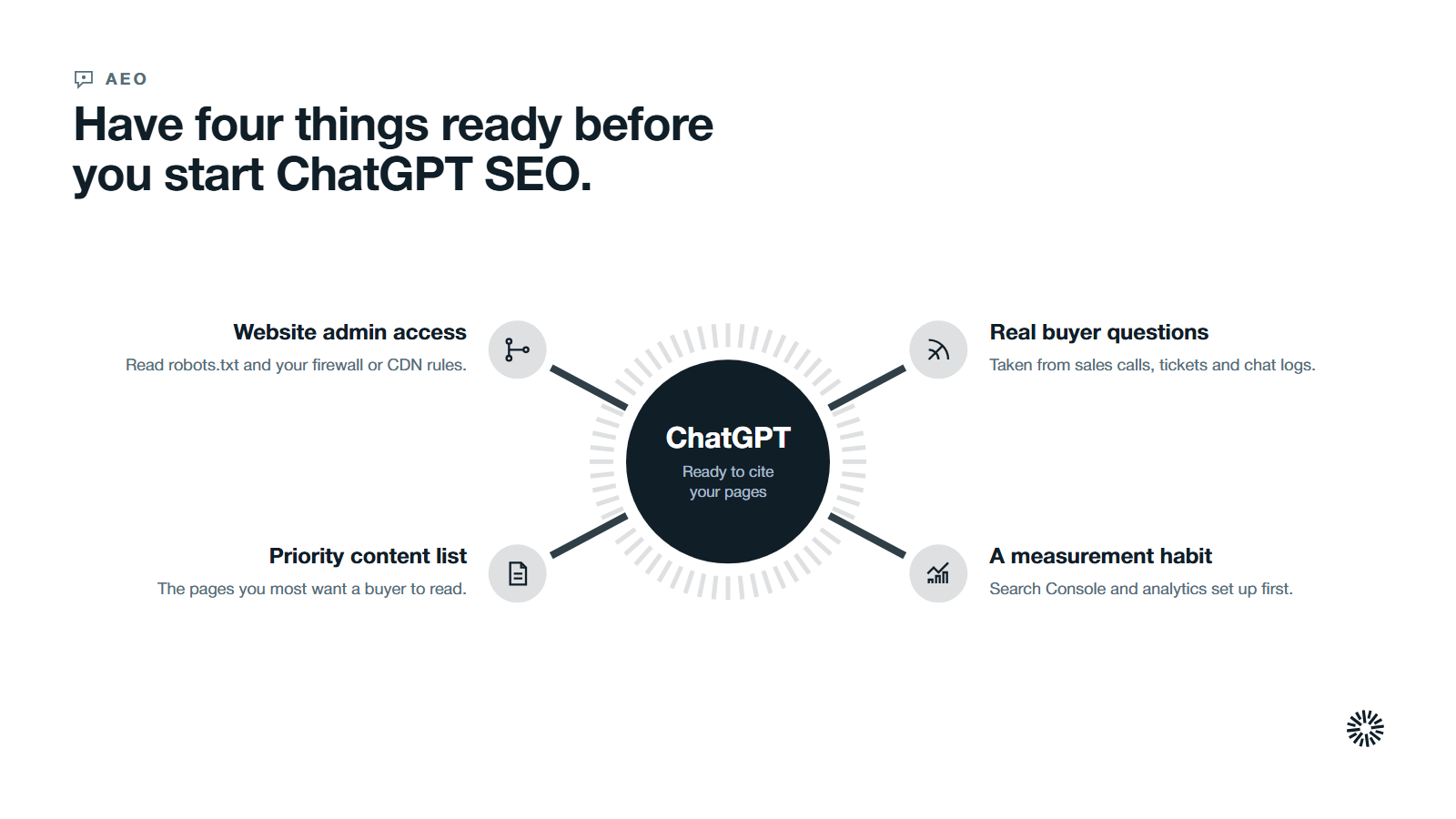
Check these four things first.
- Admin access to your website. You need to read your robots.txt file and your firewall or CDN rules, or to reach the person who controls them.
- A list of content that matters. Name the ten URLs you would most like a buyer to read: service descriptions, comparison guides and your best explainers.
- Real buyer questions. Collect them from sales calls, support tickets and chat logs.
- A measurement habit. Set up Google Search Console, a free tool, and Google Analytics so you can see organic traffic and referral sources before you change anything.
ChatGPT SEO adds to search engine optimization, because the crawler access, clear writing and trust signals that help you rank in search engines also help you be cited. If you are still deciding how the two relate, read AEO vs SEO.
How to do ChatGPT SEO in seven steps
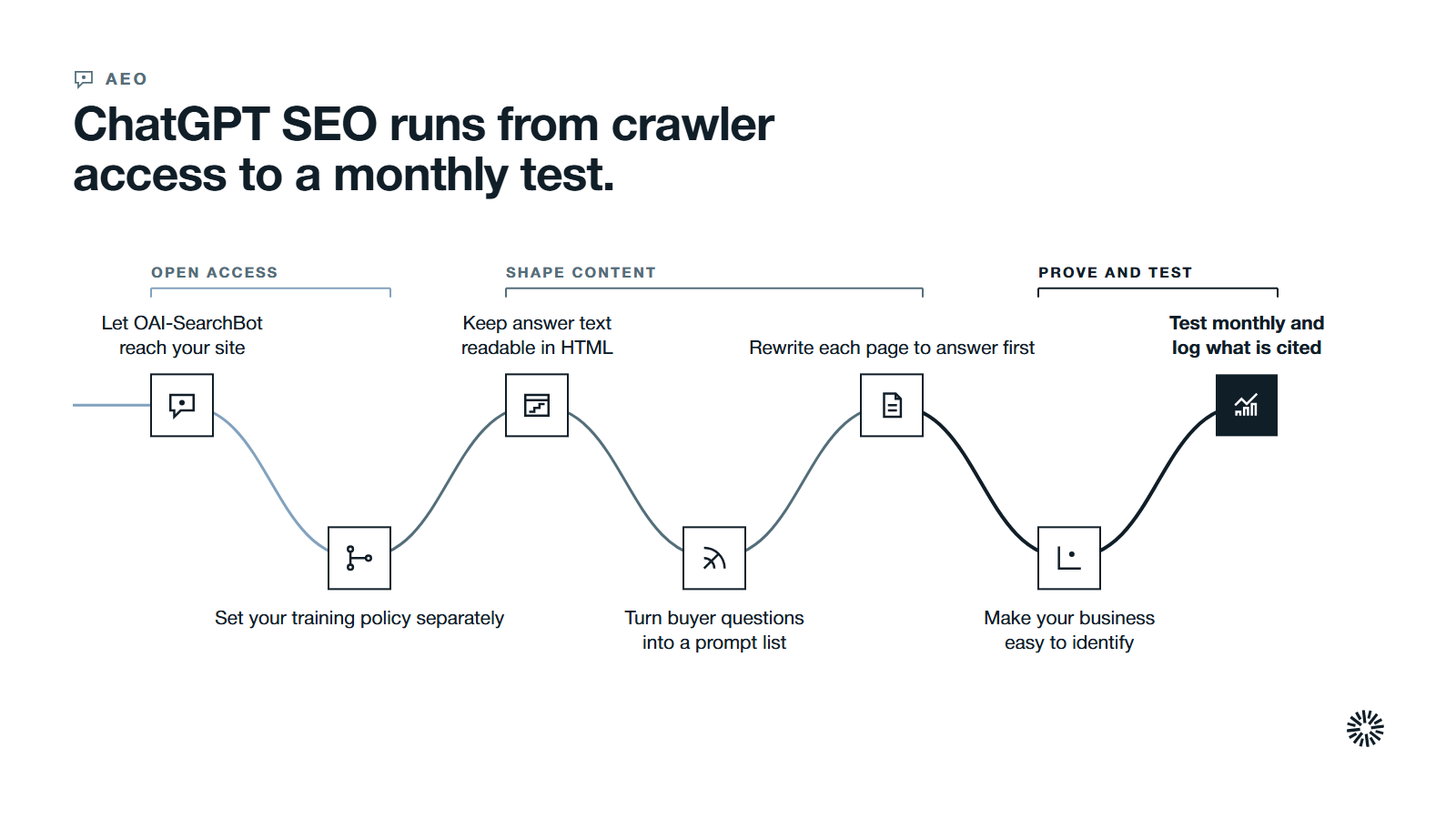
Each step is an instruction and ends with what done looks like, so you know when to move on.
1. Let OpenAI's search crawler reach your site
OpenAI documents separate crawlers for separate jobs. OAI-SearchBot is the one used to surface websites in ChatGPT search, and OpenAI recommends allowing it in your robots.txt file so your site can appear in search results.
Sites that opt out of OAI-SearchBot can still show up as navigational links, but they will not appear in ChatGPT search answers. OpenAI also publishes IP address ranges for its bots, which matters if a firewall or CDN blocks unknown traffic.
You are done when your robots.txt does not disallow OAI-SearchBot and your firewall logs show its requests succeeding. OpenAI says it can take about 24 hours for its systems to adjust after you change robots.txt.
2. Decide your training policy separately
GPTBot is a different crawler. OpenAI describes it as collecting content that may be used to train its generative AI foundation models, and says that disallowing it signals your content should not be used for training.
OpenAI states that each of these robots.txt settings is independent of the others. A third crawler, ChatGPT-User, acts when a person asks ChatGPT to visit a URL, and OpenAI says robots.txt rules may not apply to it.
You are done when a named person has chosen a stance for each crawler and written it down with the reason.
3. Keep the answer text in a well structured document search engines can read
A crawler can only cite what it can read. Put the important text in the HTML a visitor receives, not behind a login, a pop-up or a script that has to run first.
A well structured page uses real headings, short paragraphs and lists, and its titles, headings, formatting and readability make the order of ideas obvious.
Add images such as diagrams where they explain a process, give each of the images alt text and compress the images so each article stays fast.
Then check your key URLs in Google Search Console to confirm Google can index them.
You are done when each of your ten priority URLs loads its main text without scripts, has a clear structure and is indexed.
4. Turn buyer questions into a prompt list
Write the questions your buyers ask in natural language, the words they use, then group them by search intent: understanding a problem, comparing options, choosing a provider and checking risk. This is keyword research for conversational queries, and your sales notes are the best data you have.
Content that covers the full intent behind a question gives an engine more to use. For example, "What breaks when we merge two CRMs?" is worth a page, while "What is a CRM?" is already answered everywhere. Note how users phrase each question, and give every answer a clear structure.
Think about your audience and your niche. A question only your segment asks is easier to win than a broad one that every blog post and news article already answers. The challenge is knowing which questions your buyers really ask.
Aim for thirty questions. Match each to a single page that should answer it, and mark the gaps where none does. Those gaps become your content creation backlog.
You are done when every question on the list points to one URL or to a gap with an owner.
5. Rewrite each document to answer first and show its references
Present the answer in the first two sentences under each heading, then add the reason, an example and the exceptions. Name the subject in each paragraph of an article so a passage keeps its context when it is lifted out.
Create high quality content from your own experience, with every reference visible: a method, a worked example, a decision rule. Where you use someone else's fact, link the original publisher on a short anchor, much like in-text citations in a research paper. Never state a number you have not seen on the source.
Use natural language and a plain tone, the way you would speak to a buyer, and keep the answer helpful. Ask sales for feedback on quality. Ask one named owner to sign off each rewrite.
You are done when a stranger reading only the first two sentences under any heading gets the answer.
6. Make your business easy to identify and easy to mention
AI models that cannot identify which company a document describes will not cite it with confidence, so give them context. Use one name for your company, one description of what you do and one set of facts everywhere: your about page, your profiles and your Organization schema markup.
Then earn mentions on sites you do not control, such as partner directories, trade publications, blog posts and customer write-ups. These are practitioner signals, not rules OpenAI has published. For the details, see knowledge graph SEO and entity authority and how to maintain organization schema.
You are done when your company is described the same way on your site and on your three most visible third-party profiles.
7. Test every month and record what ChatGPT cites
Open a fresh chat and ask the same thirty questions in the same wording each month. Record the date, whether your brand is named, whether your URL is cited and which sources appear instead. Each response varies between runs, so look for the pattern over several months.
Check Google Analytics for visits from chatgpt.com in your referral sources, and compare the URLs on your website that receive them with your priority list. Use what you find as feedback for the next round of edits, and compare each response with the last. For a full measurement setup, read AI search analytics.
You are done when you hold a dated log of prompts, answers and cited sources, with a note of what you will change next.
What nobody can promise about ChatGPT citations
OpenAI's crawler documentation explains how to allow or refuse access. It does not publish a list of ranking factors for ChatGPT search, so any agency that sells a guaranteed citation is guessing.
Access is the part you control fully. Whether AI models then choose your content for a given question depends on the question, the other sources available and the engine's own choices, which can change without notice.
Which third party search providers or indexes an engine draws on is also its decision, so do not build a plan on guesses about them.
Treat the steps above as best practices that raise your odds, and measure results as a trend. Good AI optimization is a repeatable process.
Practical tips for using ChatGPT in content creation and SEO work
ChatGPT is also a tool. As a generative AI tool built on large language models, it has the ability to streamline content creation and speed up research. Its functional uses for an SEO team are real, but artificial intelligence of this kind does not replace judgment, so keep a person in charge of your business.
- Use it to generate options, not answers. Ask it to generate ten angles or questions buyers might ask, then choose the ones your experience supports.
- Group keywords by intent. It can generate a keyword list and sort it into clusters, which helps you organize topics and build topical authority.
- Draft the supporting pieces. FAQ sections, meta descriptions short enough that search results do not cut them off, structured metadata and schema markup are good first drafts, but a person must verify each one.
- Support technical checks. It can help you read crawl errors and a sitemap, and suggest internal links so readers find related content. Confirm the findings in Search Console.
- Give it context. Paste your audience, brand tone and the facts you can prove, and write your prompt in natural language. Use the response for sections of a draft, not whole pages.
- Add what only you know. Original insights separate your content from every other article or blog post that says the same thing.
- Compare with other tools. Search Console and your analytics show what readers actually do.
One final note: a generative AI tool and a good content creation process make a strong combination, but the pages you publish carry your name, so a person must own them. Whatever software you choose, test it against your own data.
Citing ChatGPT in your own writing is a separate job
Some readers arrive here wanting the right way of citing ChatGPT as a source in an essay, report or article. That is a different task from getting cited by it. Citing AI tools is essential for academic integrity, and it helps you avoid a misconduct investigation.
Style guides differ. Purdue's writing lab says APA in-text citations give the author's last name and the year, while MLA in-text citations give the last name and page number, with a full entry at the end. MLA calls its reference page Works Cited, while APA calls its reference page References.
For an AI tool, also note the prompt, the date and the tool, so a reader can see where the text came from. Citing ChatGPT well means citing the original source.
Mistakes that waste a quarter of ChatGPT SEO work
- Blocking every AI crawler in one rule. A blanket disallow also blocks the search crawler, so you vanish from ChatGPT search answers while believing you only refused training.
- Publishing thin AI-generated blog posts and articles. An AI tool can draft, but content with no original point of view gives an engine no reason to prefer it. Review everything a person publishes.
- Treating it as separate from SEO. The same technical basics, content quality and trust signals feed both, and each one is a sign that your site deserves a citation. See the annotated AEO checklist for a page-level review.
What you gain when this is done properly
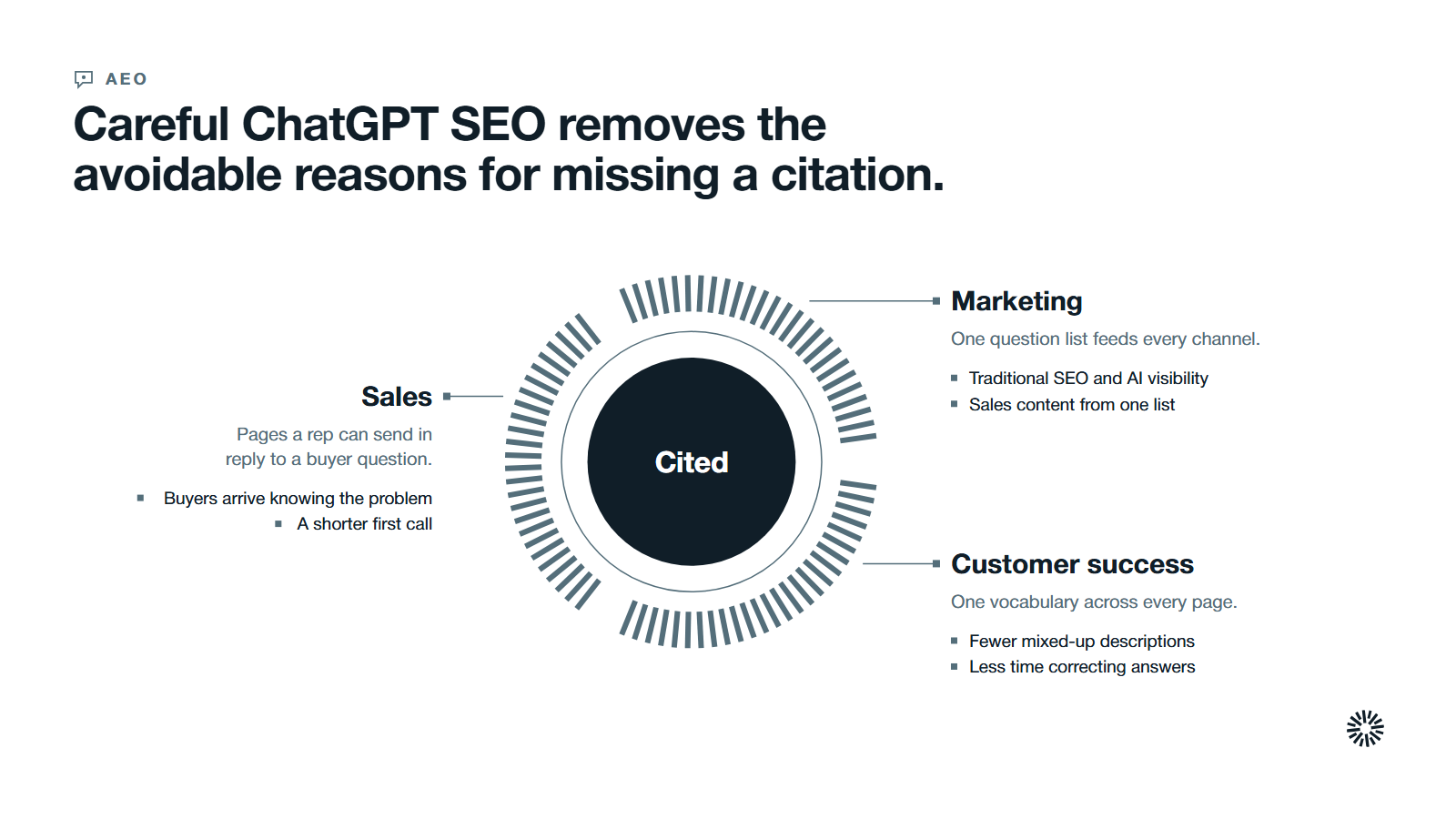
The work is mostly editorial and technical discipline. None of it guarantees a citation, but it removes the avoidable reasons for missing one, and it opens new opportunities for businesses that answer niche questions better than anyone else.
Sales gets pages worth sending
A page that answers one buyer question in its opening sentences is a page a rep can send in reply to that exact question. Buyers and users who arrive after reading a clear answer in ChatGPT already know the problem you solve, which shortens the first call.
Marketing works from one question list
The prompt list replaces a calendar of loosely related posts, and it gives every blog article a clear audience. The same list feeds traditional SEO, AI visibility and sales content.
Customer success gets consistent language
When every page describes your product and company in the same words, an AI answer built from several of your pages has less to contradict. Customers and users meet one vocabulary, and your support team spends less time correcting mixed-up descriptions.
Start with access, then measure for three months
Open the robots.txt file on your website this week and confirm that OpenAI's search crawler is allowed.
Then complete the first step, pick ten URLs, rewrite the first two sentences under each heading and log your thirty prompts. After three months you will know where ChatGPT mentions you, where it does not and what to fix next.
Propello is a HubSpot partner and designs and builds connected go-to-market systems on HubSpot. If you want an outside view of how visible your company is in AI answers, an audit is the place to start.
