You asked an AI assistant about your own category, and competitors dominate the answer while your brand is nowhere in it. If you are a CEO, founder, CRO or revenue leader at a growing B2B company, that moment deserves attention, because your buyers are asking the same questions.
Your brand is missing because the engines cannot find, understand or trust enough about you, and each cause can be checked. This guide defines AI search visibility, walks through six causes of poor AI visibility with a check and a fix for each, and shows you how to measure your position this week.
|
AI Search Visibility AI search visibility is how often and how accurately AI engines mention, describe and cite your brand when buyers ask questions about your category. |
Why AI search visibility is now a revenue question
Buyers already use AI tools to research vendors. In its 2026 survey of 5,119 U.S. adults, Pew Research Center found that 44% say they use ChatGPT, and about four in ten say they use chatbots to search for information.
The answer itself is also where attention stops. In a Pew Research Center analysis of the browsing of 900 U.S. adults in March 2025, people who saw an AI summary clicked a traditional result link in 8% of visits, against 15% for people who did not.
Unlike traditional search engines, AI search engines do not hand your buyer a list of pages to compare. They cite sources and name brands inside one composed answer. Ranking well in traditional search does not on its own put you in that answer.
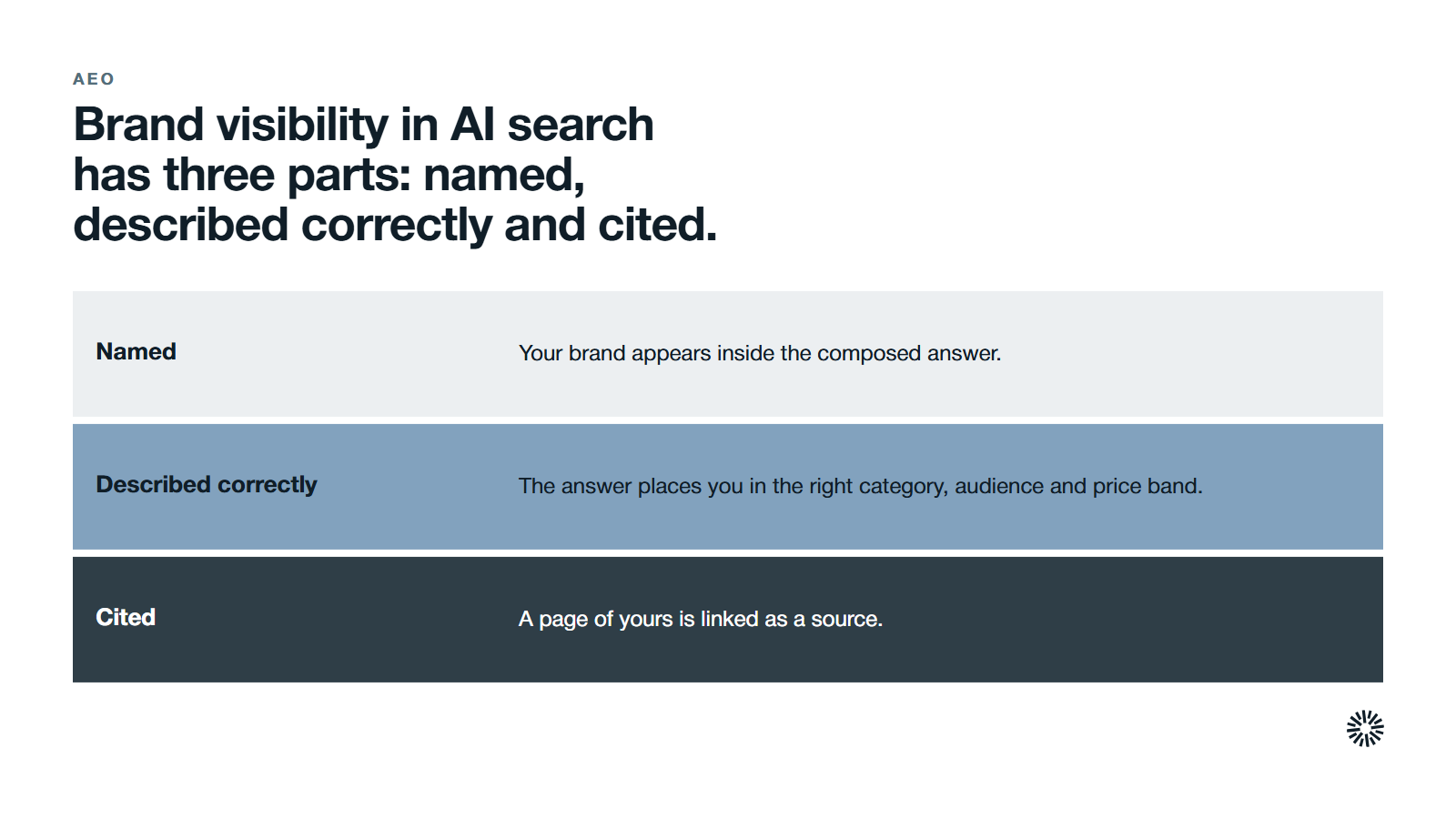
Brand visibility in AI search has three parts: being named, being described correctly, and being cited.
Propello calls the discipline of being found and described well in these answers AI Engine Optimization (AEO). The wider market calls the same thing answer engine optimization. Most of what follows is practical work to improve AI visibility, sitting between your marketing, content and RevOps.
Why your brand goes missing from AI answers
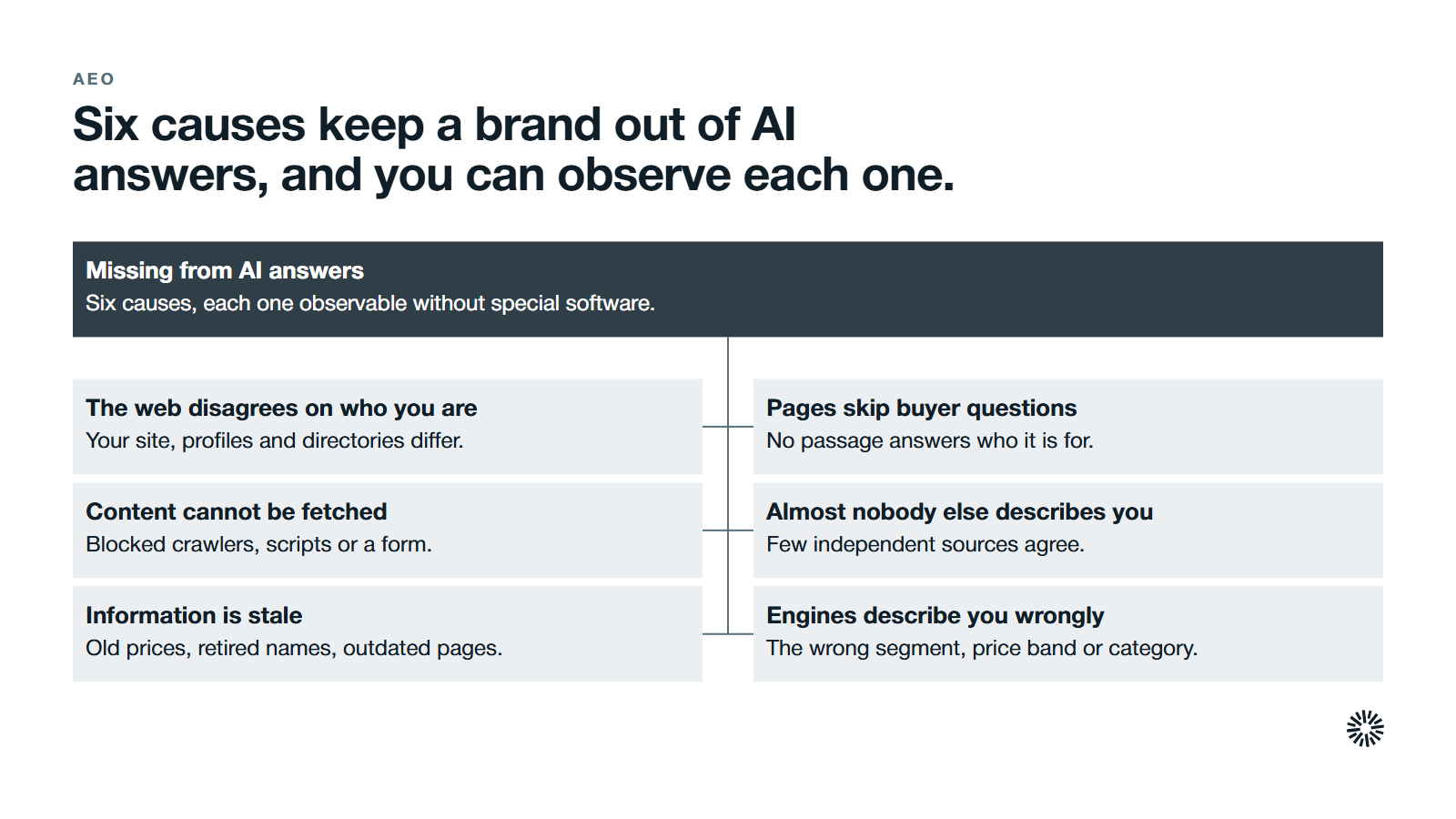
Six causes of weak AI visibility show up again and again, and you can observe each one without special software. Fixing a cause does not guarantee a mention, because engines vary and answers change, but each fix removes a reason to be left out.
The web does not agree on what your company is
Engines that retrieve pages first and then write an answer from them, a method called retrieval-augmented generation, have to merge what they find into one description of you. Your website says revenue platform, your LinkedIn page says marketing agency, and a directory carries your old name.
When those conflict, the merge fails and AI models have nothing coherent to draw on. The fix starts with entity clarity, which knowledge graph SEO walks through step by step for growing companies. You get a vague mention, a wrong one, or silence.
To check, put your website header, LinkedIn company page, your review sites and business directories, and your latest press release side by side. Record the name, category, one-line description and leadership in a table. If a stranger would think these were different companies, your brand presence is fragmented.
The fix is one canonical name and one sentence that says what you are, who you serve and what you do. Publish it on your site first, then update every profile and third party site that describes you.
Your pages do not answer the questions your buyers ask
Many company sites are built around features, pricing and solutions, and never answer "who is this for" or "how does it compare." Engines lift facts, definitions and figures that are direct and well supported. If no passage on your site answers the question plainly, there is nothing to quote.
To check, take your fixed list of buyer questions from the manual check below, starting with high intent prompts such as comparisons. For each one, find the page on your site that answers it in its first two sentences. Every question without a page is a gap, and the gaps are your content plan.
The fix is to rewrite the page around the question, in the words buyers use, because engines work on meaning and context more than on repeated keywords. Use clear headings, put a direct answer in the first two sentences, then add the detail. Good content structure gives software a map of the page.
Short, plain sentences at a grade six to eight reading level, with an immediate, scannable answer at the top of each section, are easier to lift and summarize accurately. Structured data can add a machine-readable layer that helps software understand how the page is organized.
Citation worthy content is also specific. Thin copy gives an engine little to use, while your own definitions, figures you can source and an author with a named role give it authoritative content to quote.
Your content cannot be fetched or read by AI engines
Some brands are invisible to AI models for a mechanical reason. Crawlability and technical readiness decide whether your content is available at all. A blanket rule in robots.txt blocks crawlers, the copy only appears after scripts run, or the explainers sit behind a form.
Google's documentation says a page must be indexed and eligible to show in Google Search with a snippet to appear as a supporting link in AI Overviews or AI Mode.
OpenAI's crawler documentation says sites that opt out of OAI-SearchBot will not be shown in ChatGPT search answers, though they can still appear as navigational links. It describes a separate crawler for training data, so blocking model training and blocking search are different decisions.
To check, read your robots.txt line by line for old blocks that someone added and nobody remembers. Load your key pages with scripts switched off and see whether the core copy survives. Confirm your pages are not set to noindex or nosnippet, and that the explainers a buyer needs are not behind a form.
The fix is to allow the crawlers you want, put core content in plain HTML, keep pages fast, and ungate the explainers that earn trust.
Almost nobody else describes your brand
If only your own domain says you matter, an AI system has little to go on. Systems that check a claim against several places trust it more when independent sources agree. Third party mentions, such as reviews, analyst notes, podcasts and community threads, supply that evidence and build brand authority.
To check, list every brand mention from the last year on sites you do not control. Do the same for the competitors that keep appearing in AI answers. A short list next to theirs tells you where you stand.
The fix is slow and honest work. Ask customers for reviews on the sites buyers use, offer expert commentary to publications in your category, co-create content with partners, and publish original research others can cite. There is no shortcut, and no single mention guarantees AI citations.
Your information is stale or contradicts itself
An AI system facing two versions of the truth can only blur them or skip you. Freshness matters for the same reason: if it cannot tell which version is current, it has to guess. Old pricing pages that are still live, retired product names in help articles and outdated partner pages all send conflicting signals.
To check, search your own site for retired names, old prices and old claims. Then review your most visible third-party profiles for the same problems.
The fix is to redirect or retire legacy pages, standardize naming, and give one person ownership of a review rhythm tied to your release calendar. Change a page's date only when the content really changed, because a recently reviewed page gives an engine current evidence to quote.
AI engines mention you but describe you wrongly
Being named is not enough. An assistant that calls you project management software for small teams, when you sell workflow automation to enterprises, can cost you more than silence. AI generated responses, including comparison tables, can put you in the wrong segment, price band or category, and on the wrong shortlist.
To check, run brand-specific questions on each AI platform and record the category, audience, price band and use cases it assigns to you. Compare those with your competitive positioning.
The fix usually combines the earlier ones. Find the source of the wrong description, often an old page or a strong third-party profile, and correct it there. Then publish a positioning page that says who you serve and who you do not, plus a comparison page and an FAQ.
How to track brand mentions in AI engines with a manual check
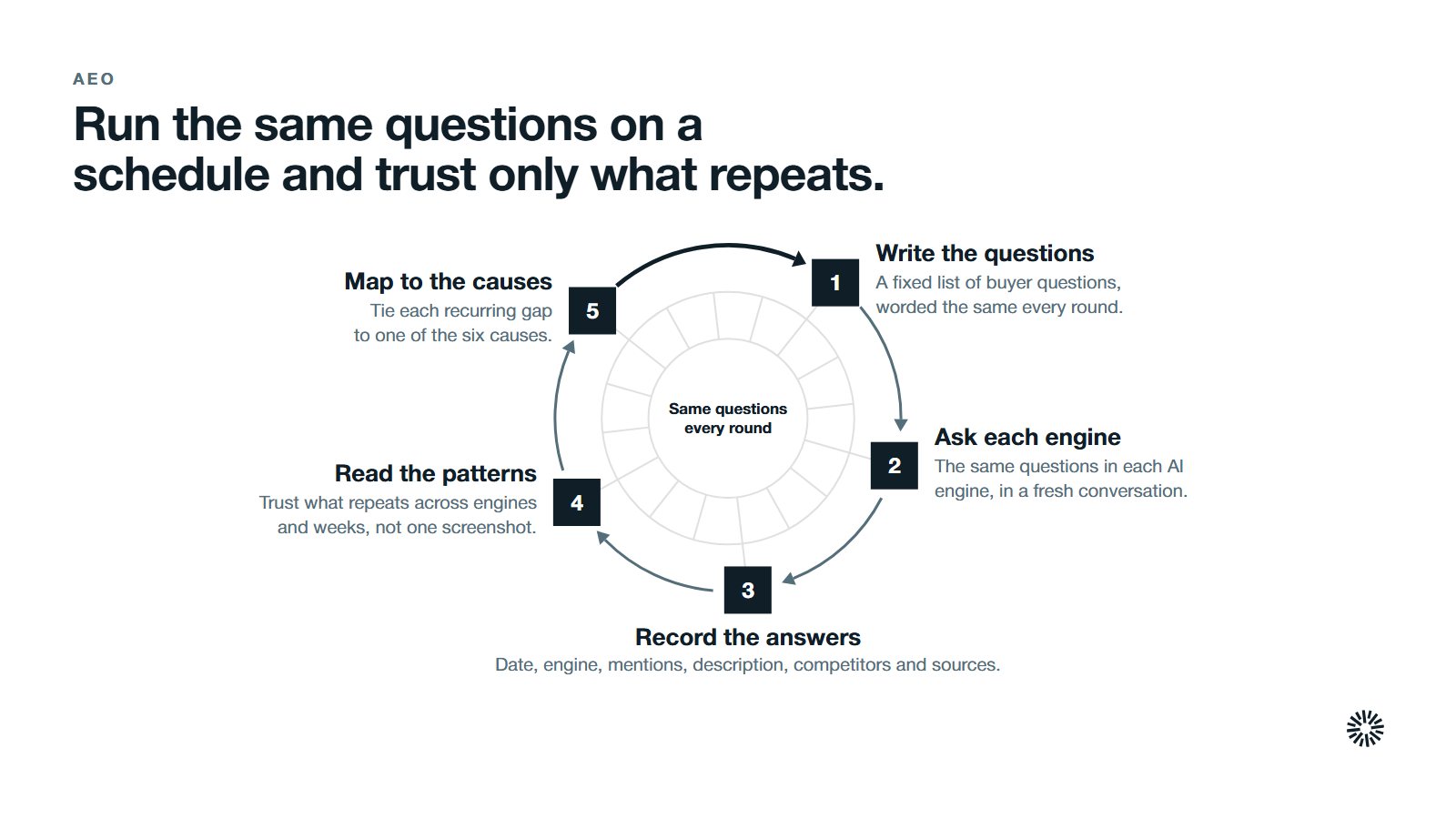
You do not need AI visibility tools to start. Paid AI tools that track mentions can help later when you need scale, but a manual routine shows whether you have an AI visibility problem and which cause is behind it.
Write a fixed list of buyer questions
Write the questions your buyers actually ask. Include category questions, comparisons, problem-led questions and brand-specific questions such as what your company does. Take the wording from sales calls and support tickets. A few dozen questions are enough, and the wording must not change between rounds.
Ask the same query in several AI engines
Run the list on each major AI platform: ChatGPT, Google AI Overviews and AI Mode, Perplexity, Gemini, Microsoft Copilot and Claude. ChatGPT brand visibility can look very different from what you see in Google AI Overviews or in ordinary Google search results, so test each engine on its own.
Start a fresh conversation for each question so earlier answers do not shape the next. Note whether ChatGPT mentions you, and whether your brand appears in the others.
Record the answers on a schedule
Use one shared spreadsheet with one owner. Record the date, engine, question, whether your brand appears, how it is described, which competitors are named and which sources are cited. Repeat weekly for a month, then monthly, so the visibility data builds into performance trends. When you are ready to go further, AI search analytics covers which measures to track and how to read them.
After a few rounds, work out a simple visibility score of your own: the share of your questions where your brand appears. It is a rough measure, not an industry standard, and it only means something if the questions stay the same.
Treat patterns as evidence and single answers as noise
Be honest about what this method can prove. Answers vary by user, time and phrasing, and random variation is real. AI search results shift from day to day, so one screenshot proves little, whether it flatters you or alarms you.
Do not judge from one platform or one run. Ask each question more than once, remember that AI models can answer the same question differently each time, and trust only what repeats across engines and weeks.
Then map each recurring set of visibility gaps to one of the six causes above.
What a missing brand costs you
AI generated responses, including Google AI Overviews, often answer the question without sending anyone to a website, so a brand missing from the answer may never get the visit. Your demand generation spend then has to work harder to create awareness that a clear answer could have supplied.
Misdescription costs in a different way. It damages brand perception before a relationship starts, so sales spends discovery calls correcting a wrong idea of what you sell, and marketing writes more content to repair a narrative it did not know had drifted.
What you gain when this is done properly
Fixing AI visibility is shared work, and each revenue team gets something different from stronger brand visibility.
Sales meets buyers who already know where you fit
When AI generated answers name you and describe you correctly, buyers arrive with a sensible picture of what you sell and who it is for. Discovery calls can start further along, with fewer conversations about who you are and more about whether you fit.
Marketing learns which questions it owns
A fixed list of buyer questions, tracked over time, shows marketing where your brand shows up in answers and where it does not. That gives content strategy a clearer target than guessing at topics, and it shows where organic traffic and AI answers tell different stories. Your content marketing and traditional SEO still count.
Customer success starts from one consistent story
New customers often arrive with expectations shaped by what an assistant told them. When your site, your profiles and the AI responses describe you the same way, onboarding has fewer misunderstandings to unwind, and support content can answer the same questions customers already ask.
What to do first
You can start improving AI visibility this week without buying anything or hiring anyone. The page-level steps for doing so are laid out in optimizing content for AI search for your content team. Work in this order.
- Write down the questions your buyers ask and run them in three engines. Record what comes back. That is your baseline.
- Choose one sentence that says what you do, who it is for and what outcome you deliver. Update your website header, LinkedIn page and one top directory listing to match.
- Pick the question that matters most to your pipeline, favoring a page that already ranks well in organic search, and rewrite it with the answer in the first two sentences.
AI search visibility is a system problem you can fix on purpose
One bad page is rarely to blame. The causes sit across your site, your profiles and the wider web, so they persist when teams work alone. Clear identity, direct answers, readable pages, independent coverage and current information form one go-to-market system, and AI powered search needs it built on purpose.
Propello designs and builds connected GTM systems on HubSpot. If you want your website, your profiles and your teams telling the same accurate story about your brand, an audit is the place to start.