
If you lead marketing or revenue at a growing B2B company, you can find out in one afternoon whether answer engines are likely to cite your site. Score yourself on five areas, from access to measurement, and the lowest score shows what to fix first.
This article is for CEOs, founders, CROs and marketing leaders who want an honest AEO audit before spending on AI visibility. It takes about three hours and is the first step of answer engine optimization. You get 25 questions, a scoring method, what low, medium and high look like, and a fix order.
|
AEO Readiness AEO readiness is how well your site lets answer engines reach, understand, trust and quote your pages when a buyer asks a question in an AI tool. |
Why answer engines reward a ready site
Answer engine optimization (AEO) is the work of making your content easy for AI systems to find, read and quote. These AI powered search engines include Google AI Overviews and AI Mode, ChatGPT and Perplexity. Each one runs on large language models that read many pages, assemble AI generated answers and name a few sources.
That changes what a good page does. In traditional search engine optimization, you earn a click from a list of ten blue links. With AI answers, the page has to be understood well enough to be quoted, and your company has to be a name the system associates with the topic.
Answer engines now sit beside traditional search engines, voice search and the usual search results page, so buyers meet your company in more places.
The change shows up in your numbers in different ways. Organic traffic may stay flat while AI referral traffic appears, and some influence never shows up as a visit.
SparkToro's 2024 study of panel data found that 58.5% of American Google searches resulted in zero clicks, so search rankings alone no longer tell you whether you are visible.
Google is clear that the fundamentals still apply. Its documentation says there are no additional requirements to appear in Google AI Overviews or AI Mode.
Its guide to generative AI features adds that a page must be indexed and eligible to show with a snippet, and that from Google's perspective, whether it is called AEO or generative engine optimization, this work is still SEO.
Good traditional SEO is the base of answer engine optimization, which is why this self-check starts with basics before it moves to newer questions. Unlike traditional SEO, though, AEO also asks whether your brand is understood and mentioned elsewhere.
What an AEO audit looks at
An AEO audit is a structured review of how ready a site is to be used as a source by AI search engines. A full one checks technical access, content structure, schema, brand signals and AI visibility tracking. Its primary goal is to help the brand be cited by AI search tools.
An AEO audit differs from a traditional SEO audit in what it emphasizes. SEO focuses on keywords, links and rankings that earn traffic.
AEO targets selection as a direct answer, and an audit measures whether AI mentions and citations occur. That is your AI search visibility in the zero-click and AI generated environments where buyers now look. It also benchmarks you against competitors that AI tools cite, so improvements can be tracked over time.
Our self-check follows the same five areas, scaled so your own team can run it. It is a do-it-yourself AEO audit, not a replacement for outside review, and the scoring bands are Propello's own framework rather than an industry standard. Use them as a conversation tool, and adjust the questions to your business.
How to run the AEO readiness self-check
Plan on three hours and invite one person who owns the website, one who owns content, and one who sees buyer questions in sales calls. A shared document works well. Open your site in a private window so you see what a stranger sees.
You will answer 25 questions, five in each of five areas. For each question, give two points for yes, one for partly and zero for no. Partly means it is true on some pages or only part of the time. Be strict. A guess that you probably do it counts as partly at best.
Add up each area separately and leave the five totals as they are. Do not add them into one grand total. A site with strong content and blocked crawlers is not average. It is stuck, and a single blended number would hide that.
What to have open before you start
Gather a few things first so the answers rest on evidence rather than memory.
- Your robots.txt file, which sits at the root of your domain.
- Google Search Console, for indexing and the links report.
- Google Analytics, for referral traffic from AI tools.
- Your ten most important pages, such as your homepage, main service pages and best articles.
- A list of ten questions your buyers ask before they choose you.
Score yourself on five areas
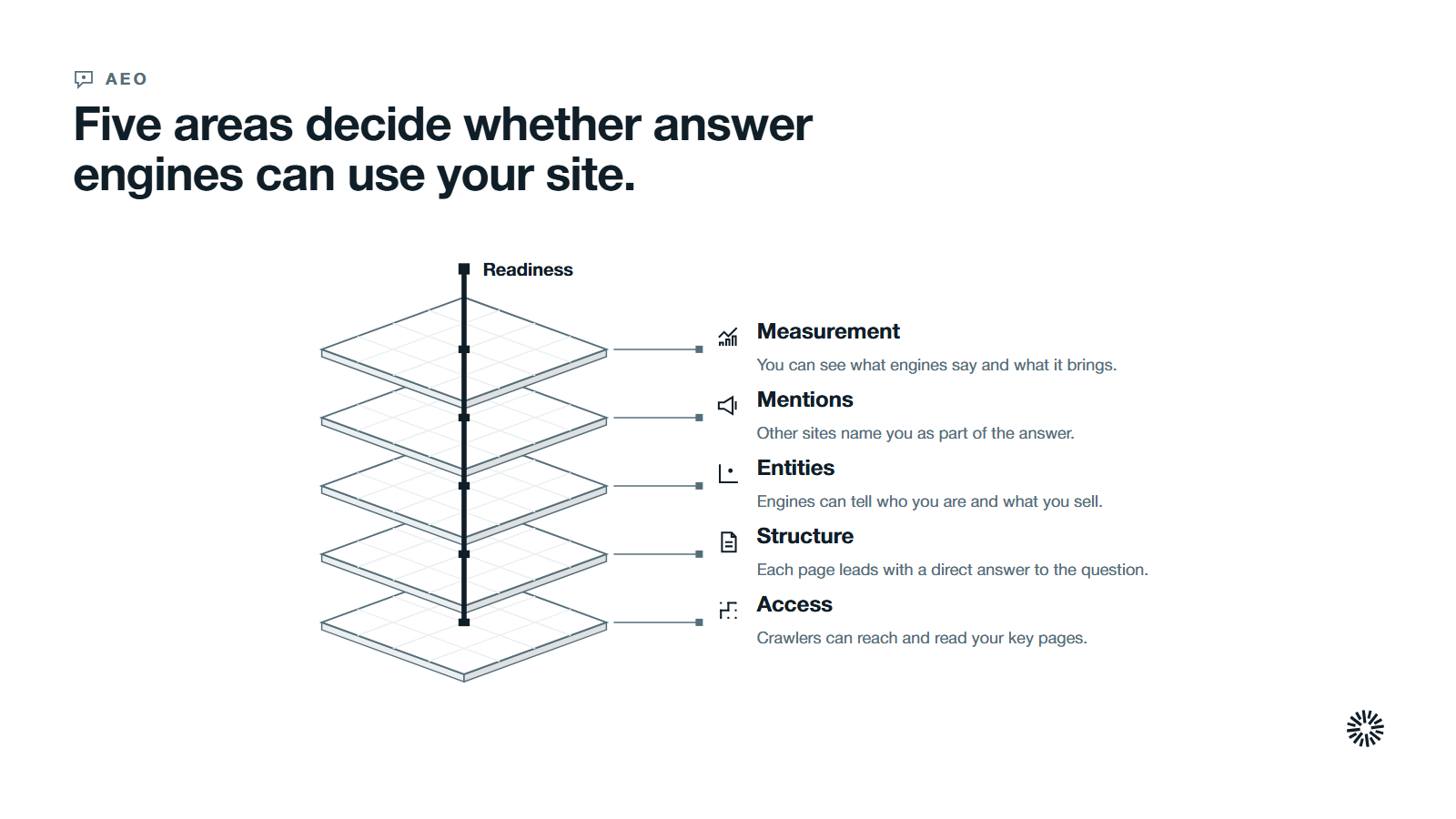
The five areas apply whether buyers use AI assisted search or AI powered tools. Your organic rankings and the AI search results that cite you depend on the same basics.
Work through the areas in order. Each one covers a different way AI answer engines can fail to use you: it cannot get in, it cannot find the answer, it cannot tell who you are, nobody else mentions you, or you cannot see what is happening.
Access and crawling: can AI systems reach your pages?
If technical access fails, nothing else on this list matters. AI bots add new decisions to technical SEO. A robots.txt file tells crawlers which URLs they may request. Google notes that it is used mainly to manage crawl traffic, and that it is not a way to keep a page out of Google.
Technical readiness simply means AI tools can access and interpret your content.
Pages need to meet Google's Core Web Vitals thresholds, and web.dev says a good largest contentful paint is 2.5 seconds or less.
Fast load times belong to the good page experience that Google's guide lists among the technical basics, and pages that load in a few seconds are easier for any system to use. Strong internal links also help search engines and AI bots find related pages.
Score each question as yes, partly or no.
- Your key pages return a normal response, load without logging in, and show their main text in the page source rather than only after scripts run.
- Your robots.txt file does not block the AI crawlers you want to be found by, including those used for AI search.
- You have made a deliberate decision about AI training crawlers, such as GPTBot, and written it down.
- Your important pages are indexed, which you can confirm in Google Search Console.
- Your pages load quickly on a phone, your URLs are clean and descriptive, and your internal links let a crawler reach every key page in a few clicks.
OpenAI's documentation shows why the decision needs care. It lists separate crawlers for search and for training, and says each setting is independent.
A site can allow the search crawler so it can appear in ChatGPT search while disallowing the training crawler. Treating them as one switch is a common mistake, and a blanket decision to block AI crawlers can remove you from the answers you want to appear in.
Answer-first structure: do your pages answer the question fast?
Answer engines lift passages, not whole pages, and favor direct answers in the first hundred words or so.
A page that buries the answer under a long introduction is harder to quote than one that states it in the first lines under a clear heading. This area asks whether your content structure is built for direct answers.
- The top of each key page gives concise answers to its main question in a sentence or two, in plain words, with detailed answers below for readers who want more.
- Your headings state the point or ask the question a buyer would ask, in the natural language queries and voice queries people actually use in voice search, rather than vague labels.
- Definitions, steps and comparisons sit in short paragraphs, bullet points or tables that can be read on their own, and internal links connect each of your key queries to a page of its own.
- Each key page has a short FAQ that answers real user queries concisely, and the questions come from sales calls rather than guesses.
- Your key pages show a visible update date and someone reviews them on a schedule, so they stay current.
Clear heading hierarchies and lists help AI systems pick out an answer, and properly formatted content is easier to extract. Short direct answers also suit voice search, where voice assistants such as Google Assistant read one answer aloud. Other voice assistants work the same way.
In our reading, structure helps citation. Pages with a clear heading hierarchy are cited more readily because each answer can be lifted out on its own. Structured FAQs hand an engine ready-made questions and answers, and schema markup can improve the chance of citation even though Google does not require it.
Freshness matters too. Pages that look maintained are easier to trust, and stale pages lose their chance of being cited over time.
AI systems prefer content that was updated recently. Ahrefs' July 2025 study of 17 million citations across AI assistants found that the pages they cite are 25.7% fresher on average than pages in organic search results, so review key pages at least quarterly.
As a working rule, refresh every key page at least once a year, and refresh pages that carry fast-moving facts within the past month.
A content structure test helps. Cover everything but one section and ask whether it still makes sense. If it does, an AI system can quote it. If it relies on the paragraph above it, it cannot. Our annotated AEO checklist shows what these patterns look like on a real page.
Entities and schema: can AI systems tell who you are?
An entity is a clearly identified thing, such as your company, a product or a person.
Clear entity authority signals stop AI systems from confusing you with another brand, and they support E-E-A-T. Answer engines are more confident when your brand identity, description and facts match everywhere they appear, which helps AI understanding of what you do.
Structured data is one way to state those facts in a form machines read directly. Google says structured data isn't required for its generative AI features and there is no special markup to add, so treat schema as a way to state facts unambiguously, not as a citation lever.
- Your company is described in the same words on your site, your social profiles and your business listings, including your Google Business Profile if you have one.
- Your key pages carry structured data that matches what is visible on the page, and it validates without errors.
- Your site has organization markup that names the company and links to its official profiles.
- Authors and experts are named on articles, with a page that shows their role and experience, which supports E-E-A-T.
- Your products or services have one clear name each, used consistently across pages.
Structured data must follow Google's content and spam policies to qualify for rich results, and it should describe what is on the page.
Do not mark up claims a reader cannot see. Schema markup still helps machines understand what a page is for and keeps rich results available.
If the idea of an entity is new to you, our guide to entity authority and the knowledge graph explains it in plain terms.
Mentions and authority: do others say you are the answer?
AI systems build answers by reading many pages on the same topic. When multiple pages from independent sources describe your company the same way, a system has more reason to name you. When only your own site does, it has little to go on.
Consistent mentions across reliable sources add to your credibility and to E-E-A-T, and they improve your AI visibility. This is our reading of how AI trust is formed, not a published formula, and Google's guide warns that seeking inauthentic mentions is not as helpful as it seems.
- Industry publications, partners or respected directories describe your company and link to you.
- You are present on the review sites and communities where your buyers compare vendors.
- You have published at least one piece of original material, such as research, a method or a benchmark, that others can cite.
- Customers and partners describe what you do in the same terms you use.
- Someone on your team owns earning mentions, rather than hoping they arrive.
Mentions take months to build, which is why this area often scores lowest. If it does and you want to dig deeper, start with the sources you already have: customers, partners and the trade press in your category. Our comparison of brand mentions and backlinks explains which to build first and why.
Measurement: can you see what is happening?
You cannot manage what you cannot see, and AI search is harder to see than ordinary search.
Referral traffic from AI tools shows up in your analytics as AI referrals, separate from organic search traffic, but a lot of influence arrives as a brand name in an answer with no click at all. Organic traffic and website traffic alone understate it, so your AI search visibility needs its own check.
- You check Google Search Console on a schedule, not only when something looks wrong.
- Your analytics can separate visits from AI tools from other referral traffic.
- You keep a list of buyer questions and ask the major AI platforms each one on a schedule, several times, because a brand visible in one AI answer is often absent from the next.
- You record whether your brand is named, which pages are cited and whether the description is correct. This is basic AI citation tracking, and a spreadsheet is enough.
- Someone reviews the results each month and has authority to change the content strategy because of them. That habit is continuous improvement in practice.
Google gives site owners a first-party view. Its guide points to the Generative AI performance report in Search Console, which shows how people discover your content through those features.
Beyond that, track your mention rate and citation rate over time, and compare your AI share of voice with the competitors that appear in the same answers.
If you need an outside reading, the HubSpot AI Search Grader can show how AI responses describe your brand and where your search visibility stands. For building the routine itself, see our guide to measuring AI search visibility.
What low, medium and high look like
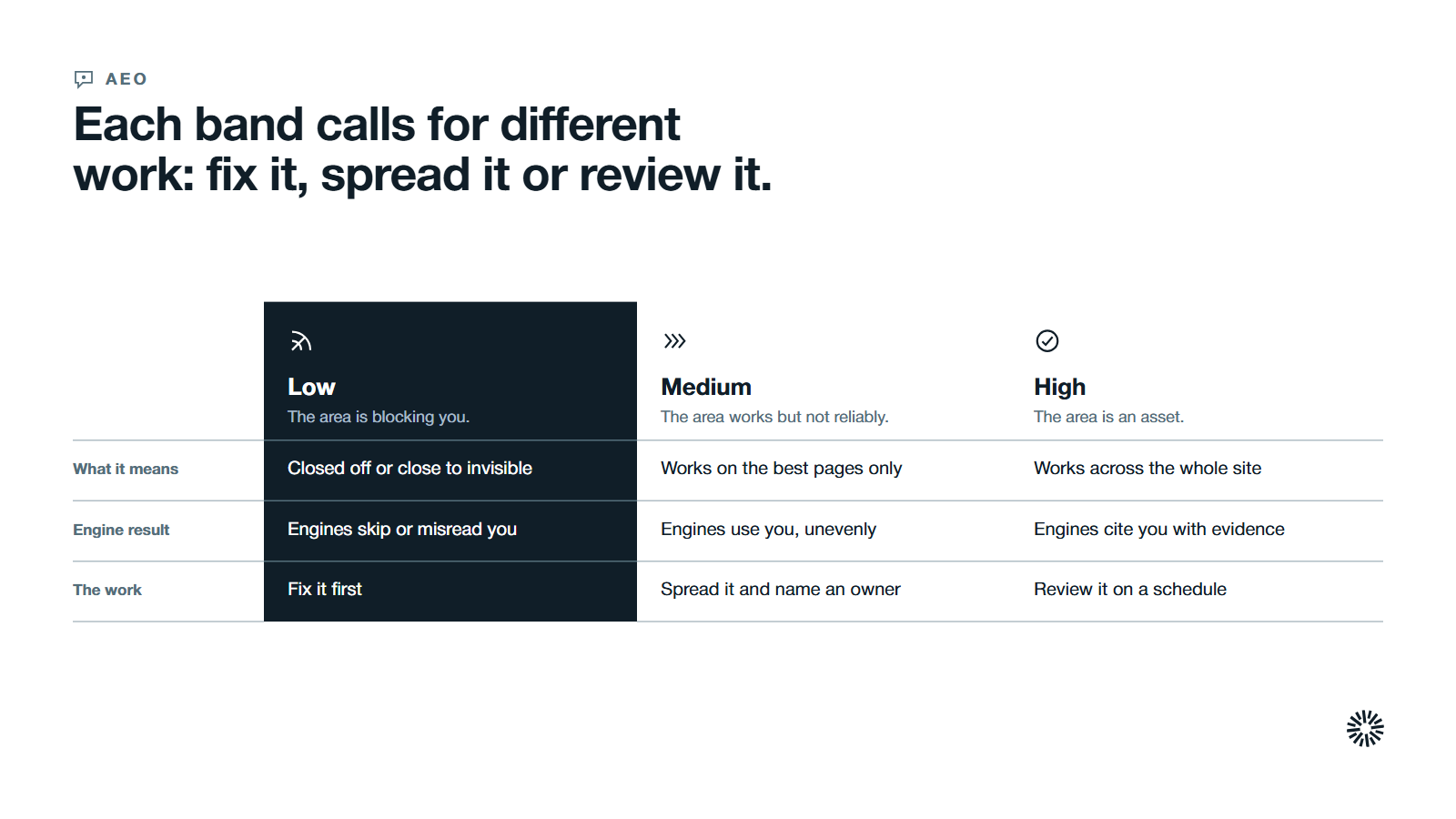
Each area now has a total from 0 to 10. We read them in three bands. These bands are Propello's own framework, built to prompt decisions, so treat the edges as soft. A site that scores 7 in one area and 8 in another has no real difference between them.
Low: the area is blocking you
A low band covers totals from 0 to 3.
In this band the area is working against you. In access, an answer engine may not see your pages at all. In structure, the answer exists but nobody can find it. In mentions, you are close to invisible outside your own site, which hurts your AI search visibility.
Low is not a disaster. It is information. Most sites that run this for the first time find at least one area here, usually mentions or measurement, because few teams have given them an owner.
Medium: the area works but not reliably
A medium band covers totals from 4 to 7.
The basics are in place on some pages or some of the time. Your best pages probably meet the standard, and the rest do not. Answer engines can use you, but your AI visibility is uneven, and AI answer engines may pick a competitor with a more consistent site.
The work here is rarely invention. It is consistency: applying what already works on your best pages across the rest, and giving someone ownership so it stays that way.
High: the area is an asset
A high band covers totals from 8 to 10. The area supports citation and strong AI visibility, and you can show evidence for it. High does not mean finished. Answer engines change, and crawler names, features and policies move, so a high area needs a regular review, not a victory lap.
If every area scores high, be suspicious of your own scoring and ask a colleague who did not take part to test five answers. Teams that mark themselves generously rarely find out until an outside test shows them.
Fix the deepest gap first
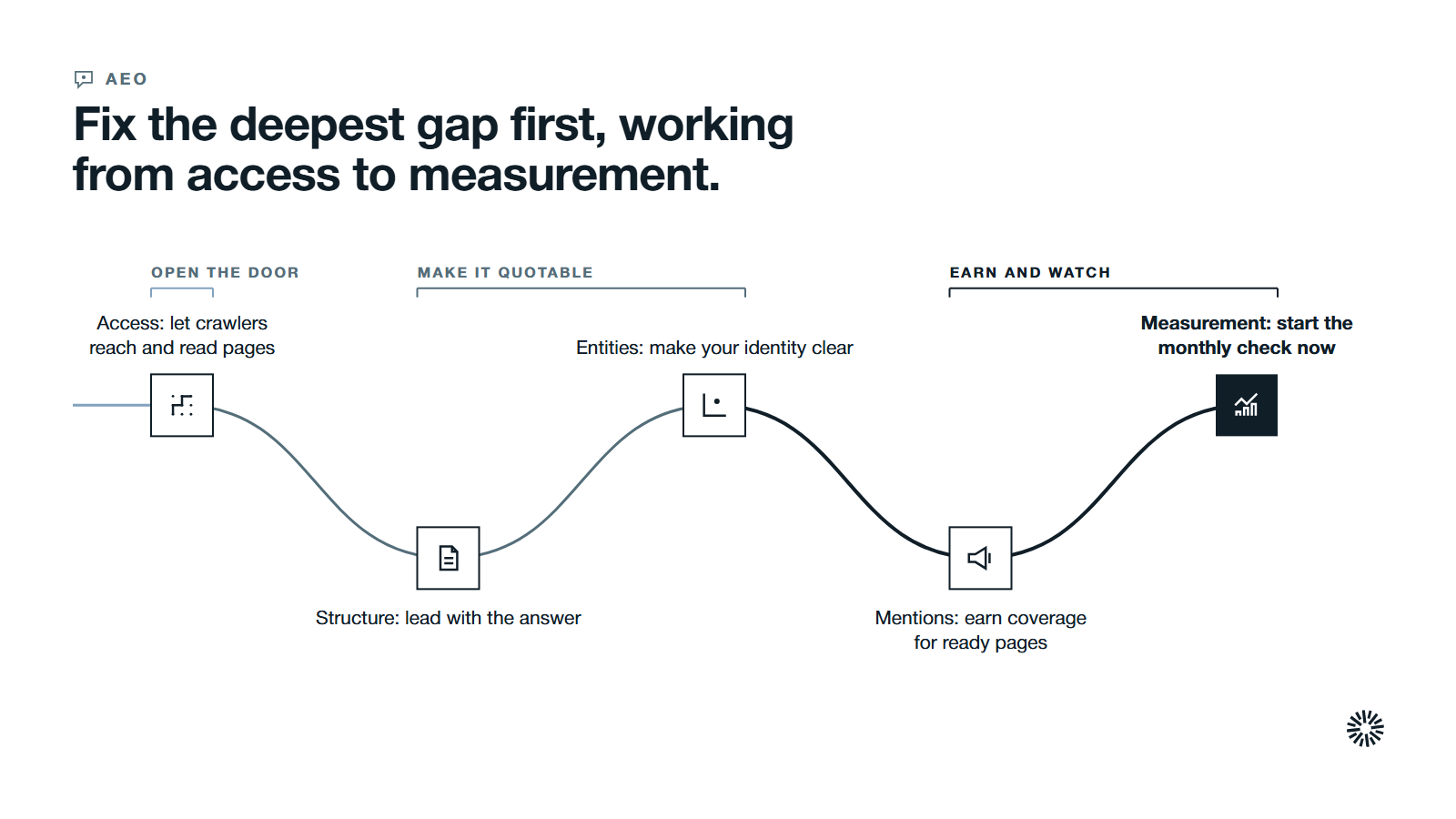
Look at your five totals and find the lowest one. That is where you start. Answer engine optimization and wider AI search optimization work best in this order, because the areas depend on each other.
- Access first. If crawlers cannot reach or read your pages, every other improvement is wasted.
- Structure second. A clear content structure gives every later effort something worth quoting.
- Entities and schema third. Once the pages are readable, make your identity unambiguous.
- Mentions fourth. Earn coverage for pages that are ready to be cited.
- Measurement throughout. Begin the monthly check now, so you can tell what changed.
When two areas tie, fix the one nearer the top of that list. When the lowest area is mentions and the rest are medium or better, it is the real gap, and you should plan for months, not weeks. Do not polish a high area while a low one sits untouched.
Turn the results into a short plan
Write one page. Name the lowest area, the three actions that would move it up a band, an owner for each and a date to rescore. Then repeat the self-check in a quarter. AI answers change slowly, so judge progress by your scores and question log.
Where a self-check ends and an outside review begins
A self-check shows where you stand. It cannot tell you whether your reading is right, how you compare with competitors, or how to sequence fixes against commercial goals. Those need an outside view and context about how you win customers. A good review is aligned with your customer goals, not a generic list.
Treat AI search optimization as one channel in your wider go-to-market system. If your website, CRM and sales process do not share the same picture of the buyer, then even a well-cited page will not turn into pipeline. Our marketing maturity self-check looks at that wider picture and takes about as long as this one.
If your scores show several low areas, or you are not sure you scored honestly, the practical next step is a GTM Audit, which reviews how your go-to-market system works as a whole, including how buyers find you. Our guide explains what to expect and how to prepare.
Common mistakes when you score yourself
The check is simple, so the errors are usually about honesty and follow-through.
- Scoring the page you wish you had rather than the one a stranger sees.
- Letting the person who built the site mark it alone.
- Blocking every AI crawler without a decision, or allowing all of them without one.
- Adding schema that says things the page does not.
- Treating one of the AI answers as proof. Answers vary between tools and between days, and a brand named in one answer can be missing from the next.
- Treating AEO as a replacement for traditional SEO rather than an addition to it.
- Buying links or placements to look mentioned. Google lists buying or selling links for ranking as link spam.
- Repeating the check but never changing a page.
What you gain when this is done properly
When the self-check becomes a habit, the benefits reach every team that touches the buyer.
Sales meets buyers who already trust the answer
When answer engines describe your company accurately in AI generated answers, buyers arrive with the right context, and strong AI visibility means more of them arrive. Sales spends less time correcting what they read and more time on fit, price and timing.
Marketing gets a clear order of work
Instead of a long list of answer engine optimization tactics, marketing has a ranked list with an owner for each item. It also gets a shared language for talking to finance and leadership about what to fund first.
Customer success gets answers that match reality
Customers also ask AI systems about you, and the AI answers shape what they expect. Watching AI Overviews for your own brand is a good habit. Consistent, accurate pages mean current customers find the same story they were sold, which helps renewals and expansion.
Start with the lowest score
Run the self-check this week, write down five totals, and begin with the lowest. Readiness is the first step of answer engine optimization, and it is not a single score to chase. It is five conditions that must hold at once: reachable, answerable, identifiable, mentioned and measured.
Fix the weakest and your AI visibility becomes easier to improve across the board.
Propello designs and builds connected go-to-market systems on HubSpot for CEOs and revenue leaders at growing B2B companies, using revenue operations and account-based marketing to build systems that learn and improve.
If you want help deciding what your scores mean for your wider go-to-market plan, a GTM Audit is the place to start.
