
If you lead revenue at a B2B business, someone has probably asked whether the HubSpot AI Search Grader is worth running. It is a free, one-time check of your AI search visibility: it shows what ChatGPT, Perplexity and Gemini say about your brand and turns that into a score out of 100 across five parts.
This article is for CEOs, founders and revenue leaders who want to read that result correctly. You will learn what the grader measures, what each of the five parts means, how it differs from HubSpot AEO, where its limits are, and what to do once you have your number.
|
HubSpot AI Search Grader The HubSpot AI Search Grader is a free, one-time check that asks ChatGPT, Perplexity and Gemini how they describe a brand, then scores the answers out of 100 across five weighted parts. |
How a HubSpot AI Search Grader run works
The tool is built for a simple question: how do AI search engines and other AI tools describe your brand right now, and how does your brand appear in AI answers?
HubSpot describes it as a one-time snapshot based on what the models say from their training data, with no account needed to start. It also accepts any brand, so you can run a competitor as well as your own company.
You give it four required details: company name, location, product or service in a few words, and industry. The location can be a city, a country, a region or global reach. Describe the product the way a customer would, because the tool uses your wording to frame the question it asks each engine.
HubSpot lists the engines as GPT-5.4 mini from OpenAI, Perplexity and Gemini from Google, and says results are cross-validated across all three. That means no single model decides your score.
The page does not name Google AI Overviews or Google AI Mode, so do not read the result as a check of those Google AI features. Traditional search engines and SEO rankings are a separate measure.
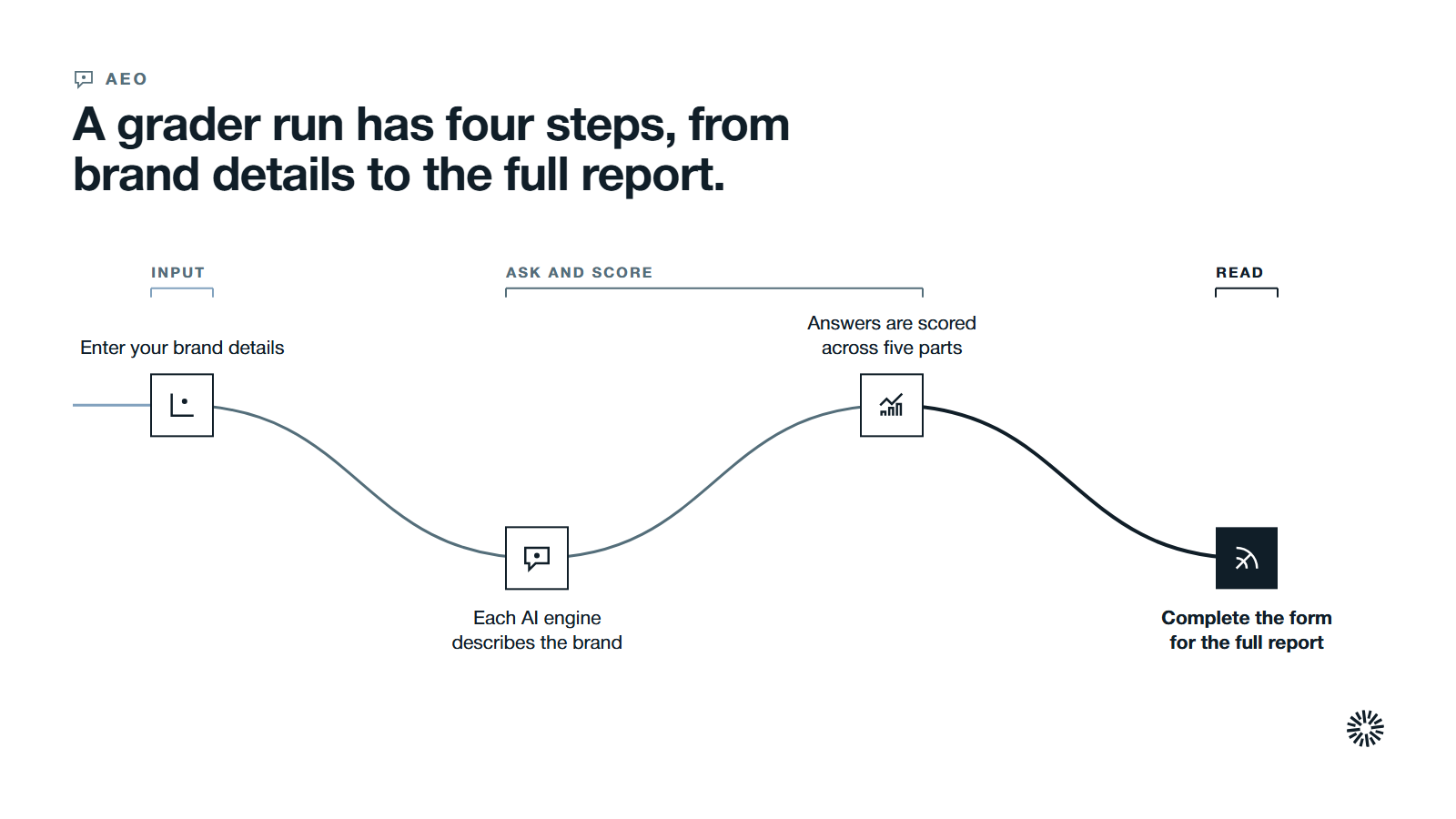
The run has four stages, in this order:
- You enter the brand details.
- The tool asks each of the three AI engines how it characterizes the brand.
- The answers are scored across five dimensions into a composite out of 100.
- You complete a form to see the full report, which includes the composite score, a breakdown and a written interpretation of what your scores mean.
Treat the score as a description of what the large language models behind these assistants already believe about you. These AI models and AI systems do not read your site live, so the result shows your AI visibility as it stands, not a forecast.
Why AI search visibility needs its own measure
AI search does not rank a list of links by keyword. Engines such as ChatGPT, Perplexity and Gemini act more like curators than indexers: they gather sources and write a synthesized response. Traditional SEO metrics, such as keyword rankings, therefore say less about whether your brand is named in an answer.
AI search engines tend to favor clarity, structure and authority. Clear content also helps AI models classify what your company does and who it serves.
When an AI summary answers the question, fewer people may click through to the sources, so AI-generated answers can capture a share of the traffic that once went to ranked links. Being named inside the answer matters more.
The grader helps you find gaps in brand messaging and content relevance. Optimizing for AI context means giving the engines consistent, well-structured descriptions to learn from, so content is easy for them to extract.
The five scores behind the number
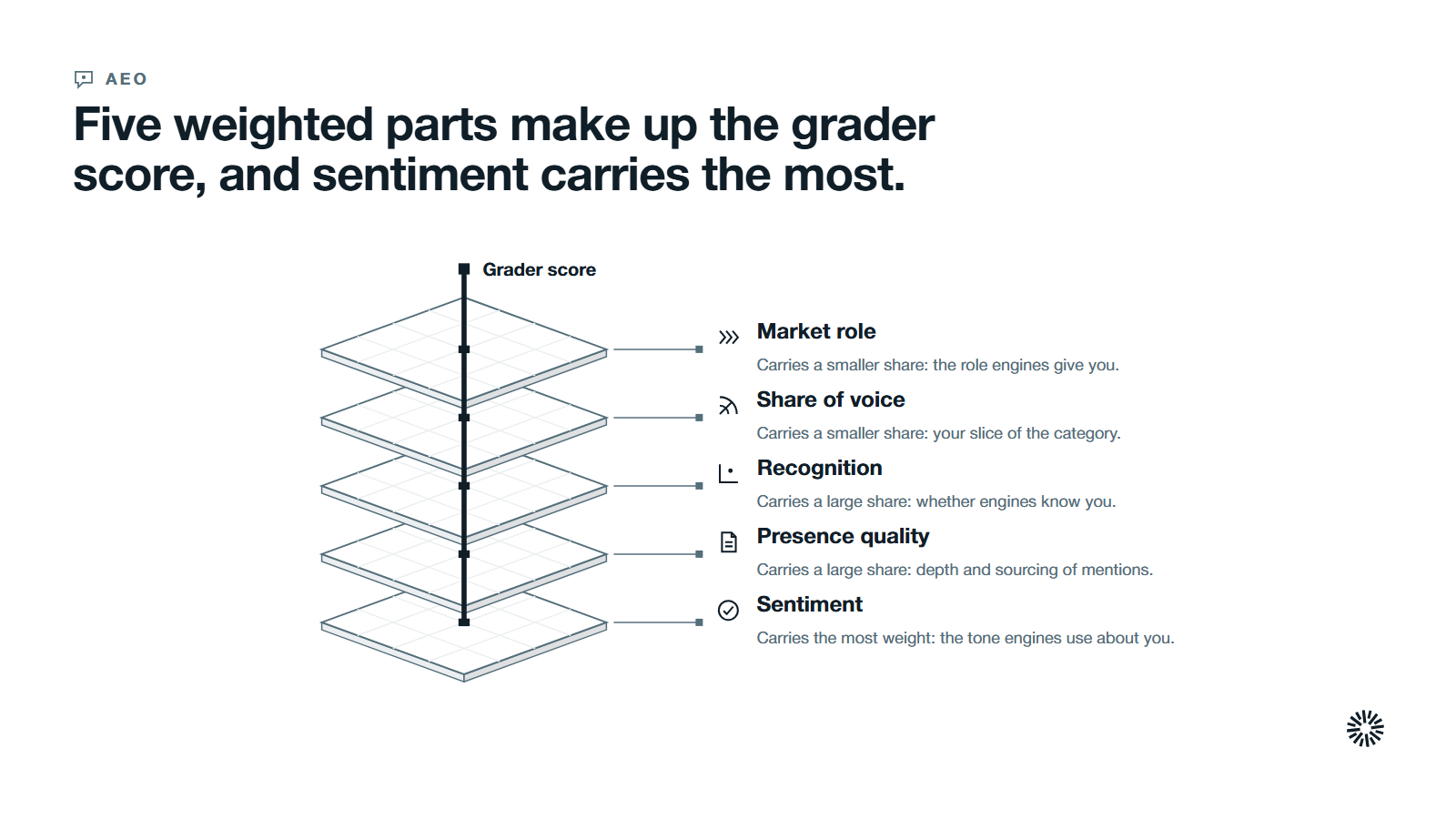
The grade is a weighted sum. According to the HubSpot AI Search Grader page, the five parts carry these maximum points.
| Part | Maximum points | What it looks at |
|---|---|---|
| Sentiment Results | 40 | The tone the engines use about your brand |
| Presence Quality | 20 | How deep and well sourced the mentions are |
| Brand Recognition | 20 | Whether the engines know who you are |
| Share of Voice | 10 | Your share of the category conversation |
| Market Competition | 10 | The role the engines give you in your market |
Sentiment Results is the largest part
Sentiment carries up to 40 of the 100 points, which makes it the biggest single lever. HubSpot says it covers general sentiment, contextual sentiment and source-based sentiment. In plain terms, this is sentiment analysis of how the answers talk about you, not only whether you are named.
The page explains the weighting this way: it measures how AI characterizes your brand, not just whether it recognizes it. A well-known brand described with doubt can score worse here than a smaller brand described with confidence.
Presence Quality and Brand Recognition
Presence Quality is worth up to 20 points and looks at mention depth, source quality and data richness. A passing reference scores lower than a detailed one that draws on strong sources.
Brand Recognition is also worth up to 20 points. It reflects whether the engines recognize your brand at all and describe what it does accurately. Low recognition means fewer AI mentions of your name when buyers ask category questions. If a model confuses you with another company, this is where it shows.
Share of Voice and Market Competition
Share of Voice is worth up to 10 points. HubSpot says it combines an estimated percentage of the category conversation with a rank bonus. It is your brand visibility compared with competitors, so it shows how often your brand shows up next to theirs, not an absolute number.
Market Competition is also worth up to 10 points. It records the category role the engines assign you (Leader, Challenger or Niche Player) and how they perceive your innovation (Innovator, Disruptor or Traditionalist). This is your market position as the models see it.
How to read your AI visibility score without over-reading it
A single number invites false precision. These three habits keep the result useful.
Read the parts before the total
Two brands can land on the same total for different reasons. One may have strong brand recognition and weak sentiment, the other the reverse. Each needs a different fix, so write down the five parts, not just the headline score.
Compare against competitors, not against 100
The page does not publish bands that say what a good score is, so do not invent one. Because the tool accepts any brand, run it on the two or three competitors a buyer would compare you with. Your gap to them is the more honest benchmark.
Remember it is a snapshot from training data
HubSpot calls the check one-time, and it draws on what the models learned in training. A product launch, a rebrand or fresh press coverage may not appear yet. Run it again after meaningful changes, and use it as a starting point, not as proof that an AI answer will say the same thing tomorrow.
How the grader differs from HubSpot AEO and AI Search Sensor
HubSpot offers three related visibility tools, and they get confused.
AEO stands for answer engine optimization, the practice of improving how often and how accurately your business appears in AI-generated answers. In practice it focuses on content structure, shaping pages so AI tools such as ChatGPT can read and reuse them. HubSpot's AEO product page draws the lines between the three tools.
| Tool | What it is | Best used for |
|---|---|---|
| AI Search Grader (also called the AEO Grader) | A free, one-time snapshot of one brand | A first look at how AI describes you |
| HubSpot AEO | Ongoing tracking of tracked prompts, citations, competitor share of voice and recommendations | Ongoing monitoring and acting on gaps |
| AI Search Sensor | A free tracker of industry-wide AEO trends | Watching the market, not your own brand |
The key difference is time. The grader answers one question once. HubSpot AEO runs your chosen prompts daily and shows how your brand visibility moves, which is what prompt tracking is for. If you want to track AI search visibility over months, that is the job of the ongoing tool, not the grader.
HubSpot also offers AEO inside Marketing Hub, where recommendations connect to CRM data.
Prompts are the questions people type into AI tools, such as the customer questions your buyers ask before they ever visit your site. Choosing them well matters more than the tool you pick. Our guide to AI search analytics and how to measure visibility shows how to build that list.
Where the grader fits among AI search visibility tools
An AI search visibility tool does three jobs: it shows where your brand appears in AI-generated answers, compares you with competitors, and tells you what to change. The grader does the first two once.
It does not run live search on a list of tracked prompts. Citation analysis, which shows which blog post, landing page or outside site an engine references, belongs to the ongoing tool.
When a prospect asks an assistant about your category, the engine returns a synthesized response, and your brand shows up in it or does not.
A visibility tool earns its place by repeating that check often enough to show movement. If you are unsure how many prompts to start with, begin with the questions your sales team hears most.
What to do after you get your result
The score is the start of the work. HubSpot's knowledge base ties AI visibility to three factors: consistent messaging across channels, demonstrated subject-matter authority, and a broad enough presence with real content depth. Use them to turn the result into a short plan that improves AI visibility and, over time, your search visibility across platforms.
- Find your weakest part. If sentiment is low, look at the sources the engines would draw on, such as reviews, press coverage and your own pages.
- Fix inconsistencies first. If the engines describe your product differently from how you do, align your site, profiles and listings so every source tells the same story.
- Make your pages easy to quote. Use clear headings, direct sentences, specific alt text on images and structured data where it fits, so AI answers can lift the right facts. The annotated AEO checklist walks through a page.
- Measure before and after each change. HubSpot recommends measuring metrics before and after a change to see its real effect.
- Repeat on a schedule. The same page suggests auditing content regularly, about every three months.
Treat each change as an experiment with a clear hypothesis. Our article on an AEO strategy built on testing and learning explains how to run that loop.
What you gain when this is done properly
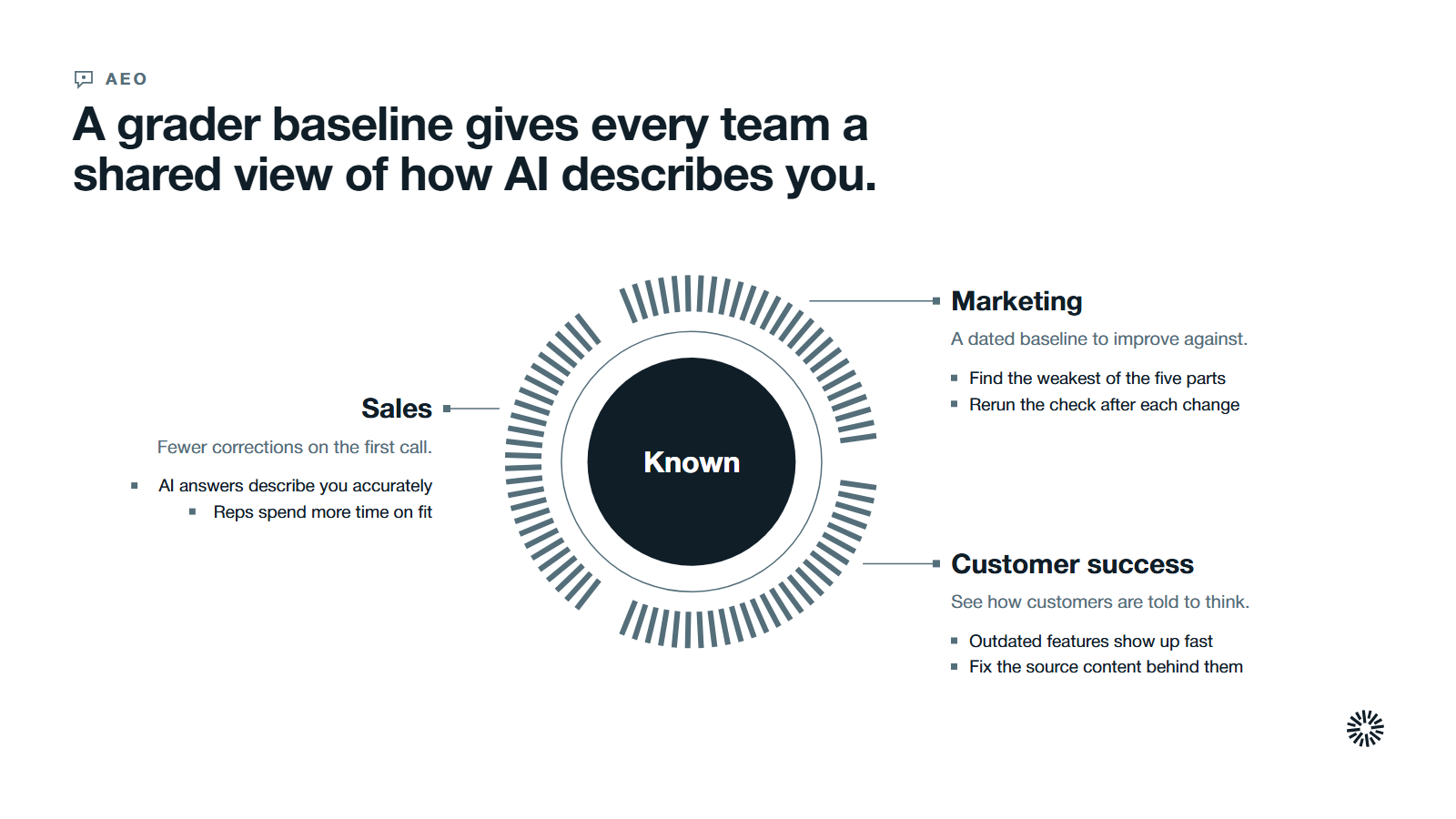
Used as a baseline, the grader gives the whole go-to-market team a shared, repeatable view of how AI presents the company. The value comes from acting on it, not from the number alone.
Sales walks into fewer corrections
Buyers increasingly ask AI tools about vendors before they take a call, and what those AI answers say shapes the traffic and conversations that reach your reps. When the engines describe your product accurately and favorably, reps spend less of the first meeting correcting a wrong picture.
Marketing gets a baseline to improve against
Marketing leaders get a dated starting point for answer engine optimization and a way to see where AI search visibility is weakest. You can see which of the five parts holds the score down, direct effort there, and rerun the check to see whether brand mentions and framing move.
Customer success sees how customers are told to think
If an engine describes your product with outdated features or wrong use cases, customers arrive with wrong expectations. The grader surfaces those misconceptions, so your team can fix the source content that feeds them.
Turn the grade into a measured AI search program
The grader is a good first look, and a poor place to stop. Think of it as a free visibility tool for the first reading, not the whole program. A one-time snapshot tells you where you stand. Ongoing monitoring, a clear list of prompts and a content plan tell you whether you are improving.
Propello is a HubSpot partner. We design and build connected go-to-market systems on HubSpot, and our guide to AI Engine Optimization shows where this fits. If you want to know where AI search effort belongs in your system, an audit is the place to start.
