If you lead sales, marketing or customer success at a B2B company, account planning is the practice of writing down what you want from one named account, who decides there, where the opportunities and risks sit and what each person on your side will do next. You do it by building one account plan, kept short and reviewed on a schedule.
This guide is for account executives, sales professionals, strategic account managers, sales leaders, marketing leads and revenue operations owners who work key accounts together. It suits any sales team and sales organization that runs strategic account management and wants effective account planning for its important customers.
You get six steps with a finish line for each, a plain text outline you can copy, the checks to make first and the mistakes that waste a first plan.
|
Account Plan A written plan for one named customer or target account that states your goal, maps the buying group, lists opportunities and risks, and assigns plays and owners with review dates. |
By the end you will have an account plan the whole account team can use
A good plan fits on one or two pages and supports long term growth with high value accounts. It is specific enough that a colleague who joins next month can read it and act.
- A goal for the account, with a date and a clear reason it matters to your business.
- A short account profile: what the company does, how it makes decisions and what it cares about this year.
- A map of the buying group, with a role, a relationship owner and a next step for each person.
- A list of opportunities and risks, ranked, with the evidence behind each.
- A set of plays with owners and dates, plus a review rhythm.
What to have in place before you start
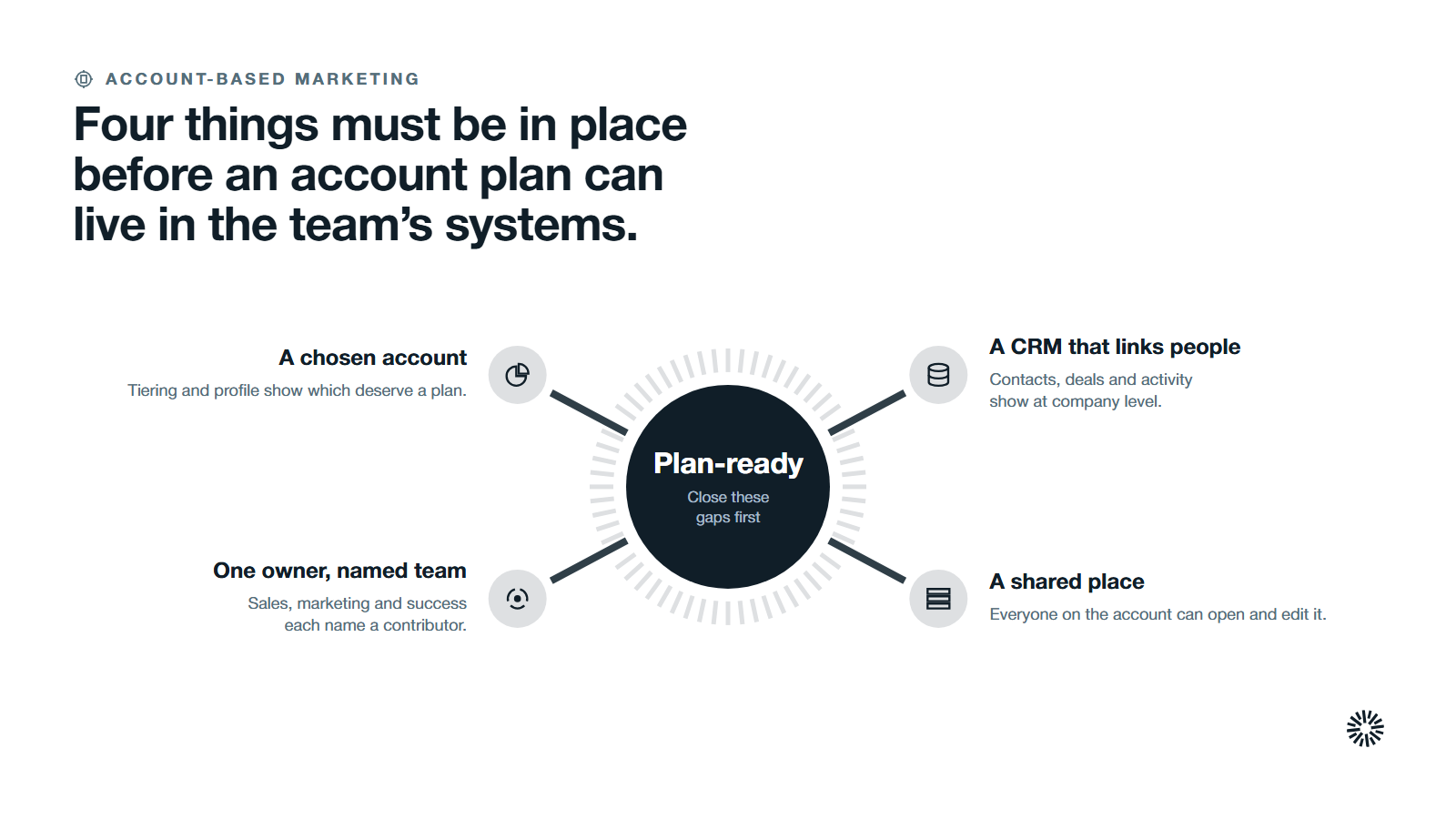
Account plans fail because they are written once and filed. Close these gaps first so that the plan can live in the systems your team already uses.
- A chosen account. You know which accounts deserve a plan. Use your ideal customer profile and your tiering to pick them, because a plan for every account is a plan for none. Segmenting accounts by strategic value shows where the effort should go, and strategic account planning usually covers only your top accounts, often with a multi-year view.
- One owner and a named account team. One person is accountable for the plan, and sales, marketing and customer success each have a named contributor.
- A CRM that links people to companies. You can see contacts, deals and activity at the company level, not only per person.
- A shared place to keep the plan. Everyone who touches the account can open and edit the same document or record.
Account planning is a team sport
Strong account management depends on shared effort. Sales knows the key contacts, marketing knows what content landed, and customer success knows how the customer uses the product. Most organizations that run key account management efforts treat account planning as a team sport, because account strategy works the same way in each. For the full picture, read our complete guide to account based marketing strategy.
An account team that meets on a regular basis keeps customer relationships healthy over the long term. The right team is a mix of sales, marketing and customer success, and cross-functional collaboration is what makes the plan useful.
Effective account planning also asks for a change in mindset. You stop acting as an order-taker and become a strategic partner who sets objectives jointly with the customer.
You may see this called key account planning, strategic account planning or an account planning strategy. The names vary, but the account planning process is the same: choose important accounts, understand them and agree an action plan. Teams that work existing accounts may call the plan a strategic account plan or a sales account plan.
Where an account plan sits
An account plan is the working document for one account. It is not a replacement for your wider approach. If you run account-based marketing, the plan is where strategy meets a specific company. For the wider picture, read what account-based marketing is and the ultimate guide to ABM.
The same plan works for a customer you want to grow and a prospect you want to win. For finished programs from other teams, see these ABM examples.
An account plan in six steps
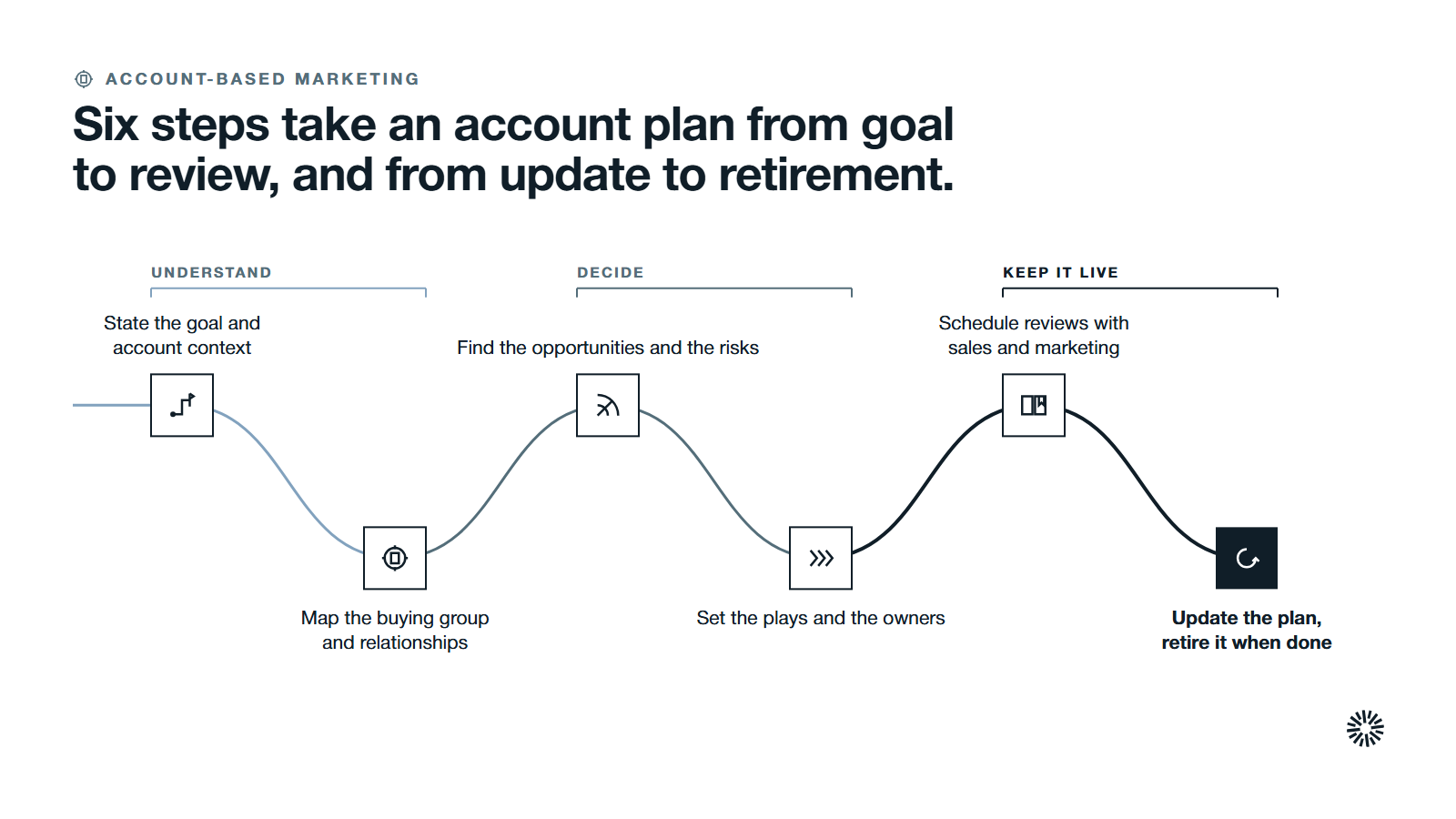
Each step ends with what done looks like. Work through them in order, because each depends on the one before.
1. State the goal and the account context
Begin with the goal for this account. It might be a first deal, a renewal with an existing customer, expansion into a second department or a new contract. Write one sentence for the goal and one for the date by which you want to reach it.
Then record the context. Note what the company does, who it serves, its strategic priorities and the pressures on its business this year. Add the current relationship: what they buy from you, which products or services they use and how long you have worked together.
Add the business units you sell into, the number of employees and the revenue, if you know them, because they show how large the account could become. Keep to facts you can point to, such as annual reports, news, the company's website and what your own customer contacts told you. Mark anything that is a guess as a guess.
Use qualitative and quantitative research to understand the account: customer interviews and meeting notes on one side, usage and spend data on the other.
You are done when one page states the goal, the date, the account profile and the current state of the relationship.
2. Map the buying group and the relationships
Most B2B purchases involve many people. Forrester's State of Business Buying 2024 found that on average 13 people within an organization are involved in the buying decision, with 89% of purchases involving two or more departments. Your plan needs to show who they are.
Build a stakeholder map. For each person, record the role in the decision, such as economic buyer, user, technical evaluator, influencer or blocker. Add their stance toward you, who on your team knows them and when you last spoke.
Draw an org chart or organizational chart of the company, then mark the decision makers and key contacts on it. A dynamic org chart helps you track key contacts and their influence as people change roles.
Relationship mapping reveals hidden influences in an organization and identifies decision-makers. It is also essential for understanding customer needs.
Relationship building matters here, and building relationships takes more than one contact. Look for an executive sponsor and a champion on their side, and for people who may block the deal. If you only know one or two people, that gap is itself a finding for the plan.
Gartner's survey of 632 B2B buyers found that buying groups that reach consensus are 2.5 times more likely to report a high-quality deal. So note where the group agrees on the buying decision and where it does not. Change management inside the customer, such as a reorganization or a new leader, can shift who decides.
In HubSpot, records are linked through associations. Associations are two-way, and a deal can be associated with several contacts and their company record, so the whole group appears in one place.
You are done when every known person in the buying group has a role, a stance, a relationship owner and a next step, and the gaps are listed.
3. Find the opportunities and the risks
Now look at what could grow and what could go wrong. A simple SWOT analysis helps: list your strengths and weaknesses in the account, then the opportunities and threats around it.
List opportunities first: other teams or departments that could use what you offer, products they do not yet use and projects they have announced.
This is whitespace, the untapped potential within an existing customer account, and finding it requires understanding customer problems. Whitespace analysis surfaces cross-sell and up-sell opportunities. These are your expansion opportunities and growth areas, and account managers often keep them in a short list of upsell and cross-sell ideas.
Name the pain points and customer problems each one would solve, and note how it could increase revenue for both sides. Record the average deal size you expect, so you can compare options.
Check the buying process too. If you are mapping how the company moves from interest to purchase, the B2B buyer journey shows the stages to look for.
Then list the risks. Typical ones are a champion who may leave, a competitor already in the account, a budget cut, a contract end date, low product use and a relationship that rests on one person.
Rank both lists, and review customer satisfaction and performance data, such as support tickets and product use, as part of the evidence. For each item write the evidence, such as a meeting note, a usage report or a message from a contact, and who is best placed to act.
Signals from buyer behavior can feed this step. The intent signals to sales action guide explains how to turn them into a next step, and lead scoring shows how a score can flag an account for review.
You are done when opportunities and risks are each ranked, each carries evidence and each has a proposed response.
4. Set the plays and the owners
A play is a defined set of actions aimed at one opportunity or risk. Write each play as a verb, an audience, an owner and a date. For example: arrange an executive introduction, run a workshop for the operations team, send a tailored case for the finance lead, or schedule a renewal conversation.
Match each play to a person in the buying group from step two. Decide who leads, who supports and what the account team needs from marketing, such as tailored content, an event invitation or a targeted ad to named contacts.
This list becomes your action plan for the account, and it can cover acquisition, retention and advocacy. Keep the number of plays small. A team can run three or four well. A long list means the plan has not yet chosen.
Put the plays where people will see them. In HubSpot, tasks are reminders for work you need to complete and can be associated with specific records, such as contacts, companies or deals. A task with an owner and a due date, linked to the company, keeps the play from drifting.
You are done when each play has an owner, a due date, a target person and a task that sits in someone's work queue.
5. Schedule the reviews with sales and marketing
A plan changes when the account changes, so set the rhythm now. Choose regular check ins, a short weekly or fortnightly check for the live plays, and a longer account review each quarter. Put them in the calendar before you finish the plan.
Each review asks four questions: what changed in the account, which plays moved, which assumptions were wrong and what do we do next? Sales, marketing and customer success should attend, because each sees a different part of the account.
Regular reviews keep account plans relevant and actionable, and they keep the plan aligned with business objectives. Where you can, hold some of these conversations in person with the customer.
Use the quarterly review as an internal review of the big picture, including the relationship map, the goal and the opportunities. Invite the executive sponsor from your side when the account is a priority.
Record the outcome in one place. A short note after each review is enough.
Measure campaigns and plays with established success metrics, and agree a few key performance indicators for the account, such as win rate, average deal size and customer lifetime. They show whether the plan is moving toward the goal. Strategic growth and revenue growth targets belong in the goal, and increased sales from the account can be one measure among them.
You are done when the review dates are in the calendar, the attendees are named and the first agenda is written.
6. Update the plan and retire it when it has done its job
An account plan is a living document, and updating it is continuous improvement in practice. After each review, change the profile, the map, the lists and the plays. Remove finished plays and add new ones, and keep the date of the last update at the top.
Record what you learned. If a play worked or failed, say why, so the next plan for a similar account starts from evidence.
Retire the plan when the goal is met, the account is no longer a priority or the relationship has ended. Write a closing note with the outcome, the lessons and where the records are stored. If the goal is met and the account stays important, write a fresh plan with a new goal instead of stretching the old one.
You are done when the plan shows its last update, every play is current or closed, and a retired plan has a closing note.
A plain text account planning template
Use this account planning template as a reference point. Copy it into your CRM notes, a shared document or a slide. Replace each line with your own words.
ACCOUNT PLAN: [Company name]
Owner: [name]   Account team: [sales / marketing / customer success]
Last updated: [date]   Next review: [date]

1. GOAL
   Goal: [one sentence]   Date: [when]   Why it matters: [one sentence]

2. ACCOUNT CONTEXT
   What they do: [one sentence]
   Priorities this year: [two or three]
   Current relationship: [what they buy, since when]

3. BUYING GROUP
   [Name] | [role] | [stance] | [our owner] | [next step]
   Gaps: [people we do not know yet]

4. OPPORTUNITIES (ranked)
   [Opportunity] | [evidence] | [response]

5. RISKS (ranked)
   [Risk] | [evidence] | [response]

6. PLAYS
   [Play] | [target person] | [owner] | [due date]

7. REVIEWS
   Weekly check: [day]   Quarterly review: [date]

8. LOG
   [Date] [what changed] [decision]
Mistakes to avoid in account planning
Most weak plans repeat the same few errors. Check yours against this list.
- Writing it once and filing it. A plan that is never reviewed becomes out of date within weeks.
- Planning too many accounts. Plans take real thought, so write them only for the accounts that merit it.
- Knowing one contact. A map with a single name in it shows a risk, not a plan.
- Listing plays without owners. A play with no name and no date does not happen.
- Treating the plan as a sales document alone. Marketing and customer success hold information and levers that sales does not.
- Mixing facts and guesses. Label assumptions so the team knows what to test.
- Overstuffing the page. If nobody can read the plan in a few minutes, nobody will use it.
- Skipping the retirement note. Without it, the lessons stay in one person's head.
What you gain when this is done properly
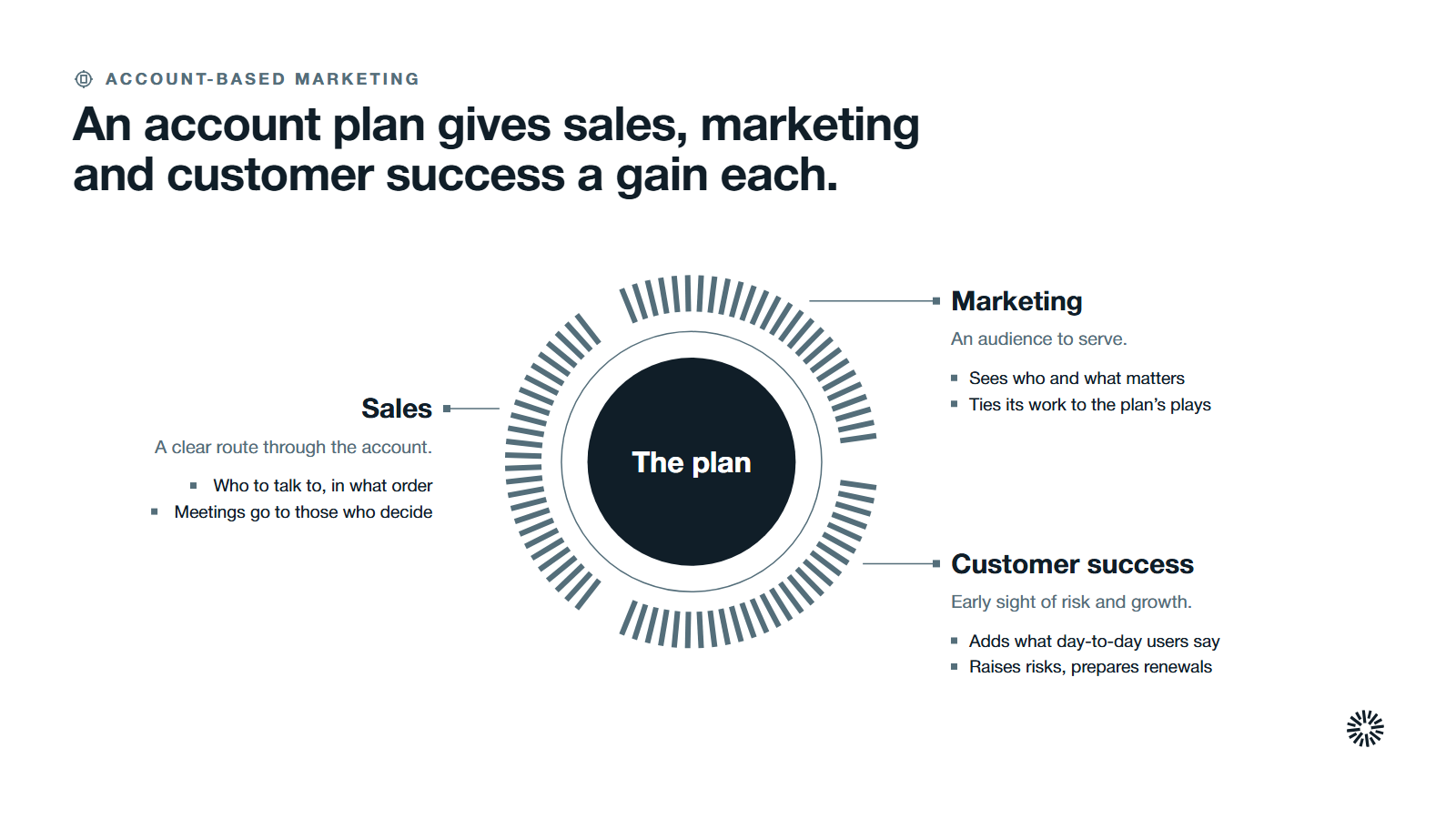
A good account plan gives the team one shared view of the account. Each function gains something different.
Sales gets a clear route through the account
Sellers know who to talk to, in what order and with what message. They spend meetings on the people who decide, not on whoever replies first.
Marketing gets an audience to serve
Marketing sees which people and which topics matter in the account. It can make content, events and ads for named contacts and tie its work to the plays on the plan.
Customer success gets early sight of risk and growth
Customer success adds what it hears from day-to-day users. The team can raise a risk early, prepare a renewal and bring growth ideas to the account review.
Plan the account, then run the plan
Account planning turns what you know about one company into a short set of decisions: the goal, the people, the opportunities, the risks and the plays. It works because it is written down, shared and reviewed.
Propello designs and builds connected go-to-market systems on HubSpot. If you want your account data, associations and tasks set up so that plans live in the CRM, an audit is the place to start.