
If you lead marketing or revenue at a growing B2B company, your website probably carries more of the buying decision than anyone on your sales team realizes.
A website strategy is the plan that decides what the website must achieve, for whom, and how you will know it is working, before anyone opens a design tool.
This article is written for CEOs, founders and revenue leaders who are about to commission, rebuild or rescue a B2B website. For the full picture, read our complete guide to b2b website design.
It explains the six parts of a website strategy, how it differs from a design brief and a sitemap, how to set website goals you can measure, and the mistakes that quietly weaken the plan.
|
Website Strategy A website strategy is the written plan that links a website's goals to your business objectives, your target audience, the content and structure that serve them, and the measures that show whether it works. |
Why a website strategy comes before design
Your buyers form a shortlist before they ever speak to your sales team. In its 2025 B2B Buyer Experience Report, 6sense found that 95% of the time the winning vendor is already on the buyer's day one shortlist, and that buyers now make first contact about 61% of the way through their journey.
That shortlist forms from what people read, compare and trust while you are not in the room. Your website is where most of that happens. It is the one place that works for you around the clock, with every potential buyer and potential customer, in every market you serve.
A website built without a strategy tends to describe the company rather than help the buyer. It grows page by page as requests arrive, and nobody can say which page exists to do what. Redesigns then change how the website looks and leave the underlying confusion in place.
A strategy fixes that order of work. You decide the job first, then the audience, then the content and structure that do the job.
A website strategy has six parts
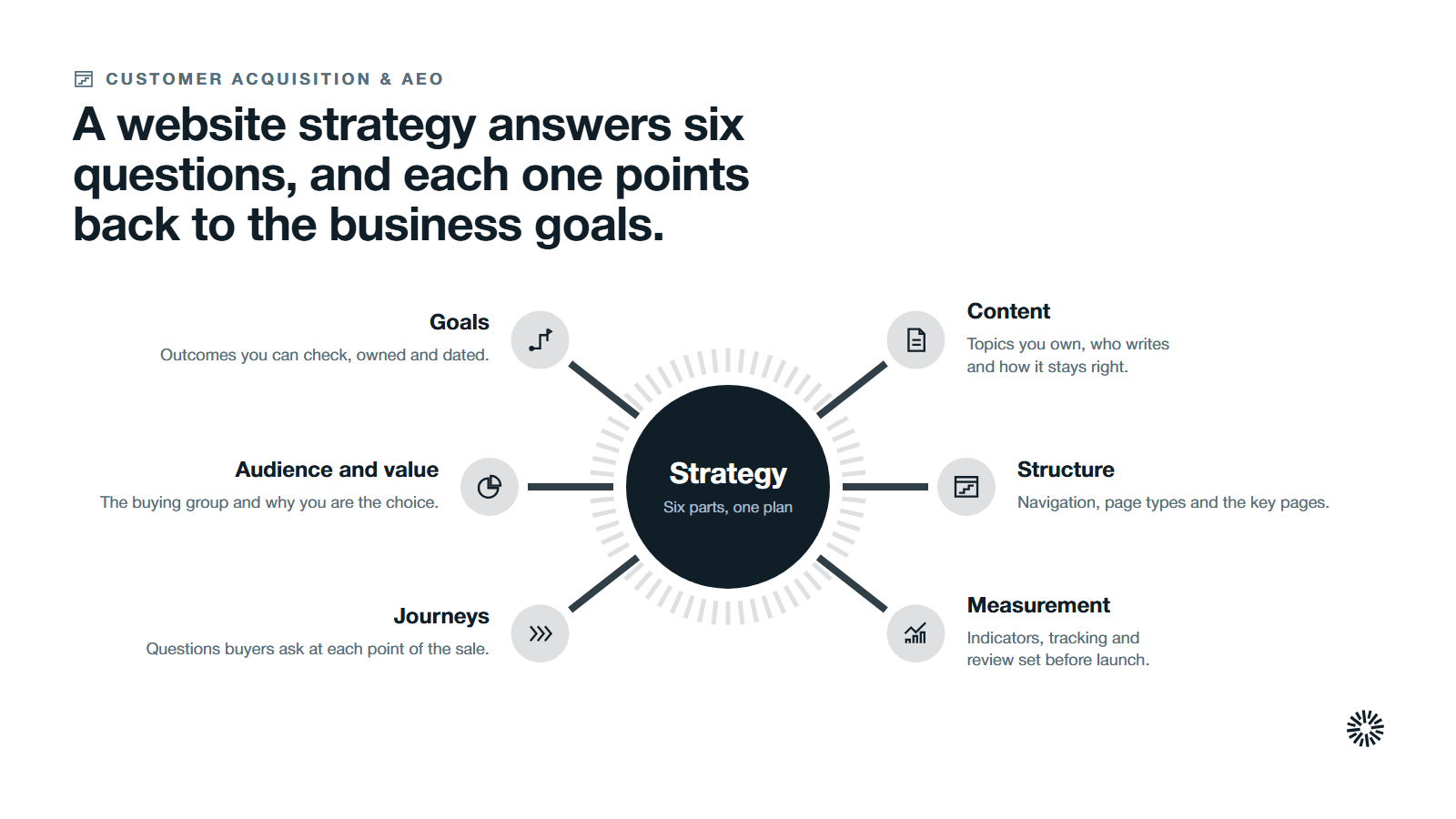
Every sound website strategy answers six questions, and each one points back to your business goals. Together they turn a vague wish for a better website into a plan that your marketing team, your web developer and your sales team can all work from.
Goals and business objectives come first
Website goals are the outcomes the website must produce for the business, stated so that you can check them. They flow from your overall business strategy, never the other way round. If the company needs more pipeline from a new segment, the website's goals follow that.
Write each of the website goals as a clear objective with a number, an owner and a date, so the goals and objectives are checked the same way as any other business goals. "Look more modern" is a preference. "Double the demo requests from mid-market accounts within two quarters" is a goal.
Audience and value proposition define who the website speaks to
Your target audience on a B2B website is rarely one person. It is a buying group: an economic buyer, a technical evaluator, a user and often someone in finance or legal. Each reads your website for different relevant information.
Define who they are, what each needs to decide, and the value proposition that makes you the obvious choice for them.
Interview your best existing customers and your sales team, then turn what you learn into short audience personas that describe each person's needs and behavior. Their words are better raw material than anything invented in a workshop.
Journeys and the sales cycle shape what each page must do
B2B sales cycles run long, and your buyers move through awareness, the consideration stage and decision, often out of order. Map the questions they ask at each point and match a page or a path to each one.
This is the sales funnel seen from the buyer's side. A visitor reading a comparison is in a different place than one reading your pricing approach, and the page should know it. Mapping journeys also shows where sales support content, such as case-style walkthroughs and implementation guides, is missing.
Content strategy decides what the website says and why
Content strategy for a website covers which topics you will own, how content creation is organized, which formats you will use, who writes and approves them, and how content stays accurate.
It is the part of the plan that stops the website filling up with pages nobody asked for, and it connects your content marketing to the website's objectives. The detail is covered in its own section below.
Structure and key pages give the content a home
Structure covers navigation, page types, URL logic and the key pages that carry most commercial weight: home, services or solutions, pricing or engagement, proof, and contact. A sitemap is the output of this thinking, not a substitute for it.
Structure also covers the tools behind the website. Your content management system should let non-technical people publish, add landing pages and update website copy without a developer's help.
Measurement shows whether the plan is working
Measurement fixes the key performance indicators, the tracking that feeds them in Google Analytics and the review rhythm before launch. Agree the website's objectives and their numbers before the new website goes live. If the goal is lead generation, the strategy names what counts as a qualified lead and where that number is read.
Without this part you launch on opinion and argue about results afterward. With it, you can track progress and change course early. The metrics themselves are explained in website metrics to measure and track.
How a website strategy differs from a design brief and a sitemap
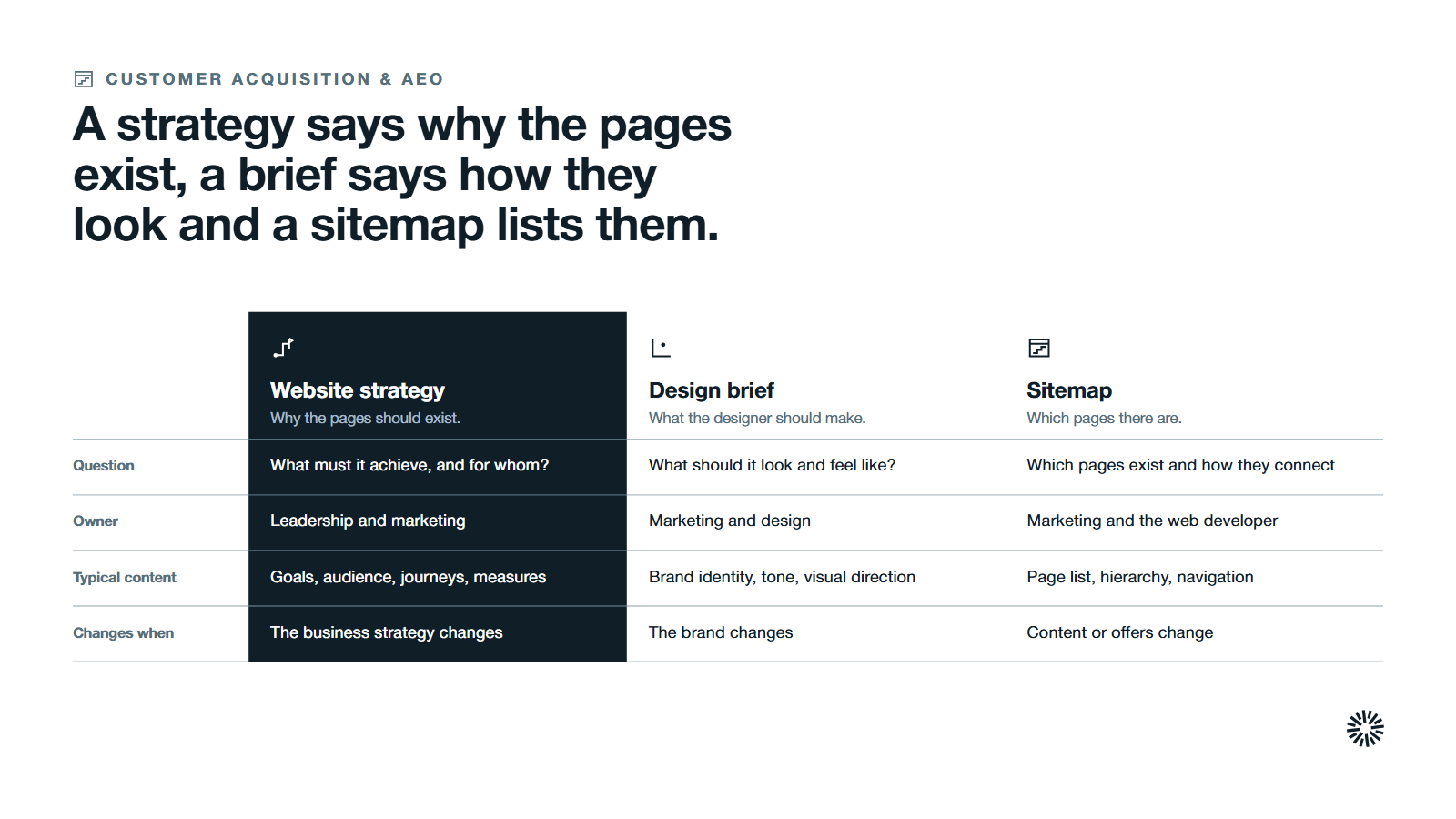
These three documents get confused, and the confusion is expensive. A design brief tells a designer what to produce. A sitemap lists the pages. A strategy explains why those pages should exist and what the website is for. It has to come first because both of the others depend on its answers.
| Website strategy | Design brief | Sitemap | |
|---|---|---|---|
| Question it answers | What must the website achieve, and for whom? | What should it look and feel like? | Which pages exist, and how do they connect? |
| Owner | Leadership and marketing | Marketing and design | Marketing and the web developer |
| Typical content | Goals, audience, journeys, content, measures | Brand identity, tone, visual direction | Page list, hierarchy, navigation |
| Changes when | The business strategy changes | The brand changes | Content or offers change |
If you hand a designer a brief with no strategy behind it, you will get an attractive website that nobody can judge. The designer has no basis for saying no to a feature, and you have no basis for saying whether the result is good.
The same goes for the sitemap. A map drawn from your org chart reflects how you are organized, whereas a map drawn from buyer journeys reflects how people actually decide. Only the second helps.
A strategy also differs from an inbound-ready website, which describes a website built to attract and convert visitors. You can read what that involves in what is an inbound-ready website. The strategy is the thinking that tells you what such a website should contain for your business.
Turn website goals and objectives into numbers you can track
Goals only help if you can check them. The usual test is whether each one is specific, measurable, achievable, relevant and time-bound. For a website's objectives, that means connecting a business goal to a behavior on the website and then to a count.
Most website goals fall into a few families. A B2B website exists to generate leads, support the sales team, serve existing customers or build brand authority, and the right ones for you depend on your model.
- Lead generation: a website that helps you generate leads, with more leads and more qualified leads coming from the pages that attract them, measured as completed contact forms, demo requests and booked meetings.
- Sales support: content that shortens the sales cycle by answering questions before the first call, measured by how often reps send pages to prospects.
- Online sales: for companies that sell through e commerce websites or self-serve plans, completed orders and average order value.
- Customer engagement: existing customers finding answers, onboarding material and upgrade paths without a ticket.
- Brand authority: the website becoming a place that search engines and buyers treat as a reliable source on your subject.
- Reduce support costs: help content that resolves common questions so fewer requests reach your team.
Choose the two or three that matter most this year. A website asked to do ten jobs does none of them well.
Define what counts as a conversion
Every goal needs an event you can count. In Google Analytics, which many B2B teams already use, Google describes a key event as an event that measures an action that's particularly important to the success of your business. A form submission, a booked meeting, a phone call booked from the page or a pricing page visit can each be set up as one.
Each one tells you something about website visitors that traffic alone does not.
Decide the list of key events before launch, and give each a name your whole team uses. Then check that the tracking fires. A goal you cannot measure becomes an opinion.
Connect the goal to the sales team
For a B2B website, a conversion only matters if it becomes pipeline. Agree with your sales team what a good lead looks like and how it moves from a form to a conversation. That agreement is what lets you judge the website on qualified leads rather than raw form fills.
Plan website content strategy around what buyers need to decide
A website content strategy is the part of the plan that governs the words, pages and media on the website. It sits inside the wider web content strategy and works alongside your content marketing, but it has a narrower job: making sure the website holds the right website content for each buyer at each point.
Content marketing is the ongoing work of publishing blog posts, guides and other assets that attract and educate an audience. A website content strategy decides which of that content marketing belongs on the website, where it lives and what it should lead to. Good content strategy keeps the two pulling the same way.
Start with a content audit of the existing website. This is the best practice for any rebuild.
List every page, mark what it is for, and sort it into keep, improve, merge or remove. Most B2B websites find a large share of pages that serve no goal, and removing or merging them often helps more than adding new ones.
Use keyword research to see what buyers ask
Keyword research shows the questions potential customers type into search engines, and the topics where you can earn organic search visibility from the people who are already looking. It tells you which subjects deserve a page of their own and which belong inside a larger one.
Treat search engine optimization as a way of serving those questions properly, not a trick for pleasing search engine results pages. Pages that answer a real question clearly tend to do well and to convert, because the visitor found what they came for.
Map content to the buyer's journey
Plan blog posts and guides for early questions, comparison and explainer pages for the consideration stage, and proof and pricing pages for decision. Each page should state who it is for and offer one next step. That next step might be a related article, a contact form or a call.
Content development works best as a small, steady program, not a launch-day burst.
Decide who will create content, who approves it, and how often you review pages for accuracy. Engaging content that encourages users to take the next step is worth more than a long archive, and available resources should go to the pages that matter most. Valuable content ages quickly if nobody owns it.
Write for the people on the other side
High quality content in B2B is specific. It names the problem in the words paying customers use, shows how you solve it and gives enough detail to compare you fairly. Clear website copy that a busy executive can scan beats long, clever phrasing.
More pages do not mean more demand. A smaller set of useful pages kept current will increase traffic from the right people, while a large set of thin pages dilutes the website.
Choose structure and technology that support the plan
Once the content plan is set, structure and technology become practical decisions. Your web project should give the plan a platform that is easy to run, fast and consistent on every screen.
Compare how other websites in your market handle navigation and proof, then decide which patterns serve your buyers.
Responsive design is now table stakes, since a large share of your visitors will first meet you on mobile devices. Navigation, forms and key pages must work as well on a small screen as on a desktop.
Speed and stability are part of the user experience, and Google publishes the targets. According to Google's web.dev guidance on Core Web Vitals, the largest content on a page should load within 2.5 seconds, interactions should respond within 200 milliseconds, and layout shift should stay at 0.1 or less, measured at the 75th percentile of page loads.
Build those targets into the web project from the start rather than discovering them at testing. The design choices that serve users well are covered in what is UX design.
Navigation deserves the same care. Intuitive navigation groups pages by the question they answer, keeps menus short and gives information a logical flow, so visitors spend their effort on your message rather than on finding it.
Each key page should carry one clear call to action. Consistent messaging and visuals across every page also strengthen your brand identity.
Plan the conversion points as carefully as the pages, because certain tasks, such as booking a call or requesting a quote, are why most visitors came. Landing pages should each have one purpose, and contact forms should ask only for what your team will use. Every extra field costs you completed forms.
Keep the website healthy after launch
Technical performance and security protect the trust you have worked to earn. Regular maintenance, timely updates, backups and basic security checks belong in the plan as recurring work with a named owner.
Governance matters for the same reason. Decide who can publish, who approves changes and who is accountable for each section, so the website stays accurate and accountable as the team grows. Accessibility checks belong here too, because a website that some visitors cannot use fails them regardless of how good the content is.
Mistakes that weaken a website strategy
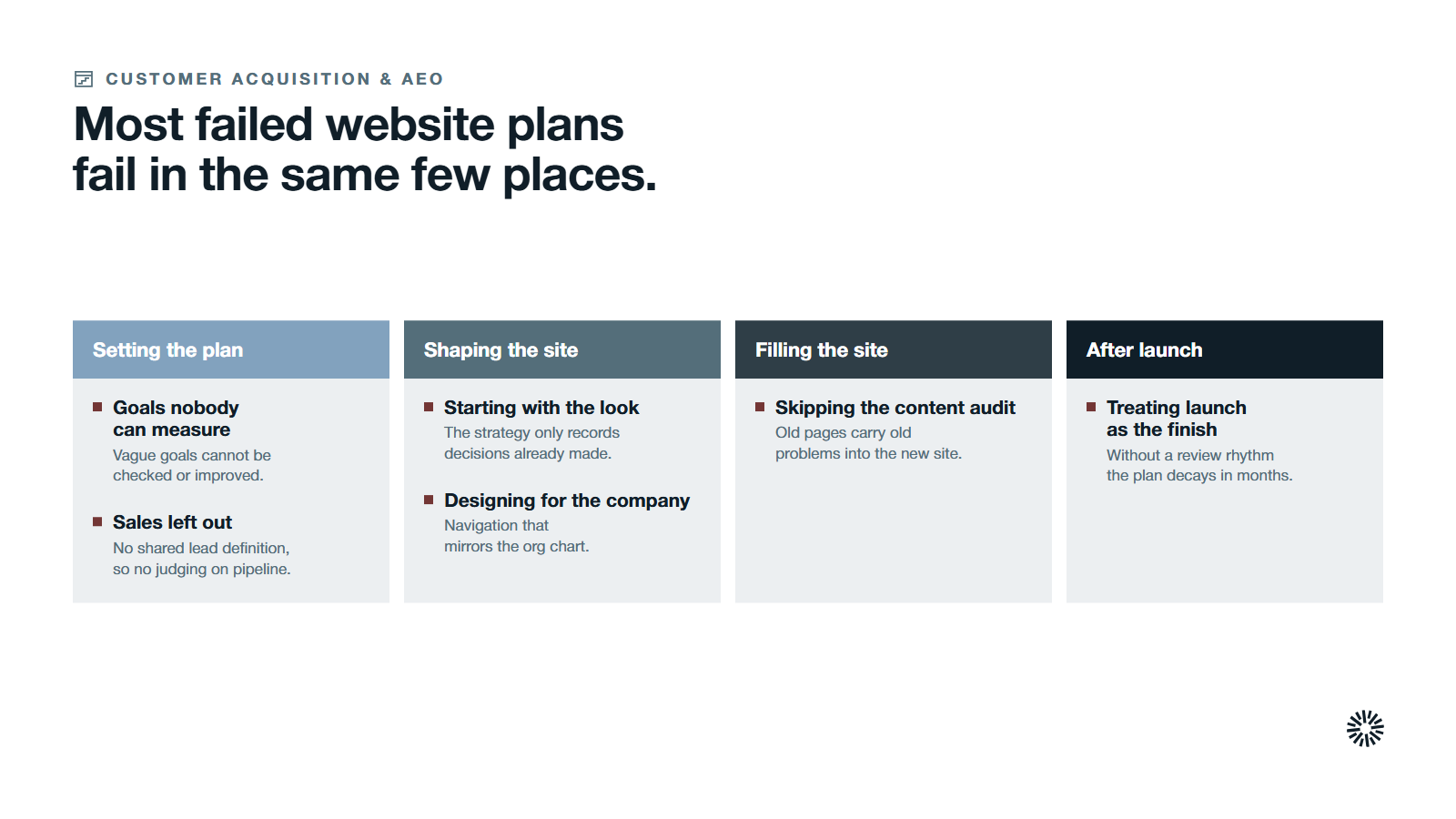
Most failed website plans fail in the same few places. Knowing them early lets you steer around them.
- Starting with the look instead of the job. A strategy written after the design only documents decisions already made.
- Writing goals nobody can measure. Goals such as "improve engagement" cannot be checked, so they cannot be improved.
- Designing for the company, not the buyer. Navigation that mirrors your org chart sends visitors hunting for things they came to find.
- Treating launch as the finish line. A website is a working system. Without a review rhythm, the plan decays within a few months.
- Leaving sales out. If the sales team never helped define a qualified lead, the website cannot be judged on pipeline.
- Skipping the content audit. Carrying every old page into a new website brings old problems with it.
A new website built on an unexamined content set rarely performs better than the old one. Run the audit first, and carry over only what earns its place.
Review the strategy on a steady rhythm
A website strategy is not a document you write once.
It has to evolve with user feedback and performance data, so give the reviews a named owner. Set a short monthly review of the numbers that matter, a quarterly review of the goals themselves, and a yearly check that the plan still matches your business strategy.
Small, regular changes beat occasional large rebuilds. This is the idea behind growth-driven design, which treats the website as something you improve continuously from evidence.
Analytics tools make this practical, since they show how people behave and which indicators are moving. Use the same loop for conversion work. Test one change at a time against a key event, keep what works and drop what does not. The practice is described in what is conversion rate optimization.
What you gain when a website strategy is done properly
When the plan exists and the team follows it, the website stops being a debate and becomes a tool. Each function gets something specific.
Sales gets better conversations and a shorter path
Your sales team meets prospects who already understand what you do and why it matters, because the website answered their first questions. Pages written for the consideration stage also give reps something useful to send, which supports a shorter cycle.
Marketing gets focus and a clear way to prove results
Marketing efforts stop competing for space on the website. Every campaign has a landing page with a reason to exist, and every page has a measure. That makes it far easier to show which marketing campaigns produce more leads and which only produce visits.
It also helps the business's success become visible in numbers the board recognizes.
Customer success gets fewer repeat questions
Existing customers find onboarding guidance, answers and next steps on the website without waiting for a person. The customer success team spends its time on accounts that need judgment, and the website quietly supports retention and expansion.
Start with a plan, then build the website
A website strategy is the cheapest part of a web project and the one that most affects whether the rest pays off. It gives your team a shared answer to what the website is for.
Propello designs and builds connected GTM systems on HubSpot. If you are about to rebuild your website, or you cannot say which pages produce your qualified leads, an audit is the place to start.