If you lead sales or revenue at a growing B2B company, sales prospecting works best when you contact a good sales prospect because something observable says they may be ready to talk, not because their name sat on a list. Signals tell you who to contact, when, and what to say.
This guide is for CEOs, founders, CROs and the sales and marketing leads who run the work, and it suits sales teams of any size. You get a six-step prospecting process with a finish line for each step, the foundations to set up first and the mistakes that waste a quarter.
|
Signal-Based Prospecting Choosing which target accounts and decision makers to contact, and when, from observed behavior and events such as site visits, hiring and leadership changes, then opening with the signal itself. |
What you will have at the end
Prospecting stops feeling like guesswork once these five things exist and a new rep can use them in the first week.
- A short list of buying signals your team agrees are worth acting on, each with a clear meaning.
- A ranked list of target accounts, refreshed as signals arrive.
- A repeatable account research routine that takes minutes, not hours.
- A first touch that cites the signal and offers something useful.
- A log in your CRM that shows which signals led to conversations.
What to have in place before you start
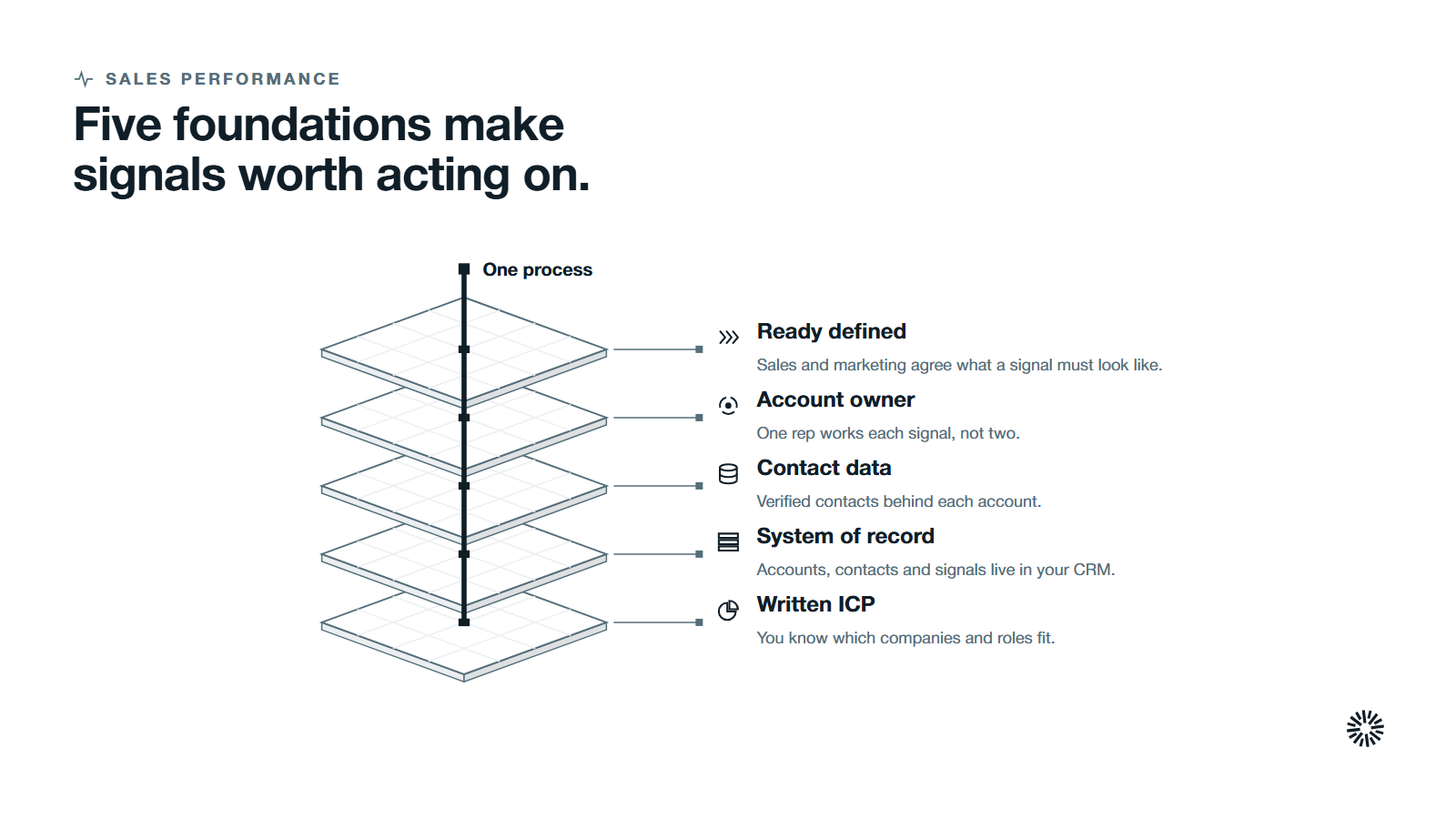
Signals only help when the basics underneath them hold. Check these foundations before step one.
- A written ideal customer profile. You need to know which companies and roles fit, or every signal looks equally interesting. The ideal customer profile template is a quick way to write it down.
- One system of record. Accounts, contacts, signals and activity belong in your CRM, so a rep never has to search three places before writing a message.
- Accurate contact data. Signals point at an account, but you still need verified contacts for the decision makers behind it.
- An agreed owner for each account. Two reps working the same signal is how a prospect receives two emails in one day.
- A shared definition of ready. Sales and marketing should agree what a signal must look like before it reaches a rep.
Inbound and outbound prospecting, side by side
Inbound prospecting starts with people who raised a hand: they found your content through search, filled in a form, replied to an email or asked for a price. Outbound prospecting is direct outreach to potential customers: you choose the account and make the first move, so conversations start on your schedule.
Inbound leads arrive with their own interest already shown, while outbound starts with yours. Outbound can open conversations sooner, because you do not wait for the buyer to find you.
Signals blur that line. A visit to your pricing page is an inbound clue that you can answer with an outbound touch, and a hiring surge at a target company is an outbound clue that you can answer with a relevant note. The same process serves both.
Why the old way runs out of road
Sales prospecting already fills a heavy share of a rep's week.
Salesforce's State of Sales 2026 survey of 4,050 sales professionals found that the average seller spends 40% of their time selling. The same report says nearly one full day of the workweek goes to prospecting efforts, and 48% say they still lack the bandwidth for adequate cold outreach.
Buyers are not waiting either. Prospects research a company on their own before they contact it, and they have little patience for generic messages. Gartner's survey of 632 B2B buyers found that 73% actively avoid suppliers who send irrelevant outreach. Relevance is no longer a nice extra. It decides whether the message gets read.
Timing matters as much as relevance. 6sense's 2025 buyer experience report found that in 95% of cases the winning vendor was already on the buyer's Day One shortlist. Signals help you get onto that list before the buyer ever talks to a seller.
What makes a good sales prospect
A good sales prospect has four traits. They fit your ideal customer profile, they have a problem your product solves, they include a decision maker you can reach, and they show a recent signal of interest or change. Fit tells you whom to pursue. Timing tells you when.
Potential prospects who miss one trait are not dead ends, but they belong on a watch list, not in a rep's queue.
Treat every new prospect as a hypothesis that the next signal can confirm or weaken. Signals also separate potential buyers who are browsing from those with a project under way, which is how buyer intent shows up in practice.
The sales prospecting process with signals, in six steps
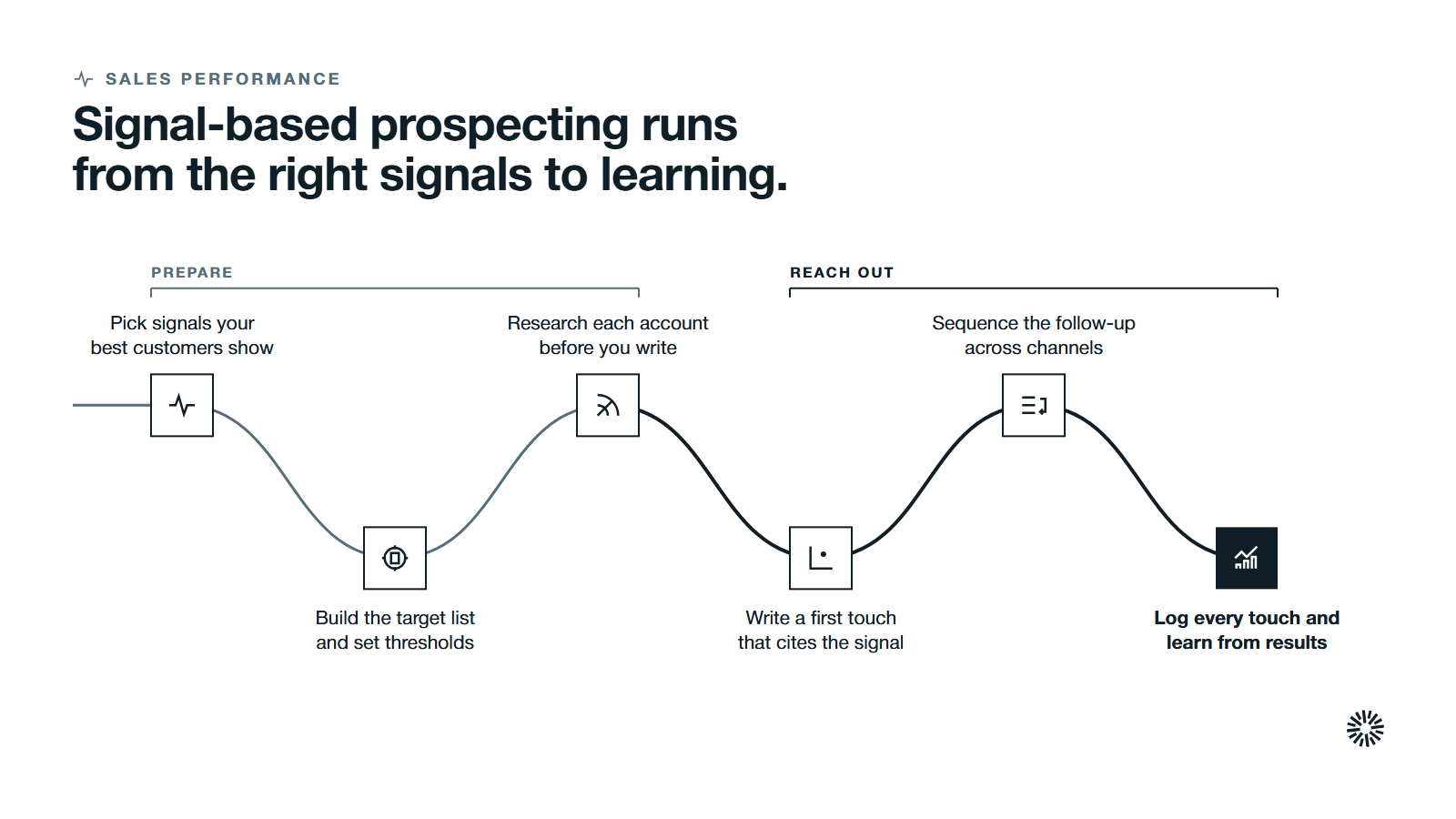
This sales prospecting process fits inside the sales process you already run, at the top of the sales funnel. Work through the steps in order. Each one ends with what done looks like, so you can tell when to move on.
1. Pick the signals that match your best customers
Start from your wins. Look at the last customers you closed and ask what was visible beforehand: which pages they read, who they hired, what changed at the company, who replied to what.
Sort the findings into three groups. First-party signals come from your own channels, such as site visits, email replies and form fills. Third-party signals come from outside, such as intent data about topics a company researches. Trigger events are changes at the company: a new leader, a funding round, an expansion or a new tool.
Keep the list short. Five or six signals you trust beat thirty you never act on. For each, write what it suggests about the buyer's situation and what action it earns.
The intent signals workflow shows how to turn a signal into a defined action once the list exists.
Done looks like: a one-page list of signals, each with a meaning, a source and an owner, and a note of which ones you will not use yet.
2. Build the list of target accounts and set the thresholds
A signal means little without fit. Start with target accounts that look like your most profitable current customers by industry, company size and market, and then let signals decide the order. This is account-based prospecting: a carefully researched list of target companies instead of a wide net.
Give each signal a weight. A pricing page visit by a decision maker might outrank a blog view by an unknown visitor, and a leadership change at a perfect-fit company might outrank a weak signal at an average one. Write the weights down so the ranking is not a matter of opinion.
Set two thresholds. The first decides when an account joins the active list. The second decides when it moves to a rep's queue for same-day action. Everything below the first line stays in nurture with marketing.
Keep customer data and contact data healthy as the list grows. Data enrichment fills gaps in company and role details, contact enrichment adds verified emails and phone numbers, and a regular check on data accuracy stops reps from emailing people who left months ago. Good data quality is what lets a score mean something.
Done looks like: a ranked list of target accounts with a score, an owner and the date of the latest signal on every row.
3. Research each account before you write a word
Good account research answers four questions: what does this company do, what changed recently, who owns the problem you solve, and what is the likely pain point.
Read the company website, recent news and job postings. Check your existing CRM for earlier conversations, closed deals and colleagues who already know someone there.
Then look at the person: role, tenure and what they have posted in their professional network. A warm introduction from a mutual contact carries trust that a cold note cannot, so look for one before you write.
Qualifying starts here too. Research should tell you about the prospect's needs and readiness to buy, and when the evidence is thin, the account stays on the watch list.
Timebox it. Ten focused minutes per priority account is usually enough, and a template keeps the notes consistent. Sellers expect AI agents to cut prospect research time by 34%, according to Salesforce's 2026 survey, so draft the template now and let tools fill in the easy fields later.
Look for the buying group, not one name. Forrester's State of Business Buying 2024 reports that on average 13 people within an organization are involved in a buying decision, with 89% of purchases involving two or more departments. Identify at least two roles to approach.
Done looks like: a short account note with the signal, the likely pain point, two roles to contact and one fact that shows you did the work.
4. Write a first touch that cites the signal and offers something useful
The first message has one job: earn a reply. Open with the observation that made you write, tie it to a problem the person is likely to own, offer one useful thing and ask a small question.
Do not recite the surveillance. Say "I saw you are hiring your first revenue operations lead" and not "I saw you read our pricing page twice on Tuesday." Public events are fair game to mention. Private behavior should shape your timing and your wording, not appear in the message.
Write for the target audience you identified, in the words they use. Keep it short and concrete. One idea, one proof point you can back up, one question. Your value proposition belongs in a single sentence in the buyer's own language.
Lead with value, not a pitch: a relevant insight or a piece of practical advice. Real personalization goes beyond inserting a name. It shows that you understand the prospect's business, and it focuses on the problem rather than your product.
Speed matters when the signal is a hand raised by the buyer. The speed to lead guide covers how to respond while the interest is fresh.
Done looks like: a message of a few sentences that names the signal in public terms, links it to a pain point and ends with a question that can be answered in one line.
5. Sequence the follow-up across channels
One touch rarely finishes the job. Plan a short sequence of messages over a few weeks, and change the angle each time: the first cites the signal, the next shares something useful, the next asks a different question.
Use multi channel outreach. Email outreach carries the detail, a call or voicemail adds a human voice, a short video message adds a face, a social note or comment adds familiarity, and for high-value accounts a piece of direct mail can stand out.
Social selling builds a relationship before formal outreach begins, so a thoughtful comment can come first. Choose two or three channels per account, not all of them. For the full picture, read our complete guide to signal based selling.
Build a daily prospecting routine too. A fixed block each day for research and outreach keeps the work timely and methodical, and it stops follow-up from slipping.
Let new signals change the sequence. If the prospect opens a pricing page or a colleague replies, move the account up. If a bounce shows the contact left, pause the sequence and find the right person.
A sales engagement platform or the sequence features in your CRM can schedule the steps and automate outreach. Sales automation works well as long as the research and the first line stay human. Automation should handle timing and reminders, never the thinking.
Done looks like: every active account sits in a sequence with a clear next step, a channel mix and a rule for when to stop.
6. Log every touch and learn from the results
Record each touch, reply and meeting against the account in your CRM, and note which signal started it. In HubSpot, properties store information on records, so a custom property for the originating signal lets you report on which signals lead to conversations.
Review on a fixed rhythm. Each week, look at the replies and meetings by signal. Each month, retire a signal that never leads anywhere and promote one that does. Each quarter, compare the signal list with your newest customers.
Track a few measures: replies, meetings booked, qualified leads created and the pipeline each signal contributes. Judge signals on conversations and pipeline, not on volume sent.
Then feed what you learn back to step one. A prospecting workflow that never changes its signals is just a list with extra steps.
Consistent prospecting is what keeps the sales pipeline steady. Without it, pipeline management turns reactive, and the sales cycle starts and stops with each quarter's scramble.
Done looks like: a weekly report by signal, a named owner for the review and a record of the last change made because of it.
Sales prospecting techniques that work with signals
Signals do not replace sales prospecting techniques. They decide which technique to use, on whom, and when. Each of the following fits a different kind of signal, and each applies the same sales prospecting process from the steps above.
Personalized email outreach
Email suits a first touch that cites a public event. Write a subject line that names the company or the event, because it is the first thing the reader sees.
Keep the outreach messaging short, ground it in the prospect's business and offer one useful thing. Personalized outreach means relevance to the recipient, not a swapped-in first name.
Calls and voicemail
A call fits the strongest signals, such as a pricing page visit by a known contact. Aim to move the conversation forward with one question about their situation, and leave a short voicemail that echoes the email.
Social selling and networking events
Social media platforms let you follow target companies and comment before you ever message anyone. Networking events and industry meetups add warm introductions to your professional network, and a signal-led note a few days later gives the contact a reason to remember you.
Referrals and partner introductions
A referral starts with borrowed trust that a cold note has to earn from scratch. Ask happy customers and partners for introductions to accounts that already show a signal, and your message begins with a name the buyer knows.
Direct mail for high-value accounts
A small, relevant item sent to one or two roles at an account that crossed the top threshold can break through a crowded inbox. Use it sparingly, and only where a signal and a clear fit justify the cost.
Which sales prospecting tools fit your tech stack?
You need fewer tools than vendors suggest. A signal-based process needs four capabilities, and one platform may cover more than one.
- A CRM as the record. It holds accounts, contacts, activity and the originating signal. Good CRM integration with your other tools keeps data in one place.
- Sales intelligence. Sales intelligence platforms supply company and contact details, hiring and news events and verified contacts.
- Intent and visitor data. Intent data and website visitor identification show which accounts research your topics or visit your company website.
- Sequencing and alerts. Tools that schedule touches and alert the right rep when a signal fires.
Categories overlap. Many platforms combine a contact database with buying intent signals and outreach features, some pull verified contact details from public professional profiles, and professional-network search tools offer advanced filters for building lists.
Marketing platforms feed first-party signals from your site into your CRM systems, so check the integration before you buy. A free plan can be enough to test one signal, but confirm what it includes.
Choose by the gaps in your tech stack, not by a ranked list of the best sales prospecting tools. Ask three questions of each option: does it write to your CRM, can you see where its data comes from, and will a rep use it every day?
Mistakes to avoid in sales prospecting with signals
Most signal programs stumble in the same few places, and each one wastes sales prospecting efforts that were otherwise well aimed. Check your process against this list.
- Treating every signal as equal. A job-change alert and a pricing page visit mean different things, and they deserve different responses.
- Chasing signals without fit. A strong signal from a company outside your ideal customer profile wastes a rep's best hours.
- Reciting what you tracked. Mentioning private browsing in a message feels like surveillance and costs trust.
- Letting stale signals trigger outreach. A signal loses value as it ages, so set an expiry date.
- Automating the message as well as the timing. A generic note sent at the right moment is still a generic note.
- Sending everything to sales. Without thresholds, reps drown in alerts and stop reading them.
- Skipping the log. If you cannot tell which signal started a conversation, you cannot improve the list.
- Working one contact only. Buying decisions involve several people, so a single-threaded account is fragile.
What you gain when this is done properly
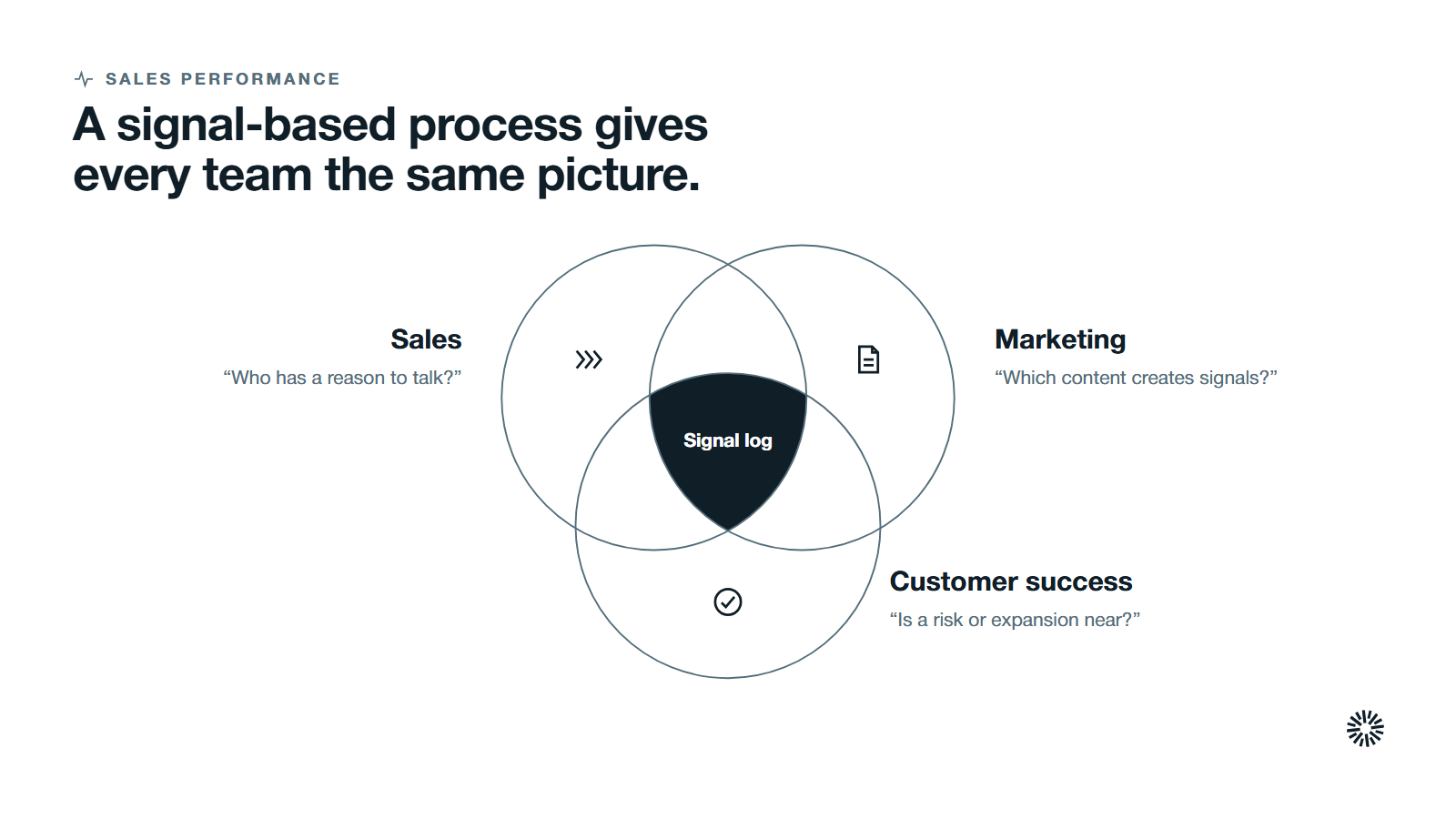
A signal-based process gives every team the same picture of who to talk to and why. Each team gains something different.
Sales gets a better reason to reach out
Sales reps start the day with ranked accounts, a note on the signal and a draft opening line. They spend less time choosing whom to call and more time with potential leads who have a reason to talk, so the sales pipeline reflects real interest.
Marketing gets proof of what works
Marketing teams see which content, pages and campaigns create the signals that lead to meetings. The shared signal log turns debate about lead quality into evidence, and it shows which sources produce high quality leads worth the next dollar of investment.
Customer success gets earlier warning
The same signals work on existing accounts: a new leader, a rollout across departments or a drop in product activity. Customer success can raise a risk or an expansion with sales before the renewal conversation starts.
Start with one signal and one rep
A sound sales prospecting strategy for B2B prospecting does not need a full stack to begin, and it makes a stronger sales strategy than a bigger list.
Pick one signal you already see, one segment that fits your ideal customer profile and one rep to run steps two to six for a month. Review what happened, then widen the circle.
Propello designs and builds connected go-to-market (GTM) systems on HubSpot. If you want your signals, scoring, alerts and reporting set up before you ask reps to prospect from them, an audit is the place to start.