If you lead sales or marketing at a growing B2B company, you already know that most buyers do not announce themselves. Buying signals are observable clues that an account is moving toward a purchase, such as a pricing page visit, a new hire in the right role or a question about next steps.
This article is written for CEOs, founders and revenue leaders. It explains the main types of buying signals, how to tell strong ones from weak ones, how they differ from intent data, and how they show up along a real B2B buying journey, so your sales team can act when timing matters.
|
Buying Signal A buying signal is an observable action, event or statement showing that a person or account is more likely than usual to be looking for, or ready to buy, a solution like yours. |
Buying signals show who is in market before they raise a hand
Most of a purchase happens before anyone speaks to a seller. 6sense's 2025 B2B Buyer Experience Report found that the winning vendor was already on the buyer's Day One shortlist 95% of the time. If you only start working an account after it contacts you, you are often late.
Buyers also prefer to learn on their own. A Gartner survey of 646 B2B buyers, published in March 2026, found that 67% prefer a rep-free experience. That makes the quiet signs of interest more valuable, because a form fill may never come.
Decisions are also shared. Forrester's 2024 report on the state of business buying puts the typical buying group at 13 people, with 89% of purchases involving two or more departments. One person's visit tells you little. Several people from one company acting in the same week tells you a lot.
That is the job of buying signals. They tell your sales and marketing teams which accounts are in market, who inside them is involved, and what to say first.
Four types of buying signals
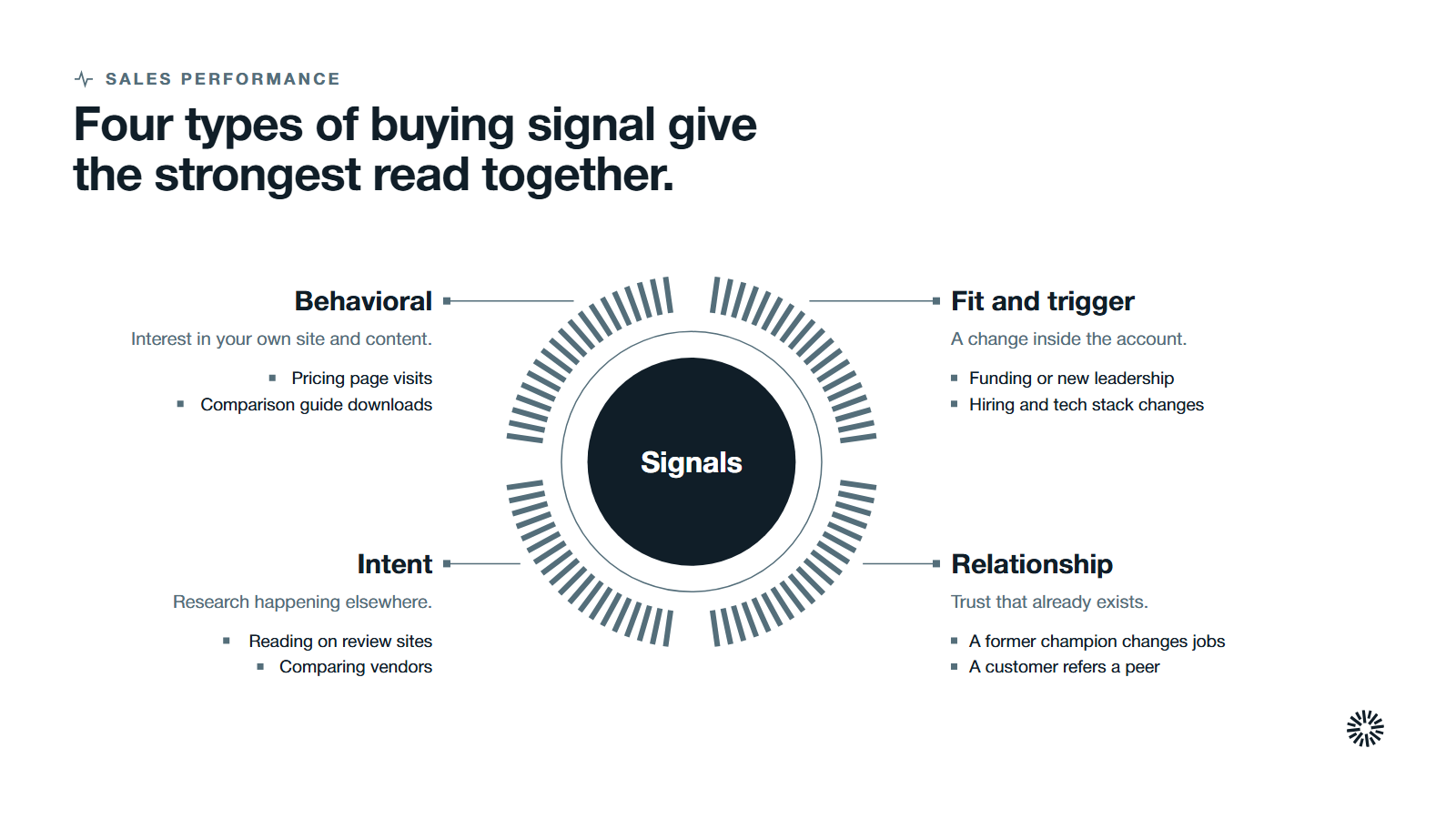
Most buying signals fall into four groups. Each answers a different question, and none is enough on its own. The strongest read comes from combining multiple signals about the same account.
Behavioral signals show interest in your own website and content
Behavioral data is what people do with your marketing and product. It is first party, because you collect it yourself.
Common examples are a visit to your pricing page, repeated website engagement across several pages, a download of a comparison guide, a case study read to the end, a webinar attended live and form submissions asking for a demo. Your own website analytics and CRM already hold most of this.
Interest in a specific product or service is stronger than interest in a general topic. Someone reading about one module has a narrower problem than someone browsing the blog.
Firmographic and trigger signals show a change inside the account
A firmographic signal says an account fits your ideal customer profile. A trigger signal says something has just changed at that account, which opens a window to talk.
Typical triggers include a successful funding round, new leadership, an expansion into a new region, a merger or a change in the tech stack. Hiring signals belong here too. A run of job postings for roles your product supports reveals upcoming priorities and suggests a team that is investing in the problem you solve.
Technographic signals are a related kind. When an account adopts or drops a tool near yours, it shows interest in a specific technology.
Fit alone is not intent. A perfect target account that has not changed anything may not buy for years.
Relationship signals show trust that already exists
Relationship signals come from people who know you. A former champion takes a job at a new company, a customer refers a peer, or an existing user from a past account appears in a new one. Job changes are the clearest example.
These signals tend to convert well because the first conversation does not start from zero. Someone has already seen your product work and can speak for it.
Verbal buying signals live here too. They are the things prospects say on sales calls: questions about pricing, onboarding, contract terms or next steps, or a pain point described in detail. Verbal cues also include who joins the call, such as a finance leader or an IT lead.
Non-verbal cues count too. On a video call, someone leaning in, nodding or taking notes while you describe the solution is showing interest, and active listening is how reps catch it.
A question about timelines or budget is an especially clear sign. The right reply is a tailored next step rather than another pitch, which moves the conversation from pitching to closing.
Intent signals show research that happens elsewhere
Intent signals reveal that an account is researching your category away from your own channels. They include reading on review sites, comparing vendors, searching for solutions and consuming content on topics tied to your product.
Third party intent data is the commercial version, gathered across many sites by outside companies. Intent data providers sell it as topic interest by account.
Buyer intent signals of this kind show where the market is heading, since the topics accounts research hint at what they will need next.
Treat them as a hint to check, not a verdict. Our guide to intent data covers how it is sourced and used.
Strong buying signals and weak ones
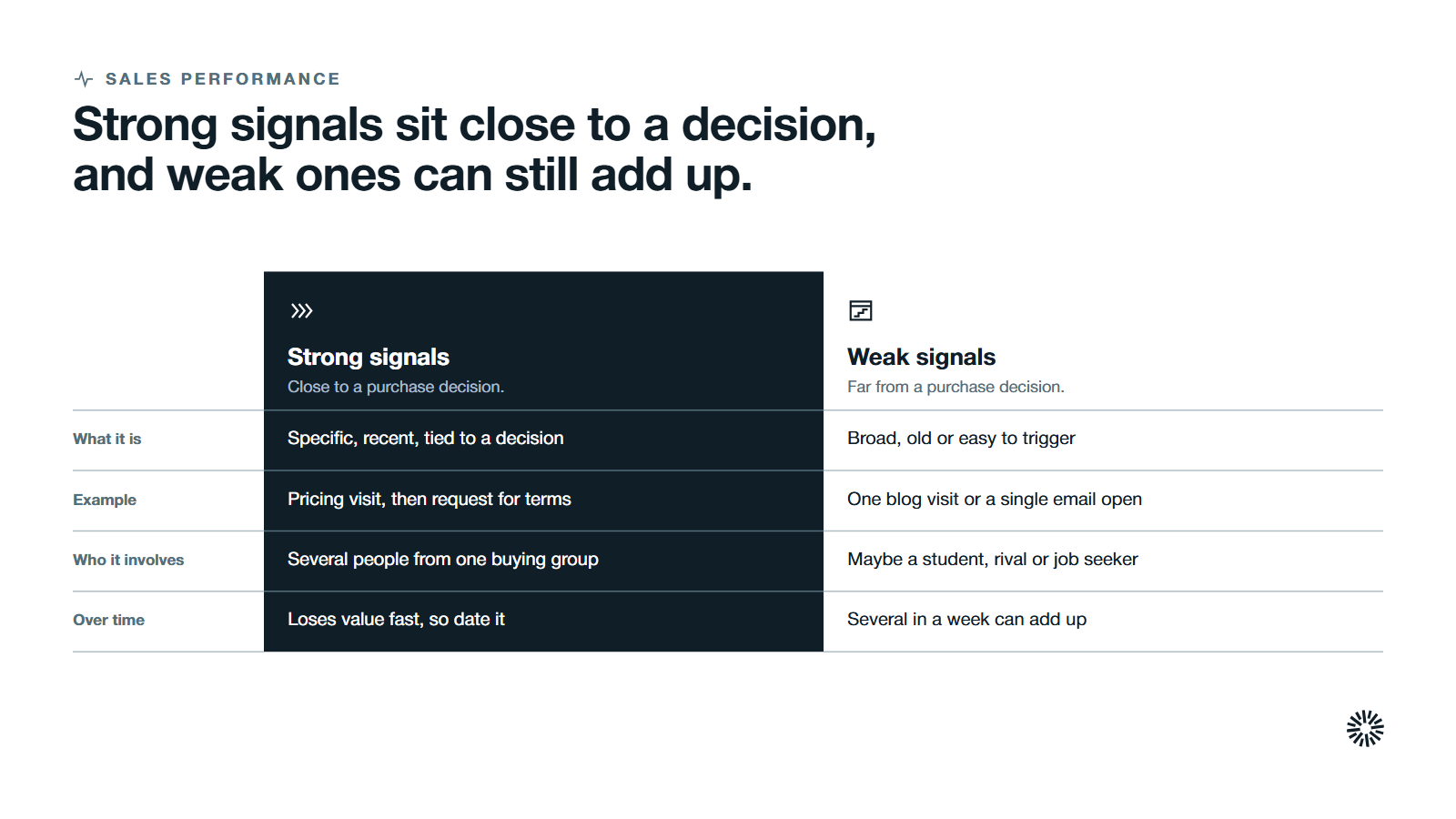
Not every signal deserves a call. A useful rule is to ask how close the signal sits to a purchase decision and how many people it involves.
Strong signals are specific, recent and tied to money or a decision. A pricing page visit followed by a request for terms is strong, since a prospect's interest in price shows the buying process has moved from learning to choosing.
A senior contact asking about implementation is strong. Several members of one buying group reading your content in the same week is strong.
Weak signals are broad, old or easy to trigger by accident. One blog visit is weak. A single email open is weak, because mail privacy features and link scanners can open messages without a human reading them. A student, a competitor or a job seeker can create a weak signal that looks like interest.
Weak signals still matter in groups. Three weak signals from the same account in one week can add up to one strong one.
Freshness matters as much as strength. A signal loses value quickly, so a strong signal from last quarter is worth less than a modest one from yesterday. Record the date on every signal you capture.
Marketing buying signals and sales buying signals read differently
Sales buying signals come from direct contact: a reply, a question on sales calls or a request for a meeting. Marketing buying signals come from engagement data, such as email clicks, event attendance and content views across marketing campaigns.
Marketing teams understand reach and patterns, and sales reps understand context. Each side sees half the picture.
When prospects interact directly with your team, the signal is clear and personal, such as a positive response to outreach. When they interact with content, the signal is quieter but there is more of it.
Educational content that matches a stage of the buyer's journey, such as a guide to evaluating vendors, draws a different kind of interest than a pricing page does.
Sharing both views lets sales and marketing efforts point at the same accounts. When marketing and sales efforts split, reps chase names marketing has no data on, and campaigns reach people reps already know.
Track intent signals with the systems you already own
You can track intent signals without buying anything new. Start with first party intent: engagement data from your website, email and product, plus notes from calls, all on one CRM record.
Add third party data only when that view leaves gaps, such as accounts that never visit your site. Buyer intent data from outside sources works best as a second opinion on accounts you already know.
Then decide what you want to see: high intent accounts among your target accounts, potential customers who fit your profile and show purchase intent, and paying customers showing signs of growth.
Use that list to prioritize leads, engage target accounts earlier and identify high intent prospects before a competitor does. The focus protects marketing spend and helps accelerate sales, because effort goes where strong buying intent is visible.
How buying signals differ from intent data and lead scoring
The terms overlap, which causes confusion. Buying signals are the broad category: any clue of buying interest, from any source, including things people say. Intent data is one source of those clues, mostly research behavior captured at the account level. Lead scoring is a method that turns signals into a number.
Put simply, signals are the evidence, intent data is one supply of it, and a score is how you rank it. Lead scoring works only if the signals feeding it are well chosen.
The next step is turning a signal into action: who gets alerted, how fast and with what message. We cover that workflow in intent signals to sales action, so this article stays on recognizing the signals.
A buying journey seen through signals
A short, hypothetical example shows how the types stack up. It is an illustration, not a client story.
A mid-sized software firm raises a successful funding round and posts several jobs in revenue operations. Those are trigger and hiring signals. A new revenue leader joins and used your product at a previous company, which is a relationship signal.
Over the next two weeks, three people from the account read your integration guides and the new revenue leader opens your pricing page. Those are behavioral signals, and the group pattern points to an active buying group. Review sites show the account comparing your category, an intent signal.
Finally, the leader replies to an email and asks how onboarding works and who owns the contract. That is a verbal buying signal and the clearest of all. Each signal alone is ordinary. Together they say this account is in market, and your sales reps should call now with context rather than a generic pitch.
Mistakes that make buying signals noisy
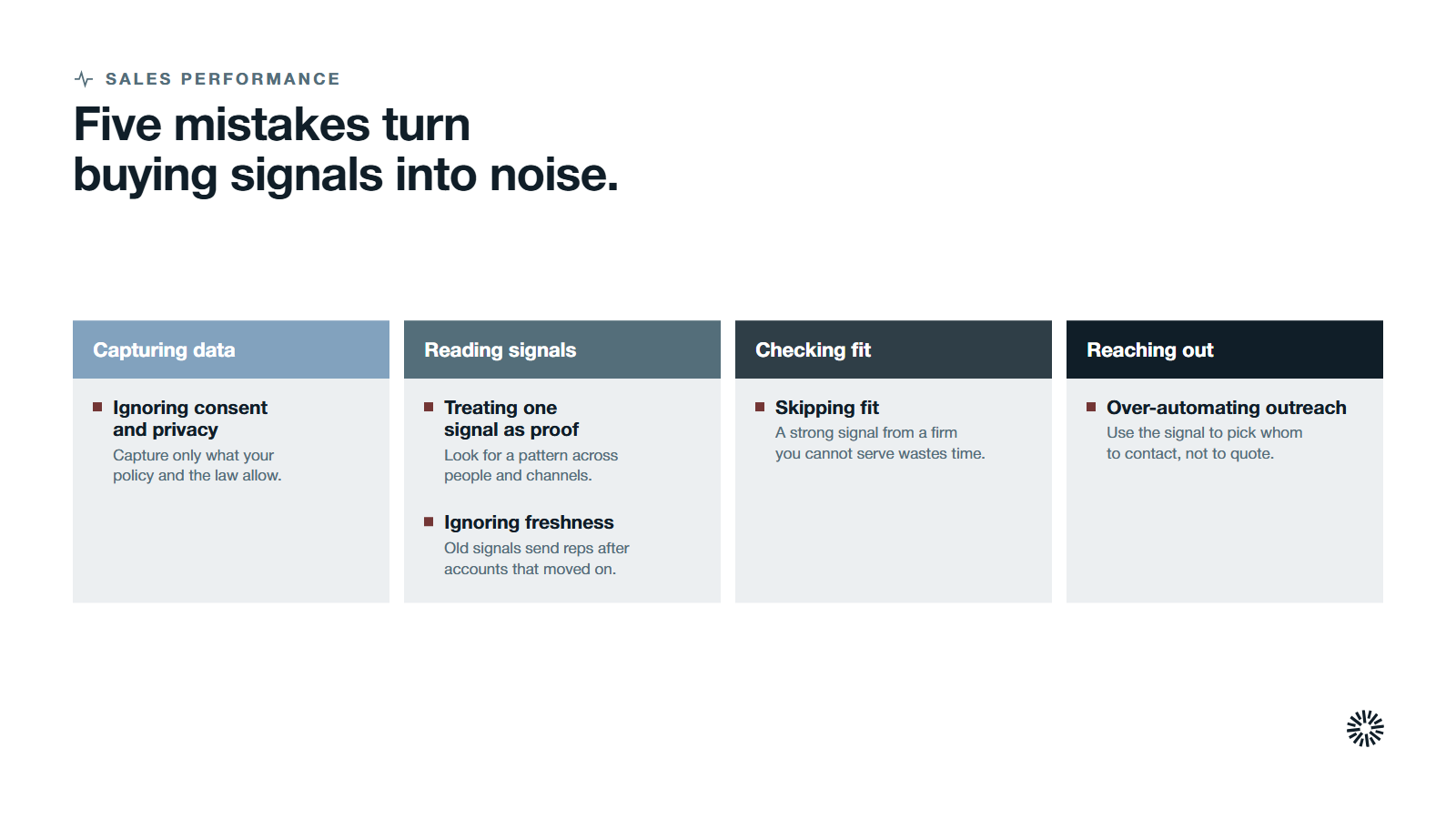
Teams that start tracking signals tend to hit the same problems. Most come from collecting more than they can act on.
- Treating one signal as proof. A single visit rarely means a purchase is coming. Look for a pattern across people and channels.
- Ignoring freshness. Old signals clog the queue and send reps after accounts that moved on.
- Skipping fit. A strong signal from a company you cannot serve wastes selling time.
- Over-automating outreach. An email that says you saw their page view feels intrusive. Use the signal to choose whom to contact and what to offer, not to quote their behavior back.
- Ignoring consent and privacy. Capture only what your policy and the law allow, and be open about how you use data.
The common thread is discipline. A short list of signals your team trusts beats a long list nobody checks.
What you gain when this is done properly
When signals are defined, captured in one place and shared, each team works from the same view of who is ready.
Sales gains better timing and warmer conversations
Sales reps spend time on accounts that show real movement. Timely and personalized outreach replaces generic outreach. Sales outreach reaches people while interest is fresh, and calls open with context about what the account is working on.
Outreach can refer to the specific content a lead read, which makes it relevant rather than generic. That helps shorten sales cycles, because the conversation starts closer to the decision.
Marketing gains proof of what content drives interest
Marketing teams can see which pages, offers and topics sit in front of accounts that later buy. Marketing campaigns can then focus on the content that moves target accounts, and handoffs to sales carry the evidence that justified them.
When both teams work the same accounts, their marketing efforts and selling support revenue growth together. For the full picture, read our complete guide to signal based selling.
Customer success gains early warning and expansion cues
The same idea works after the sale. A drop in product use, a new executive or a jump in usage are all signals. Customer success can act before a renewal is at risk and spot accounts ready to buy more.
Make buying signals part of how you sell
Buying signals work when they are a shared habit in your sales process, not a dashboard few people open. Start with a short list, agree what each signal means, and decide who acts on it.
Propello designs and builds connected GTM systems on HubSpot. If you cannot yet say which signals your team trusts or who owns the follow-up, an audit is the place to start.