Is the marketing funnel dead? No. The funnel still describes how prospects convert, but it stops at the sale, and your growth does not. The marketing flywheel, a model adapted by HubSpot, adds what the funnel leaves out: what your customers do for you after they buy.
This article is for CEOs, founders, CROs and revenue leaders at growing B2B companies. It compares the two models fairly, explains where each earns its place, and shows how HubSpot's Loop Marketing builds on the flywheel. You will leave with a way to run your go-to-market as one connected system.
|
Marketing Flywheel The marketing flywheel is a growth model, adapted by HubSpot, in which attract, engage and delight stages feed one another so that satisfied customers add momentum to the business. |
Why the funnel falls short for today's buyer
The traditional funnel gave B2B leaders a clear picture of the buyer journey, from awareness through consideration to closed-won. It produced useful stage definitions such as marketing qualified leads, sales qualified leads and opportunities. In sales-led models, those linear handoffs between marketing and sales worked well enough.
What changed is how buyers decide, and digital marketing channels let them decide alone. Four CEB surveys of more than 5,000 B2B purchase stakeholders, reported in Harvard Business Review's 2015 article Making the Consensus Sale, found customers were on average 57% of the way through a purchase process before they engaged supplier sales reps.
The same CEB surveys found that 5.4 people now have to formally sign off on each purchase, so you are persuading a committee, not one champion.
The deeper problem is structural. A funnel treats the customer as the end of the process. Once the deal closes, the effort stops, and service becomes an afterthought. HubSpot makes the same point on its flywheel page: funnels produce customers but do not consider how those customers can help you grow.
The funnel also encourages silos. Marketing optimizes its stage, sales optimizes its own, and service inherits whatever is left. In HubSpot's 2026 State of Marketing survey, 27.6% of marketers named sales-marketing alignment among their top challenges. For a wider view, see how go-to-market has moved from funnels to systems.
How the marketing flywheel works in practice
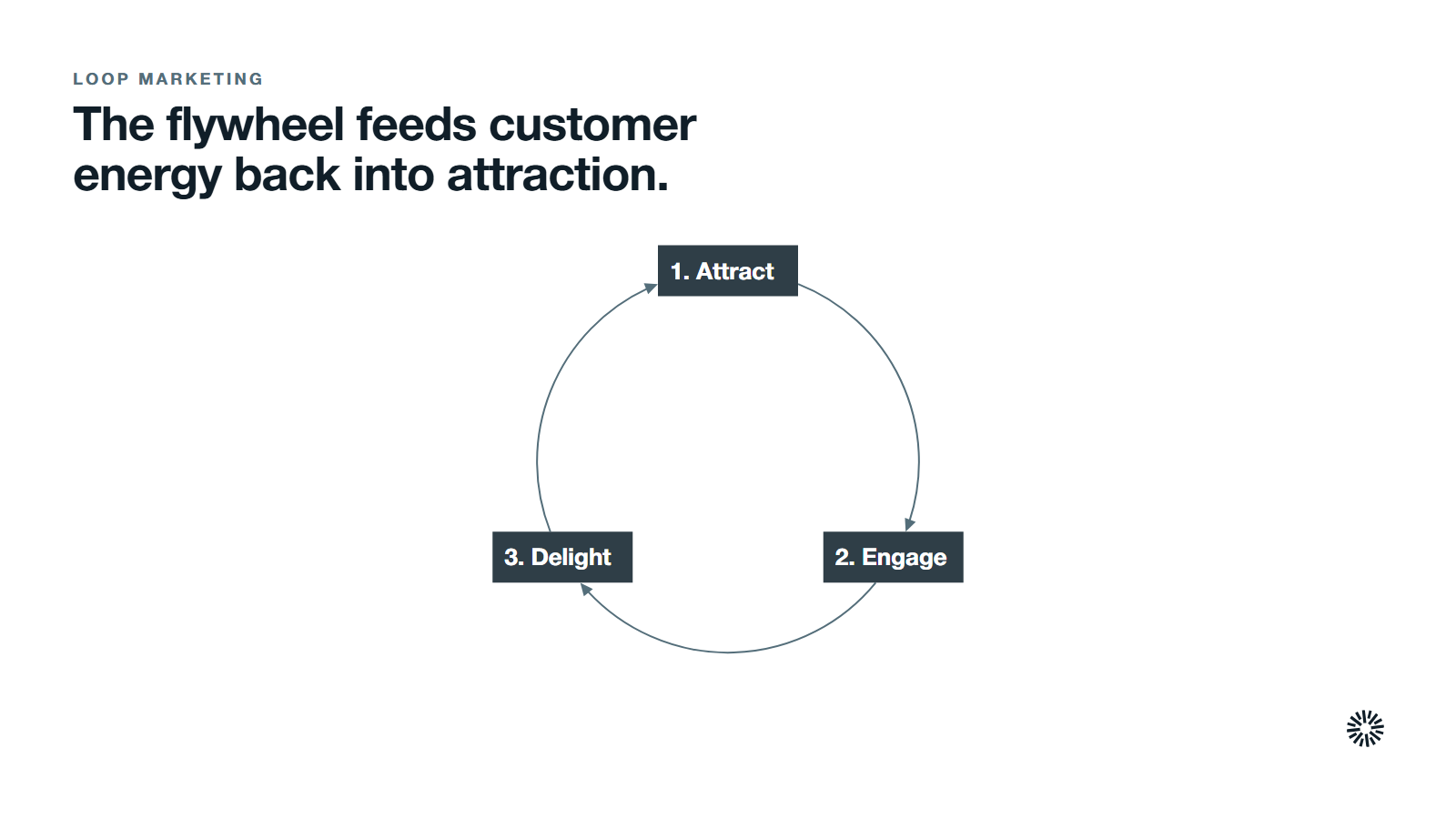
HubSpot redesigned its inbound marketing methodology around the flywheel. It places the customer at the center and describes growth in three phases: attract, engage and delight. The flywheel concept replaces the funnel's one-way pipe with a circular growth system, so the energy spent on customers feeds back into the business.
Adopting it is not a diagram swap. It changes how teams work, what they measure and how value compounds. The flywheel approach requires alignment across marketing, sales and customer support, because each team's actions affect how fast the next team's work can move.
Attract earns attention before buyers raise a hand
The attract stage focuses on creating qualified traffic with valuable content. For a revenue leader, that means insight-led content marketing efforts, events and thought leadership that speak to the pain points of your target audience, such as return on investment, implementation risk and integration.
Attract is built to help, not to harvest email addresses. Inbound marketing earns credibility with both people and AI-driven discovery tools, through organic traffic from search and relevant content shared on social media marketing channels. The goal is to be findable and useful to potential customers before one of them asks for a demo.
Engage makes it easy to buy from you
The engage stage turns visitors into leads through tailored interactions. It blends marketing, sales and product: educational demos, mutual action plans and self-serve options. Customer engagement happens across multiple channels, on the buyer's timeline, and it applies at every stage, not just at the point of purchase.
Engage is about fit and clarity, not pressure. Qualification becomes a two-way conversation, and expectations are set early. The sales process then helps the right person judge whether your solution matches their situation, which keeps energy in the system instead of leaking it into stalled deals.
Delight turns customer experience into a growth input
In B2B, delight means onboarding, implementation, adoption and proactive customer support that solve the problem the customer bought you for. Proactive support improves the post-purchase experience and promotes advocacy. Customer satisfaction is what generates word of mouth, so the customer experience after the sale is a growth input, not just a retention metric.
Each stage of the flywheel feeds the next, and delighted customers feed new energy back into attract. They become brand advocates, share success stories, write reviews and refer peers.
Each referral is a new customer you did not have to reach through paid channels, so customer acquisition cost falls as referrals grow. In a funnel, activity largely stops after closed-won. In a flywheel, that moment is where compounding begins.
Force, friction and momentum explain why the flywheel works
Per HubSpot, the momentum of the flywheel depends on how fast you spin it, how much friction it meets and how big it is. Force is any program or strategy that adds energy: stronger positioning, better content, shared goals between teams, and automation that removes repetitive tasks.
Friction is anything that slows the wheel: conflicting targets, manual processes, poor data, clumsy onboarding and inconsistent messaging. Friction often comes from poor alignment between teams, and shared goals are the simplest place to start. When you reduce friction, customers have a better experience, and as friction falls the flywheel spins faster.
Marketing flywheel vs marketing funnel: how they differ and work together
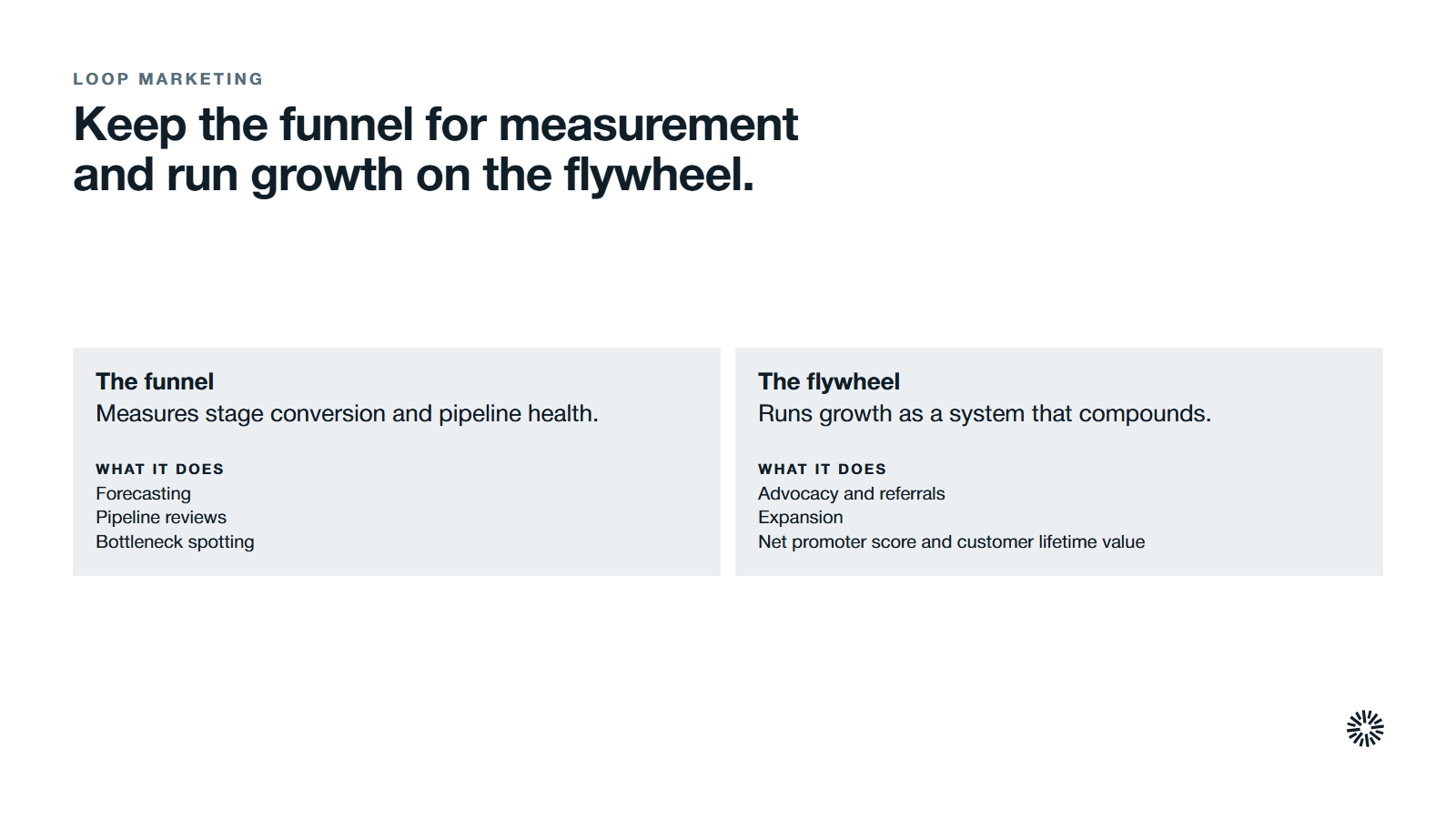
The funnel is not dead. It remains a useful measurement tool. What it cannot do is serve as your operating model for growth. Keep using it to measure stage conversion and pipeline health, and run your go-to-market with a flywheel mindset that connects marketing and sales to service and success.
Where the marketing funnel still helps you run the business
A funnel gives clarity on progression. You define the stages from lead to opportunity to closed, and that supports forecasting, resource allocation, pipeline reviews and a consistent sales process.
Funnel metrics also help you spot bottlenecks. To compare it with another growth model, read growth loops vs funnels and see which fits your stage. When conversion drops between two stages, you know where to investigate. That diagnostic value stays when you adopt a flywheel, as one layer of performance data inside a larger view of the system.
What the flywheel adds that the funnel cannot see
The flywheel highlights what the funnel misses: advocacy, expansion, referrals, customer loyalty and the compounding effect of deep connections with existing customers. Word of mouth matters here. Nielsen's 2021 Trust in Advertising study put recommendations from people they know at 89%, the most trusted channel among its U.S. respondents.
The most useful view is a funnel inside a flywheel. Stage metrics sit inside a system that also tracks net promoter score, customer lifetime value and how well delighted customers drive organic growth.
Net promoter score is a key measure of customer loyalty and satisfaction, and customer lifetime value shows what a retained customer is worth. Together they show whether the system is compounding or only converting.
Where Loop Marketing fits: HubSpot's newer playbook built on inbound
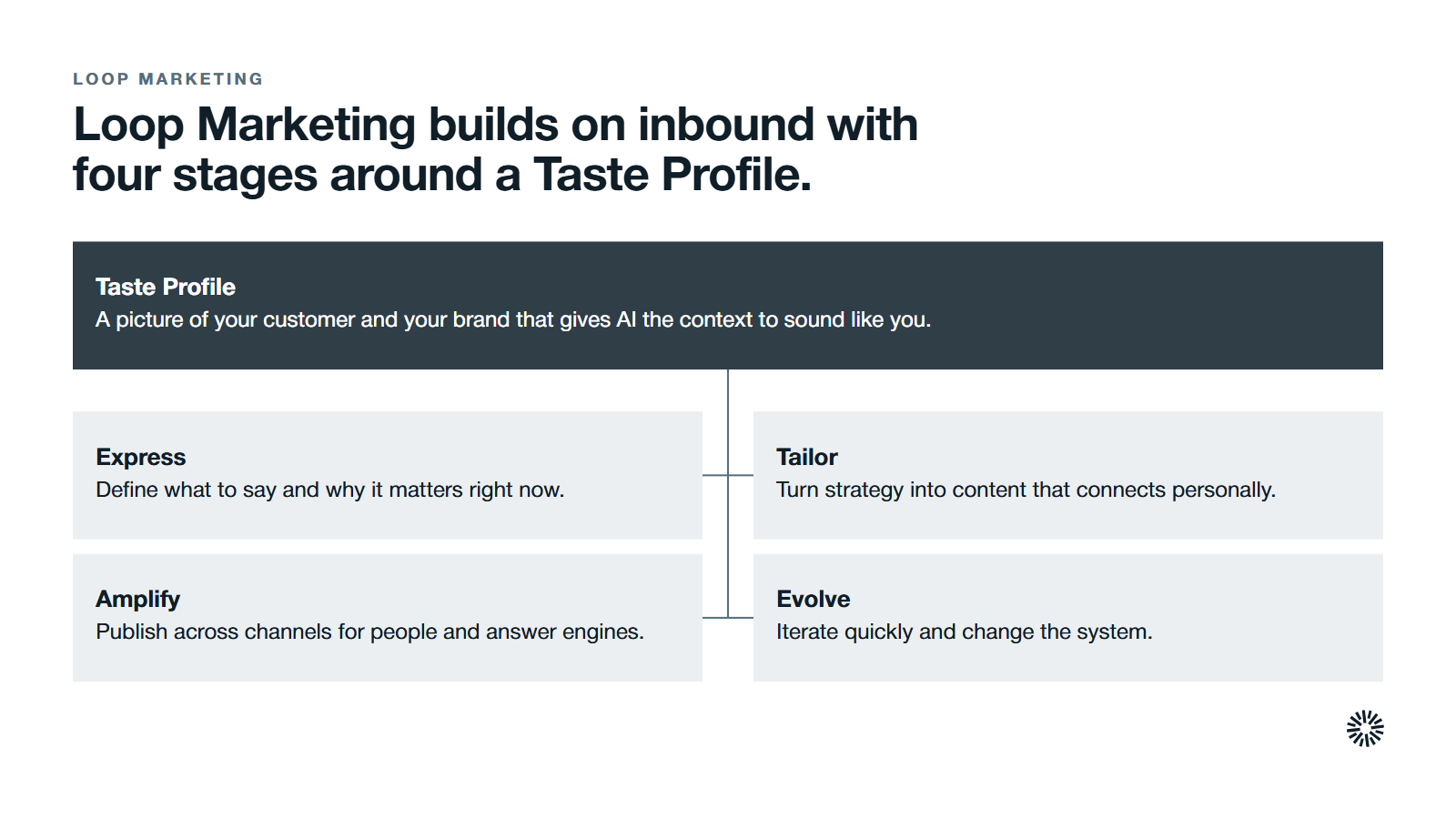
HubSpot introduced the Loop in September 2025 as a new playbook for growth in the AI era. It calls Loop Marketing a four-stage framework any marketing team can use, with the stages Express, Tailor, Amplify and Evolve. HubSpot says it builds on inbound marketing rather than replacing it. The reasons behind that move are covered in why marketing is moving to loops.
Loop starts from what HubSpot calls a Taste Profile, a picture of your customer and your brand that gives AI the context to sound like you. HubSpot's own comparison with inbound maps Express to the attract phase of the flywheel and Evolve to delight, so the two models read as layers, not rivals.
Express defines what to say and why it matters now
Express is where you decide what to say, how to say it and why it matters right now. It shapes every piece of content and every sales conversation. When it is weak, attract turns generic and your value proposition blurs against competitors.
Tailor makes your message personal
Tailor uses AI to turn your strategy into content that connects personally, in every format your audience consumes. It links to engage: when a message matches a buyer's situation, there is less friction, and the right person sees the right message at the right time.
Amplify publishes across channels for people and answer engines
Amplify publishes your content across diversified channels, optimized for people and for answer engines such as ChatGPT, Google AI Overviews and Perplexity.
Evolve learns from each pass and changes the system
Evolve is the stage where you iterate quickly. Each stage is worked through in practice in the Loop Marketing playbook for growing teams. HubSpot says AI helps you make changes in days, not quarters. You use performance data and customer insight to change the system, not just the campaign calendar, and each pass feeds the next.
What you gain when this is done properly
When you treat the funnel as a measurement tool inside a flywheel, with Loop Marketing as the way you keep learning, you gain a connected go-to-market system. Marketing, sales and customer success work from the same picture of the customer instead of three separate ones.
Sales teams meet better-prepared buyers and fewer stalled deals
Prospects enter the engage stage better prepared. They have read useful content, their intent is clearer and expectations are set. That means fewer deals stall on mismatched expectations and less time goes to accounts that were never a fit.
Revenue also stops depending only on net-new acquisition. Referrals and expansion add pipeline from existing customers, which gives you more sales conversations that start warm. Feedback from customer success shows which deals are worth pursuing, so the sales cycle becomes easier to forecast.
Marketing teams get a mandate beyond lead volume
Marketing moves from chasing top-of-funnel counts such as more leads and more traffic to contributing across attract, engage and delight. That includes onboarding content, advocacy programs and campaigns co-owned with sales and service.
Your marketing efforts are judged by the energy they add to the system rather than the number of landing pages they fill.
Customer success teams become a growth driver
In a flywheel, customer success is central to growth. Adoption, renewals and expansion all sit here. Excellent customer service turns customers into advocates, and deliberate chances for them to advocate, such as references and reviews, help sustain the flywheel effect.
Success teams also send structured insight back to marketing, shaping positioning and messaging. When success sits upstream of acquisition rather than downstream, retention and expansion become shared wins for the whole company.
Signs your business is ready for flywheel thinking
You will recognize the shift is overdue if several of these sound familiar:
- Marketing reports strong volume metrics, but pipeline quality is weak or revenue growth has flattened.
- Sales complains about lead quality while marketing complains about follow-up speed.
- Customer success is firefighting renewals instead of shaping growth strategy.
- Revenue depends heavily on net-new acquisition, with weak expansion and retention.
- Data is fragmented, and no one can trace a customer from first touch to renewal in one system.
The funnel is not dead, but your operating model must change
Keep your funnel for measurement. Operate your growth as a marketing flywheel. Use Loop Marketing to keep learning from each pass through the system. The real shift is not a new diagram. It is moving from disconnected campaigns to one designed system in which every customer interaction adds energy and every team contributes to momentum.
The flywheel only spins when the foundations are sound: clean data, one CRM architecture and clear cross-team accountability. Without them, friction remains and the flywheel becomes a relabeled funnel. That is the work behind sustainable growth, and it is a systems job as much as a marketing one.
Propello designs and builds connected GTM systems on HubSpot. If you want to move from a funnel-led plan to a flywheel your whole revenue team runs on, an audit is the place to start.