HubSpot Loop Marketing is a four-stage framework for growth in the AI era. It replaces the one-way funnel with a repeating cycle built around how B2B buyers now research and decide, and it shows where the future of B2B marketing is heading.
This article is for CEOs, founders, CROs and revenue leaders at growing B2B companies. You will learn what changed in how buyers research, what HubSpot announced and when, how the four stages of Express, Tailor, Amplify and Evolve work, and what the shift asks of your revenue team.
|
Loop Marketing Loop Marketing is HubSpot's four-stage framework of Express, Tailor, Amplify and Evolve, a continuous, AI-informed cycle of customer engagement that replaces a straight-line funnel. |
How B2B buyer research has changed
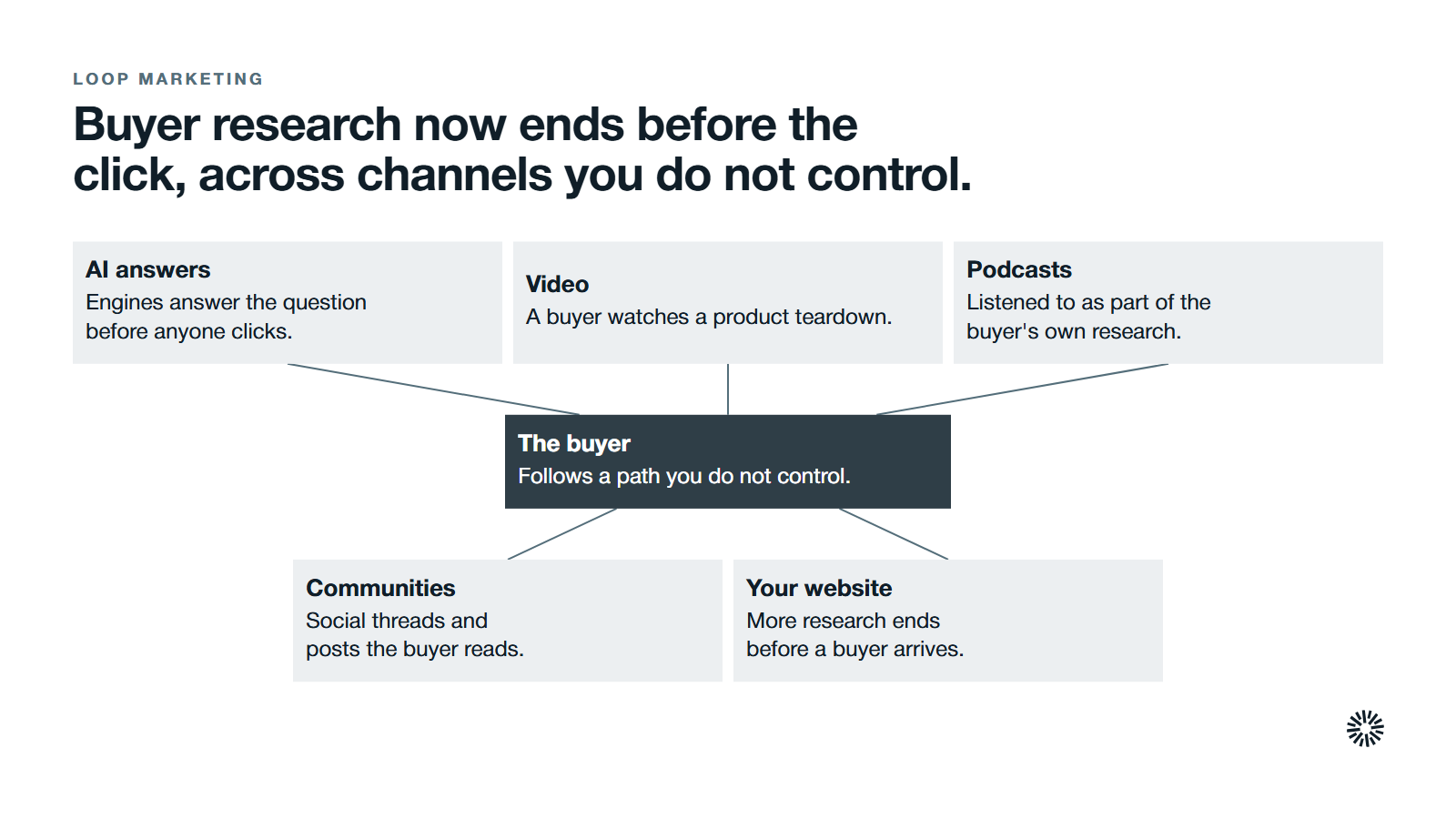
Your buyers no longer follow a path you control. AI engines such as ChatGPT, Google AI Overviews and Perplexity answer questions before anyone clicks, so more research ends before a buyer reaches your website.
The data points the same way. SparkToro's 2024 Zero-Click Search Study found that just under 60% of searches in the United States, across mobile web and desktop, ended without a click on any result. HubSpot's announcement cites that study.
AI summaries add to the effect. A Pew Research Center analysis of 900 U.S. adults' browsing in March 2025 found that people clicked a traditional result link in 8% of visits when an AI summary appeared, against 15% when it did not.
Pew also found that they clicked a link inside the summary in just 1% of visits.
For you, that means website traffic from search engines can fall even when your content is good.
The customer journey has also split across multiple channels. HubSpot describes buyer attention as scattered across YouTube, TikTok, Reddit and podcasts.
A buying committee member might watch a product teardown, ask an AI tool for a shortlist and read a peer's post. None of those touchpoints sits inside your funnel, and your CRM never logs them.
Siloed teams make this worse. When marketing runs campaigns, sales works a pipeline and customer service handles renewals as separate worlds, nobody sees the full picture. In HubSpot's 2026 State of Marketing survey, 27.6% of marketers named sales-marketing alignment among their top challenges.
What is driving the move from funnels to loops
Three forces push B2B marketing away from funnels and toward loops: AI answers that arrive before a click, attention spread across many platforms, and a need to learn faster than annual plans allow.
AI engines now sit between your buyer and your brand
When someone asks Google or ChatGPT a question about your category, an AI-generated summary often appears first. It pulls from several sources, writes an answer and resolves the question on the spot. The buyer learns what they needed without visiting your site.
That weakens the classic attract, nurture and convert sequence. Forget the assumption that awareness starts on your website or landing pages: when AI sits in the middle of discovery, your system has to respond to real buyer signals, not only page views.
Loop Marketing is designed to react to buyer behavior as it happens, using intent signals and customer data instead of waiting for a form fill.
Buyer attention is fragmented across channels and creators
Picture a VP of Operations evaluating a new platform. She reads a social thread, listens to a podcast and asks an AI tool for comparisons. She never visits your blog and never enters your funnel.
A funnel assumes one controlled path. Buyers hop across multiple platforms, share links inside their own tools and piece together their own research. Loop Marketing fits better because every touchpoint, owned or not, teaches you something for the next version of your message. It applies to social media, AI search and online communities alike.
Revenue teams need to learn and adapt faster
Teams stuck in start-stop campaign mode struggle to react. Their systems are built for one-time pushes, not for a continuous cycle of learning. The flywheel offers one answer to that gap, compared against the old model in marketing flywheel vs funnel. HubSpot makes the same point about the Evolve stage: AI helps you make changes in days, not quarters.
Continuous optimization replaces the static quarterly review, and Express, Tailor, Amplify and Evolve can run in short cycles.
What HubSpot introduced with Loop Marketing in September 2025
HubSpot introduced the Loop on September 3, 2025, as part of its INBOUND 2025 news, and called it a new playbook for growth in the AI era. HubSpot treats digital marketing as a continuous cycle powered by AI capabilities and unified data, not a straight line to closed won.
HubSpot says Loop Marketing stays true to the principles that made inbound marketing work. Its own Loop Marketing page puts it this way: the core components of inbound are still essential, but they are no longer enough.
You can use Loop Marketing as an operating model for any go-to-market team, whatever software you run. For a fuller explanation of what Loop Marketing is, read our guide.
The framework pairs human creativity and brand voice with AI efficiency. HubSpot's knowledge base describes it as built for a world where buyers research with AI, get answers before clicking and discover solutions across scattered channels.
The four stages of HubSpot Loop Marketing
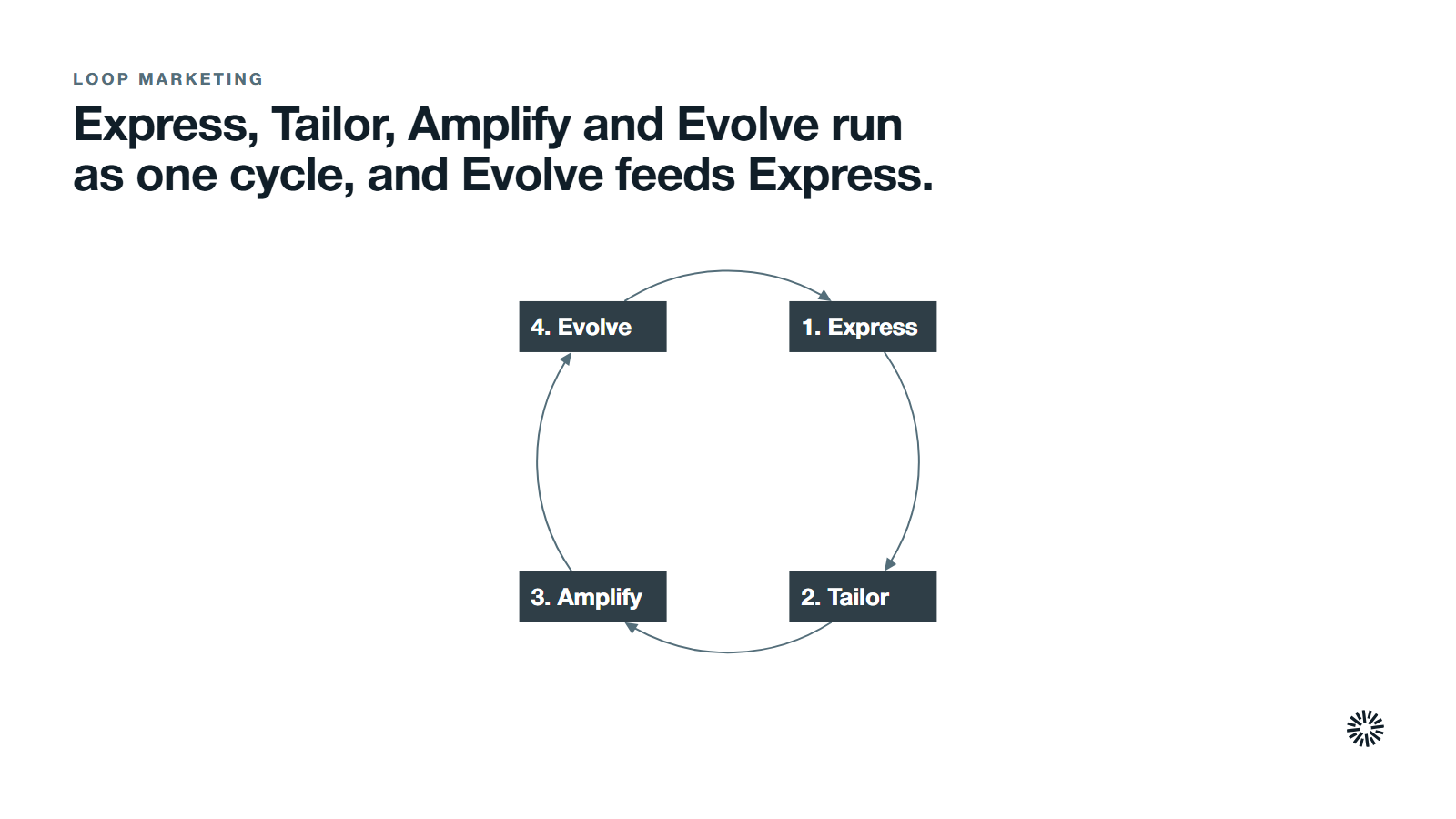
Express, Tailor, Amplify and Evolve are parts of a cycle, not steps in a project plan. Each feeds the next, and what you learn in Evolve goes back into Express.
Express: define what you stand for
HubSpot describes Express as deciding what to say, how to say it and why it matters right now. You establish your point of view, brand story, brand identity and ideal customer profile before AI touches anything, so the output sounds like your brand.
HubSpot calls the resulting picture of your customer and brand a taste profile. In practice you create a style guide, structured content briefs and positioning statements your team can reuse in any channel. Every later touchpoint then carries the same narrative instead of generic content any competitor could publish.
Tailor: make every interaction fit the buyer
Tailor uses AI to turn your strategy into content that connects personally, in every format your audience uses. You shape emails, landing pages and sequences around customer data, behavior, timing and the buyer's role on the buying committee.
Personalization at scale needs unified customer data and clear rules, so each interaction stays relevant to the buyer's role. Without clean data and consent management, personalization misfires and erodes trust. Humans set the guardrails, AI tools do the adapting, and smart segmentation replaces random one-off edits.
Amplify: meet buyers where they spend their time
HubSpot frames Amplify as publishing across diversified channels, optimized for humans and for answer engines. You stop treating your website as the only stage and spread distribution across social posts, communities, podcasts, events, partner channels and AI engines.
You repurpose Express work into short video clips, podcast topics and material structured for AI answers. Answer engine optimization is part of Amplify, because it is how you maximize visibility when an AI engine writes the response. Our guide to AI engine optimization covers it in depth.
Evolve: learn from every signal and feed it back
Evolve focuses on continuous learning. You review what happened, work out why and adjust your strategy across Express, Tailor and Amplify. For day-to-day practice in each stage, follow the Loop Marketing playbook for all four stages. Feedback from each campaign informs the next, so you optimize on evidence and campaign effectiveness becomes something you improve on purpose.
A workable rhythm is a monthly loop review, qualitative feedback from sales and customer success, a look at engagement rates and pipeline data, and then rapid experiments to test what you learned. Without Evolve, the loop stalls and falls back into disconnected campaigns.
Why HubSpot Loop Marketing fits the AI era
Express helps AI systems represent your brand correctly. An AI engine summarizing your category draws on content you have published, so scattered messaging produces vague summaries. Clear Express work gives AI prompts and models structured material that reflects your actual point of view, which helps you stay competitive where discovery happens inside AI tools.
Tailor keeps AI-powered personalization relevant. AI tools can speed up marketing automation, but only when they run on clean data and clear rules about your target audience. Without those rules, messages read as robotic.
Amplify answers fractured attention by putting your message where buyers spend time. Evolve builds a habit of small, frequent adjustments, so you continuously improve by feeding AI-powered insights from every stage back into the loop.
What the shift to loops means for revenue leaders
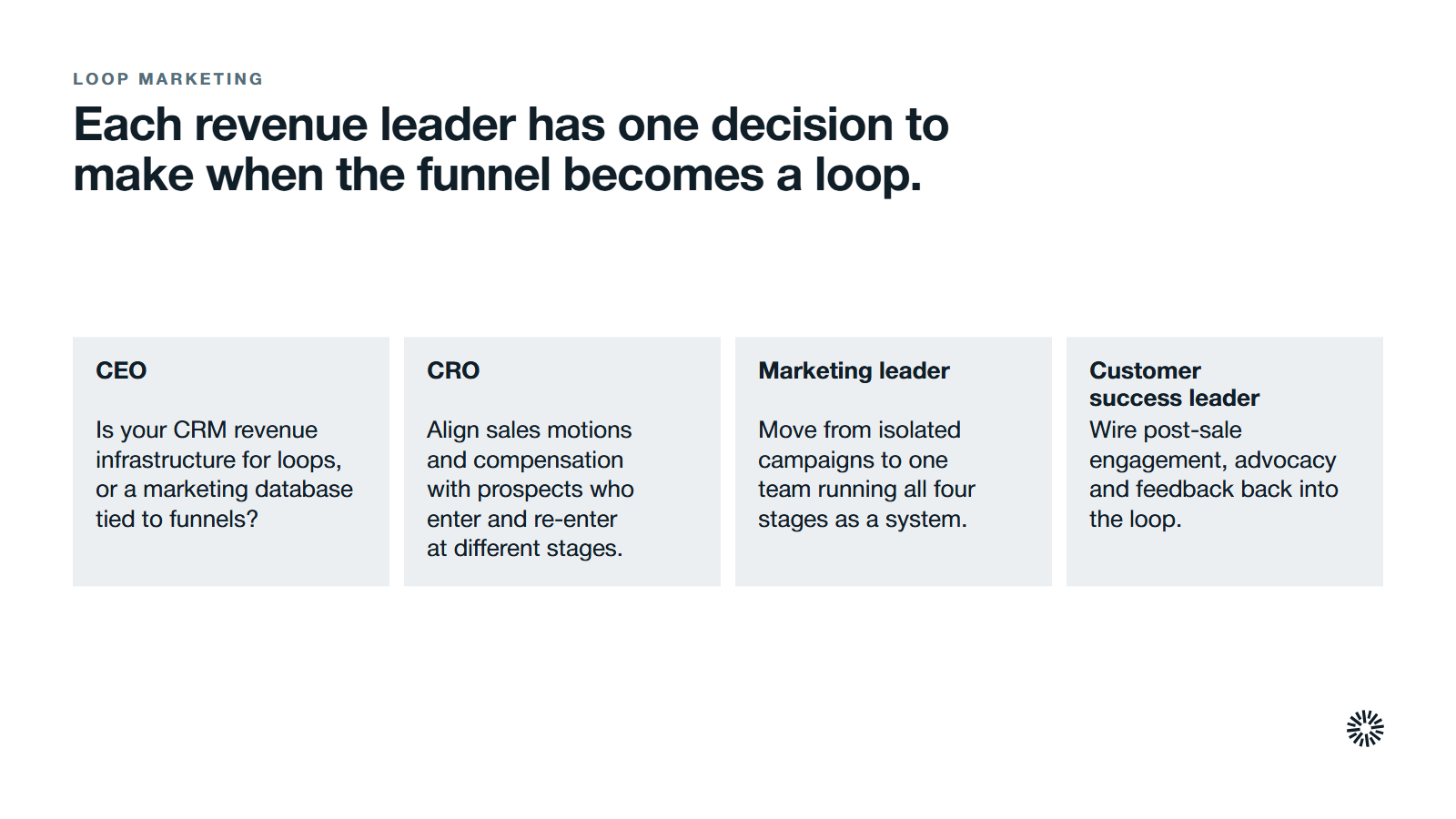
Loop Marketing is not only a marketing framework. It changes how your revenue system is governed, so decisions about targets, strategy, content and success metrics have to assume repeating cycles, not a single pass through a funnel.
What each leader has to decide
- CEO: Decide whether your CRM is revenue infrastructure that supports loops or a marketing database tied to funnels.
- CRO: Align sales motions and compensation with a loop in which prospects enter and re-enter at different stages, rather than moving through one pipeline.
- Marketing leader: Move from channel teams running isolated campaigns to one team responsible for Express, Tailor, Amplify and Evolve working as a system.
- Customer success leader: Wire post-sale engagement, advocacy and feedback back into the loop instead of keeping them separate.
What a team organized around loops does differently
A team built around loops treats go-to-market as a connected system, not a sequence of handoffs. For example, sales, marketing and success define Tailor rules together, and Evolve reviews capture lessons instead of only reporting numbers. Three more habits stand out:
- Express assets such as brand narrative, ideal customer profile and messaging are owned by a cross-functional group, not only by marketers.
- Amplify plans start from a map of where your audience pays attention, not from internal channel preferences.
- One shared system of record makes loop signals visible to every team, which supports building relationships across functions instead of protecting silos.
What you gain when this is done properly
Each revenue team feels the change in a different place, but all three depend on the same connected cycle.
Sales gets clearer signals and better timing
Sales gains a view of where an account sits in the loop, not just a label like MQL or SQL. Outreach can follow the buyer's latest interactions, so conversations start with context.
Reps can prioritize accounts on live engagement and intent signals instead of historic lead scores that decay, and shared language with marketing and success means handoffs carry context.
Marketing builds a system that compounds
Marketing reuses core narratives from Express and personalization patterns from Tailor instead of starting from zero each quarter. Amplify and Evolve show which channels and messages move pipeline, so budget decisions can improve with each cycle. AI powered insights give marketers shared learning cycles to work from rather than gut feel.
Customer success becomes a source of growth
In a loop, customer success is not an endpoint. The reporting side of that feedback is explained in closed loop marketing and ROI plateaus. It is a source of insight. Success teams feed product feedback into Express, surface advocacy moments into Amplify and flag expansion opportunities for sales. When post-sale data flows back into the loop, each new customer interaction gives the whole system more to learn from.
Where to start if you are still running funnels
You can begin applying HubSpot's Loop Marketing ideas this quarter without buying anything new.
- Map your current loop on a whiteboard. Trace how one customer discovers, buys and stays with you across a full year, and mark where you lose the thread and where data goes dark.
- Choose the one stage where friction is highest and define a simple improvement to test for a full quarter.
- Set up a monthly loop review with sales, marketing and success leaders to look at signals together and agree on one or two changes per cycle.
From funnels to loops is a decision for this quarter
Buyer research, AI answers and scattered attention have made the one-way funnel a weaker model for B2B growth. HubSpot Loop Marketing gives your business a practical framework for a system that keeps learning from every customer interaction. The technology matters less than the decision to connect your teams around one cycle.
Propello is a HubSpot-powered Go-to-Market Agency that applies it. If you suspect your funnel is holding back your revenue team, an audit is the place to start.