If you lead a growing B2B company, you may be paying for more campaigns, content and ads every quarter while revenue barely moves. Marketing ROI plateaus because the results of your sales and customer success work never travel back to marketing, so budget keeps following leads instead of customers.
This article is for the CEO, founder, CRO or revenue leader who wants to know why that happens. You will get a plain definition of closed loop marketing, the three causes of the plateau, how the practice relates to HubSpot's Loop Marketing, and the first moves that improve marketing ROI.
|
Closed Loop Marketing Closed loop marketing is the practice of reporting sales outcomes, such as opportunities, closed deals, revenue and churn, back to marketing so spend follows customers rather than leads. |
What closed loop marketing means for your business
Most marketing reports end at the moment someone fills in a form. A closed loop carries the story on. It follows each lead through the sales process, records whether it became an opportunity, a customer or a lost deal, and sends that result back to the people who planned the campaign.
HubSpot's own guidance puts it simply: closed-loop reporting connects marketing data to sales outcomes. That connection is what lets you see which campaigns, channels and offers produce customers, not just traffic or leads.
Tracking follows a person from the first touchpoint to the purchase and beyond. With that trail in place, you can measure return on investment accurately and move spend toward the sources that add revenue.
What does "closed loop" mean in business?
In business, a closed loop is a process whose results return to the start so the next round improves. In marketing, the result that must return is revenue. A loop that stops at the lead is open: marketing acts, but nothing tells it what happened next.
Why marketing ROI plateaus even when spend keeps rising
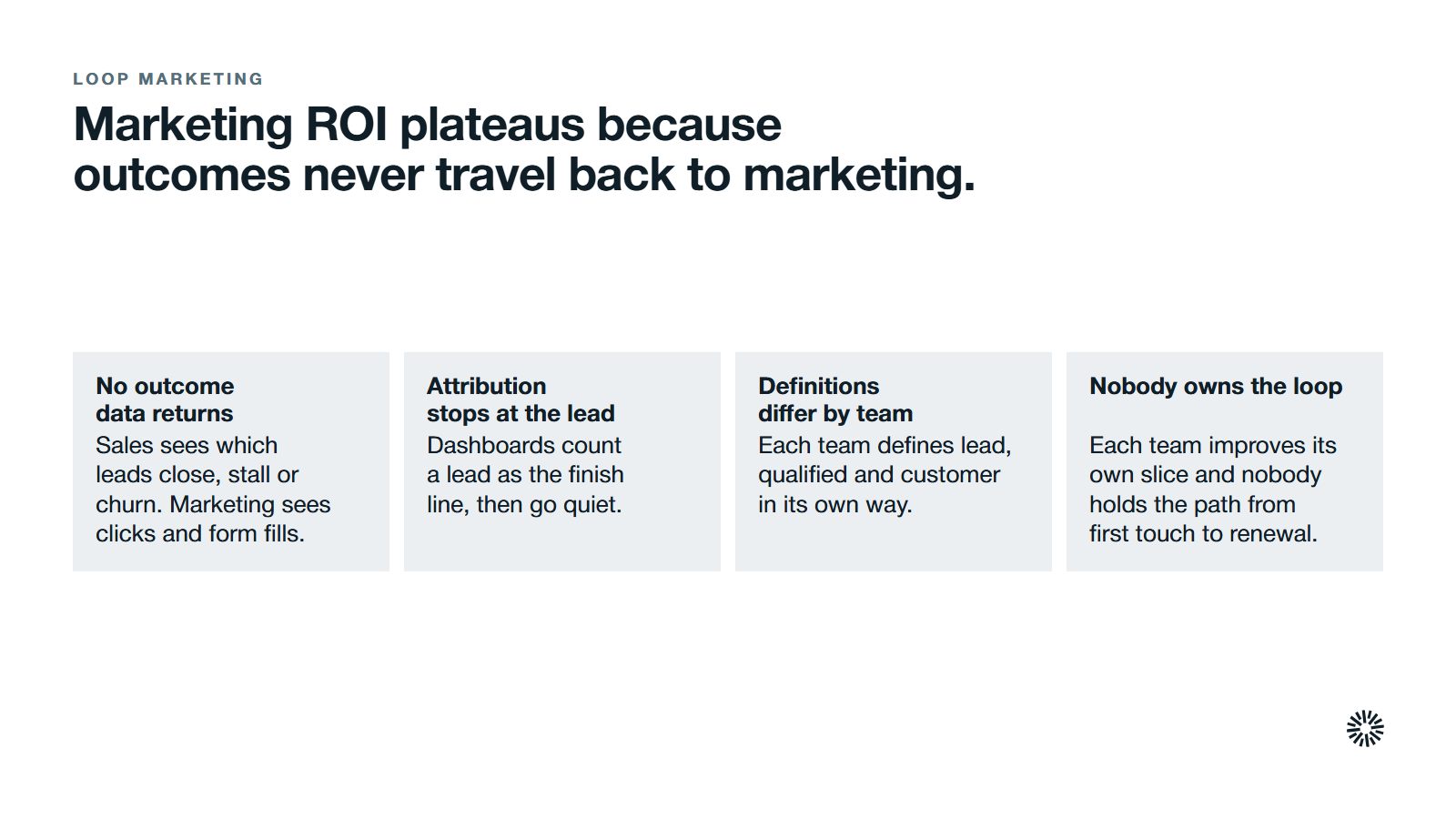
Leaders feel this pressure already. In HubSpot's 2026 State of Marketing survey of more than 1,500 marketers, 33% named measuring the ROI of marketing activities as a top challenge. The causes sit in how your teams share data, not in how hard they work.
No outcome data returns to marketing
Sales sees which leads close, stall or churn. Marketing sees clicks and form fills. Without a route for the first set of facts to reach the second team, marketing keeps funding what looked good at the top and cannot learn what produced customers.
Disconnected tools make this worse. Salesforce's 2025 MuleSoft Connectivity Benchmark Report, a survey of more than 1,050 IT leaders, found that organizations manage 897 applications and only 29% of them are integrated. Outcomes get stuck in whichever system the team happens to use.
Attribution stops at the lead
Many dashboards count a lead as the finish line. They credit a campaign when someone downloads an offer, then go quiet. Cost per lead looks healthy while the channel behind it sends buyers who never sign. Your best customers may come from a channel you are about to cut.
Website analytics show what happened on the page, not what happened in the deal. Engagement data from emails and pages becomes useful only once it is tied to a closed sale.
An attribution model only helps when it reaches revenue. HubSpot explains that revenue attribution reports can show which marketing efforts result in the most won revenue. Pick one model, keep it steady, and read it at that level.
Each team defines lead, qualified and customer differently
Marketing may count anyone who completes a form as interested. Sales may want confirmed budget before calling a lead qualified. Customer success may track renewal risk on a calendar that has nothing to do with campaign cycles.
When definitions differ, reports contradict each other and nobody trusts the numbers. HubSpot's survey found 27.6% of marketers named sales-marketing alignment among their top challenges. A shared set of lifecycle stages is the base of any loop.
Nobody owns the loop from first touch to renewal
Marketing owns awareness. Sales owns new deals. Customer success owns renewals. Operations keeps the tools running. Each team improves its own slice, and nobody holds the whole path.
Without an owner, learning stays trapped. Win and loss reasons never change targeting. Churn patterns never change messaging. Every quarter starts from scratch instead of building on the last one.
What an open loop costs your marketing spend
The plainest cost is wasted marketing spend. If you optimize on lead volume, you keep investing in channels and content that attract low-fit leads. Moving money away from sources that never convert is the simplest way to lower what each new customer costs you.
A marketing investment you cannot trace to revenue is a guess, however well the campaign performed along the way.
The hidden cost is slower learning. You cannot test a new message, audience or channel and read revenue results quickly enough to adjust. Competitors who close the loop learn from every deal, while your plan resets each planning cycle.
Leaders also feel the pressure from above. In the Demand Gen Report 2024 Marketing Measurement and Attribution Benchmark Survey, 73% of B2B marketers said they were increasing their emphasis on measurement and attribution because of a push to show ROI from all marketing investments.
Measure customer lifetime value, not only cost per lead
A closed loop changes which metrics you trust. Cost per lead measures what it costs to attract a lead. Customer acquisition cost shows whether a campaign was worth running, because it measures what it costs to win a customer.
Customer lifetime value measures the total profit that customer brings. Only the last two need sales and retention data.
Customer lifetime value is worked out from how long customers stay, the profit they bring each year, and what it cost to acquire them. Churn rate therefore shifts the answer directly: a customer who leaves early is worth less, whatever the lead cost. The figure also helps you identify which customers deserve the most attention.
Retention changes the economics sharply. A Harvard Business Review article from 2014 cites Bain & Company research by Frederick Reichheld showing that increasing customer retention rates by 5% increases profits by 25% to 95%.
Knowing lifetime customer value by source lets you determine which channels deserve more budget. A source with expensive leads and loyal customers may beat a cheap source with fast churn. Without the loop, you cannot tell them apart.
How closed loop marketing connects to HubSpot's Loop Marketing
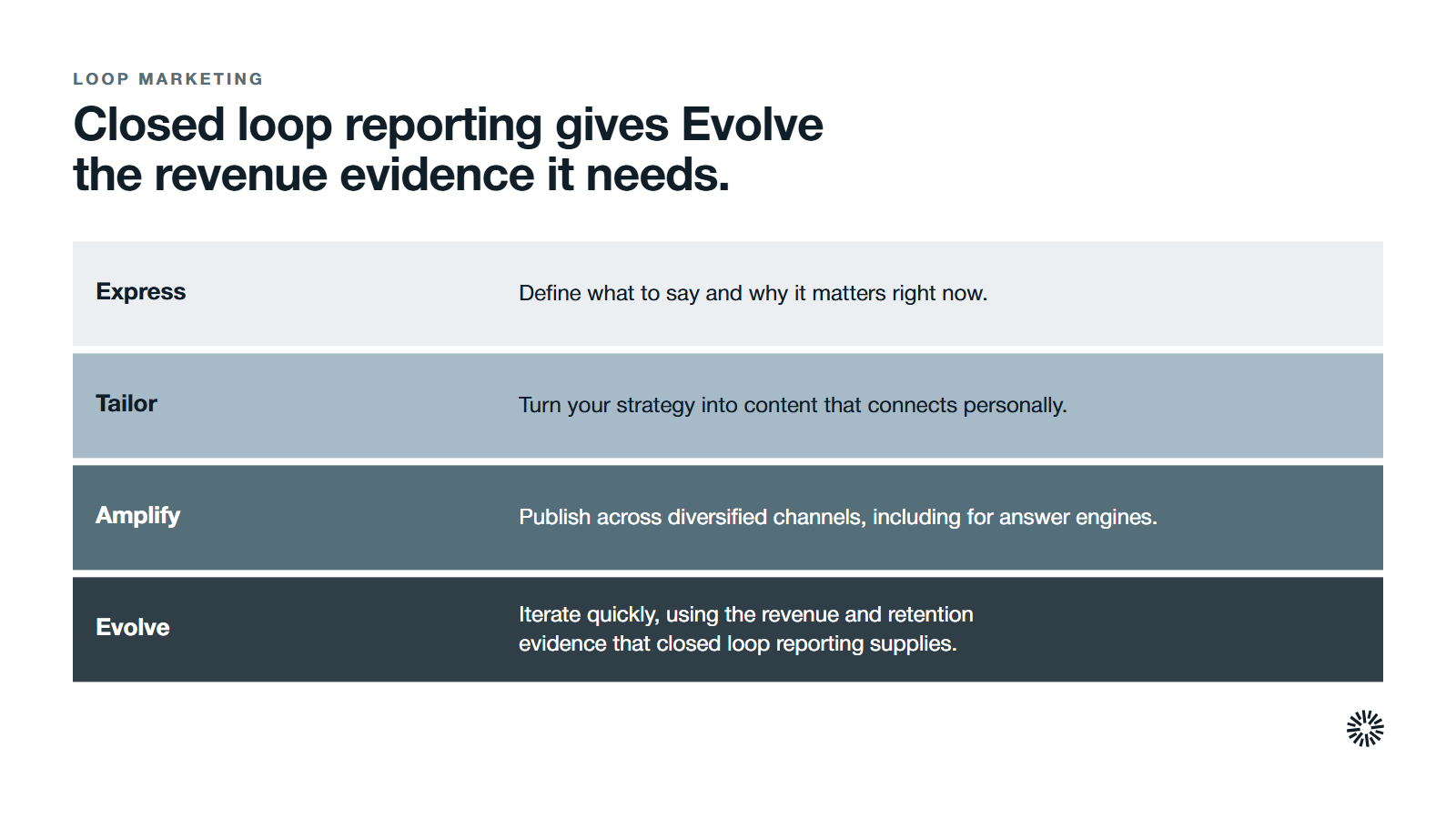
Loop Marketing is HubSpot's four-stage framework for marketers in the AI era, and the two ideas are related but not the same. Closed loop marketing is an established reporting practice. Loop Marketing is a framework HubSpot introduced for how marketers create, publish and improve. For the framework itself, see moving from funnels to loops and what changes for each team.
HubSpot's Loop Marketing page describes the stages as Express, Tailor, Amplify and Evolve. Express defines what to say and why it matters right now. Tailor turns your strategy into content that connects personally. Amplify publishes across diversified channels, including for answer engines.
Evolve is where the two meet. HubSpot describes it as iterating quickly and effectively, and you cannot iterate well on guesses. Closed loop reporting supplies the revenue and retention evidence that Evolve needs, so each round of your marketing strategy starts from what customers actually did.
What a working feedback loop looks like
You do not need a large program to see one. A working loop is a few agreed habits with data behind them.
What is an example of a feedback loop?
A prospect reads a guide on one of your landing pages and becomes a lead. Sales works the lead and records why the deal was won or lost. Marketing reads those reasons at month end and changes the next campaign's audience, offer and message. The new results then flow back again.
What makes a marketing feedback loop effective?
Three things: shared definitions, one place where every stage of the customer journey is recorded, and a fixed time when the teams review results together. Thoughtful data collection matters more than volume. Start with a few fields you will actually use, and add more only when a decision needs them.
A loop can start small. Carry a single attribute, such as original source, from the form to the deal, and you already have something to learn from.
Forms can help here. Progressive profiling asks a returning visitor one new question each time, so each visit adds a fact instead of repeating the last form. Refresh what you know regularly, because buyer preferences change and an old record can mislead your targeting.
Feedback also improves engagement and personalization, since your messages can reflect what each segment responded to, and every response is an insight you can reuse.
What you gain when this is done properly
When the loop is closed, outcomes change decisions upstream, and each team feels the difference. Your growth plans also rest on firmer evidence.
Sales: cleaner pipeline and better conversations
Sales can see which campaigns and signals produce opportunities that match your ideal customer and close at healthy values. Follow-up becomes more confident, and reps stop spending time on leads that were never going to buy. Targeting improves because it is refined by what sales actually closed.
Marketing: budget that follows revenue
Marketing moves from asking which channel brings the cheapest leads to asking which efforts create customers who stay and expand. Content, audiences and offers adjust to closed-won, closed-lost and churn reasons, which makes your demand generation programs more precise.
Vanity metrics lose their pull, and your focus moves to customer lifetime value and acquisition cost by channel.
Budget allocation also becomes easier to defend. When a board member asks what a channel returned, you can answer with actual results rather than lead counts.
Analytics that reach revenue show customer behavior you could only guess at before. They also help you identify the buying triggers behind each sale, so your focus moves to the touchpoints that matter.
Customer success: a voice at the front of the funnel
Customer success sees onboarding friction, feature adoption and renewal risk before anyone else. Turning that retention data into marketing decisions is covered in the customer feedback loop guide. Fed back into targeting and qualification, that knowledge changes who marketing attracts and what sales promises. Fewer customers arrive with the wrong expectations, so fewer leave in the first year. The whole go-to-market strategy gets sharper for it.
How to improve marketing ROI in three moves
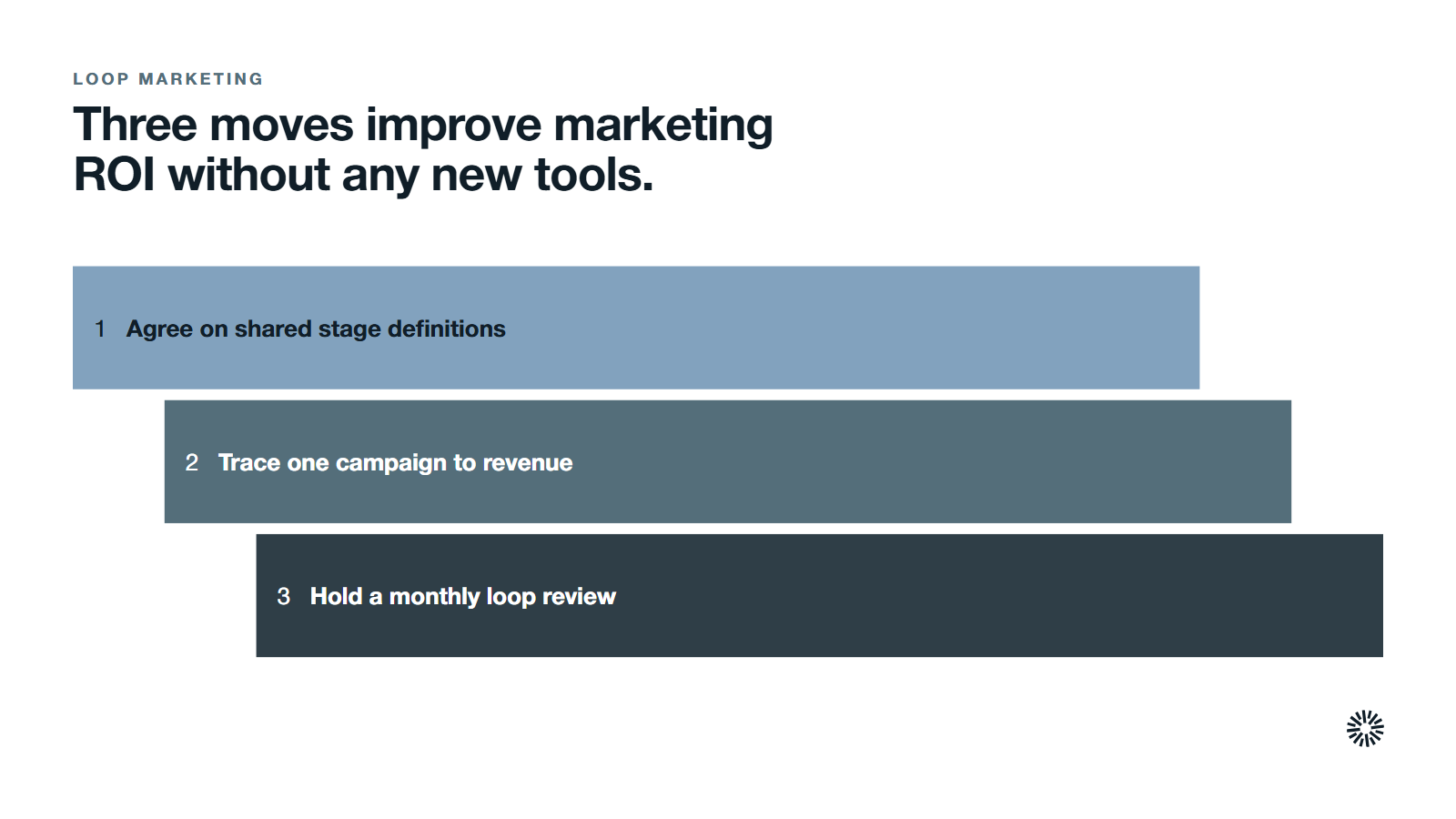
You can start in your existing HubSpot portal this month, without new tools. The setup steps are laid out in our guide to implementing Loop Marketing in HubSpot.
- Agree on shared lifecycle and deal stage definitions. Write one meaning each for lead, qualified, opportunity and customer. Align HubSpot stages to match, and give every record an owner.
- Trace one campaign all the way to revenue. Pick an active offer, connect it to deals, and require source and campaign properties. Review it at pipeline and revenue level.
- Hold a monthly closed loop review. Bring one leader from each team to one report: revenue by original source, plus top win and loss reasons. Record one change per month, then scale what works.
Closed loop marketing turns your marketing strategy into a system that learns
A flat return is rarely a sign that your team lacks effort. It points to a system that does not learn from outcomes. When acquisition, sales and retention results feed back into planning, your marketing efforts stop resetting every quarter and start building on each other.
Growth then comes from learning which spend works, not only from spending more.
Closed loop marketing connects your digital marketing efforts to sales results, so you can make data driven decisions about where the next dollar goes. It is the practical base of any marketing strategy that intends to improve.
Propello designs and builds connected GTM systems on HubSpot. If you want to see where your own feedback loops break today, an audit is the place to start.