
If you lead revenue at a B2B company, you have probably heard you need content other sites cite. The short answer: a page earns links and AI citations when it holds something new that a writer or an AI engine cannot get anywhere else, and original data is the most reliable way to do that.
This article is for CEOs, founders and revenue leaders deciding what to publish. You will learn what linkable assets are, which types work for B2B, why original research holds up best, and how to start without a research department.
|
Linkable Asset A linkable asset is a page or resource on your site, such as original research, a free tool or a definitive guide, that is valuable enough for other websites to reference and link to without being asked. |
How linkable assets earn links and AI citations
A linkable asset works because it gives other people a reason to point at you. A journalist needs a figure to support a claim. A blogger needs a source for a definition. A buyer needs a calculator.
When your page is the best answer, they link to it, and that link is a vote of trust that no amount of self-promotion can replace.
Search engines and AI engines both reward pages that other sites trust, and AI engines depend on the same signals. They answer questions by pulling from pages they can trust and attribute, so a page that contains a clear, dated, sourced fact is easy to quote.
Our guide to AI search ranking factors explains how engines choose which sources to cite, and linkable content sits behind several of those factors.
Why linkable assets are important for link building
Link building is the work of getting other websites to reference your pages. It is slow when you have nothing worth referencing, because every outreach email asks for a favor. With an asset in hand, the same email offers something useful, and some links arrive without any outreach at all.
Without one, you end up asking for so many links, one at a time, that the work stops paying back.
That is why linkable assets are important for any link building campaign: they turn a request into an offer. Creating linkable assets is also how you attract links at scale, because one strong page can earn natural backlinks from many editors and keep earning them.
They also help you earn quality backlinks from relevant websites in your market, which count for more than a large number of links from unrelated pages. The aim is not as many links as possible.
It is a few strong links from the right places, because the quality and context of the sites that link to you matter more than the count.
Why links still matter
Search engines have used links as a trust signal for decades, and the data shows why quality links matter for organic traffic and for visibility in Google search results.
Ahrefs studied around 14 billion pages and found that 96.55% of them get no traffic from Google, while pages with more referring domains tend to get more traffic.
Links are not the only factor, but they are the one you can only earn from other people. They help pages rank higher in search engine results pages, and strong search engine rankings help a page get found by the writers who link next.
Scores such as domain authority are third-party estimates, not Google metrics, so treat them as rough guides.
Why mentions matter even more for AI answers
AI engines care about who talks about you, not only who links to you. In a 2025 study of 75,000 brands, Ahrefs found that branded web mentions correlated with brand visibility in AI Overviews at 0.664, against 0.218 for backlinks.
That is a correlation, not proof of cause, but it points the same way: being discussed across the web counts.
A strong linkable asset earns both. People link to it, and they also name your company when they cite it, which builds the brand mentions engines read.
Types of linkable assets that work for B2B companies
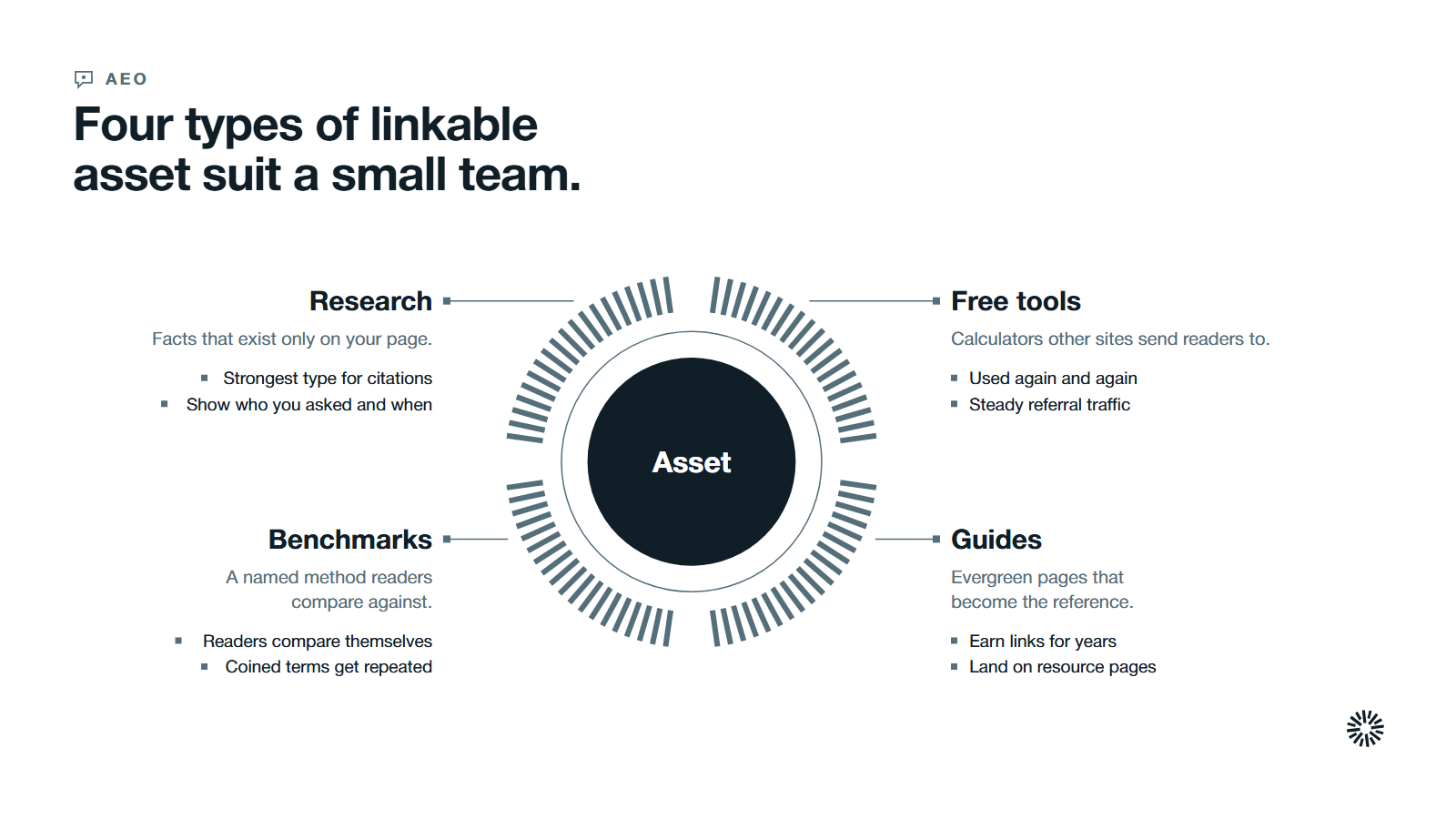
Not every asset suits every business. For a B2B company with a small team, the types of linkable assets below are the ones most likely to pay back the effort. A successful linkable asset is one your buyers actually need, and a good linkable asset is one you can keep accurate.
The right choice depends on what your buyers ask and what you can prove.
Original research and proprietary data
Original research is a survey, an analysis of your own aggregated data, or a study of public information that nobody has published before. It is the strongest type because the facts exist only on your page. Anyone who wants the number has to cite you.
Free tools and calculators
A free tool solves a small problem for your buyer, such as a calculator that estimates the cost of a process or a checker that scores a page. Online tools earn links because other sites send their readers to them. If you build one with partners, they may embed company logos and link back.
A valuable tool is used again and again, which builds a steady flow of referral traffic.
Definitive guides and glossaries
A comprehensive resource that defines a topic better than anything else on the web gets cited as the reference. Long form content suits this job, because a thorough page can answer the question and its follow-ups.
Evergreen content like this keeps earning links for years if you maintain it, and it often lands on the resource page that a trade body, partner or publisher keeps for its readers.
Frameworks, benchmarks and coined terms
If your team has a method with a clear name and steps, publishing it gives others something to point to. A benchmark that lets readers compare themselves against a standard works the same way.
Infographics, templates and checklists
Infographics are a popular format because they compress a finding into one image. Charts, diagrams, checklists and downloadable templates are easy to embed or reuse, and a ready-to-use template saves your reader time. When a writer includes your diagram, the credit and the link travel with it.
Shareable content like this also travels on social media platforms, which helps writers discover it. Visually appealing content only earns links when the substance underneath is sound, and you should not rely on social media followers alone to spread it.
Roundups and case studies
A roundup of expert views or a list-style guide is easy to read and easy to cite, and the experts you include often share it. A case study can work too, but only when the client has approved the facts.
What makes original data worth citing
Publishing numbers is easy. Getting them cited is harder, and the difference comes down to four things a writer or an engine checks within seconds.
A clear question with a clear answer
The best research answers one question buyers actually ask, such as how long a process takes or what most teams struggle with. A study with a single headline finding is easier to quote than a report that tries to say everything.
A method anyone can inspect
State who you asked or what you measured, how many, and when. A visible method turns a claim into a source. Without it, a careful writer will leave your number out, and an AI engine has less reason to trust it.
A date and a fixed place on the web
Engines and writers prefer facts that carry a date and sit at a stable address. Publish the study on its own page, put the year in the text, and update it on a schedule instead of replacing the address each time. Annual studies with the same categories let readers compare years.
Detail that fits how people ask
A broad study loses to a specific one when someone asks about a particular industry or company size. Break the results down by segment so the page can answer the narrow question as well as the general one.
Research on how engines treat statistics supports this. An academic paper that introduced the term Generative Engine Optimization tested content changes across a large set of queries and reported that optimization strategies can boost visibility by up to 40% in generative engine responses, with the effect varying by domain.
It is one academic benchmark, not a guarantee.
How linkable assets differ from ordinary content and from link building
People mix up three ideas that overlap but are not the same. Keeping them apart helps you plan.
| Idea | What it is | What it needs from you |
|---|---|---|
| Linkable asset | A page worth referencing | A reason for others to cite it |
| Link building | The work of getting links to a page | Outreach, relationships and patience |
| Digital PR | Earning press and brand mentions | A story and a spokesperson |
A blog post that restates what everyone already knows gives nobody a reason to link. The asset comes first, and link building efforts then make sure the right people see it.
This also separates a link campaign built on value from link schemes. Paying for link insertions in existing articles is one example. Google's spam policies list buying or selling links for ranking purposes as link spam.
A good asset helps you attract backlinks and earn high quality links without paying for them, and those links are the ones that stay.
Creating linkable assets without a research department
You do not need a large team to create content that attracts links. You need one question worth answering and the discipline to publish the result properly. Effective link building starts with that question, not with a list of sites to contact.
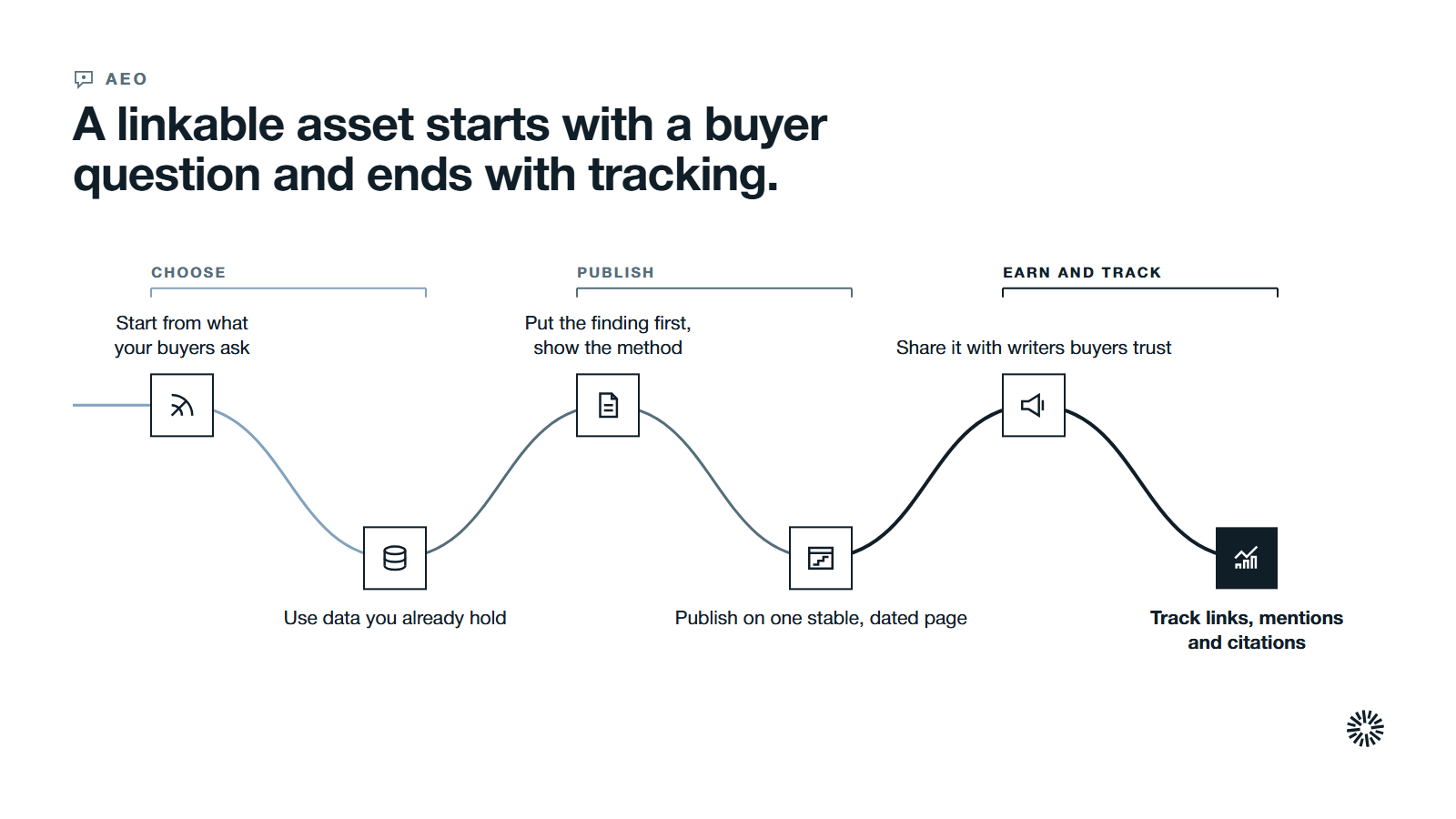
Start from what your buyers ask
List the questions prospects raise in sales calls and the figures your customers keep requesting. The overlap between what you can measure and what the market wants to know is your topic. Check it against your target audience. A blog post built from those questions is a natural home for the research.
Basic keyword research and a look at search intent show how buyers phrase the question, and which of your target keywords already has a page that answers it.
Use data you already hold
Aggregated, anonymized patterns from your own operations are often the richest source. Process timings, adoption rates and common mistakes can be summarized without exposing any customer. Remove anything that could identify a client before you publish.
Publish for people and for engines
Put the finding in the first paragraph, show the method, add a clean chart, and give each result a short sentence that can be quoted on its own.
A blog article, a tool page or a report that follows this pattern is linkable content in the plain sense: easy to understand, easy to cite and easy to find. Long form content works when each section answers a question on its own.
Quality content of this kind also needs a clear about page and named authors, so readers can see who stands behind the numbers. Use clear anchor text for internal links so readers and crawlers understand where each path leads. Our AEO checklist shows what an answerable page looks like.
When you present data, put the headline figure in text, not only in an image, so readers and crawlers can both read it.
Link from the asset to the service pages and other pages that answer the buyer's next question, and show external links to your sources so people can see where the numbers come from.
Promote it where your buyers already are
An asset does not attract links by existing. Share it with the writers, analysts and communities your buyers trust, including the SEO community if your topic touches search, and tell the customers and partners who appear in it. Ask owners of a resource page in your field to consider adding it.
Digital PR is the usual route for this, and the same asset can support a link building campaign for months. Your digital marketing team can reuse it across channels, and teams that acquire links this way spend less time pitching.
A short list of relevant websites in the same niche, built before you publish, keeps the work focused on readers who care instead of a broad audience that does not.
Measure what it earns
Track new referring domains, brand mentions and citations in AI answers, not only traffic. Link impact on rankings takes time, so judge the asset over months, not days. Each new link is a sign the page is worth linking to, and link acquisition that slows down tells you it is time to refresh it.
Our guide to measuring AI search visibility covers how to see whether engines mention you. Review the asset each quarter and refresh the numbers while the topic is still current. Regularly updating a page keeps the links it has and can bring new ones.
Improving on an older page that already ranks, sometimes called the skyscraper approach, is a fair way to start.
Mistakes that keep an asset from earning anything
A study with a tiny, unexplained sample reads as marketing. A tool that needs a signup before it shows a result gets skipped. A report locked behind a form cannot be linked, because the people who want to cite it cannot see it.
Another common mistake is chasing volume. Creating high quality content for one clear audience beats ten thin pages, and the effort of maintaining it is lower. Valuable information, clearly presented, is what makes link worthy content. Do not publish a figure you cannot stand behind.
What you gain when this is done properly
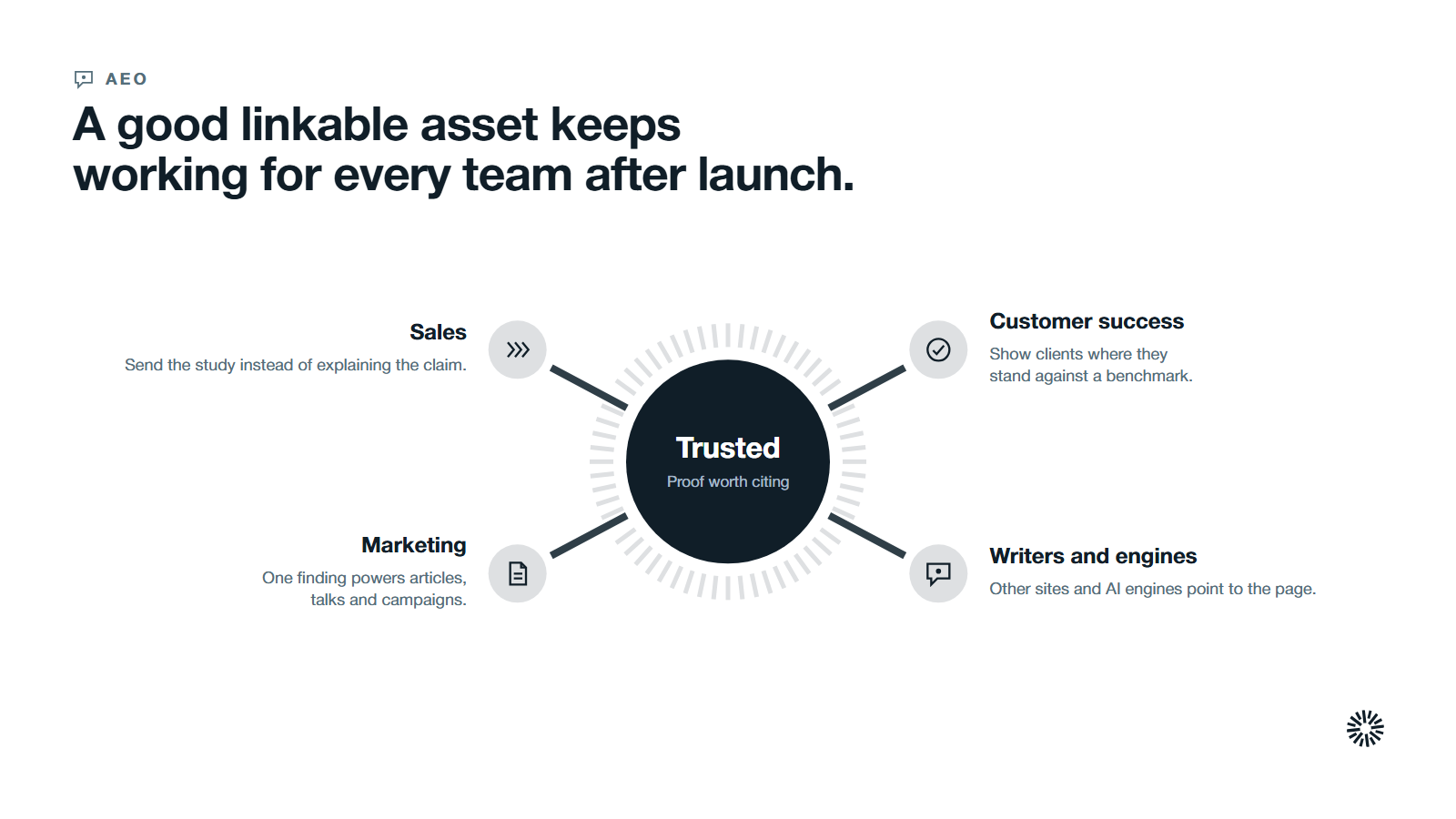
A good asset keeps working after launch, because other people and AI engines point to it.
Sales gets proof buyers already trust
When prospects meet your research in an assistant's answer or a trade article, the first conversation starts from credibility. Reps can send the study instead of explaining the claim, and the figures give them a neutral reason to reach out.
Marketing earns reach it cannot buy
Marketing gets content that can generate links and mentions for months from one piece of work. The same finding also powers articles, talks and digital marketing campaigns.
Customer success gets a benchmark to teach with
Customer success can use the benchmark to show clients where they stand and what good looks like.
Treat linkable assets as part of a go-to-market system
Original data is most useful when it feeds the rest of your go-to-market work: the same findings should shape your sales messaging, your content plan and your reporting.
Propello designs and builds connected go-to-market systems on HubSpot. If you want to know which asset your team could publish first, an audit is the place to start.
