Most growing B2B companies do not need an intent data provider yet. Start with the first party intent data you already own: website visits, content downloads, email replies and sales conversations. Buy third party intent data only when your own intent signals run out and a team is ready to act. For the full picture, read our complete guide to signal based selling.
This article is for CEOs, founders, CROs and revenue leaders at growing B2B companies deciding whether to pay an intent data provider. You will get what a provider replaces, what it costs in kind, when first party signals are enough, what breaks when you buy too early and a decision by company stage.
|
Intent Data Provider An intent data provider is a company that collects behavior signals from across the web and sells them as lists of accounts and topics that show who is researching a purchase like yours. |
An intent data provider replaces a guess about who is in market
Without any intent source, you choose target accounts by fit alone. You know which companies look like your potential customers, but not which are actively researching a purchase today.
An intent data provider sells an answer to that second question, and nothing else. Used well, intent data helps sales and marketing teams agree on which accounts to pursue first.
The answer matters because buyers move before they talk to you. In its 2025 B2B Buyer Experience Report, based on a study of nearly 4,000 buyers, 6sense found that 95% of the time the winning vendor was already on the Day One shortlist.
The same study put the point of first contact at 61% of the journey.
Buyers also prefer to research without you. Gartner's March 2026 survey of 646 B2B buyers found that 67% prefer a rep-free experience. That research happens where you cannot see it, a space often called the dark funnel.
Intent data is an attempt to see part of that space. It does not replace your ideal customer profile, your messaging or your follow-up.
It captures signals before a prospect ever fills out a form. Intent data helps you identify intent in accounts that already fit, so your buyer journey work can start earlier and reach in market buyers while they are still researching solutions.
The types of intent data decide what you are paying for
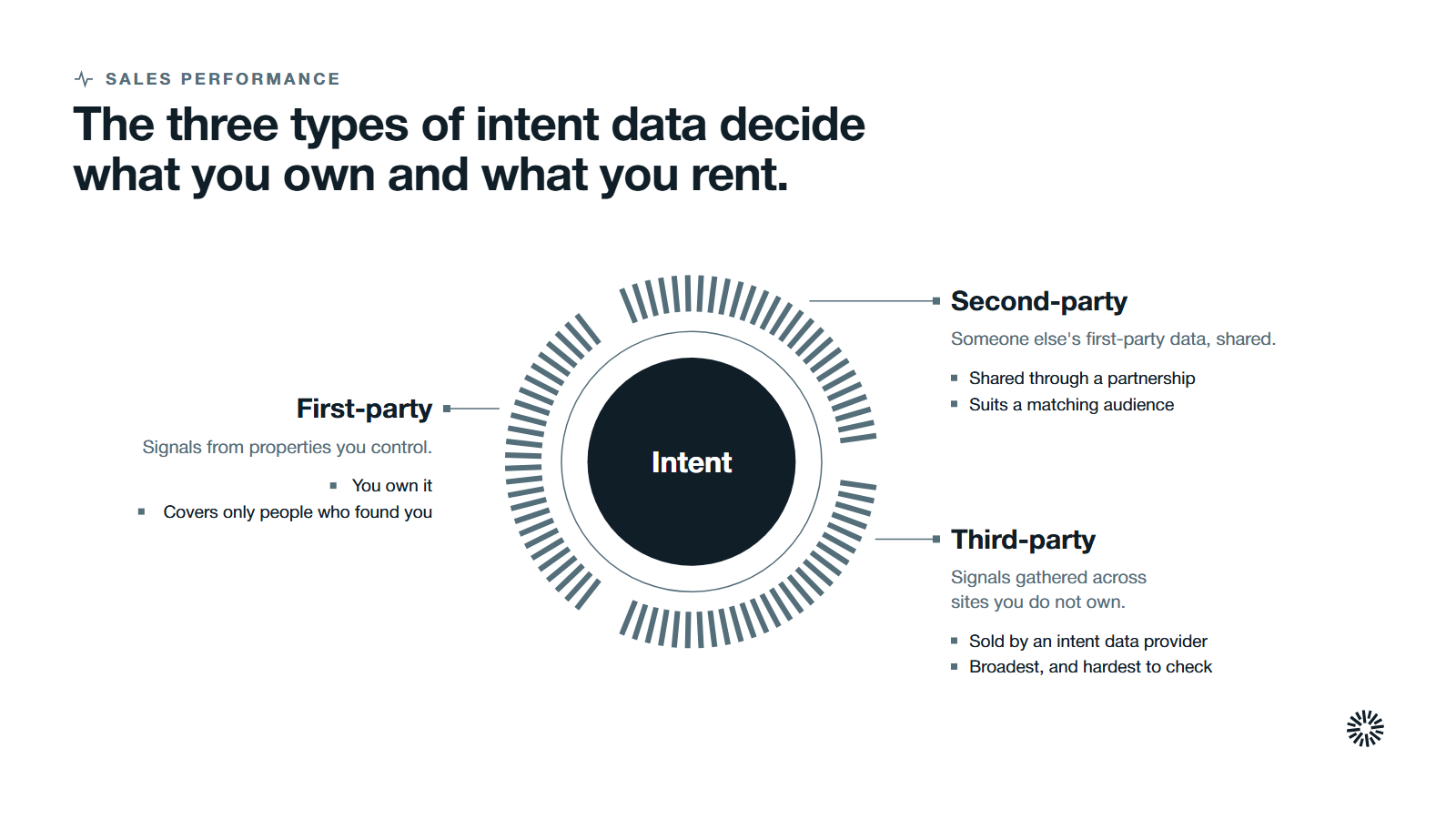
Buyer intent data is grouped by who collected it. The label tells you what you own, what you rent and how much of the buying activity it can see. Most confusion about the types of intent data comes from mixing the three together when you compare providers.
- First party intent data. Signals from properties you control, such as website visits, content downloads, event participation, product usage and email engagement. You own it, and it covers only people who found you.
- Second party intent data. Someone else's first party data, shared through a partnership. A review site or publisher might pass along the activity of readers who looked at your category.
- Third party intent data. Signals gathered across many sites you do not own and sold by an intent data provider. It is built from online behavioral information, such as content consumption patterns and searches.
Second party data suits a case where a partner's audience matches yours. Third party data is the broadest and the hardest to check, because you do not see how it was collected.
It reflects buyer behavior outside your channels and points to potential customers you have never met, but it is less precise than your own first party data.
B2B intent data of any type answers the same question, and the answer is only as good as its source.
Providers often add contextual and behavioral types of intent data on top of these three. Contextual intent data ties signals to the kind of content read, and behavioral intent data focuses on actions such as repeated website visits.
A third party intent data provider usually collects activity from a network of publisher sites and other sources.
Providers track digital footprints, and many use natural language processing to assign pages to topics, then summarize an account's interest in each topic over time. You receive a ranked list of accounts and topics, not a record of one person.
Buyer intent signals also vary in strength. A pricing page visit and a request for a demo are strong. A single article view is weak.
Intent signals are most useful when several kinds of user behavior line up, such as a pricing page visit, a search engine query comparing vendors and a repeat visit within days.
Other intent signals include review site activity, event participation and social media posts about a problem. Reading a topic once shows an interest to learn, while repeated research across several topics in a week looks more like an interest to buy.
For the workflow that turns these signals into sales action, see our guide to intent signals. To place the signals in the wider model, read how buyer signals feed the tailor stage.
What an intent data provider costs in kind
Quotes from providers are easy to compare. The cost that matters is the work your team takes on, and no price list shows it. A provider sells a feed of third party intent data. Actionable insights come only when your team turns the feed into decisions, and the cost lands in four places.
- A data layer to receive it. Account names have to match the records in your CRM, so someone owns matching rules, duplicates and the accounts the provider cannot resolve.
- Triage time. Someone has to identify patterns, review which spikes are real, and check which accounts are already customers.
- Rules for action. Sales and marketing need one agreed meaning for a signal, and sales teams need to know who follows up, how soon and with what message.
- Governance. You need to know where the data came from, how it was collected and what your markets expect around consent.
None of these costs shows on the invoice. All of them decide whether the feed becomes pipeline or becomes another dashboard that nobody opens.
There is also the cost of coverage. A provider tracks a fixed set of topics and sources. If your category is narrow or new, the topics that describe it may be broad, and the intent data market may not map cleanly to how your buyers search or how market trends shape their pain points.
Ask what the provider covers before you ask what it costs.
Real-time integration with your marketing automation platforms lets you act on intent signals the day they appear, so your existing tech stack must be ready for it.
A signal that cannot be routed to an owner, scored and measured is a data point, not a decision. If you have not built a lead scoring model sales will use, build that first.
First party intent data is enough when these conditions hold
First party signals are not a consolation prize. For many companies they are the better source, because they come from people who know you. They are also cheaper to act on, because the contact is already in your system.
First party intent data is usually enough when most of these are true:
- Your target accounts are a known, short list. You can name the accounts you want and track their visits directly.
- Your site and content already attract the right buyers. Visits, downloads and replies give sales and marketing teams enough intent signals to stay busy with potential customers.
- You are not working the signals you already have. If high intent visits sit unread today, a bigger feed makes the gap wider.
- Your sales cycles are short or your buyers come through referral. Few of your buyers research for months before reaching out.
- Your data is not clean yet. Duplicate and missing records make any new feed harder to use.
The last point is the one most often skipped. Unified customer records are the base that every signal sits on, and first party data work comes before renting anyone else's.
Combining first party and third party data later improves lead validation and gives a more comprehensive view of each account, because each source checks the other.
Buy third party data when the opposite is true: your target market is larger than your own traffic can reveal, your team acts on every first party signal within a day, and you keep finding out about deals late.
What breaks when you buy an intent data provider too early
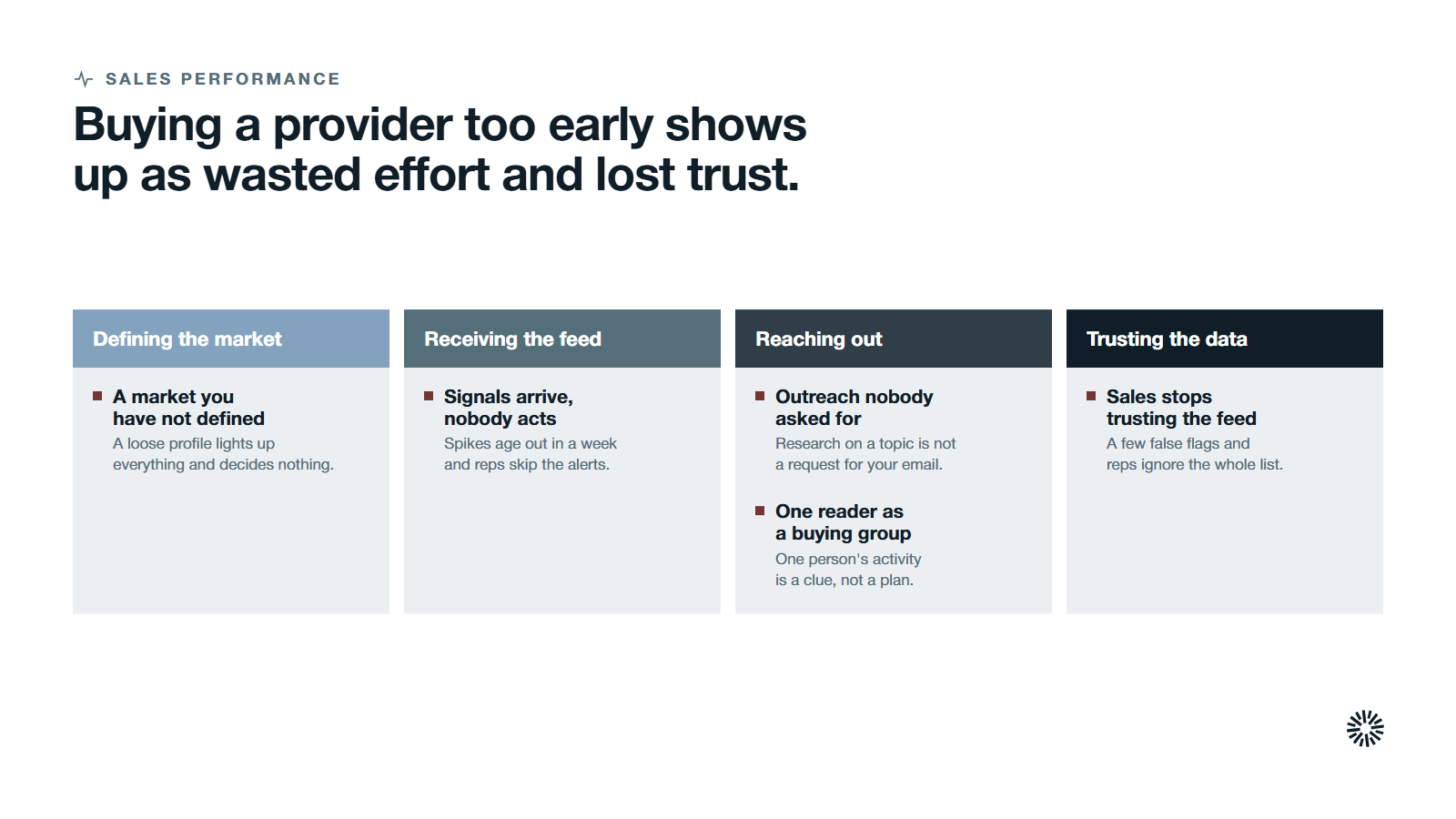
The cost of buying too early rarely shows up as a failed purchase. It shows up as effort that goes nowhere and a team that stops believing the numbers.
Signals arrive and nobody acts
A feed of high intent accounts is only useful if someone owns the next step. Without that owner, spikes age out in a week, reps skip the alerts, and the contract renews on hope. The intent signals were not the missing piece. The routing was.
Outreach lands on potential customers who did not ask
Intent data tells you an account is actively researching, not that a person wants your email. Gartner's 2025 survey of 632 B2B buyers found that 73% actively avoid suppliers who send irrelevant outreach. Mass sales outreach triggered by a topic spike risks being exactly that.
One signal gets treated as a whole buying group
A third party feed usually reports account behavior, while a purchase involves many people. Forrester's 2024 research on business buying found that 13 people are involved on average, and 89% of purchases involve two or more departments. One reader's activity is a clue about the buyer journey and the buying process, not a plan.
Sales sees noise and stops trusting the feed
Accounts flagged as in market that turn out to be customers, competitors or students waste time for sales teams. A few of these are enough for reps to ignore the whole list, and data accuracy becomes the argument instead of the pipeline.
You pay for coverage of a market you have not defined
If your ideal customer profile is still loose, intent data lights up everything and decides nothing. The cost of not defining your ideal customer profile is paid again when a feed expands the list to accounts you should never have chased.
Match the decision to your company stage
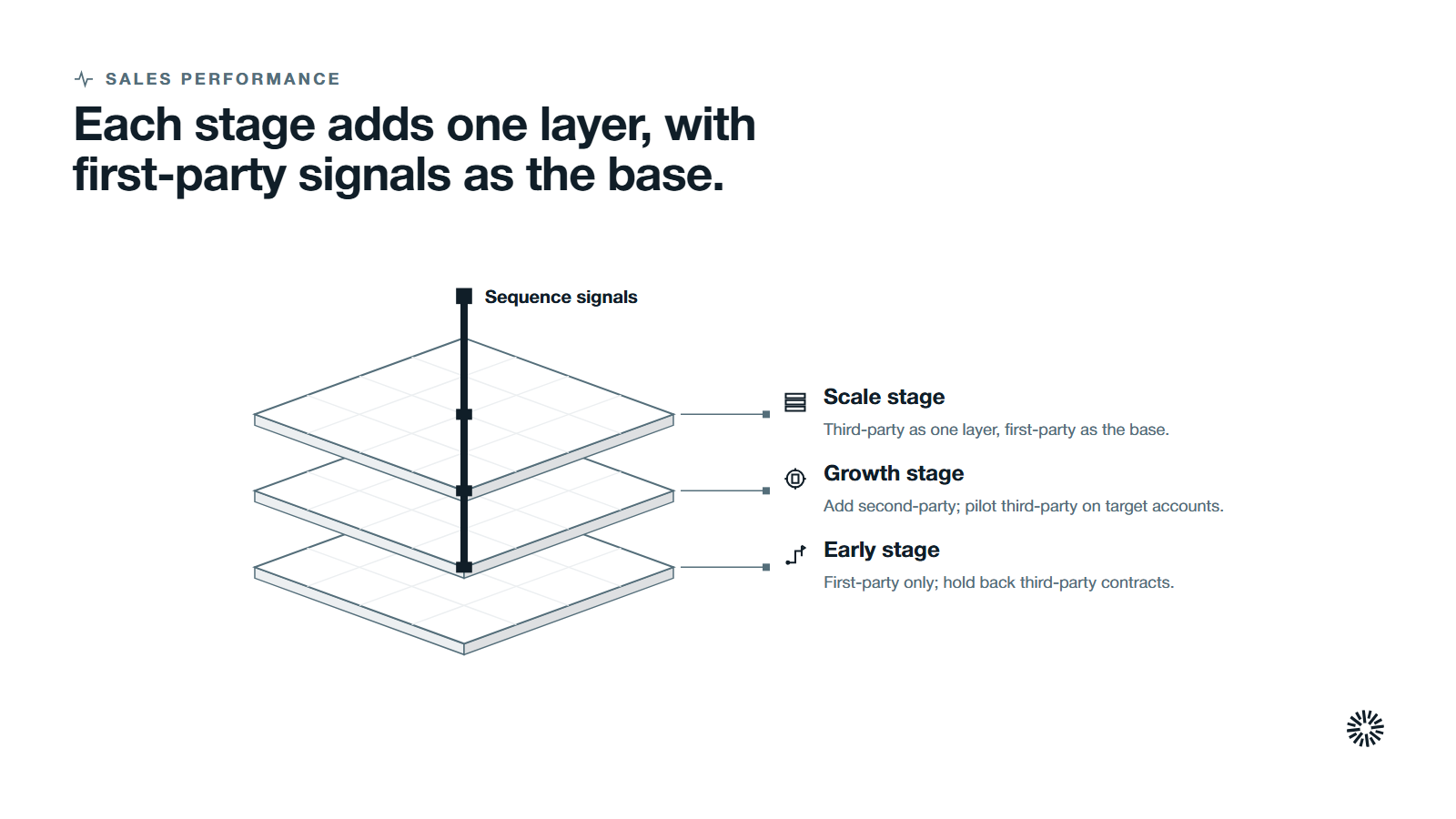
Company size changes whether an intent data provider pays back. The principle is the same at every stage: sequence the signal sources, and use intent data from a provider only when the team can act on it.
Early-stage company with a small team
Use first party data and its intent signals only. Track pricing page visits, demo requests, replies and the accounts that return to your site, and give one person ownership of the follow-up. Hold back any third party contract. Watch whether your team acts on every first party signal quickly and without being chased.
Growth stage with several teams
Add a second party data source if a partner shares audience activity that matches your market.
Pilot third party intent data on a small set of target accounts, alongside account based marketing. Hold back wide topic lists. Watch whether marketing and sales teams agree on what counts as a real signal. The guide to account-based marketing shows how to choose those accounts.
Scale stage with several products or regions
Use third party data as one layer in a connected model, with first party signals as the base. Account intelligence combines them into a comprehensive view of each account.
Mature teams can add predictive analytics once the history is clean. Hold back a separate feed for each region. Watch whether the same account looks different by team, because that points to a data problem, not a buying problem.
Four questions to settle before you talk to any provider
A provider demo is persuasive because it shows the most exciting accounts. These four questions cover the key factors. Settle them first, and every conversation gets easier to judge.
- Name the decision a signal will change, such as which accounts sales calls this week.
- Name the person who owns each alert and the time they have to respond.
- List the first party signals you already collect and the share you act on today.
- Ask each provider where its data comes from, how it assigns accounts and how it checks quality.
Ask each provider to explain its answers in plain language and to show how the feed would enter your systems. A provider that cannot do this is not ready for your team, whatever its coverage claims.
What you gain when this is done properly
Intent signals pay off when the right source meets a team that can turn them into actionable insights. The benefit shows up in the work of each team.
Sales spends time on accounts that are researching
Sales teams start from a short list of accounts with a reason to engage prospects, ranked by how urgent the research looks. Reps stop opening cold lists, and managers can ask why an account was worked rather than how many calls were made.
Intent data also feeds lead scoring, so the ranking moves as behavior changes, and marketing and sales outreach stays in step.
Marketing aims campaigns at the accounts that are in market
Marketing teams can follow what accounts are researching. Segmentation by topic supports targeted multichannel campaigns, so you can personalize content and digital advertising, retarget the accounts you want, and review campaign performance against whether the signal led to a conversation. Revenue attribution gets clearer because the trigger is recorded.
Customer success hears about change sooner
Signals do not stop at the first sale. Monitoring existing customers lets you track churn and expansion signals. If a customer account starts researching a competitor, you can step in early instead of finding out at renewal. That is competitive intelligence you did not have to ask for.
Buy signals after you can act on them
The honest answer to whether you need an intent data provider is that it depends on what you do with signals today. If you already act on your first party signals, a provider can widen your view. If you do not, it widens a gap that already exists.
Propello designs and builds connected go-to-market systems on HubSpot. If you want help deciding which signals to build on and how to use intent data before you buy any, an audit is the place to start. See what the Propello GTM Audit covers and how to prepare.