
If you lead revenue at a growing B2B company, a demand generation framework is the written structure that connects your marketing, sales and customer success work to one goal: more of the right buyers choosing you before they fill in a form. The one you can run has three stages: Diagnose, Connect and Compound.
This guide is for CEOs, founders, CROs and revenue leaders, and for the marketing and sales leads who carry it out. You get the stages as six steps, each with a finish line, plus the checks to make first and the mistakes that stall B2B demand generation in its first year.
|
Demand Generation Framework The agreed structure a company follows to build awareness and interest among its target audience, turn that interest into qualified pipeline, and learn from the results, with clear owners at each stage. |
By the end you will have a working framework, not a list of tactics
A good framework is short enough to explain in a meeting and specific enough for a new hire to run.
- One written ideal customer profile and a list of target accounts that match it.
- A map of where potential buyers learn about you today and where they drop out.
- One shared record of each account that marketing and sales teams both trust.
- A small set of demand generation campaigns tied to the stage of the customer journey they serve.
- A weekly and monthly review routine, with an owner for every decision.
What to have in place before you start
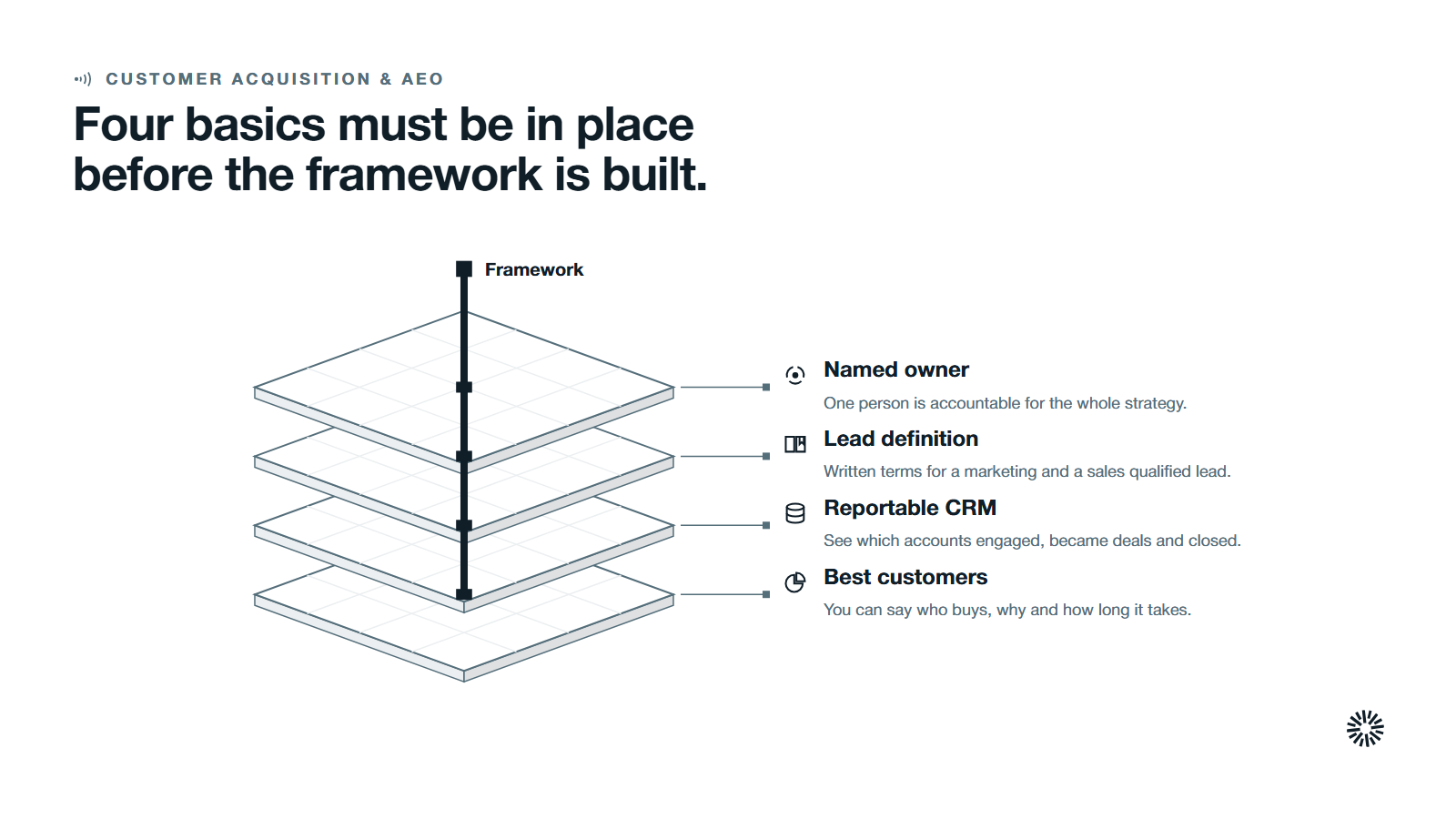
A framework gives structure to work you already do. It cannot replace the basics, so check these first.
- A named owner. One person is accountable for the whole demand generation strategy, even when several teams contribute.
- A shared definition of a qualified lead. Marketing and sales agree in writing what counts as a marketing qualified lead and what counts as a sales qualified lead.
- A CRM you can report from. You need to see which accounts engaged, which became opportunities and which closed, in one place.
- A first view of your best customers. You can describe who buys, why they buy and how long the sales cycle runs.
If the basics of the discipline are new to your team, read what demand generation is first. For a worked picture of one program in motion, see demand generation examples.
Why B2B demand generation needs a framework
Business buyers rarely decide fast. Several people weigh in, the sales cycle runs for months, and most of the research happens before anyone speaks to a seller. Without a structure, demand generation marketing turns into a set of separate marketing efforts that nobody can connect to the sales pipeline.
A framework is the long term strategy that holds those efforts together. It tells marketing leaders what to build, tells sales where to step in, and gives both sides one way to judge business growth.
Demand generation covers three jobs. It helps you generate awareness among potential customers, captures existing demand from people already looking, and turns both into qualified leads. A demand gen strategy that skips one of the three leaves a gap for a competitor to fill.
How demand generation differs from lead generation
Lead generation collects contact details from people who already want something, usually through a form, and aims for a conversation within days or weeks.
Demand generation works earlier and wider. It is long-term market education that builds the awareness, trust and relationships that make people look for you, and then captures the existing demand that results.
That is why a framework moves a team away from short-term lead generation tactics. Each stage connects to the next, so awareness builds into interest, interest into a sales conversation and a sale into a lasting customer relationship.
You need both. A framework decides how much effort goes into creating demand and how much into capturing it, so neither starves the other. It also keeps marketing and sales efforts pointed at the same accounts. Lead gen is the capture side, and the B2B lead generation guide covers it in detail.
A demand generation framework in three stages
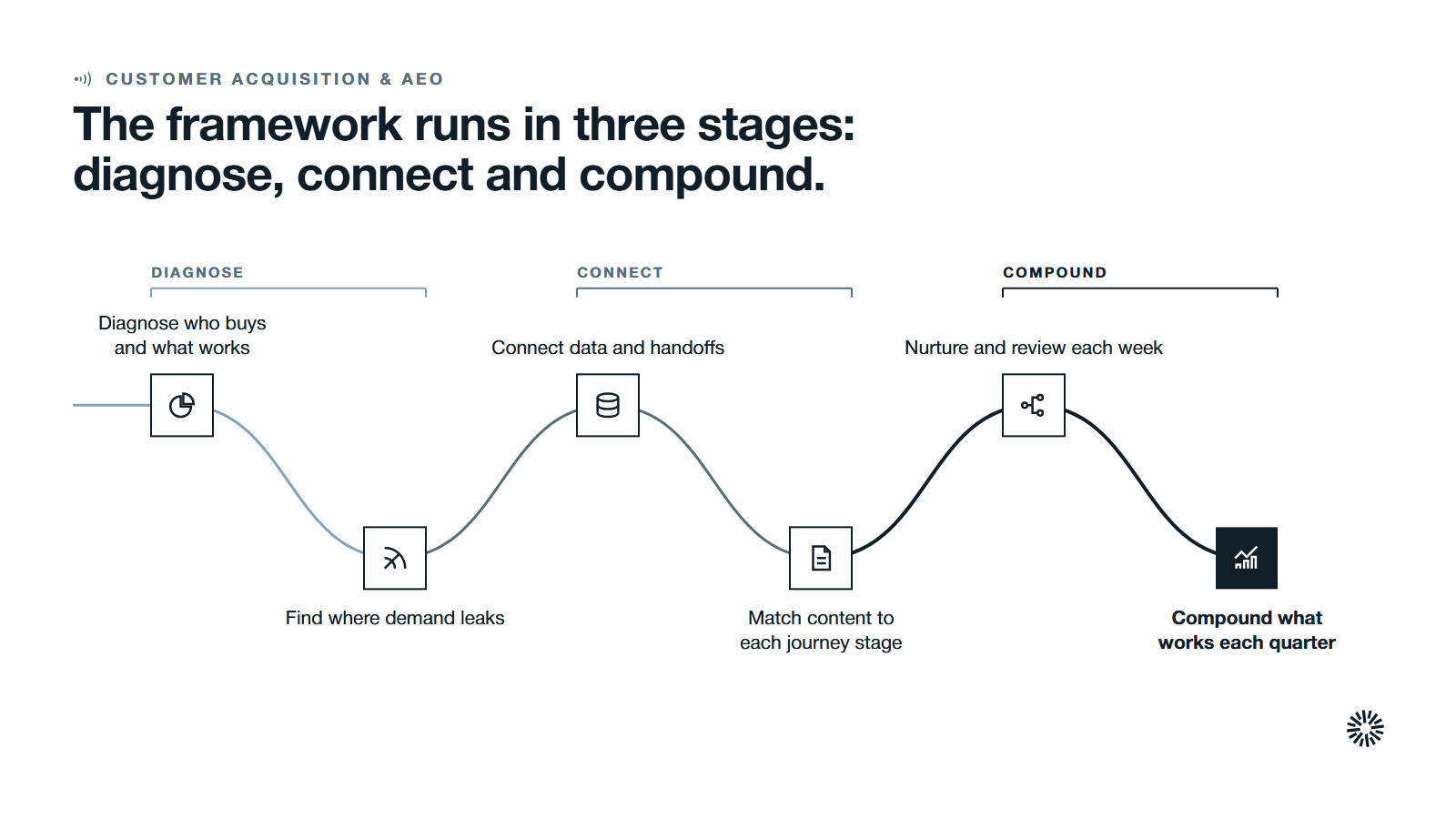
The framework has three stages. Diagnose finds out who your target buyers are and where demand breaks. Connect joins the data, the people and the content so a buyer experiences one company. Compound turns each cycle of work into a better one.
Each step below ends with what done looks like. Work through them in order, because later steps depend on earlier answers.
1. Diagnose who buys and what already works
Start with your own results. Pull the last year of closed deals and mark the ones you would happily win again. Note the industry, company size, the roles involved and the first thing each account did with you.
This tells you your real target market, which is often narrower than the one in your deck.
Demand generation marketers often skip this step and start with channels, which is how budget ends up chasing the wrong target buyers. Write the ideal customer profile from those deals, then list the target accounts that fit it. The ideal customer profile template is a quick way to put it on one page.
Keep the profile alive. A dynamic ideal customer profile changes as new closed deals and buyer signals show which accounts are most likely to convert.
Plan for a group, not a person. Forrester's 2024 survey of 16,000 global B2B buyers found that on average, 13 people within the organization are involved in the buying decision. Your content has to work for several roles, not one champion.
You are done when one page names the ideal customer profile, the roles in a typical buying group, the target accounts and the three deals that best show what a good customer looks like.
2. Diagnose where demand leaks across the customer journey
Next, follow a typical buyer from first touch to signed contract and mark every place they stall or vanish. Look at awareness, first conversation, evaluation and handoff to sales teams.
Many leaks sit between teams, not inside a channel. Leads wait in a queue, sales outreach repeats what marketing already said, and nobody owns accounts that go quiet. The B2B buyer journey guide helps you describe each stage from the buyer's side.
Also check what happens before any contact. Intent data and web activity can show which accounts are researching the problem before they talk to anyone.
6sense's 2025 study of nearly 4,000 B2B buyers found that 95% of the time, the winning vendor is already on the buyer's Day One shortlist. If buyers have decided before they speak to you, the work that earns a place on the list is the work that matters.
You are done when you have a one-page map of the customer journey with the three biggest leaks marked and an owner named for each.
3. Connect your data and handoffs in one system
Demand generation fails quietly when marketing and sales read different numbers. Put every account, contact and activity into one CRM model, with agreed properties for source, stage and owner.
This is where revenue operations earns its place. It owns the data model, the lead routing rules and the reports that both teams use. If the idea is new to your team, what RevOps is explains how the function works and why it matters here.
Then agree the handoff. Define what a marketing qualified lead must show before sales picks it up, how fast sales responds, and what happens to leads that are not ready. Write each rule down and build it into the system so it runs the same way every time.
Build one shared dashboard on top of that model so both teams work from a single source of truth, and agree the definitions of each metric before anyone reports on it. Score leads together, because collaborative lead scoring reduces the friction that appears when each team judges quality alone.
Choose demand generation tools only after the data model is clear. A tool cannot fix a handoff that nobody has defined, and it makes a weak process run faster.
You are done when marketing and sales can open one report, see the same accounts at the same stages, and every handoff has a rule, an owner and a response time.
4. Connect content marketing and demand gen campaigns to each journey stage
With the diagnosis and the data in place, plan demand generation campaigns around the buyer's journey, not around channels. Your marketing strategy sets the message and the campaigns carry it. For each stage, decide what the buyer needs to believe, what proof they need and where they are most likely to find it.
Buyers compare potential solutions long before they contact anyone, so give them high-quality content that educates them and supports the decision they are working toward. Good content solves a real pain point, which is how a company earns genuine brand preference.
Use lead generation campaigns only at the stages where asking for contact details is fair.
Match the demand generation activities to the stage they serve:
- Creating awareness: content marketing and search that help your target audience understand the problem.
- Generating interest: webinars, events and social media campaigns that bring the right people into your orbit.
- Evaluation: comparison material, customer stories and industry insights that answer the questions evaluators ask.
- Decision: sales enablement, sales engagement and sales resources that buying groups can share internally.
Choose a few marketing channels and do them well before you add more. Paid advertising, email and events all work when they serve a defined audience and a defined stage. Targeted advertising and social media campaigns reach the accounts on your list directly, which beats broad reach in a narrow market.
Thought leadership earns attention when it takes a clear position on a problem your buyers face. A clear content strategy keeps each piece tied to a journey stage and a target account list.
Be deliberate about gated content. Keep the guides that help a buyer decide open, and gate only what justifies handing over contact details, such as a template or an assessment.
Use signals to decide where to spend. Intent data shows which accounts are researching your topic now, and the guide to using it explains the signals. An account-based marketing program then focuses effort on those accounts first, treating each high-value account as a market of one.
You are done when each journey stage has one owner, one core campaign, the proof that supports it and a clear next step for the buyer.
5. Compound with lead nurturing and a fixed weekly and monthly review
A framework earns its keep through repetition. Between the first visit and the first sales conversation, lead nurturing builds trust with personalized content, email and remarketing campaigns that fit what each contact has already seen.
Automated workflows help here, because they deliver the right message at the right time without a person chasing every contact. They also lower customer acquisition cost over time, since fewer leads go cold.
Then put a short review on the calendar and keep it. Regular joint pipeline reviews improve collaboration, so marketing teams and sales teams attend together. Each week, look at engagement among target accounts, which marketing campaigns they met and anything stuck at a handoff.
Each month, check the demand generation metrics that connect to revenue:
- Marketing sourced pipeline and the pipeline marketing influenced.
- Lead quality, shown by how many qualified leads become opportunities.
- Conversion rates at each stage of the pipeline.
- Sales cycle length and pipeline velocity, meaning how fast opportunities move between stages.
- Cost per lead and customer acquisition cost against the revenue generated.
- Customer lifetime value, the total profit a customer brings over the relationship.
Count what moves accounts toward revenue, not what looks busy. A marketing KPI dashboard keeps those measures in front of both teams. Treat lead volume as a supporting figure, because a large number of weak leads costs time and hides the accounts that matter.
Keep every review to the same three questions: what did buyers do, which assumption was wrong, and what will we change before the next meeting?
You are done when the review runs without you in the room, the measures come from the CRM and each meeting ends with a change that has an owner and a date.
6. Compound what works into the next quarter
Each quarter, step back from the weekly detail. Keep the demand generation programs that created qualified pipeline, fix the ones that nearly worked and retire the rest. Move budget toward the channels and messages that reached the right accounts and helped to convert leads into customers.
Treat your demand generation marketing efforts as one portfolio and share the findings with sales, so the next sales initiatives start from evidence. This is the long habit that makes a demand generation strategy improve instead of repeat.
Capture what you learn in the system, not in someone's head. Tag the content that helped deals move, record the objections that came up, and feed both back into the next round of diagnosis.
This is where the framework meets Loop Marketing, HubSpot's four-stage framework of Express, Tailor, Amplify and Evolve. Loop Marketing describes how a marketing team creates and refines its messages. Your demand generation framework applies the same habit across the full revenue team.
For a deeper comparison with the earlier HubSpot model, read Loop Marketing vs the HubSpot Flywheel.
If you want the full picture of the model, what Loop Marketing is walks through each stage.
You are done when the quarterly review has been held, the budget has moved toward what worked, and the next quarter's priorities are written down with owners.
Mistakes to avoid when you build a demand generation framework
Most programs that stall repeat a few errors. Check your plan against this list.
- Starting with demand generation tactics. Picking channels before you know your buyers produces activity without direction.
- Measuring only leads. Programs that only generate leads say little about pipeline. Judge the program on qualified accounts and revenue growth.
- Gating everything. Putting every guide behind a form hides your best thinking from buyers who are not ready to talk.
- Splitting marketing and sales. Separate goals and separate numbers guarantee a leaky handoff, so align sales and marketing on one set of measures.
- Chasing a single channel. Betting on one source leaves you exposed when it changes.
- Expecting quick results. Demand takes time to build, and a long sales cycle means early signals are about engagement, not closed deals.
- Skipping the review routine. Without a fixed rhythm, the framework drifts into a document nobody opens.
What you gain when this is done properly
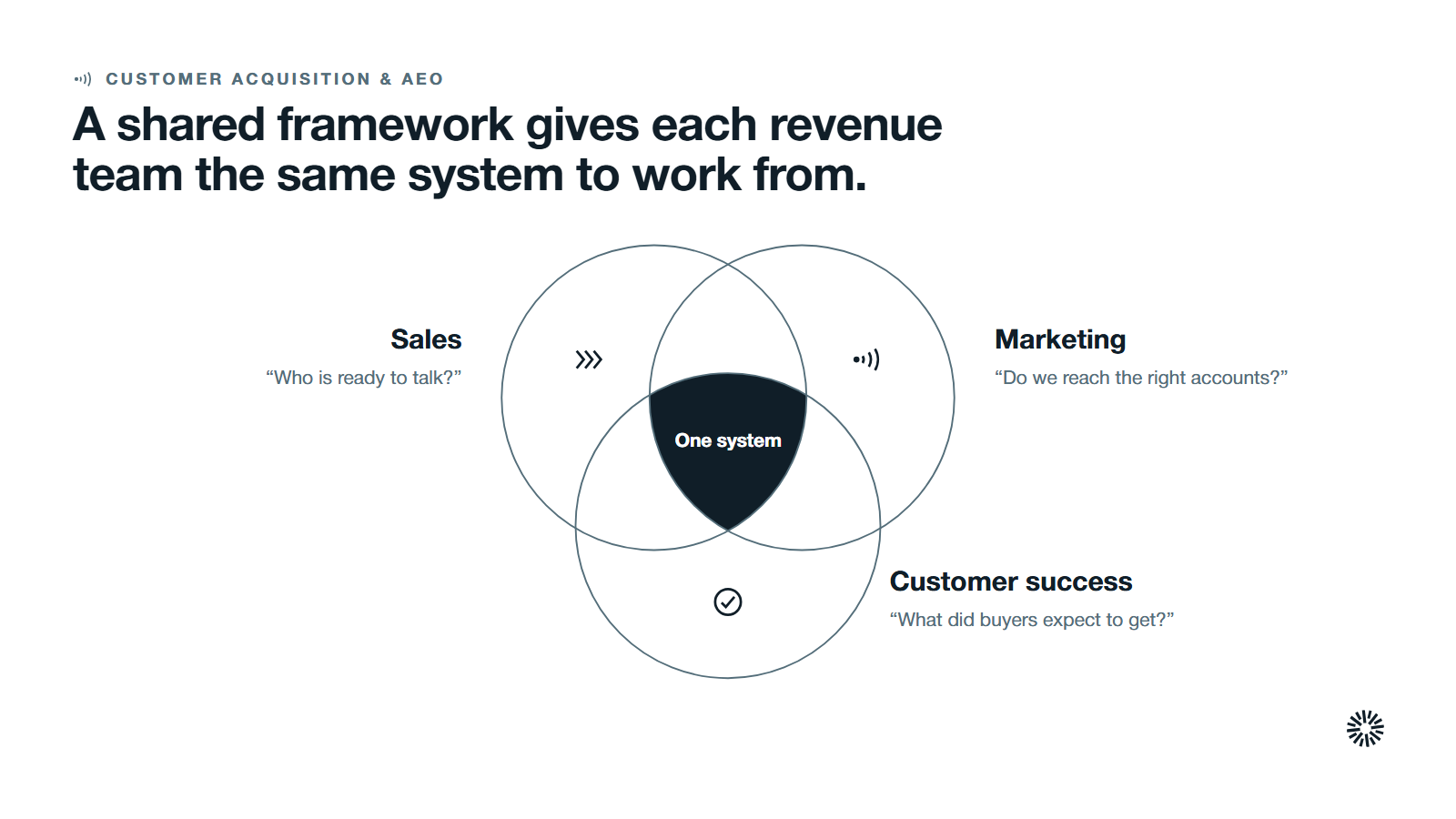
A framework turns demand generation from a set of separate efforts into one system that every revenue team can see and improve. Done well, it makes revenue more predictable and easier to scale, because demand turns into high-quality revenue by design. Each team gains in a different way.
Sales gets better conversations
Sales teams meet buyers who already know the company and have a reason to talk. Accounts arrive with context, from the content they read to the campaigns they saw, so the first call starts further along.
Marketing gets a clear target and a fair measure
Marketing builds for a defined audience and is judged on pipeline quality, not on form fills alone. The shared CRM shows which campaigns reach the target accounts, so budget follows evidence and builds market presence where it counts.
Customer success gets earlier insight and stronger references
Customer success learns what buyers expected before they signed, and can prepare onboarding around it. Timely updates and good service keep customers, and happy customers become the stories and references that the next round of demand generation relies on.
Build demand on a framework, not on a list of tactics
A demand generation framework gives your revenue team one way to decide who to reach, what to say, how to hand over and what to change. Diagnose first, connect the data and the people, then compound what works.
Start small, keep the review routine and let the evidence set the pace.
Propello designs and builds connected GTM systems on HubSpot. If you want your ideal customer profile, data model, handoffs and reporting set up so a framework like this can run, an audit is the place to start.
