If you run sales, marketing or customer success at a B2B company, you have probably watched a hard-won customer leave at renewal. A customer retention strategy is the plan that stops that: how you keep existing customers, grow what they spend and turn them into loyal customers.
This guide is for CEOs, founders, CROs and revenue leaders who want the whole picture in one place. You will learn what to measure, why customers leave, how to build a customer retention program in six steps, and how sales, marketing and customer success each carry part of the work.
|
Customer Retention Customer retention is a company's ability to keep existing customers buying, renewing or subscribing over time, measured by how many customers stay and how much revenue they keep generating. |
A customer retention strategy turns customer acquisition into lasting revenue
Most growth plans spend their energy on customer acquisition. Retention is the other half of the equation. Every new customer you win only pays off if they stay long enough to cover what it cost to win them, and then keep buying.
Customer retention refers to what happens after the signature. A retention strategy is the set of decisions, owners and routines that make staying easy and leaving unattractive. It covers onboarding, support, feedback, communication, renewals and the offers that bring existing customers back.
That is why retention is cost effective. You already know your existing customers, their products or services, their goals and their pain points. Selling more to people who trust you takes less effort than finding new customers from scratch, and it protects the revenue you have already booked.
Retaining customers is cheaper than acquiring new customers, and retention compounds. Retained customers become repeat customers, repeat customers bring repeat business, and a loyal customer base produces word of mouth that feeds customer acquisition without extra spend.
High retention also produces predictable revenue, which makes budgets, hiring and forecasts easier to plan. A strong customer retention strategy therefore supports business growth in two directions at once.
Retention is a team sport, not a support function
Retention fails when it belongs to one department. Customer success may own the relationship, but the reasons customers stay or leave start in the sales promise, the product, the invoice and the follow-up. Everyone who touches the customer journey affects it.
Our guide to what customer success is explains the role. This pillar shows how that role fits with sales and marketing in one revenue system.
Customer retention rate and churn show whether your strategy works
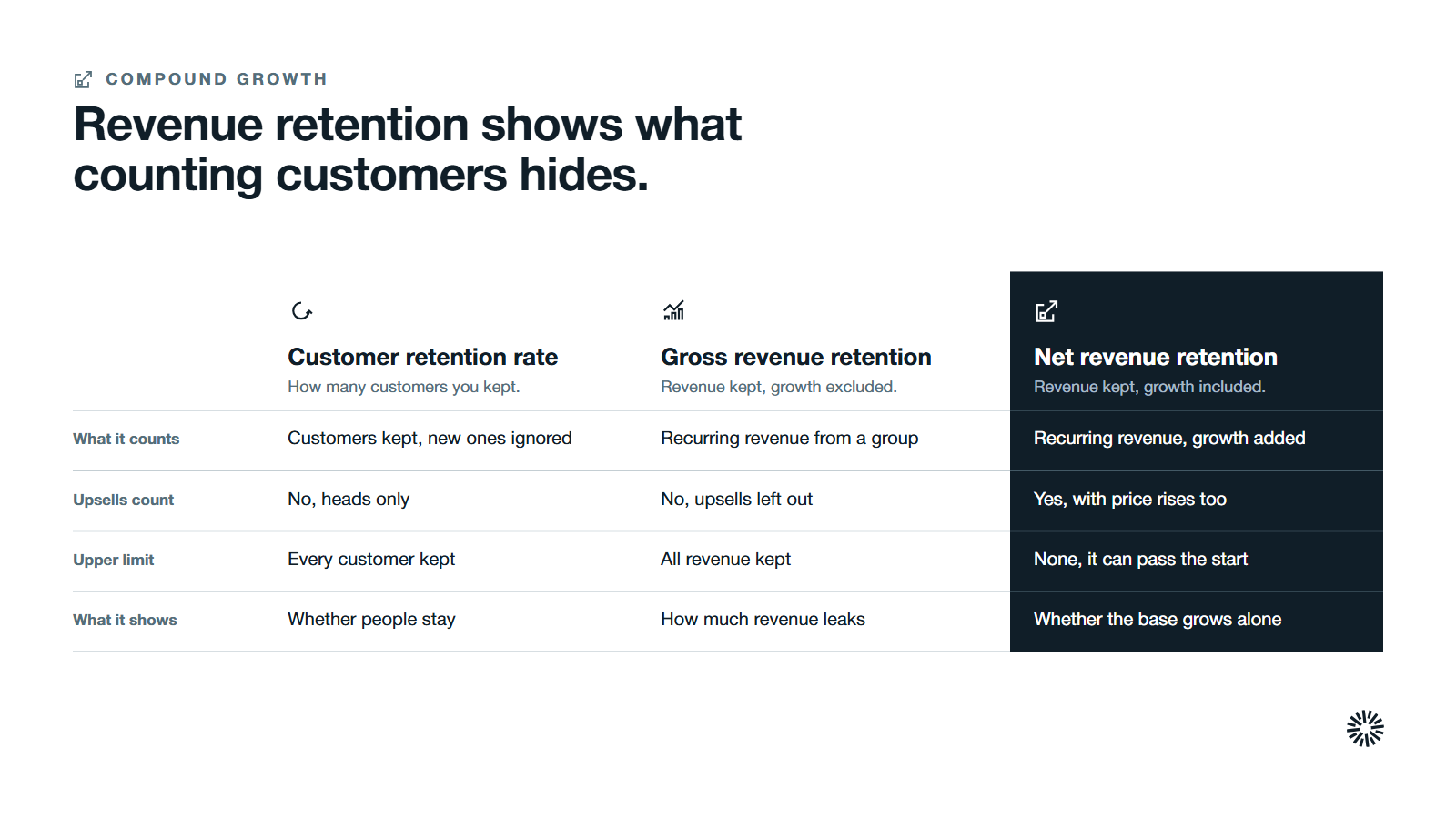
You cannot improve customer retention without measuring it. Start with two numbers that mirror each other: customer retention rate and customer churn rate. For a step-by-step plan, see how to reduce customer churn.
Retention rate tells you how many customers you kept. The customer churn rate tells you how many you lost, so a rising churn rate is the first warning that something is wrong.
How to calculate customer retention rate
The customer retention rate formula compares the customers you have at the end of a period with the ones you started with, ignoring anyone who joined during the period.
Retention rate = ((customers at the end of the period minus new customers acquired in the period) divided by customers at the start of the period) x 100.
Here is an illustrative example, not real data. You start the quarter with 200 customers, win 30 new ones and end with 210.
Customers retained: 210 minus 30 is 180. Retention rate: 180 divided by 200, or 90%. Churn is the remaining 10%. Knowing how many customers you lost, and which ones, tells you where to look next.
The same formula answers a common question: what does an 80% retention rate mean? It means you kept four in every five customers over that period and lost one. Whether that is good depends on your contract size, your market and the period you measure.
Revenue retention matters more than counting customers
Counting heads hides a lot, because the number of customers can stay flat while revenue shrinks. Losing one large customer hurts more than losing five small ones. So B2B teams track two revenue measures alongside the customer count.
- Gross revenue retention. The share of recurring revenue you keep from a group of customers, excluding upsells and price increases. It cannot exceed 100%.
- Net revenue retention. The same measure including upsells, cross-sells and price increases, so it can rise above 100%.
Benchmarks help you judge your own numbers. In its 2025 survey of private B2B SaaS companies, SaaS Capital found a median net revenue retention of 102% for companies with annual contract values between $25,000 and $50,000. The top quartile reported 111% and the lowest quartile 97%.
The same survey found that the median growth rate across companies with more than $1 million in annual recurring revenue was 24%. Groups with net revenue retention of at least 110% grew faster than that median, and groups below 100% grew slower.
The lesson is simple. Revenue that expands inside your existing customer base compounds, and revenue that leaks out of it forces you to run faster just to stand still.
The metrics that complete the picture
No single number tells you whether customers are happy. Use a small set of key metrics together.
- Customer lifetime value (CLV). The total revenue a customer brings over the whole relationship. Raising retention lengthens customer lifetime, which raises customer lifetime value.
- Repeat purchase rate. The share of customers who buy again, which suits businesses with repeat purchases rather than annual contracts.
- Net Promoter Score. A survey of how likely customers are to recommend you, useful as an early signal of customer loyalty and a simple way to measure customer loyalty over time.
- Purchase frequency and average order value. How often customers buy and how much they spend each time, which show the spending patterns of retained customers.
- Customer satisfaction scores. Short surveys after support or onboarding that show how a specific moment went.
- Product usage and customer engagement. How often and how deeply customers use what they bought, which often falls before a cancellation.
To measure customer retention well, pick the metrics that fit your model, define each one in writing and review them on a fixed schedule. The RevOps function usually owns the definitions, so every team reads the same numbers.
Customers leave for a handful of predictable reasons
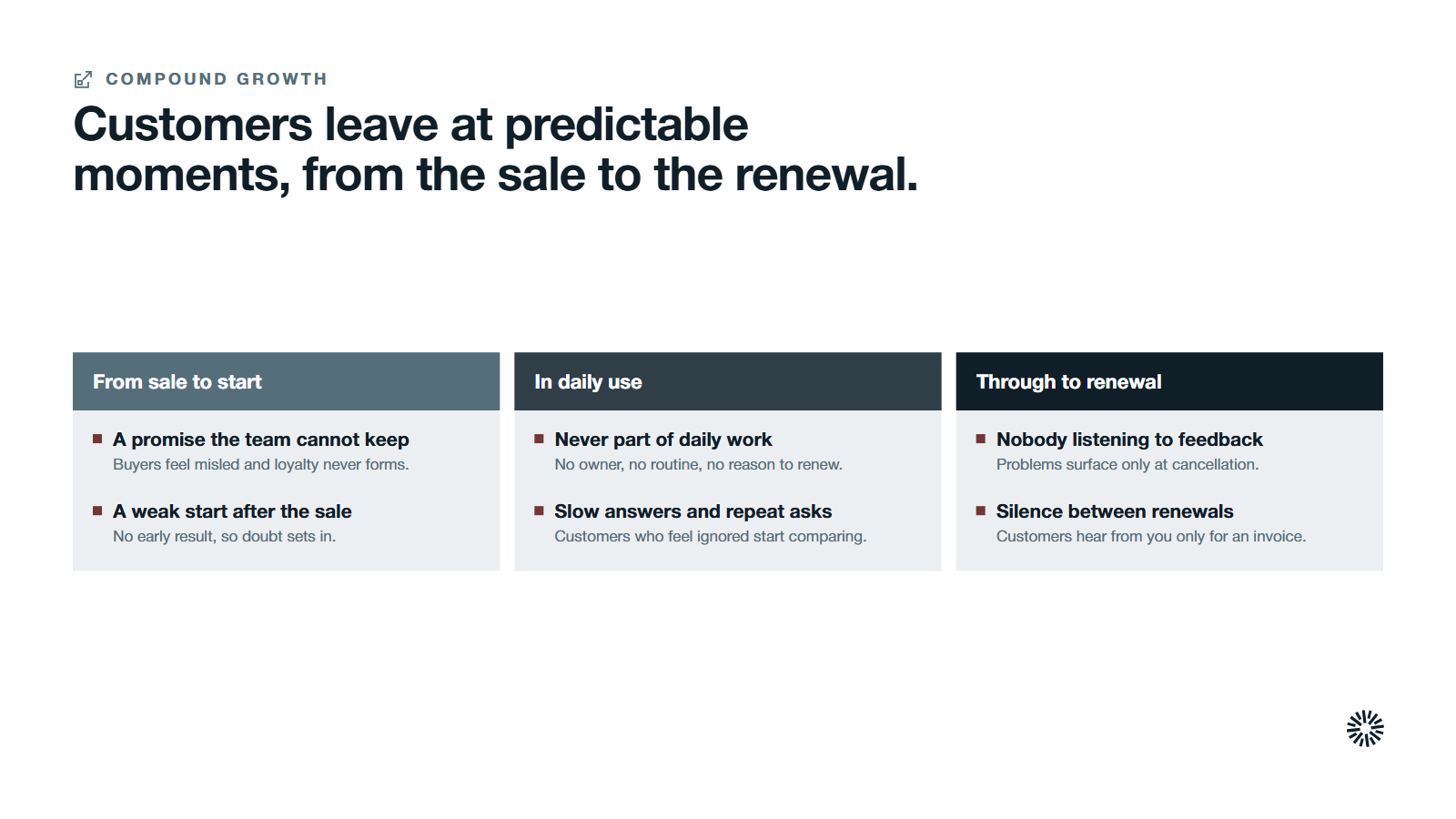
Most churn is not a surprise to the customer. They noticed the problem months before they told you. Learning why customers leave is the fastest way to decide where your customer retention efforts should go, because effective customer retention starts with the causes, not the symptoms.
Poor customer service and slow answers
Poor customer service is the most visible cause. Slow replies, repeated explanations and handoffs between people who do not share context all signal that the customer is not a priority. Customers who feel ignored start comparing alternatives.
Proactive support, such as reaching out when a problem is likely, resolves issues before they escalate and can prevent churn before it happens.
Expectations keep rising. Zendesk's 2025 CX Trends report, published in November 2024 and drawn from more than 10,000 consumers and business leaders, found that 63% of consumers would switch to a competitor after just one bad experience. It is a consumer survey, but it shows how little patience people have.
A weak start after the sale
The first weeks set the tone. If the customer cannot reach their first result quickly, they begin to doubt the purchase. Onboarding that is vague, late or handed to a stranger is a common and fixable source of early churn.
The product or service never became part of daily work
Customers who do not build the product into their routine have no reason to renew, because it no longer meets their daily customer needs. Low usage, an unclear owner on their side and a missing business case all lead to a renewal conversation that starts from zero.
Nobody was listening
When customers have complaints, ideas and customer pain points, they either tell you or tell a competitor. Companies without a way to collect and act on customer feedback learn about problems at cancellation, which is too late.
The promise did not match the delivery
Sales sometimes tries to convince customers with promises the team cannot meet. Customers then feel misled, and no loyalty program can repair that. Honest qualification up front is part of the retention strategy, not a separate topic.
Silence between renewals
Customers who hear from you only when an invoice is due feel like an invoice, not like one of your long term customer relationships. Regular, useful communication keeps the relationship warm and gives you early warning when something changes.
Customer experience decides whether customers feel valued
Customer experience is the sum of every interaction a customer has with you, from the first demo to the fifth renewal.
Customers value the experience a company provides as much as the products or services it sells, and they rarely judge one moment. They judge the pattern, and whether the company meets customer expectations consistently.
Meet customer expectations before they become complaints
Write down what you promised during the sale, what the contract says and what the customer told you they needed. Then check delivery against that list. Gaps found by your team are fixes. Gaps found by the customer are reasons to leave.
Equip your customer service team to solve, not deflect
A customer service team that can see the full account history answers faster and repeats fewer questions. Give them authority to resolve common issues without escalation, and route customer inquiries about contracts or value to the account owner.
Excellent customer service and stellar customer service are mostly about removing friction, not adding charm. Every one of those customer interactions either builds trust or spends it.
Offer more than one way to get help
Some customers want a person. Others prefer a guide at midnight. A mix of direct support, a searchable help center and short how-to videos lets each customer choose, and it keeps simple questions from crowding out urgent ones.
Round-the-clock support, even if automated for simple questions, can strengthen customer retention by meeting customers when they need help.
Onboarding and customer success protect the first year
Customer success exists to make sure customers achieve the outcome they bought for. It is the function most directly responsible for retention, and it works best when it is designed rather than improvised.
Make the first result fast
Define what a successful first month looks like for each type of customer, then build onboarding around reaching it. Share the plan, name an owner on both sides and agree dates.
Personalized onboarding helps customers extract value from the products or services immediately, instead of leaving them to find their own way. A customer who reaches a first result early has a reason to keep investing time in what they bought.
Give each segment the right level of attention
Not every customer needs the same effort. Segment by value and need, then decide who gets a dedicated contact, who gets scheduled check-ins and who is served through self service tools such as a help center, guides and community forums.
Self-service frees your customer service team for the conversations that matter.
Run customer success as an operation
Good intentions do not scale. Customer success needs health scores, triggers, playbooks and clean data, and that is the work of a dedicated function. Our explainer on customer success operations shows how to build it, and the post on customer success best practices shows how those habits grow sales.
Watch for early warning signs
Declining logins, unanswered emails, a champion who leaves and delayed payments all predict trouble. Build a simple health view in your CRM so these signals reach a person while there is still time to act.
Customer relationship management is only useful for retention when the records are current and the alerts are owned.
A customer feedback loop shows you who is about to leave
Surveys alone do not retain anyone. What retains customers is a customer feedback loop: you ask, you listen, you act and you tell the customer what changed.
Collect feedback at the moments that matter
Ask after onboarding, after a support case, after a milestone and before renewal. Short questions at the right moment beat a long annual survey.
Combine direct answers with behavior, such as usage and support volume, so you see what customers do as well as what they say. Short customer satisfaction surveys and customer satisfaction scores after each key moment show where the experience falls short.
Close the loop with the customer
Customers who see their suggestion acted on feel heard. Even a "we cannot do that yet, and here is why" response builds trust. Taking action on customer feedback builds trust and loyalty, so share what you changed in your product updates and customer emails.
Feed what you learn back into marketing and product
Retention data is also a rich source for messaging, and using it helps you improve customer retention and improve customer loyalty together. The words customers use to describe the problem and the value become your copy.
Our guide to the customer feedback loop shows how to turn retention data into better marketing, and our piece on closed loop marketing covers the reporting side.
Customer marketing and loyalty programs build brand loyalty
Marketing does not stop at the sale. Customer marketing is the work of keeping existing customers informed, successful and proud to be your customers. It is where marketing contributes most to retention, because strong customer loyalty is built by the work that follows the sale.
Educate customers so they get more from what they bought
Training, webinars, how-to content and product updates help customers use more of what they pay for. Customers who understand your offer see its value and are less likely to look elsewhere. Education also lowers support load, which improves the customer experience for everyone.
Use a customer loyalty program with a clear purpose
A customer loyalty program rewards the behavior you want more of. In B2B that might be early renewal, expansion, referrals or participation in a customer advisory group. We explain how to measure it in expansion revenue.
Loyalty programs work when rewards matter to the customer and the rules are simple. A discount alone rarely builds brand loyalty. Well designed loyalty programs can increase customer spending, and loyal customers tend to spend more over time than new customers.
For consumer-facing models, loyalty programs often reward repeat purchases with points or tiers. The same rule applies: reward the behavior that raises customer lifetime value. The average customer rarely joins a program that asks for effort without reward.
Turn satisfied customers into advocates
Satisfied customers are your best source of new business, because a recommendation from a peer carries weight a vendor claim cannot. Loyal customers also give valuable feedback and insights, and they generate referrals through word of mouth.
Ask for referrals at moments of success, make reviews easy and give advocates something useful in return.
A customer community, such as a forum or user group, deepens engagement and gives advocates a place to help each other. Word of mouth marketing costs little because the recommendation comes from someone the buyer already trusts.
Our guide to customer marketing covers programs, advocacy and expansion plays in detail. Pair it with a plan to align sales and marketing so customers hear one consistent voice.
Personalize with the data you already hold
Personalization works when it is relevant, and personalized experiences improve customer retention rates. Use what you know about each customer's industry, products, usage and goals to send the right message at the right time.
Avoid generic campaigns that treat a ten-year customer like a new lead. Some customers also stay because of what a brand stands for, so ethics-based brand loyalty is worth earning through honest, fair treatment.
Renewals and expansion are where retention shows up in revenue
Retention is invisible until a contract comes due. Treat the renewal as the end of a process that started on the day of the sale, not as a transaction that begins ninety days before the date.
Start the renewal conversation early
Review the customer's results about six months out, since a renewal is the best moment to increase customer retention. Show what they achieved, what is still open and what you suggest next. A customer who has seen the value arrives at renewal already convinced.
Expand where the customer already sees value
Upsells and cross-sells work when they follow demonstrated success. Offer a related product or a wider rollout when usage is healthy and the customer's goals have grown. Pushing more products onto an unhappy account accelerates churn.
Learn from the customers who leave
Even with a strong program, some customers go. Treat each exit as research. Ask what changed, record the answer in the same place as your other customer feedback and keep the door open. Some customers return when circumstances shift, and a respectful exit makes that more likely.
A customer retention program in six steps
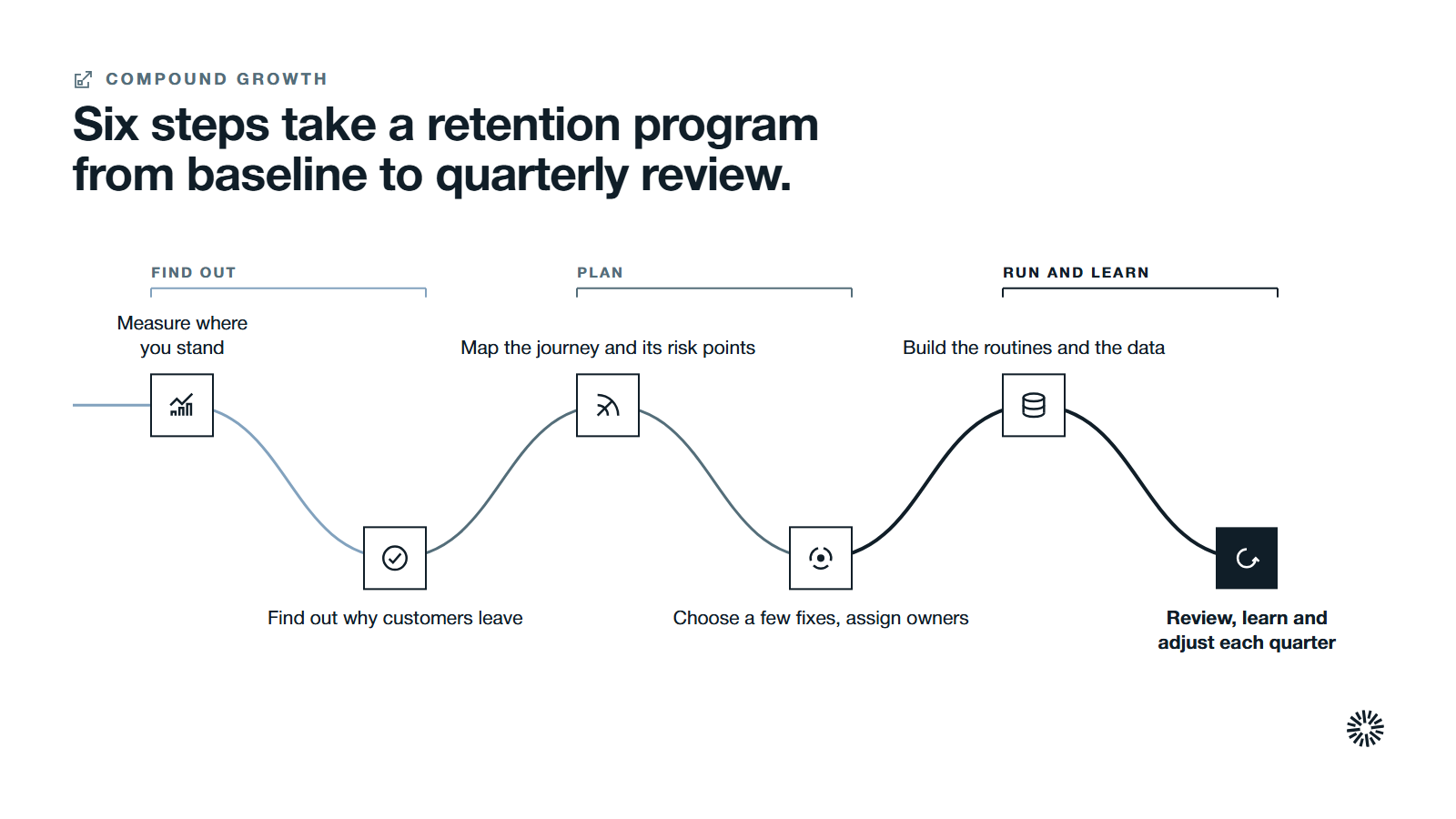
Knowing what to do is easier than doing it in order. Use these six steps to build a customer retention program that fits a growing B2B company.
1. Measure where you stand
Calculate customer retention rate, churn rate, gross and net revenue retention for the last four quarters, by segment. Record how many customers you lost and why. Done looks like: a one-page baseline everyone agrees is correct.
2. Find out why customers leave
Interview recently lost customers and a sample of at-risk ones. Read support tickets and cancellation notes. Group what you hear into causes.
Pay attention to the new customers you lost fastest, because early churn points to a weak start. Done looks like: a ranked list of the top reasons for customers lost, each with an owner.
3. Map the customer journey and its risk points
Lay out the path from signature to renewal and mark where customers stall or complain. Include handoffs between sales, onboarding and support. Done looks like: a journey map with the three riskiest moments marked.
4. Choose a few improvements and assign owners
Resist fixing everything. Pick the changes that address your top reasons for churn, such as faster onboarding, proactive check-ins, clearer service paths or a renewal process that starts early. Done looks like: a short plan with one named owner per action.
5. Build the routines and the data
Set up health scores, alerts, feedback requests and renewal reminders in your CRM, and agree a weekly review. Automation helps only after the process is clear. Done looks like: the same signals reach the same person every week without anyone remembering to look.
6. Review, learn and adjust each quarter
Compare retention against the baseline, check which actions moved it and drop what did not help. Share results with sales, marketing and customer success together. Done looks like: a quarterly note that says what changed, what you learned and what comes next.
Customer retention examples show the same pattern in different models
The mechanics change with the business model, but the logic holds. These are illustrative patterns, not client results.
- Subscription software. Retention is decided by onboarding and usage. A team that tracks first-value milestones and acts on falling activity keeps renewals predictable.
- Professional services. Retention depends on the account relationship. Regular reviews, clear reporting and a named lead on each side make renewal a continuation rather than a decision.
- Ecommerce and repeat-purchase businesses. Retention is about repeat purchases. Post-purchase communication, reorder reminders and loyalty programs bring buyers back.
- Equipment and contract businesses. Retention rests on service quality and planned maintenance. Proactive outreach before something fails protects the contract.
Notice what is common. In each model the company knows its customers, contacts them before a problem grows and measures whether they stay. That is the strategy, whatever the product.
Mistakes that quietly undermine customer retention
- Treating retention as a support problem. The reasons customers leave start earlier, with the sale and the onboarding.
- Measuring only logo retention. A stable customer count can hide shrinking revenue per account.
- Offering discounts to save every cancellation. You train customers to ask for them and keep the underlying problem.
- Waiting for the renewal notice. By then the decision has been made. Start the renewal conversation months earlier.
- Collecting feedback without acting on it. Customers notice when nothing changes and stop answering.
- Running three separate customer plans. When sales, marketing and customer success each talk to the customer differently, the experience feels fragmented.
- Spreading effort evenly. Your best-fit, highest-value customers deserve the most attention. Focus there first.
Most of these come from teams not sharing one view of the customer. A single record of who the customer is, what they bought and how they are doing fixes more problems than any single tactic.
What you gain when this is done properly
When retention runs as a shared system rather than a rescue effort, the benefits reach every team that touches the customer.
Sales
Your sales team sells to a customer base that stays and expands, which makes forecasts steadier. Referrals and references from loyal customers shorten the path to new business, and expansion conversations start from trust instead of a cold pitch.
Marketing
Your marketing team gets real customer language, real proof and a steady source of advocates. Campaigns aimed at existing customers reach people who already know you, and the proof they produce feeds the story you tell new prospects.
Customer success
Your customer success team stops firefighting. With clear health signals, a defined onboarding path and a shared feedback loop, the team can spend time on the accounts that need help and on growing the ones that are thriving.
Make customer retention part of a connected revenue system
Propello designs and builds connected go-to-market systems on HubSpot, so sales, marketing and customer success work from one record of the customer. If you want a customer retention strategy that your teams can run from shared data, an audit is the place to start.