
If you lead marketing or revenue at a growing B2B company, your AI share of voice is the percentage of brand mentions in AI answers that belong to you, across a fixed set of buyer questions and a named list of competitors. You measure it by counting, so you can raise it on purpose.
This guide is for CEOs, founders, CROs and marketing leaders who already know the basics of AI search and now need one number the leadership team can trust.
You will get a definition, the formula, a worked example, the metrics that sit around it, a weekly, monthly and quarterly routine, and the mistakes that make the number meaningless.
|
AI Share of Voice AI share of voice is your brand's percentage of all brand mentions across a fixed set of buyer prompts run on AI search engines, compared with a named set of competitors. |
What good AI share of voice looks like
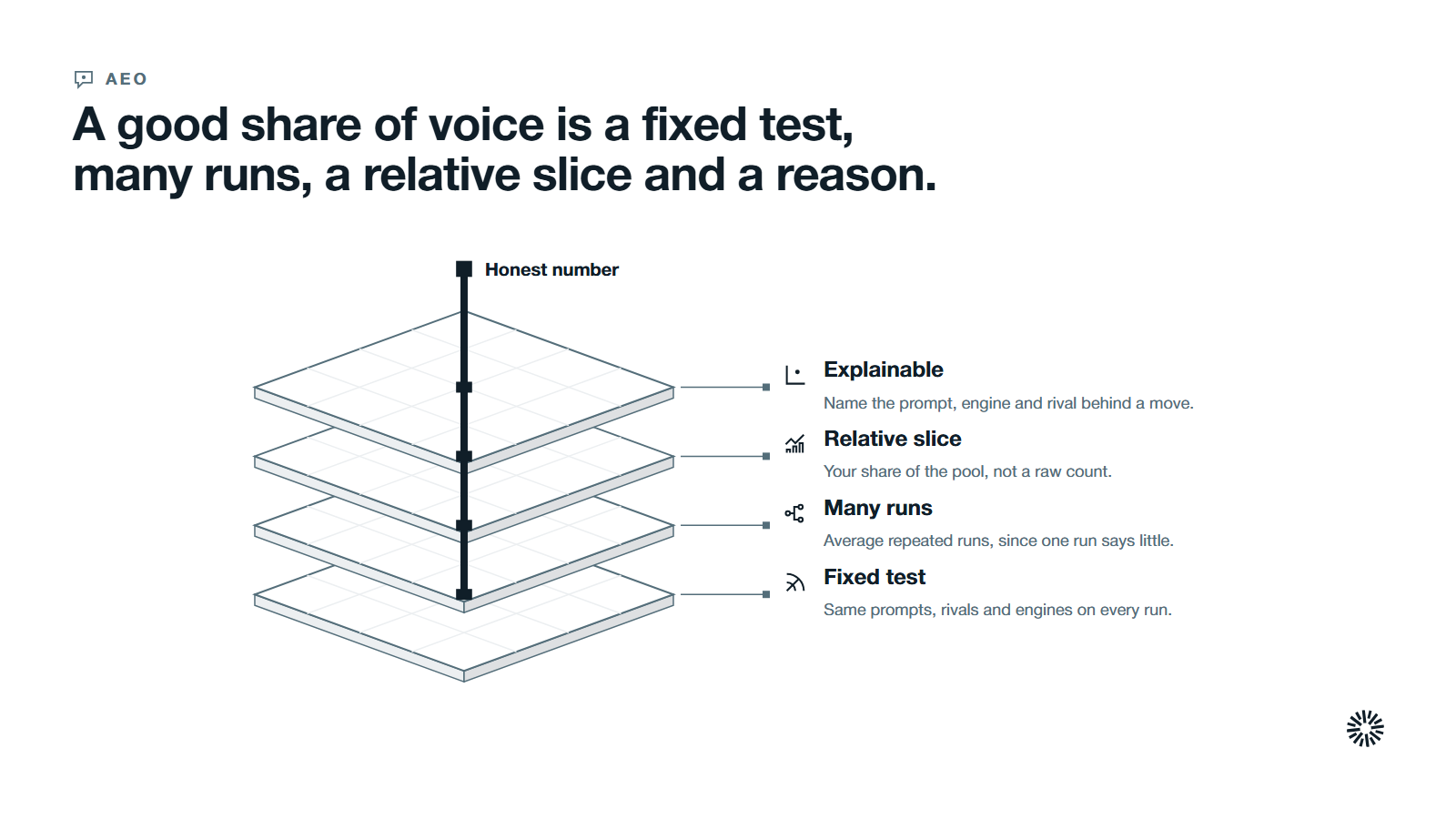
A good measurement is boring. The same prompts, the same competitors and the same engines are run on a schedule, and the number moves because your market position moved, not because someone changed the test.
Good also means explainable. If a board member asks why the figure fell, you can name the prompt, the engine and the competitor that took the space. A figure you cannot decompose is a guess with a decimal point.
Share of voice is a relative number
Share of voice has always been relative. In paid search, Google defines impression share as the impressions your ads receive divided by the total eligible impressions they could get. The idea is the same here: your slice of a pool, not a raw count.
Your count of brand mentions only means something next to everyone else's. Twenty mentions is strong in a quiet category and weak in a crowded one.
Why the number is a range, not a point
AI answers vary from run to run. In a study published in January 2026, SparkToro had 600 volunteers run 12 prompts through three popular AI tools, 2,961 runs in all.
The authors report a less than 1 in 100 chance that two responses give the same list of brands, and less than 1 in 1,000 for the same order.
So a single run tells you almost nothing. Many runs, averaged, tell you how often a brand sits in the set the engine tends to consider.
The same study found that stable pools exist. Across 994 responses to headphone prompts, four brands showed up in 55 to 77 percent of them. Share of voice measures that pool, which is why it holds up better than a ranking.
Why AI share of voice matters for brand visibility
Buyers now start research by asking AI search engines to compare options, and the reply often names only two or three companies. If you are not one of them, your brand visibility at that moment is zero, however healthy your organic search traffic looks.
Search visibility used to mean a position on a results page. Traditional SEO still matters, because AI search draws on the same web, but organic search rankings no longer tell you who gets named. In AI answers, visibility means being named, described and linked.
Your brand's presence in those answers shapes your brand reputation before a buyer ever opens your site.
That makes this figure a direct reading of your brand's performance where shortlists form, which rankings and traffic reports cannot see. It also gives you a way to increase brand visibility deliberately: you can see where you are absent, change one thing and watch whether the voice moves.
AI systems shape discovery through synthesized recommendations, not a ranked list. They act as curators of an answer instead of indexers of every page, and they draw on authoritative sources well beyond a company's own website, such as reviews, press coverage and directories.
AI search is not one engine, so treat each surface separately. Google AI Overviews summarize a topic above the links, while other engines write conversational replies, and AI generated answers on each can name different companies. A search engine you ignore may be the one your best buyers use.
How to calculate share of voice in AI answers
The calculation takes three inputs: a prompt set, a competitor set and a count. To measure share fairly, all three must stay fixed. If you need the prompt set first, our guide to AI search analytics shows how to write and freeze one. This article starts where that one stops.
Build the prompt set from keyword research
Start from keyword research. Take the relevant keywords your target audience searches and the valuable keywords tied to pipeline, then turn each into the question a person would ask an AI. A prompt set built from commercial keywords keeps the count about demand, not trivia.
The formula
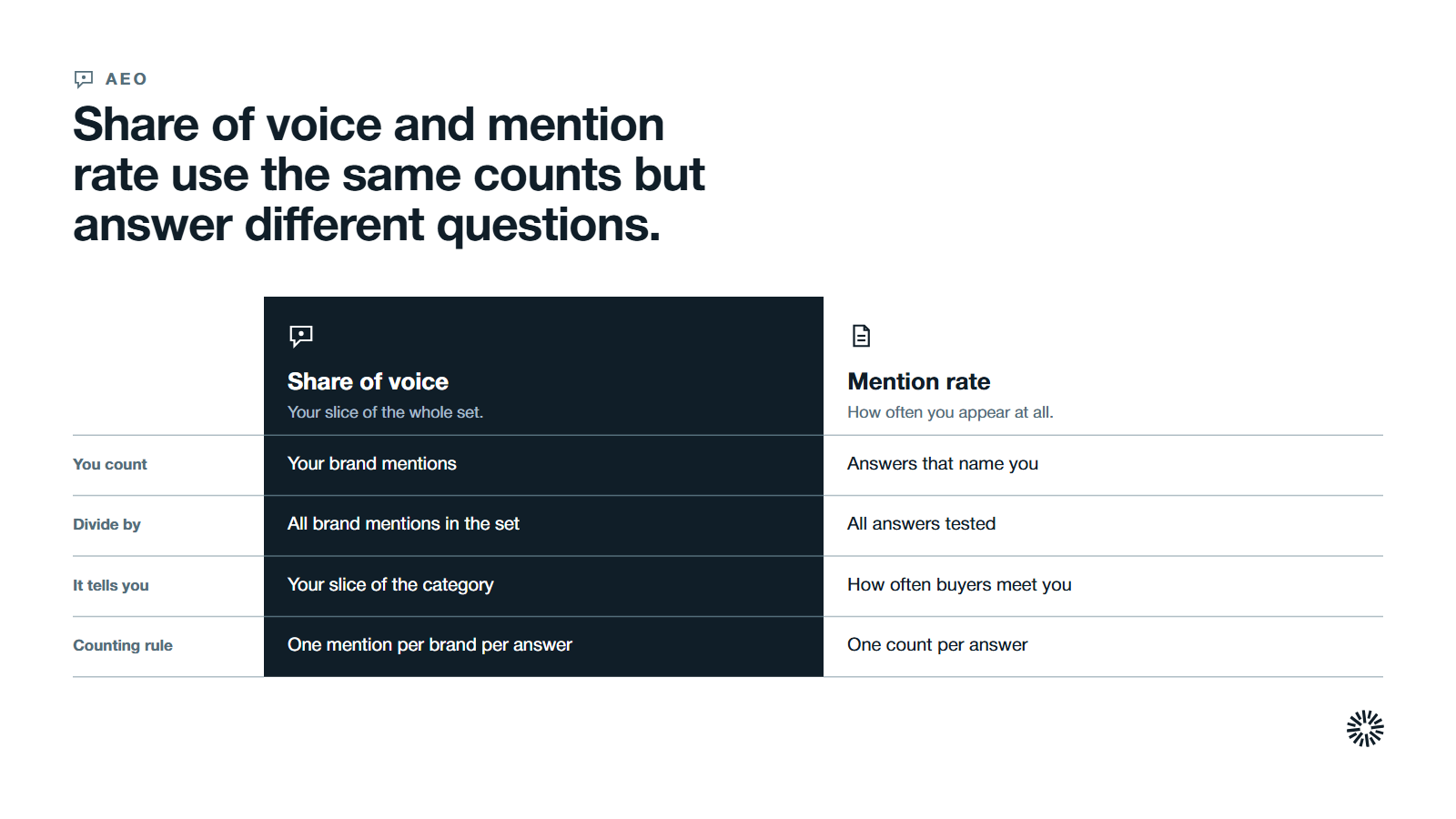
AI share of voice = your brand mentions divided by the total brand mentions of everyone in your competitor set, across all tested answers, multiplied by 100.
In plain terms, it is your brand mentions over total category mentions, the same logic as the classic formula of your brand metrics divided by total market metrics.
Count each brand once per answer. If an answer names you three times, that is still one mention, otherwise long answers inflate the figure.
A worked example (illustrative arithmetic)
This example uses invented numbers to show the arithmetic. You run 50 prompts on one engine. Across the 50 answers, you are named in 18, Competitor A in 30, B in 24, C in 12 and D in 6. That is 90 mentions in total.
When your brand appears in 18 of the answers, your brand's share is 18 divided by 90, which is 20 percent. Competitor A holds 33 percent. Your mention rate, a different measure, is 18 divided by 50, or 36 percent.
Notice that you appear in more than a third of answers yet hold a fifth of the voice. Both statements are true, and leadership needs to see both.
Choose a competitor set you can defend
Competitive analysis starts here, because the set decides the answer. Include the three to six brands a buyer would put on a shortlist next to you, plus any category leader whose presence shapes how the engine frames the topic.
Write the list down, date it and review it quarterly. If you add a rival after a bad month, you have changed the denominator, and the trend line no longer compares like with like.
Pair the count with competitive metrics such as each rival's mention rate. Include the brands the engine names that you did not expect. Sales will recognize some from lost deals, and they reveal who buyers actually weigh you against.
Decide what counts as a mention
Fix the rules before you count. A brand mention is the company or product name appearing in the answer text, spelled out or in an obvious short form. A citation is a link to a page of yours in the answer's sources. They are different events.
Decide how you treat a mention that is negative, a mention in a list of brands to avoid, and a product name that matches another company. Write each rule once and apply it to every brand in the set, including your own brand.
The metrics that sit around share of voice
Share of voice is the headline, but it needs companions. These voice metrics work as a set, and the voice data you collect once feeds all of them. Each has a formula, and the examples reuse the invented numbers above.
Mention rate
Mention rate = answers that name your brand divided by answers tested. It is not your brand's share of voice, because rivals are not in the denominator. It shows how often you are in the conversation at all. In the example, 18 of 50 answers gives 36 percent.
Use the same steps to calculate share of voice for your own set.
Track it per engine and per buyer stage. A brand that shows up for awareness questions but vanishes at the decision stage has a different problem from one that is absent everywhere.
Citation share
Share of voice comes in two versions. Entity-based share tracks brand recognition in AI answers, meaning how often you are named. Citation-based share measures links to your web pages in AI responses. Report both, because they can disagree.
Citation share = citations that point to your domain divided by all citations to the domains in your competitor set. In the example, say the engine links 60 competitor-set pages and 9 are yours. That is 15 percent.
Mentions and citations diverge. An engine can name you from memory without linking you, or link your page while naming a rival. Compare the two to see whether your pages or your reputation is doing the work.
Position-weighted share
An answer that names you first is not the same as one that names you fifth. Give each position a weight, for example 3 for first, 2 for second and 1 for anything later, and divide your weighted points by all weighted points.
Because ordering is the least stable part of an answer, treat this one as a secondary view. The SparkToro study shows how rarely two runs return the same order, so report it as a range.
Read AI visibility by engine and stage
Measure share separately for each engine and each buyer stage, then roll up. Your overall AI visibility can look steady while a blended 20 percent hides 40 percent in one engine and 5 percent in another, and the fix for each is different.
For a quick outside check, HubSpot's AI Search Grader reports share of voice as one of five scored parts, worth up to 10 of 100 points, based on your estimated percentage of category voice. It is a one-time snapshot, so use it to sanity-check your own count, not to replace it. For how to read the full report, see what HubSpot's AI Search Grader measures.
How it differs from the share of voice you already report
The voice definition most marketers know comes from advertising: your presence compared with everyone else's. Voice refers to presence, and the entire market is the denominator. Each of your marketing channels and media channels has its own version.
Media share reveals which publications mention you, counting media coverage and news articles against competitors. PPC share applies the idea to paid advertising: the impression share columns in Google Ads reports show how much of the available ad space you won compared with your potential reach.
Measuring SEO share does the same for organic search, comparing your organic traffic and visibility with rivals' for a keyword set. Social media share counts social media mentions and social media conversations against rivals.
AI share of voice measures something else: how often an engine chooses to name you when it writes the answer. Total market metrics such as market share count customers, not conversations. The two can move in opposite directions for a quarter or two.
Track brand mentions across AI search engines
Engines, including Google AI Overviews, build answers from web content, so the voice you hold in AI reflects the conversations happening elsewhere. Use social listening tools to track brand mentions and brand conversations on social platforms, and set alerts for news articles that name you or a rival.
Social listening also shows where a rival is gaining traction.
These sources show people talking about you before the effect reaches AI answers, so treat them as leading data points and the AI count as the result. Sentiment analysis adds deeper insights, because a mention that warns buyers off is not the same as one that recommends you.
Mentions with positive sentiment lift your share, and a strong share usually signals effective messaging and recognition.
Share of voice is not static; it moves with market dynamics, so read the trend across weeks, not one snapshot. Keep the AI tally separate from the social tally. Share of voice tools can automate the collection of answers.
When you compare voice tools, ask to see the prompts, engines and counting rules, or you cannot defend the voice metrics to a skeptical board. Other tools, such as web analytics, then add context.
Run the measurement routine: weekly, monthly, quarterly
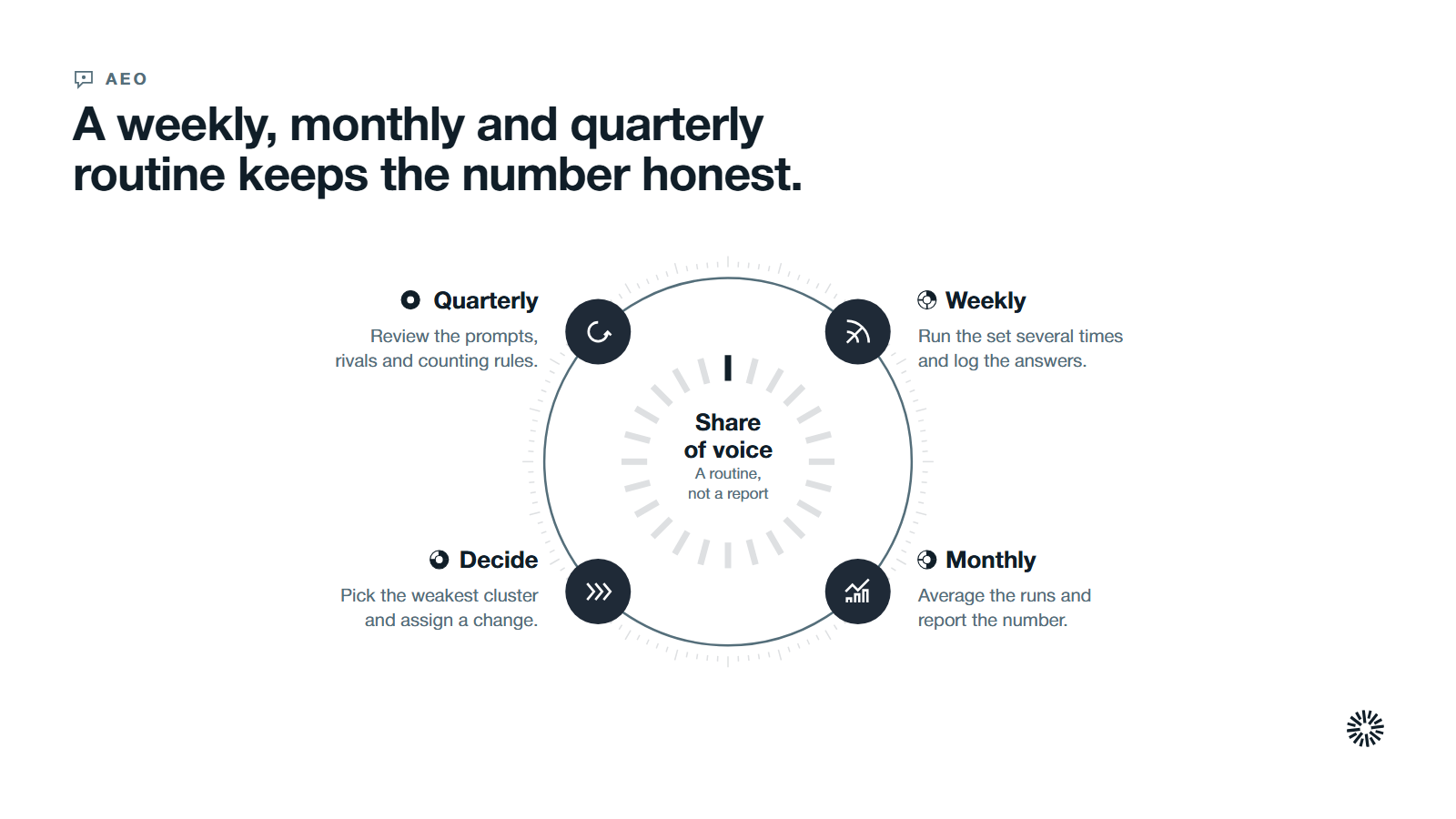
Cadence keeps the number honest. Tracking voice helps only when it is repeated. The goal is a routine small enough that someone actually does it, and large enough that a change in the trend is real.
Weekly: run the set and log the raw answers
Once a week, run the fixed prompts on each engine and save the answers in a sheet with the date, engine, prompt and every brand named. That one sheet lets you track mentions by engine. Run each prompt several times, because of the variation described above.
Do not interpret a single week. The weekly job is collection, not analysis. If a brand suddenly dominates a prompt, note it and wait for the next run before you react.
Weekly is also the time to check that nothing broke. Confirm that the crawlers you rely on are still allowed and that your key pages still load.
Monthly: report your brand's performance and decide
Once a month, average the weekly runs and calculate share of voice, mention rate and citation share per engine and stage. Put the results beside last month and the baseline you set at the start. The voice data should show where your brand fits in each cluster.
Then decide one thing. Pick the weakest prompt cluster, name the page that should win it and assign the change. A report without a decision is just a record.
Note campaign performance next to it: when a marketing campaign or launch goes live, record the date so a jump in voice has an explanation. Place two other lines beside it: branded search and direct sessions. If voice rises and they rise too, that supports the story. It does not prove it.
Quarterly: review the instrument itself
Once a quarter, review the prompt set, the competitor list and the counting rules. Retire prompts buyers no longer ask, add new ones, and note every change with a date so you can explain any break in the trend.
This is also the moment to test one change at a time. Use the method in our guide to AEO test-and-learn so you can tell which change moved the number.
How to increase brand visibility and raise your AI share of voice
You cannot buy a place in an answer, so the work is to become a brand the engine has good reason to name. Content that earns a place in AI search is clear, sourced and consistent across the web.
Google's guidance says there are no additional requirements to appear in AI Overviews or AI Mode, and that the best practices for SEO remain relevant. The levers below sit on top of that base. They turn actionable insights from the count into pages and partnerships, instead of reports nobody uses.
Earn brand mentions where engines read
Engines draw on web content, so being discussed in credible places matters. In a 2025 study of 75,000 brands, Ahrefs found branded web mentions had the strongest correlation with AI Overview brand visibility, at 0.664, against 0.218 for backlinks. Correlation is not proof of cause, as the study itself notes.
A strong presence on third-party platforms contributes to a higher share, and employee advocacy, where your own people share your work, can add to it. That supports investing in press coverage, partner pages, reviews and independent write-ups, which are the digital marketing moves that put your name in more places.
For how mentions and links differ, read brand mentions vs backlinks.
Make your own pages easy to quote
For each prompt cluster, write one page that answers the question in its first lines, defines the terms, and backs claims with named sources. AI search visibility rewards clarity, structure and authority. A page that states a plain answer is easier for an engine to lift and cite than one that circles the point.
Keep descriptions of your offer, customer and category identical across your site, profiles and partner listings. Consistent wording helps engines describe you the same way each time. Our guide on how to optimize content for AI search covers page structure in detail.
Close the gaps the data shows
Use the competitor presence pattern. When an engine keeps recommending the same rival, that rival acts as a gatekeeper to the shortlist, an effect worth naming in your report.
Share of voice analysis reveals the gaps where competitors dominate recommendations, and it shows who owns the narrative at each step of the customer decision journey. If one rival owns a decision-stage prompt, open the sources the engine cites for it. Those sources are the places your story is missing.
Fix the cheapest gap first: a missing comparison page, an outdated profile, a question you never answered. Then rerun that cluster for four weeks before judging the result.
Common mistakes that make the number meaningless
Most failures come from the instrument, not the market. These are the ones we see most often when a team reports AI share of voice for the first time.
- Changing the set mid-stream. Adding prompts or rivals after a bad month breaks the trend line.
- Reading one run. Single answers vary too much to carry a decision.
- Counting repeats. Naming a brand five times in one answer is still one mention.
- Blending engines. One blended figure hides which engine needs work.
- Skipping the denominator. Reporting your own count without the competitor total tells nobody how you compare.
- Tracking vague metrics. Specific metrics with a formula beat an unexplained score.
- Claiming cause. Voice rose and pipeline rose; that is a signal, not attribution.
- Chasing a target of 100 percent. Full voice would mean no rival is ever named, which no honest category produces.
Keep the limits visible in every report. Say how many runs sit behind each number, which engines you tested and which competitors you counted.
What you gain when this is done properly
A stable measure of AI share of voice turns a vague worry into a plan. Each team gets something it can act on in the same quarter.
Sales hears fewer surprises
When you know which rivals the engines name beside you at the decision stage, sales can prepare for those comparisons before the call. Buyers who arrive having read an answer about you ask sharper questions, and the team has the evidence to answer them.
Marketing knows where to spend
The by-stage view, with a clear brand metrics baseline, shows which prompt clusters deserve a new page, a partner story or a profile update. The team can run a competitive analysis of the gaps. Marketing stops guessing which content matters for AI search and starts assigning work against a gap it can see.
Customer success protects how the brand is described
The accuracy review that accompanies the count catches outdated pricing, wrong features and old positioning before a renewal conversation does. Customer success can send corrections upstream and point customers to pages that say the right thing.
Make share of voice part of a connected GTM system
AI share of voice is most useful when it feeds the same system that tracks leads and pipeline. Propello designs and builds connected go-to-market (GTM) systems on HubSpot for CEOs and revenue leaders at growing B2B companies, so a change in voice can be read alongside traffic, deals and renewals.
If you want a prompt set, a competitor list and a routine built for your market, an audit is the place to start.
