If you lead marketing, sales or growth at a B2B company, the short answer is this: account-based marketing puts your effort behind a named list of target accounts, and demand generation builds awareness and preference across your whole target market. One goes deep on a few companies. The other goes wide on a category.
Neither replaces the other. Teams often shorten the second term to demand gen, and the ABM vs demand generation question is really about where your next dollar and your next hour belong, given your deal size, your market and the state of your pipeline.
This article is for CEOs, founders, CROs and marketing leaders who have to pick. You will get a definition of each, a side-by-side comparison on the same criteria, decision rules by stage and deal size, and a plain account of how the two work together.
|
Account-Based Marketing Account-based marketing (ABM) is a B2B strategy in which marketing and sales choose a defined list of high-value accounts together, then run personalized campaigns aimed at the buying group inside each one. For the full picture, read our complete guide to account based marketing strategy. |
|
Demand Generation Demand generation is the set of marketing and sales programs that build awareness, trust and interest in a company and its category, so that buyers prefer it when they decide to buy. |
ABM vs demand generation starts with who each one is aimed at
Demand generation speaks to a target market. It assumes that most buyers are not shopping today, so it works to be known and trusted by the many companies that will be shopping later. Our guide to B2B demand generation covers the full program.
Account-based marketing speaks to specific accounts. Marketing and sales agree on the select accounts that matter most, then treat each one as a market of its own. Account-based marketing is a focused marketing strategy, and it suits long sales cycles. Our explainer on what account-based marketing is walks through the model, and the ultimate guide to ABM goes further.
The word "account" means a company, not a person. That single choice changes the rest of the work: the list, the content, the channels, the measures and who in the business takes part.
One more note on the term. "Demand Gen" is also the name of a Google Ads campaign type that serves ads across YouTube, Discover and Gmail, which Google describes on its Demand Gen campaigns help page. This article uses the term in the broader marketing sense.
Demand generation works on the whole target market
A demand generation approach starts with a broad audience: every company that fits your ideal customer profile, not a named few. The goal is creating awareness and creating demand where only a problem existed, so your name is already familiar when a need becomes urgent.
The demand generation definition above is deliberately broad, because demand gen covers everything that earns attention before a buyer is ready. Content marketing is the base of any demand gen program. Useful articles, research, talks and tools help potential customers understand a problem. Content marketing works best with a clear content strategy. A sound content strategy for demand gen chooses topics from the questions buyers ask on sales calls, and leaves most of the content open so it can be found, shared and cited.
Thought leadership, events, communities and paid ads carry the message across multiple channels. Marketing efforts like these also help generate leads, and they build general awareness among a broad group beyond today's buyers. Demand gen is a B2B marketing discipline for the long run, and it suits a company launching a new product that needs market education. It aims for broad visibility and a healthy volume of top-of-funnel leads. Demand gen often overlaps with lead generation, and our comparison of demand generation vs lead generation sets the two apart.
The buying process explains why this matters. In its 2025 study, 6sense reports that 94% of buying groups ranked preferred vendors before first contact. If the preference forms before anyone talks to a seller, the work that earns it is demand generation.
The honest limit is attribution. Much of the effect shows up as buyers who arrive already convinced, which no form field records.
The account-based marketing (ABM) strategy treats each target account as a market of one
An account-based marketing strategy begins with the list of target accounts. Marketing and sales build a target account list together, drawing on the ideal customer profile. The aim is to name potential high value accounts and the specific companies where one win matters most. Our ideal customer profile template is a good place to start, and our guide to defining ICP, messaging, channels and sales motion shows how the choices connect.
Then the work narrows. ABM campaigns use personalized content and personalized messaging written for the pain points of specific high value accounts. Our guide to B2B personalization explains how far that can go without becoming creepy.
Buying groups are the reason this works. Forrester's State of Business Buying 2024 reports that on average 13 people within an organization are involved in the buying decision, with 89% of purchases involving two or more departments. An account-based program is built to reach several of them with a consistent story.
ABM focuses on quality interactions with a few accounts, and it is effective where a complex buying committee needs several stakeholders to agree. High deal value is what justifies the extra investment per account. Sales is not a bystander. In account-based marketing the sales team picks accounts, names the key decision makers and acts on account engagement. Without that, you have a targeted ad campaign, not an ABM program. A targeted ABM campaign also builds deep relationships with key accounts and key clients, which supports customer relationships long after the first deal.
Our collection of B2B account-based marketing examples shows what the plays look like in practice.
ABM vs demand generation compared side by side
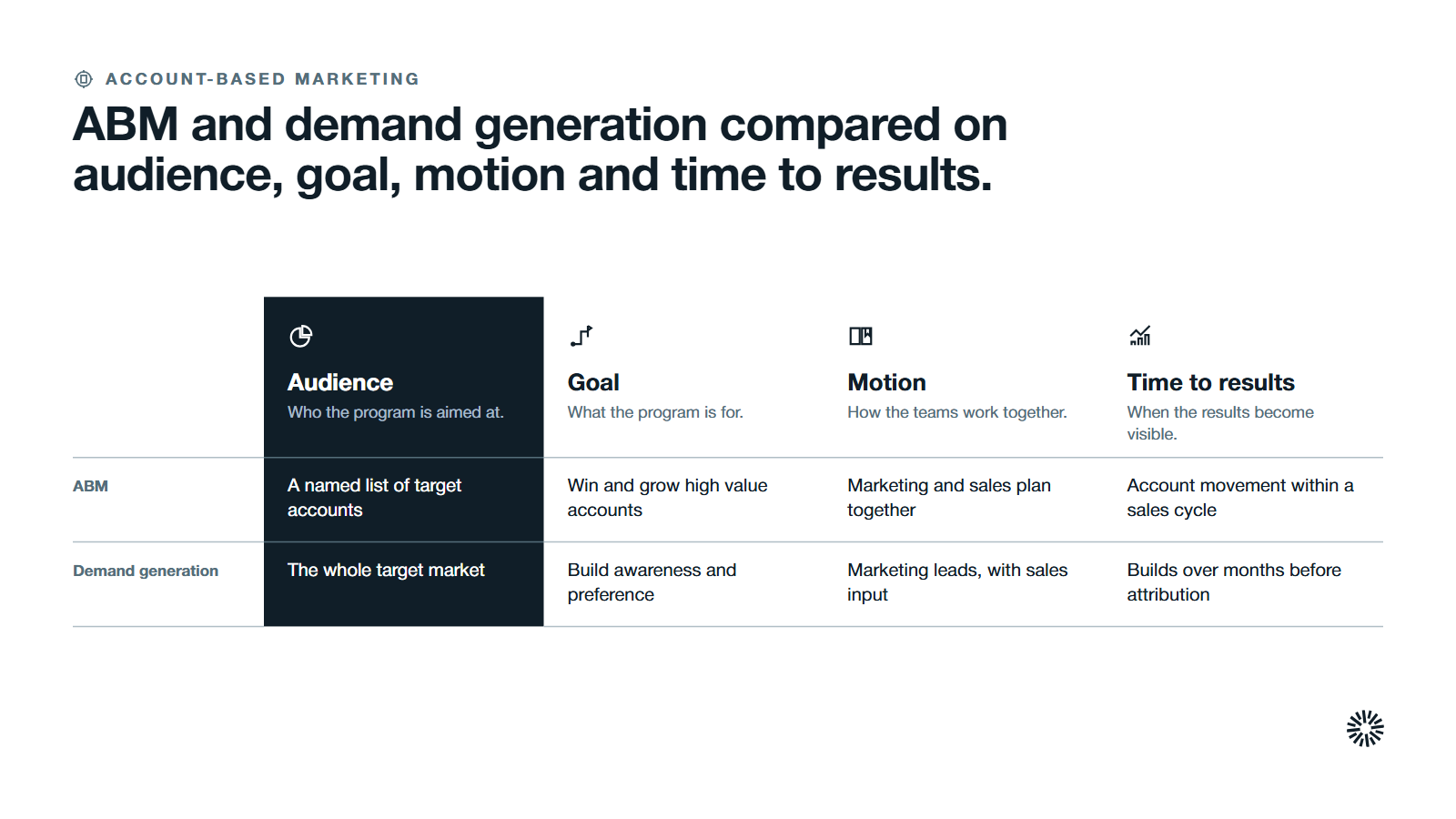
Account-based marketing and demand generation differ in audience, goal and motion. The table puts both on the same seven criteria, in the order a revenue leader usually asks about them.
| Criterion | Account-based marketing | Demand generation |
|---|---|---|
| Audience | A named list of target accounts | The whole target market |
| Goal | Win and grow specific high value accounts | Build awareness and preference at scale |
| Motion | Marketing and sales plan together, account by account | Marketing leads, with sales input |
| Metrics | Account engagement, pipeline and revenue per account | Reach, branded search, lead volume, pipeline influence |
| Cost in kind | Research, personalization and sales time per account | Content, channels and a steady publishing rhythm |
| Time to results | Visible account movement within a sales cycle | Builds over months before attribution shows it |
| Best use | Large deals with buying groups and a known list | Broad markets where most buyers are not yet shopping |
Read each row as a tendency, not a wall. A webinar can serve both programs, and an ABM program can reuse demand content.
The cost row is deliberately about effort, not price. The real cost of ABM is the attention it takes from sales and marketing for each account. The real cost of demand generation is the patience to keep publishing before results can be traced.
Demand generation metrics and ABM metrics answer different questions
Judging one program by the other's scorecard misleads. Each needs its own measures and a shared line to revenue.
Demand gen metrics show the market moving toward you: branded search and direct visits over time, share of voice, engagement with ungated content, lead volume and the share of new pipeline from accounts with earlier touches. Pipeline influence is the value of opportunities where the program touched the account before creation.
ABM metrics are counted per account. Track key metrics such as whether the right accounts are engaging, how many people at each account you have reached, whether meetings are being booked with key decision makers, and how the account moves through the sales pipeline.
A useful shared measure is pipeline created and won from the target account list. Our guide to lead scoring shows how scoring supports the demand side, and intent data shows how signals tell you which accounts are leaning in.
Demand gen usually tracks qualified leads, conversion rates and acquisition cost, while ABM tracks an engagement score and pipeline contribution for each account. Compare both programs across a full sales cycle. A quarter is rarely long enough to judge either.
Who owns the work and how the teams line up
Demand gen usually sits with marketing teams: content, brand, events and the demand team. Sales teams contribute the buyer's questions and the target market. The relationship between sales and marketing is more linear here: marketing passes leads along and sales follows up. Sales alignment matters, but it can be loose.
ABM cannot be loose. Sales and marketing teams share the list, share the plan, agree the sales process and meet often. Marketing and sales teams that skip this step end up with a list nobody believes.
Revenue operations holds the shared definitions. It keeps CRM data clean, tracks accounts across both programs and shows how a signal becomes a task for a seller. Our guide on turning intent signals into sales action shows the handoff.
Smaller teams can run a light version of both with one leader, if the scorecards stay separate.
The two programs overlap more than their names suggest
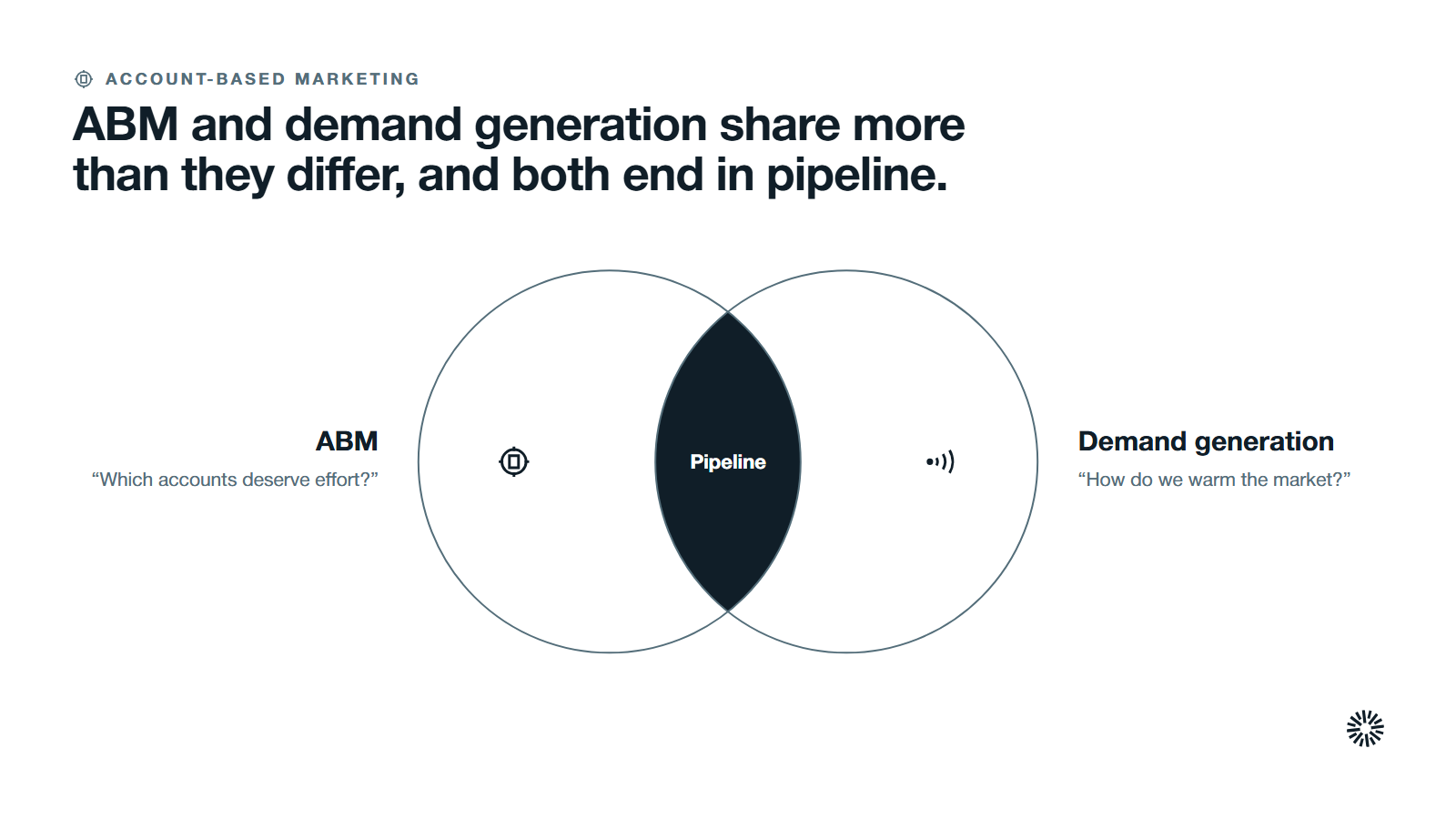
ABM and demand generation share more than they differ. Both are B2B marketing programs, and both aim at business growth. Both depend on a clear buyer persona, good content and a defined customer journey, and both end in pipeline.
Demand generation often feeds ABM. Broad awareness makes the target account list warmer before the first outreach, so ABM efforts meet less resistance and ABM enables meaningful engagement sooner. Account-based work, in turn, gives demand teams industry insights and actionable insights on which topics earn attention across an entire industry.
Understanding the buyer is the common thread. Our guide to the B2B buyer journey maps what buyers need at each stage, whichever program reaches them.
Some teams treat ABM as a form of demand generation aimed at fewer companies. That view is fair, as long as the account list, the sales role and the metrics are treated differently.
How to decide between ABM and demand generation by stage and deal size
Choose by evidence, not by which term sounds more current. These rules are our reading and are meant to be argued with.
If deals are large and the buying group is known, lead with ABM
When each deal is worth a lot and you can name the companies that could buy, the cost of personalization is small against the prize. Start with a short account list and a sales partner for each.
If your market is wide and unaware, lead with demand generation
When prospects say they have never heard of you, a small list will not fix it. Invest in content, thought leadership and presence with your target audience, and keep a simple path to a conversation.
If you are early and small, start narrow and keep it simple
A young company has limited budget allocation, so pick one. A founder-led business with a handful of ideal customers can run ABM by hand. A business with a broad product and little recognition starts with demand.
If you are established with both problems, run both on one list
Use demand generation to keep the wider market warm, and ABM to focus on the accounts you most want to win. Share one customer profile and one set of definitions.
Combine the two with one account list and one set of measures
A hybrid approach uses demand gen to fill the funnel and ABM to convert the accounts that matter, which makes the most of reach and conversion together. The strongest programs run in sequence and on one record of the buyer. Demand programs build familiarity across the market. Intent signals show which accounts are leaning in. ABM campaigns then give those accounts a personal route to a sales conversation.
The handoff has four moves:
- Demand content builds familiarity across the target market.
- Signals such as repeat visits show which accounts are active.
- Account-based plays turn that interest into a conversation with the buying group.
- Sales feedback tells demand teams which topics and accounts to prioritize.
Budget allocation follows the same logic, because you spend money where the evidence is. Fund the broad program enough that your name is known, then put the premium effort behind the accounts that matter most. Review the split each quarter against pipeline, not against activity.
What goes wrong when the programs are run apart
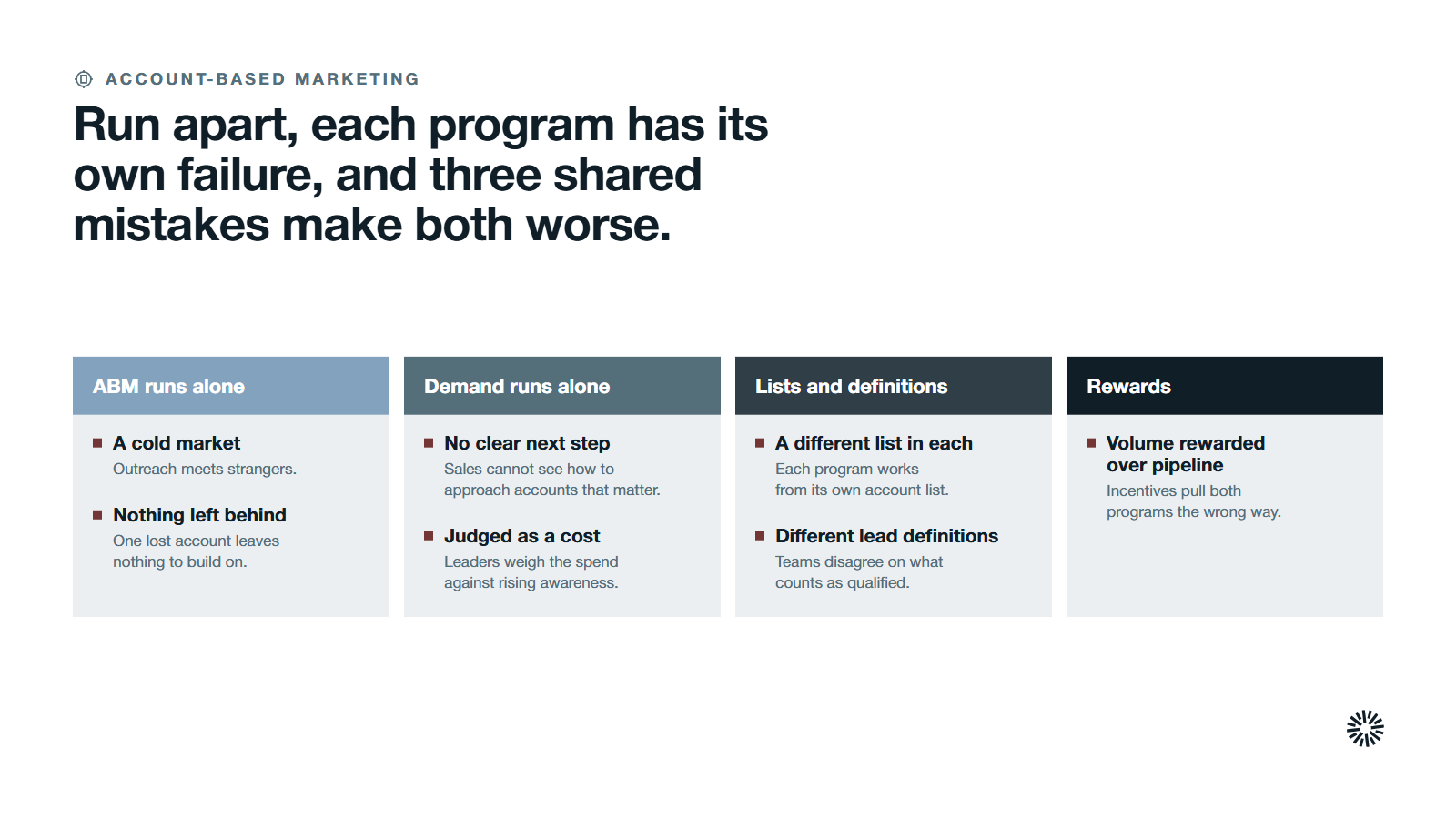
Each program has a typical failure when it runs without the other, and three shared mistakes make both worse.
When ABM runs alone, the account list is small and the market around it is cold. Outreach meets strangers, and one lost account leaves nothing behind.
When demand generation runs alone, awareness and branded search may rise while sales cannot find a clear next step with the accounts that matter. Leaders then judge it as a cost.
The shared mistakes are a different account list in each program, different definitions of a qualified lead, and rewards for volume over pipeline. The fix is structural: agree one list, one definition and one set of revenue measures, and keep the data in one system.
What you gain when this is done properly
When the choice matches your deal size and market, and the two programs share a record of the buyer, the effort stops competing for credit.
Sales gets better conversations with the right companies
Sellers work a list they helped write, and buyers arrive already familiar with your point of view. Less time goes on explaining who you are.
Marketing can show what produces revenue
Marketing can defend long-term demand work because the link from early touches to pipeline is visible, and can focus premium effort on accounts that move.
Customer success inherits clearer expectations
When buyers are educated and well understood before they sign, customer success starts with the full story of what was promised and onboarding gets smoother.
Run both programs from one connected system
The real choice is not ABM vs demand generation. It is whether your two programs share a definition of the buyer, a list of accounts and a view of revenue.
Propello designs and builds connected go-to-market systems on HubSpot. If you want a second opinion on whether your next effort belongs on named accounts or on the wider market, an audit is the place to start.

/the-ultimate-guide-to-abm-share-1200x630-v2.png)