If you lead marketing, sales or a growing B2B company, you have probably been told to become a thought leader. The phrase is used so loosely that it can mean a LinkedIn post, a keynote or a research report. Thought leadership is a point of view, backed by evidence, that helps your buyers think about their own problem differently.
This article is written for business leaders and marketing teams who want a clear answer. It explains what thought leadership is, how it differs from content marketing, the main formats, how to build credibility without invented claims, and how it connects to search and AI answers.
|
Thought Leadership Thought leadership is original, evidence-backed expertise that a company or person shares publicly to change how a target audience thinks about a problem, and to earn trust before any sales conversation. |
How thought leadership works
Thought leadership works by moving a reader from "I have heard of this company" to "this company understands my problem better than I do." It does that through ideas, not through offers.
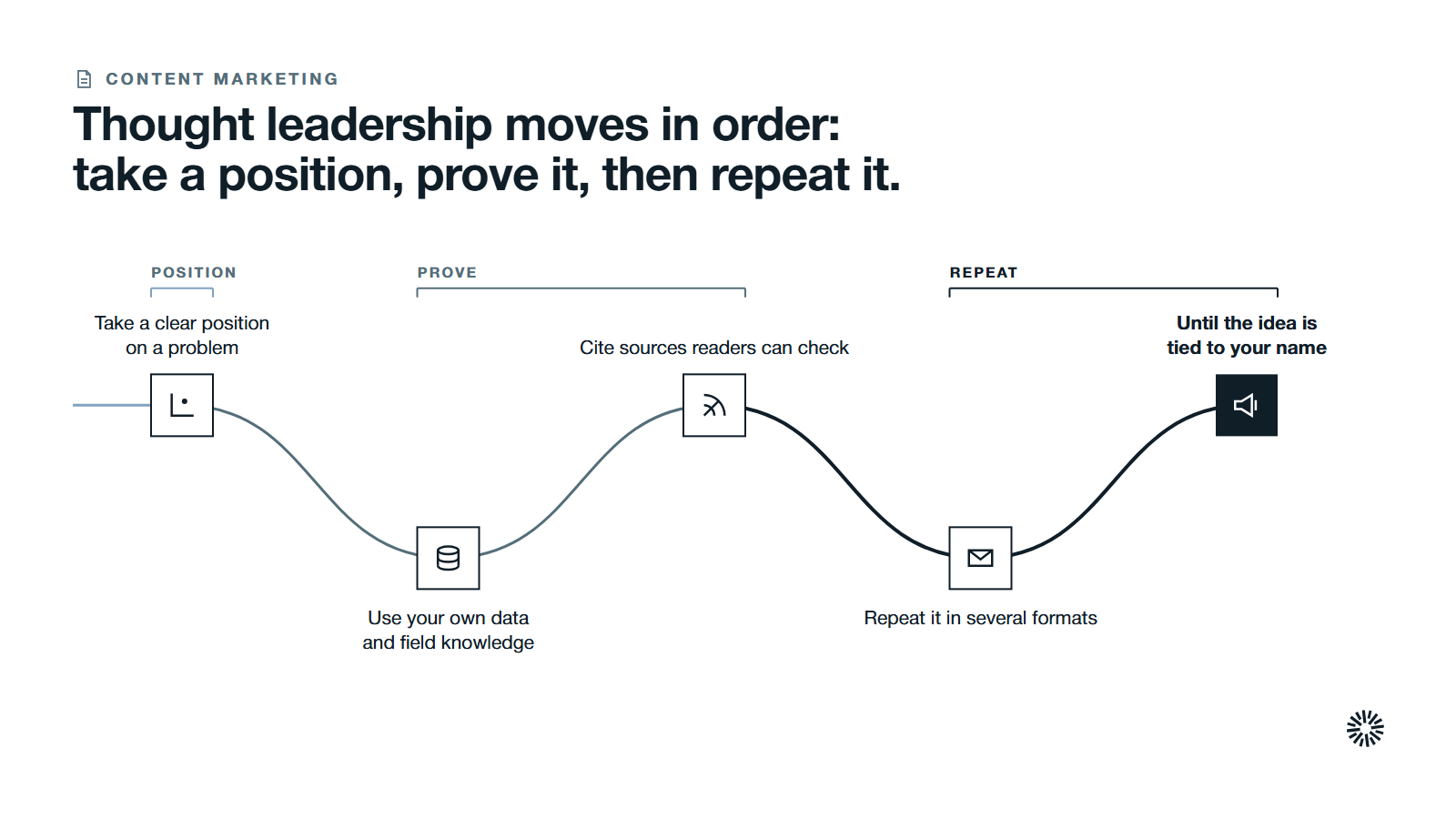
A recognized thought leader does three things in order. They take a clear position on a problem in their area of expertise. They back it with evidence the audience can check. Then they repeat it, in several formats, until decision makers associate the idea with the name.
The evidence is the part most teams skip. An opinion that anyone could have written is not an original idea. A position built on your own data, your own knowledge of the field, or a careful reading of multiple sources is. Valuable insights come from people who have done the work, and from authoritative sources that readers can check.
Research from Edelman and LinkedIn supports the link between ideas and buying. Their 2025 B2B Thought Leadership Impact Report, based on a survey of nearly 2,000 global professionals, describes thought leadership as a strategic tool for building trust and driving alignment, not only as content marketing.
Thought leadership is sharing insights that shape how others think, and it demonstrates expertise in a specific field. It requires originality and authenticity. Original insights rest on proprietary research and unique experiences, and many decision-makers say much of what they read is not valuable, which is why provocative insights that challenge assumptions stand out.
Many decision-makers find that most thought leadership lacks valuable insights, and the bar is rising. C-suite executives read it to make better decisions, and some share their contact information after reading content that earns it.
Effective thought leadership also has a human aspect. People follow people, and a positive reputation grows when a real expert explains complex topics in plain language. Leaders who successfully influence a market stay connected to customers and share what they learn, even when it is not flattering.
Why buying groups make it matter
B2B purchases are rarely made by one person. The same Edelman report focuses on hidden buyers, the internal influencers who shape a decision without appearing in your pipeline.
Those people read, compare and judge. Thought leadership is one of the few assets that reaches them before a salesperson does, because it does not need a meeting to be useful.
Thought leadership versus content marketing
Thought leadership and content marketing overlap, but they are not the same thing. Content marketing is the broad discipline of creating and distributing useful content to attract and retain an audience. If you need the full definition, start with what content marketing is.
Thought leadership is a narrower, higher-bar part of that work. It is the content where the company argues a position that others could dispute and proves it.
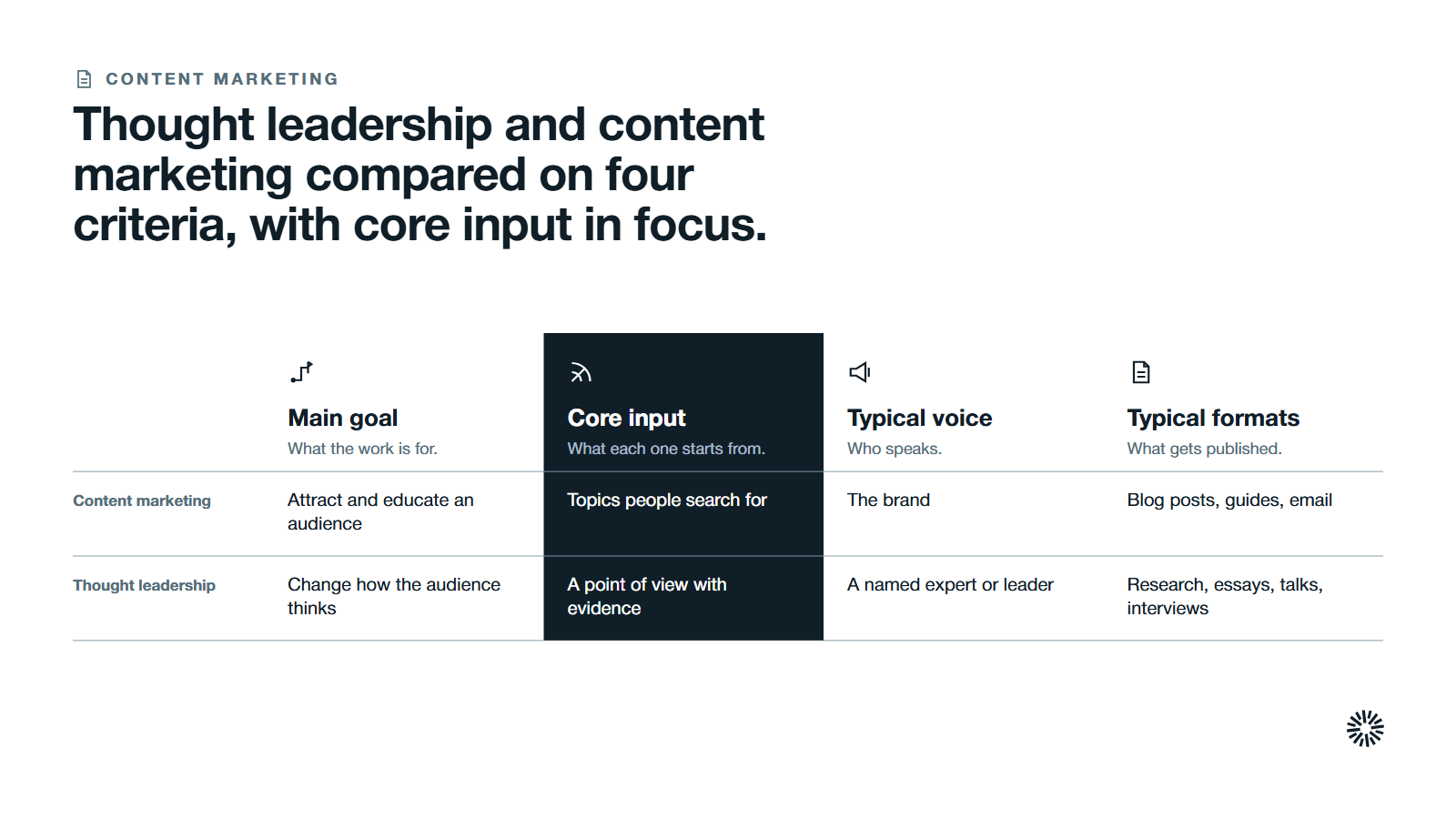
Here is how the two compare on the points that matter in practice.
| Content marketing | Thought leadership | |
|---|---|---|
| Main goal | Attract and educate an audience | Change how the audience thinks |
| Core input | Topics people search for | A point of view with evidence |
| Typical voice | The brand | A named expert or leader |
| Typical formats | Blog posts, guides, email | Research, essays, talks, interviews |
| Time to pay off | Steady, compounding | Slower, built on reputation |
A simple test separates them. If a competitor could publish the same piece by changing the logo, it is content marketing. If only your team could have written it, because it rests on your experience or your data, it is closer to thought leadership.
Most strong programs use both. Everyday content marketing builds reach, and a smaller set of thought leadership pieces builds the reputation that makes the reach worth having.
Where it fits in your content marketing strategy
A content marketing strategy decides what you publish, for whom and why. A thought leadership content strategy sits inside it and answers a narrower question: which few ideas do we want to be known for? Teams that produce thought leadership content without that answer tend to publish scattered opinions that never add up. For the full picture, read our complete guide to content strategy.
Think of it as leadership marketing in the plain sense: marketing that shows how your company thinks. It gives your engaging content a spine, so everyday posts point back to the same core ideas.
Main formats of thought leadership content
Thought leadership can take any format, as long as the idea is original and supported. The choice of format should follow where your target audience spends its time and how much evidence you have.
Original research and data
A survey, an analysis of your own anonymized data or a structured review of public sources gives you something nobody else has. It is the most credible format, and also the most expensive to produce.
Opinion essays and long-form articles
An essay argues one position in depth. It works well when you have experience that contradicts common advice. Keep the claim narrow, and show the reasoning. Industry related blogs and trade publications can carry the same essay to a wider group of industry leaders.
Social media posts and LinkedIn posts
Short posts from a named expert carry ideas to people who would never open a report. LinkedIn posts and other social media posts work best as slices of a larger piece, not as stand-alone opinions. Strong thought leadership posts lead with one clear idea, which captures attention without a long setup.
Speaking engagements and podcasts
Public speaking engagements, webinars and podcast interviews let buyers see how an expert thinks. They also create material you can reuse. Content repurposing turns one talk into articles, clips and posts.
Executive and expert commentary
Industry experts inside your company can comment on emerging trends, regulation or market changes. Commentary is quick to produce, but it only counts as thought leadership when it adds a view rather than repeating the news.
Thought leadership content can also be grouped by subject. Industry thought leadership shares insights on emerging trends. Organizational thought leadership highlights company culture and talent strategies. Product thought leadership covers how-to articles and best practices. Whitepapers, webinars and podcasts can carry any of the three, and a white paper is a concise guide to understanding one topic.
For real examples of formats in use, see content marketing examples.
How to create thought leadership content that earns trust
To create thought leadership content that holds up, work from the evidence outward. Many programs do the opposite: they pick a topic, write an opinion and look for support afterward.
Building thought leadership requires consistent value creation and strategic visibility. The sequence below keeps the idea honest.
- Choose your area of expertise. Pick a few topics where your team has real, repeated experience. Credibility combines depth with consistency, and a long list of topics dilutes both. A clear area of expertise makes it easier to build thought leadership.
- Start from your target audience's problem. Write down the question that decision makers ask when they are stuck. Identifying target audience profiles is crucial, and a thought leadership strategy begins with their question, not your product.
- Find the original idea. Ask where common advice fails in your experience. That gap is usually the idea.
- Gather the evidence. Use your own data, documented experience and published research from original sources. If you cannot support a claim, narrow the claim.
- Name the voice. Decide who speaks. A trusted figure attached to the idea makes it easier to remember.
- Publish in more than one format. Turn the idea into an article, a talk and a set of posts, then keep it consistent. A content calendar helps organize the work.
- Take a value-first approach. Educate the audience before you sell, and engage with your community and other industry influencers so the discussion reaches meaningful readers.
Build credibility without fabricated claims
Credibility is the whole asset, and it breaks easily. To establish credibility and gain credibility with buyers of business solutions, every claim needs a reliable source behind it. Low quality content that repeats unchecked statistics does the opposite.
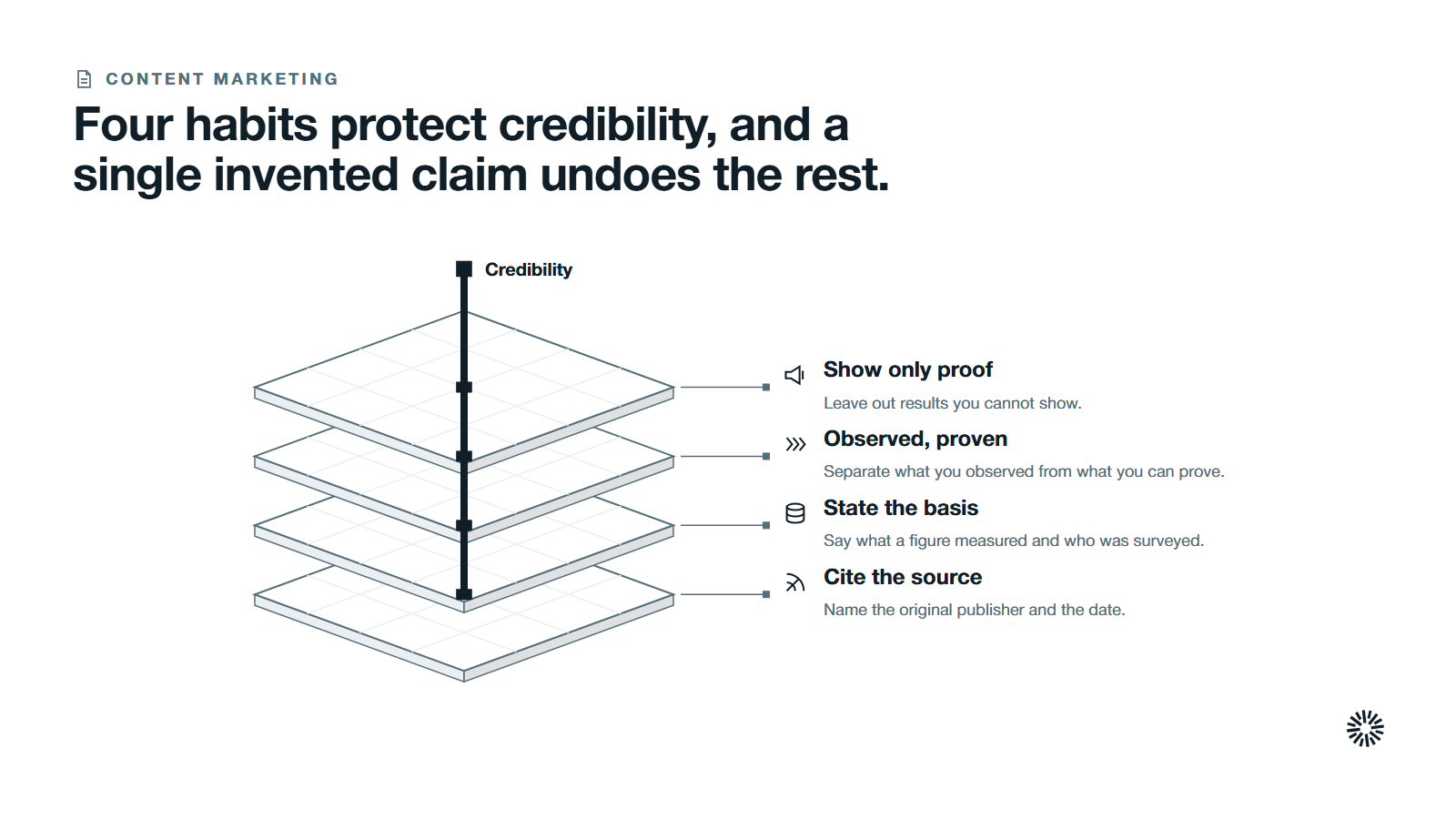
A single invented statistic or exaggerated client story undoes the rest. Transparency in sharing successes and failures builds trust, and consistent content helps establish authority in your industry.
Four habits protect it:
- Cite the original publisher of every statistic, and give the date.
- Say what a figure measured and who was surveyed.
- Separate what you observed from what you can prove.
- Leave out results you cannot show.
Google's guidance on helpful content points the same way. It asks whether content provides original information, reporting, research or analysis, and it describes trust as the most important part of what it calls E-E-A-T, a short form for experience, expertise, authoritativeness and trustworthiness. You can read it on Google Search Central.
First-hand experience counts. A practitioner who has run the process describes it differently from someone summarizing other articles, and readers can tell.
How thought leadership supports search and AI answers
Buyers now research in more than one place. In its 2025 buyer behavior survey of 1,169 B2B decision-makers, G2 reported that nearly 8 in 10 say AI search has changed how they conduct research, with 29% starting in AI chat tools more often than in Google.
That shift raises the value of distinctive material. AI answers and search results both favor sources that state clear, checkable facts. A page that holds original data, a named author and a specific position gives them something to cite.
Thought leadership therefore feeds three channels at once:
- Search. Original research and clear explanations earn links and mentions over time.
- AI answers. Defined terms, direct answers and cited statistics are easy to quote.
- Direct reputation. Buyers who already know your ideas search for your name.
To make this work, write each piece so that its main claim can be lifted out in a sentence or two, with the source beside it. Our guide on how to optimize content for AI search covers the structure in more detail.
Promotion matters too. A strong piece that nobody sees does not build an industry presence. Plan how you will promote thought leadership content from the start, using the channels in content distribution strategy.
Personal and company thought leadership
Thought leadership comes in two forms, and a B2B program usually needs both. Personal thought leadership belongs to a named expert, such as a founder, an engineer or a head of customer success. Company thought leadership belongs to the organization, and it shows up in research, frameworks and shared positions.
The personal form travels faster, because people trust people. A founder who explains a hard lesson in their own words earns attention that a logo cannot. The company form lasts longer, because it does not leave when a person does.
Choose the voices carefully. The best thought leaders for your business are not always the most senior. They are the people with extensive experience in the problem your buyers face, and with the patience to explain it clearly. Pair each expert with an editor, so that good ideas reach the page in a form that is short, specific and sourced.
What a good thought leadership piece looks like
A strong piece has five parts. It opens with the problem in the reader's words. It states the position in one or two sentences. It gives the evidence and says where it came from. It shows what the reader can do differently on Monday. It ends with a single, relevant next step.
Notice what is missing: a tour of the company, a list of product features and a promise of results. Those belong on other pages. A thought leadership piece earns the right to the next conversation by being useful on its own.
How to pick topics your buyers care about
Good topics sit where three things meet: your experience, your target audience's open questions and a gap in what is already published. Listen to sales calls, read support questions and scan the questions people ask in search. When the same question appears often and the existing answers are thin or outdated, you have found a topic.
Then test it with a simple filter. Could you defend this claim in front of a skeptical customer? Do you have a source or a first-hand example to show? If the answer to either is no, keep working on the idea before you publish.
How to measure and improve thought leadership
Thought leadership builds slowly, so measure it in layers. Start with signals that arrive early, such as time on page, shares by named people in your market and replies from target accounts. Then look at signals that arrive later, such as invitations to speak, inbound requests that mention a specific idea and sales conversations where buyers repeat your framing.
Do not force a single revenue number onto every piece. Instead, connect the work to your customer relationship data, so you can see which accounts engaged before they became opportunities. Review the results each quarter, retire topics that went nowhere and give more space to the ones that opened doors.
Refresh matters as well. A position that was fresh two years ago may now be common advice. Revisit your strongest pieces, update the evidence and say what has changed. That habit signals care, and it keeps the material accurate.
Common mistakes in thought leadership
Most weak programs fail in a few predictable ways.
- Opinion without evidence. A bold view with nothing behind it reads as noise.
- A business agenda in disguise. If every piece ends in a pitch, buyers see it as advertising. Set aside your business agenda in the piece itself, and let the call to action sit separately.
- Too many topics. Spreading across a dozen subjects prevents anyone from associating you with one.
- No named voice. Unsigned content has no one to trust.
- Inconsistent publishing. A reputation is built over many appearances, not one.
- Measuring only vanity numbers. Track whether the right people engage, not only the total reach.
On measurement, set clear objectives and SMART goals, then choose a few key performance indicators tied to them. Examples include engagement from target accounts, inbound requests that mention the idea, and sales conversations where buyers quote your content. Done well, the educational content creates long-term business opportunities, not only quick clicks.
What you gain when this is done properly
When thought leadership rests on evidence and is published consistently, each team gets something concrete.
Sales gains warmer conversations
Potential clients who have already read your position arrive with context. Sales teams spend less time introducing the company and more time on the buyer's problem, and the content gives them something useful to send.
Marketing gains a reason to be remembered
Marketing gets a distinctive core idea to build campaigns around, instead of competing on the same topics as everyone else. It also gets original material to repurpose across channels, and a way to create ideas for every channel from one position.
Customer success gains authority with existing accounts
Existing customers want a partner who sees the future before it arrives and who offers new insights, not recycled advice. Clear, evidence-based ideas help the customer success team lead renewal and expansion conversations with substance, and they help protect accounts from rivals who offer a fresh view.
Make thought leadership part of one go-to-market system
Thought leadership works best when it is connected to the rest of your go-to-market motion: the people who read it, the accounts they belong to, and the conversations that follow.
Propello designs and builds connected go-to-market systems on HubSpot. If you want to see where your expertise could reach buyers earlier, and how your content, data and sales handoffs fit together, an audit is the place to start.