If you run finance, revenue or strategy at a growing B2B company, your sustainable growth rate (SGR) is the fastest your business can grow using only the profit it keeps, without issuing new equity or changing its mix of debt and equity. Multiply return on equity by the retention ratio and you have it. For the full picture, read our complete guide to growth model.
This guide is for founders, CEOs, CFOs and revenue leaders, and for the sales, marketing and customer success leads who feel the pressure of a growth target. You get a five-step calculation with a finish line for each step, one labeled worked example and a way to turn the result into a decision.
|
Sustainable Growth Rate The highest rate at which a company can grow its earnings and sales from retained profit alone, while keeping its capital structure and profitability steady. |
By the end you will have a growth ceiling you can plan against
The result is a single number with a clear meaning, plus the judgment to use it.
- Your return on equity, retention ratio and sustainable growth rate, each written down with its source figures.
- A comparison between that ceiling and the growth your plan asks for.
- A named lever to pull when the plan asks for more than the ceiling allows.
- A review date, so the number stays current as the business changes.
What to have in place before you start
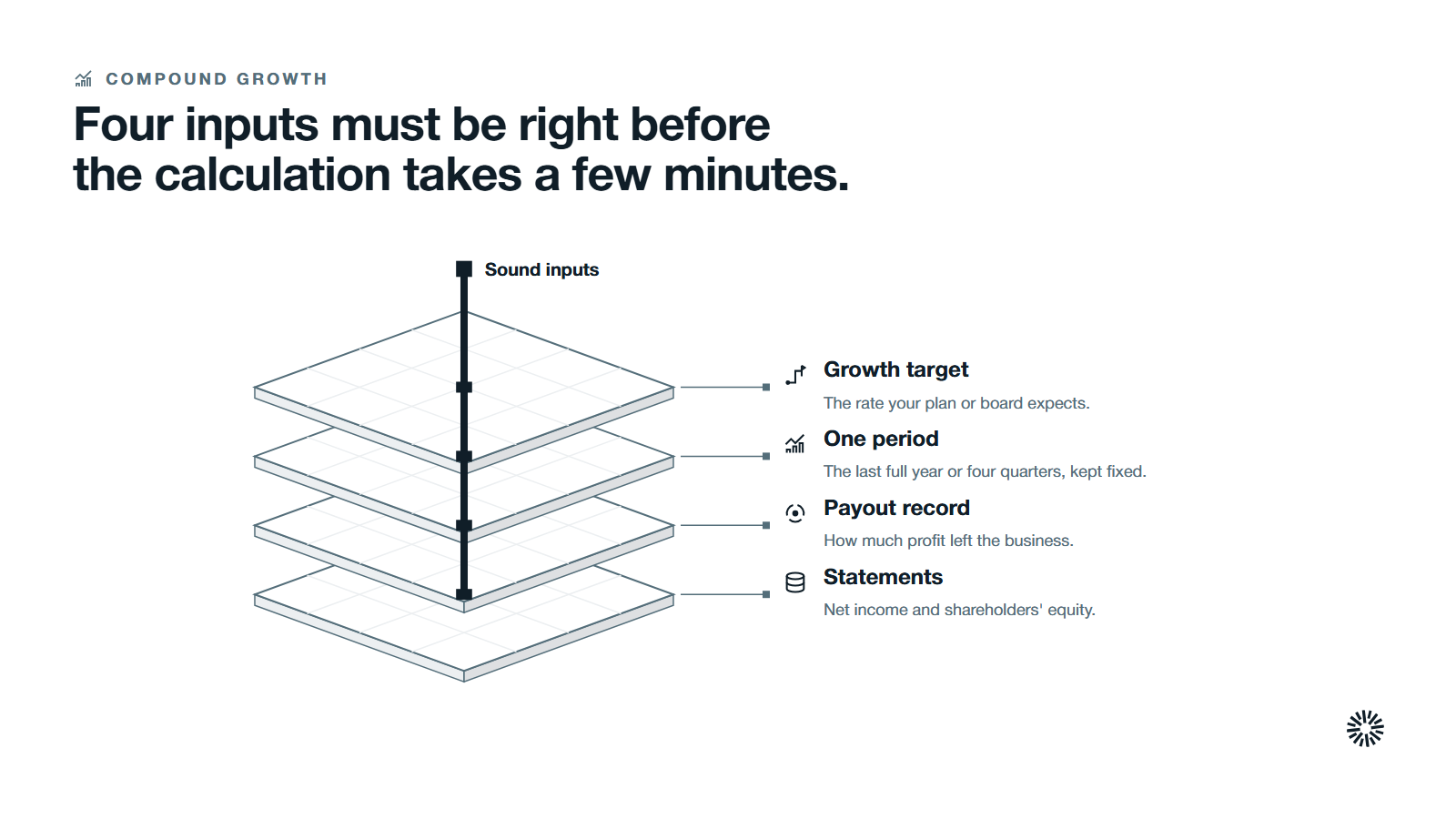
The calculation takes a few minutes. The inputs need to be right first.
- Current financial statements. You need net income from the income statement and shareholders' equity from the balance sheet for the same period.
- Your dividend or owner distribution record. The payout ratio depends on how much profit left the business.
- One agreed period. Use the last full financial year, or the last four quarters, and keep it the same each time you repeat the exercise.
- A growth target. Know the growth rate your plan or board expects, so you have something to compare with.
Where the sustainable growth rate applies, and where it stops
The sustainable growth rate is a finance concept. It comes from corporate finance and valuation, where it describes how quickly a firm can expand when growth is paid for by earnings it keeps.
It assumes stable conditions: profitability, payout and capital structure stay as they are. Real companies change all three, so treat the result as a ceiling for planning, not a forecast.
A high SGR is only as good as its assumptions, because it holds only while return on equity and retention stay where they are. Fast growth can also make earnings less predictable, so a high figure is a prompt to test your assumptions, not a reason to relax.
The result also guides two policy choices: how much to pay out and how to finance growth. The payout decision moves the retention ratio directly, and the financing decision decides whether growth stays inside the ceiling.
The same words sometimes describe environmental or social sustainability. Here the meaning is purely financial.
The measure also has a stricter cousin, the internal growth rate, which allows no outside financing at all, not even new debt. The sustainable growth rate lets debt grow in step with equity.
How it connects to compound growth
The finance formula tells you how much growth your balance sheet can fund. It does not tell you where the growth comes from inside the business.
Propello's definition of compound growth is the cumulative effect created when acquisition, retention, expansion, advocacy and continuous learning reinforce one another over time. That is the operational version of the same question: which activities keep adding to the base you grow from?
How to calculate sustainable growth rate in five steps
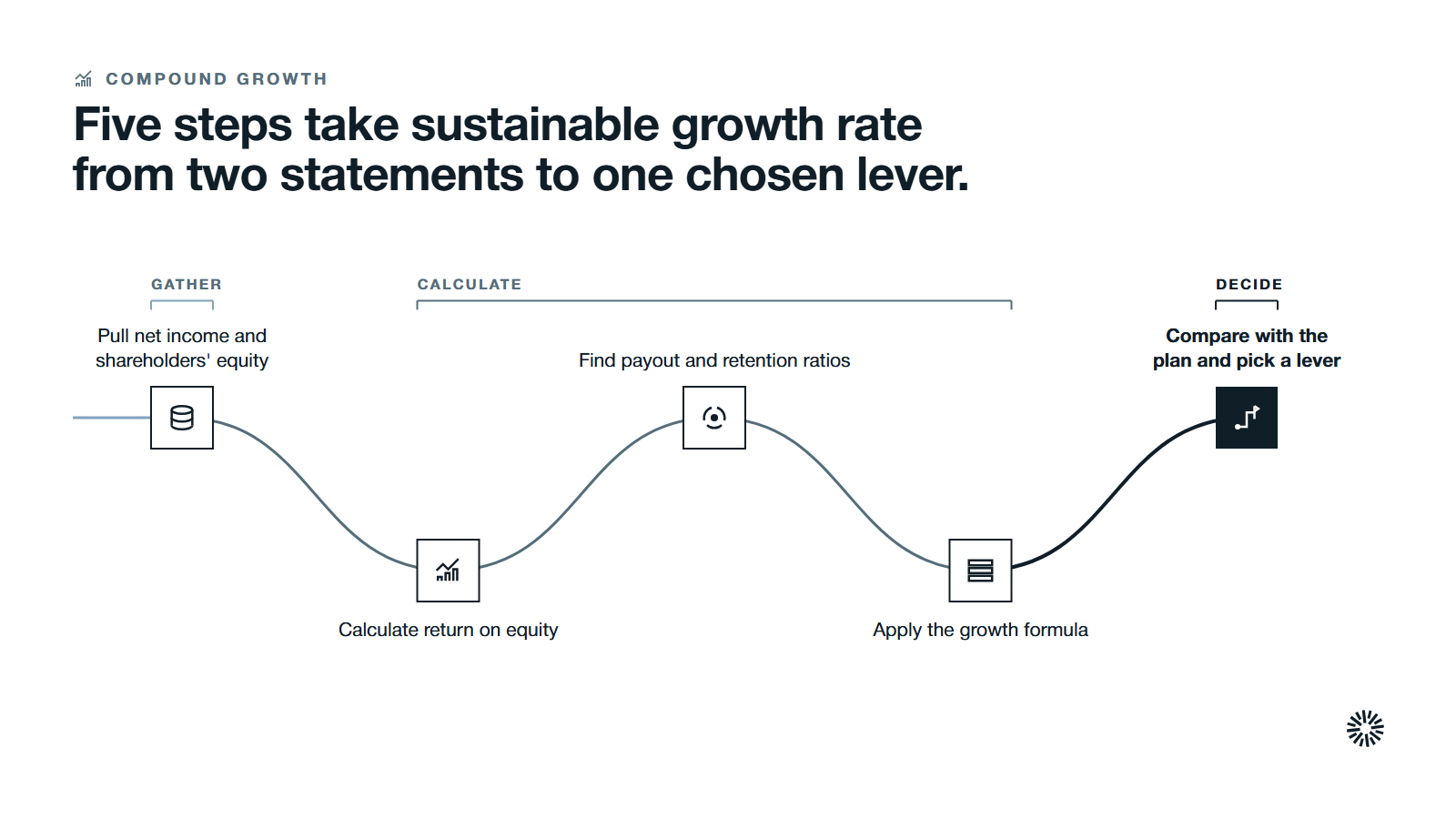
Work through the steps in order, whether you are working out your company's sustainable growth rate for the first time or refreshing last year's figure. Each ends with what done looks like.
1. Pull net income and shareholders' equity
Take net income for your chosen period from the income statement. Take shareholders' equity, also called book value of equity, from the balance sheet.
Use the same period for both. If you compare years, use the same method each year, because a mix of start-of-period and end-of-period equity will move the answer.
You are done when two figures sit side by side with the period and the statement each came from.
2. Calculate return on equity
Return on equity (ROE) is net income divided by book value of equity. It shows how much profit each unit of owner capital produces.
Aswath Damodaran's valuation notes at NYU Stern define it the same way: return on equity equals net income over the book value of equity.
A high ROE means the business turns owner capital into profit efficiently, and a higher ROE lifts the SGR. It also depends on leverage, so a heavily indebted company can show a high figure for the wrong reasons.
You are done when return on equity is written as a percentage, with the formula beside it.
3. Find the payout ratio and the retention ratio
The payout ratio is the share of net income paid out as dividends or owner distributions. The retention ratio is what is left: one minus the payout ratio. The profit that stays in the business is your retained earnings for the period.
The same Damodaran notes define the retention ratio as the percentage of net income retained by the company, equal to one minus the payout ratio.
Many private B2B companies pay little or nothing out. If that is you, the retention ratio is at or near 100 percent, and the number that does the work is return on equity.
You are done when you have a payout ratio and a retention ratio that add up to one.
4. Apply the sustainable growth rate formula
The sustainable growth rate formula is simple: return on equity multiplied by the retention ratio. Some texts call the retention ratio the earnings retention rate. It is the same number.
Damodaran states the same relationship for growth in earnings per share, where it holds when return on equity is expected to stay unchanged: growth equals the retention ratio times return on equity. His published example is Wells Fargo in 2008, with a return on equity of 17.56% and a retention ratio of 45.37%, which gives expected growth of 7.97%.
Here is a labeled, illustrative example with invented numbers, not a real company:
- Net income is 2,000,000 and shareholders' equity is 10,000,000, so return on equity is 20%.
- The company pays out 40% of net income, so the retention ratio is 60%.
- The sustainable growth rate is 20% multiplied by 60%, which is 12%.
In this example the company can grow earnings by about 12% a year from retained profit alone, if profitability and financing mix hold steady.
You are done when you have one percentage, the working shown and the assumptions written beside it.
5. Compare the result with your plan and choose a lever
Set your sustainable growth rate beside the growth your plan requires. Three outcomes are possible.
If the plan asks for less than the ceiling, you have room, and the question is whether you are using retained earnings well.
If the plan asks for about the same, you are balanced, and any slip in margin or any new payout will push the plan out of reach.
If the plan asks for more, one of four levers has to close the gap: raise return on equity, retain more profit, raise outside equity, or take on more debt. Each has a cost, which is why the gap deserves a decision, not a hope.
You are done when the gap is written as a number and one lever is chosen with an owner.
What moves the sustainable growth rate
Two inputs drive the result, and both are decisions.
Profitability. A higher return on equity raises the ceiling. In practice that comes from better margins, better use of assets or sensible use of leverage. Sales and marketing influence it through pricing, deal quality and the cost of winning customers.
Retention. A higher retention ratio raises the ceiling, because more profit stays in the business to fund growth. Paying less out means less for owners today and more capacity tomorrow.
Capital structure sits behind both. A company that issues new equity or lets debt grow faster than equity can outgrow the ceiling, but it then depends on investors or lenders to provide the money.
Use DuPont analysis to find the lever inside return on equity
DuPont analysis splits return on equity into three parts: profit margin, how efficiently assets produce sales, and financial leverage, which is how much of the asset base debt funds. A gap in any one of them shows where the ceiling can move.
A thin profit margin points to pricing and cost of sales. Weak asset use points to idle capacity or slow collection of cash. Heavy leverage raises the figure but adds interest payments and risk.
What to do when growth outruns the ceiling
Fast-growing companies often plan for a very high growth rate, well above what retained profit can fund. Rapid growth then needs external financing, which comes in two forms.
Debt financing. Additional debt financing keeps ownership intact, but it adds interest payments and changes your current capital structure. The equity ratio falls as debt rises, and lenders look closely at it.
Equity. Raising capital from equity investors funds growth without interest payments, but it dilutes existing owners and resets the base the formula uses.
Where a company sits in its life cycle shapes the choice. Early-stage firms in fast-moving industries often rely on outside money for high growth, while mature firms with a high retention ratio can fund steadier growth from within. Neither is better by default. The point is to choose financing on purpose, not by drift.
Mistakes to avoid when using a sustainable growth rate
- Treating the ceiling as a forecast. It is a limit under steady conditions, not a prediction.
- Mixing periods. Net income from one year and equity from another produce a number that means nothing.
- Ignoring leverage. A high return on equity built on heavy debt overstates what the business can safely do.
- Forgetting the assumptions. The formula needs steady profitability, payout and financing mix. Say so whenever you quote the result.
- Using it alone. The number says what the balance sheet can fund. It says nothing about whether customers will buy. Pair it with pipeline and retention data.
- Calculating once. Recalculate when margins, payout or equity change, or after a major investment.
What you gain when this is done properly
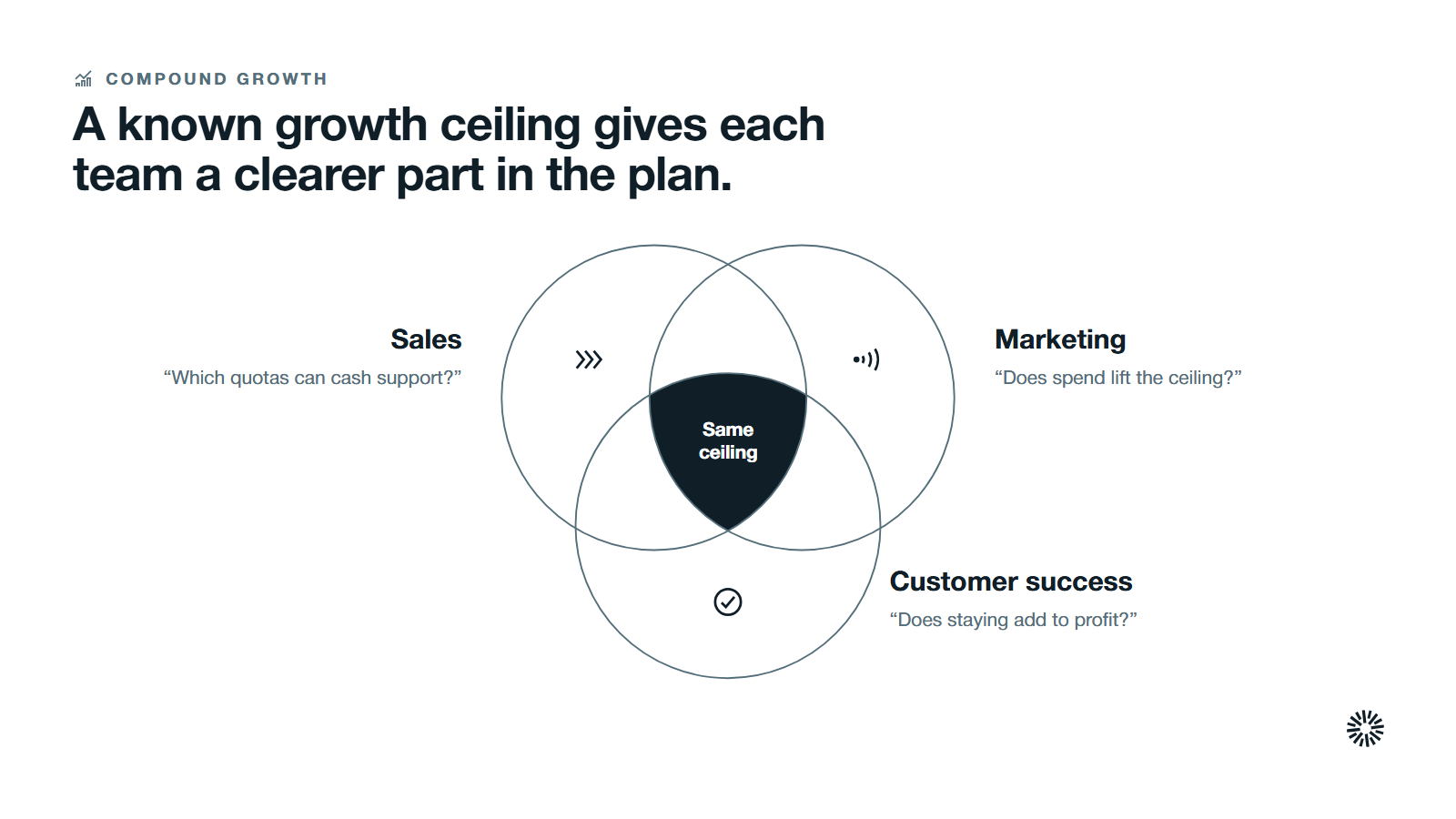
A known growth ceiling turns arguments about targets into a conversation about levers. Each team gains something different.
Sales gets targets the business can fund
Sellers and sales leaders work against quotas that sit alongside what the company can finance. Chasing growth that cash cannot support gets harder to justify, and the case for spending on deal quality gets clearer.
Marketing gets a budget argument grounded in numbers
Marketing can show how spend that raises margin or lowers the cost of winning customers feeds return on equity, and so raises the ceiling. The conversation moves from activity to contribution.
Customer success sees its place in the growth math
Customers who stay and expand add to the profit the company keeps, and that profit funds the next period of growth. Our guides to customer retention strategy and expansion revenue go deeper on both.
Plan growth against what the business can fund
Your sustainable growth rate gives you a ceiling in one line: return on equity times the retention ratio. Calculate it from current statements, compare it with the plan and pick the lever that closes any gap.
Propello designs and builds connected go-to-market systems on HubSpot. If you want the revenue side of the plan, from acquisition through retention and expansion, set up and measured in one system, an audit is the place to start.