
If you are a CEO, founder or hiring leader at a growing B2B company and your best candidates never seem to find you, this guide is for you. Recruitment marketing is the practice of using marketing methods to attract, convert and engage the people you want to hire, before and after a role opens.
You will get a plain definition, the candidate journey, how to write an employer value proposition, what a careers page needs, which channels fit, how to protect candidate experience, how to nurture talent in your CRM and how to measure the result. Each section points to a deeper guide when you want one.
|
Recruitment Marketing Recruitment marketing is the use of marketing methods to attract, convert and engage potential candidates, so the right people know your company, want to work there and apply. |
Recruitment marketing earns attention before you have a role to fill
Most hiring starts when a role opens. A job posting goes up, the hiring team waits, and the pool is limited to people who happen to be searching that week. Recruitment marketing reverses the order. You build initial awareness and trust first, so qualified candidates already know your employer brand when a job opening appears.
The idea is simple. Recruitment marketing treats candidates like consumers: it tells your story to earn interest. Your best candidates behave like your best buyers.
They research before they speak to anyone, they compare you with other employers, and they trust what current employees say more than what your ads say. Marketing principles work on them for the same reason they work on customers.
That matters most in today's competitive job market. Top talent usually has a job already, so the people you want are passive candidates who are not reading job boards.
A strong employer brand is what makes them stop and look. You reach them by being useful and visible over time, not by posting once and hoping.
A short note on the term. Some staffing agencies use "recruitment marketing" to mean marketing their own services to client companies. This guide covers the in-house meaning: how an employer markets itself to the people it wants to hire.
How recruitment marketing differs from recruiting
Recruiting, also called talent acquisition, is the work of filling a specific role. A recruiter writes the posting, screens applicants, runs interviews and makes an offer. Traditional recruiting is reactive: it begins after a vacancy opens and leans on job boards and agency services. The recruitment process ends when the role closes.
Recruitment marketing works upstream of that. It builds the talent pipeline that recruiters draw from, and it keeps working between roles. When it does its job, recruiters spend less time searching and more time talking to people who already want the company.
How recruitment marketing differs from employer branding
Employer branding is the reputation you hold as a place to work, and it is a large part of your company's reputation. It is shaped by what your people say, what you publish, your company culture and how you treat applicants. Every company has one, whether or not it manages it.
Recruitment marketing is the campaign work that carries that reputation to the people you want to reach. Employer branding efforts set the promise, and employer branding initiatives such as employee stories give it proof. Recruitment marketing efforts deliver it to the right audience, at the right moment, and turn interest into applications.
A useful test: if the work is about what you stand for as an employer, it is employer branding. If the work is about getting a specific kind of candidate to notice, trust and act, it is recruitment marketing. Strong programs run both, and the second fails without the first.
Where inbound recruiting fits
Inbound recruiting applies the inbound marketing method to hiring: attract, engage and nurture the people you want to join. It is the approach Propello uses to frame recruitment marketing for B2B companies, because it keeps the focus on being found and being useful rather than chasing people one message at a time.
If you want the full picture of how it works and how it compares with outbound sourcing, read our guide on what inbound recruiting is. This pillar contains it as one part of a larger system.
The candidate journey runs from first awareness to a signed offer
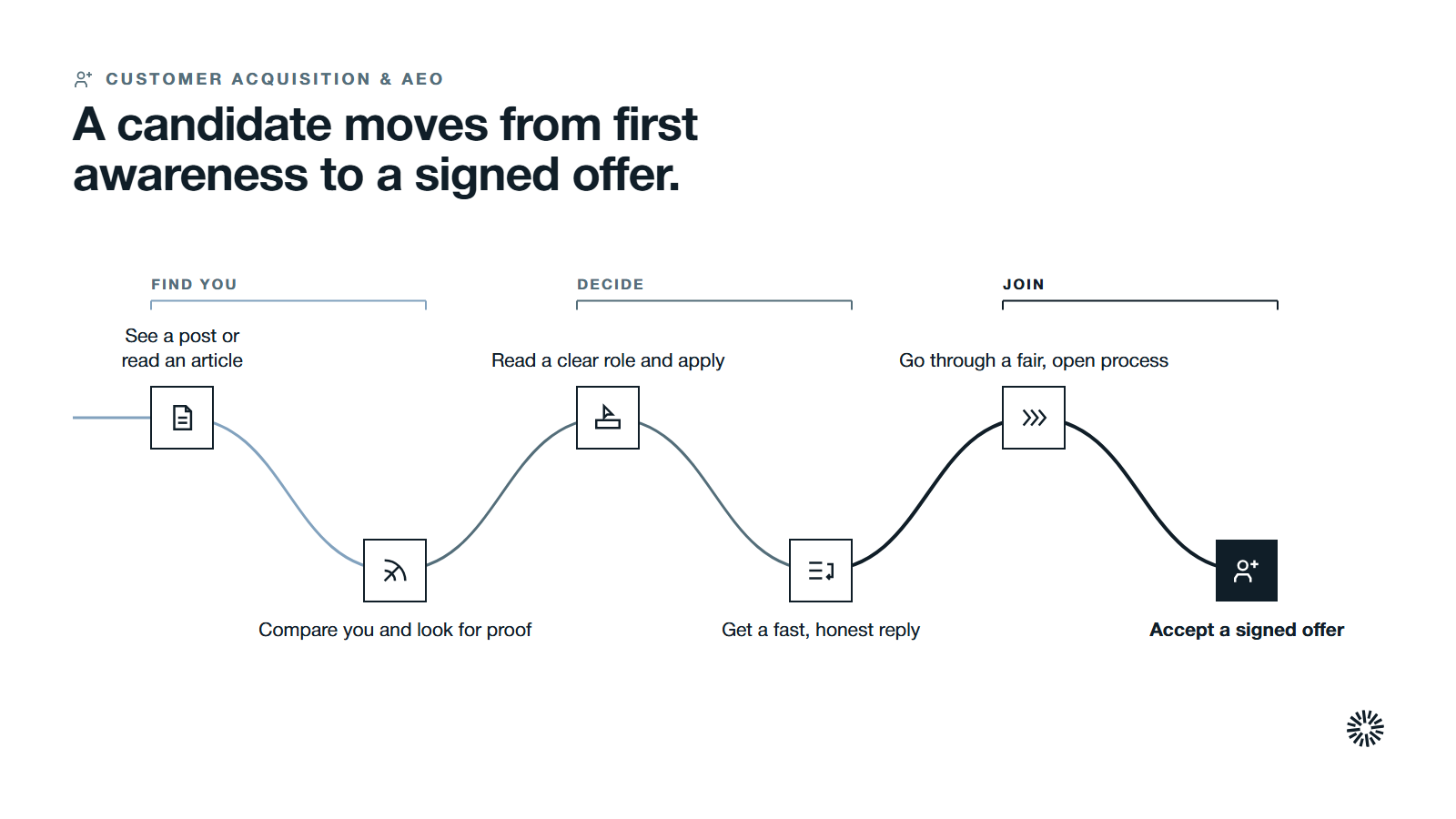
Candidates move through stages, just as buyers do. The recruitment funnel, sometimes called the recruitment marketing funnel, gives you a way to see where people enter, where they stall and where they leave. It also tells you which content and which follow-up each stage needs.
A practical version has four stages. In awareness, people form their initial awareness of your company and a first impression of its employer brand.
In consideration, they compare you with other employers and look for proof. In interest, they decide whether to apply. In hiring, the recruitment process takes over and the candidate experience decides whether they accept.
Treat these as a path with an owner at each stage, not a diagram for a slide. Awareness belongs to marketing. Consideration belongs to marketing and the hiring managers who can speak with credibility. The final stage belongs to the hiring team.
What candidates do at each stage
At the awareness stage, job seekers see a post, hear a name or read an article. These potential employees are not looking for a job yet, and a hard sell turns them away. Useful content and visible people work better than job ads here.
At consideration, they look for evidence, and many research an employer's reputation before they apply. They read your career site, check what employees and former employees say, and compare your promise with what other employers offer. This is where an employer value proposition earns its place.
At interest, they want the next step to be easy and honest. A clear role description, a short application and a fast reply keep them moving. At the hiring stage, they judge how you treat them when something is at stake.
The journey mirrors the buyer journey
If your company already maps how customers find and choose you, reuse that thinking. Our guide to the B2B buyer journey shows how buyers research before they talk to sales. Candidates research before they talk to a recruiter in the same way.
Define who you want to attract before you write anything
A recruitment marketing campaign aimed at everyone persuades no one. To identify candidates worth pursuing, start with the people you most need to hire in the next year, and describe them the way you would describe a customer. The goal is to attract potential candidates whose skills and career goals fit your roles.
For each target role family, write down the problems they want solved, what they want from the next job and their career goals, where they get information and what makes them doubt a new employer. This is a candidate persona. It turns "senior engineers" into someone you can write for.
Your sales team does the same thing for customers. Our ideal customer profile template shows the shape of that work, and the same fields adapt well to candidates: role, seniority, motivations, objections and channels.
Keep the list short. Two or three target candidates are enough to start. If you cannot name the person you want to attract, you cannot choose the message, the channel or the proof that will reach them.
Talk to people who already work for you. Ask why they joined, what almost stopped them and what they tell friends about the company. Short employee interviews are an easy way to collect them. Those answers are better raw material than any brainstorm, and they give you honest language to reuse.
An employer value proposition (EVP) gives candidates a reason to choose you
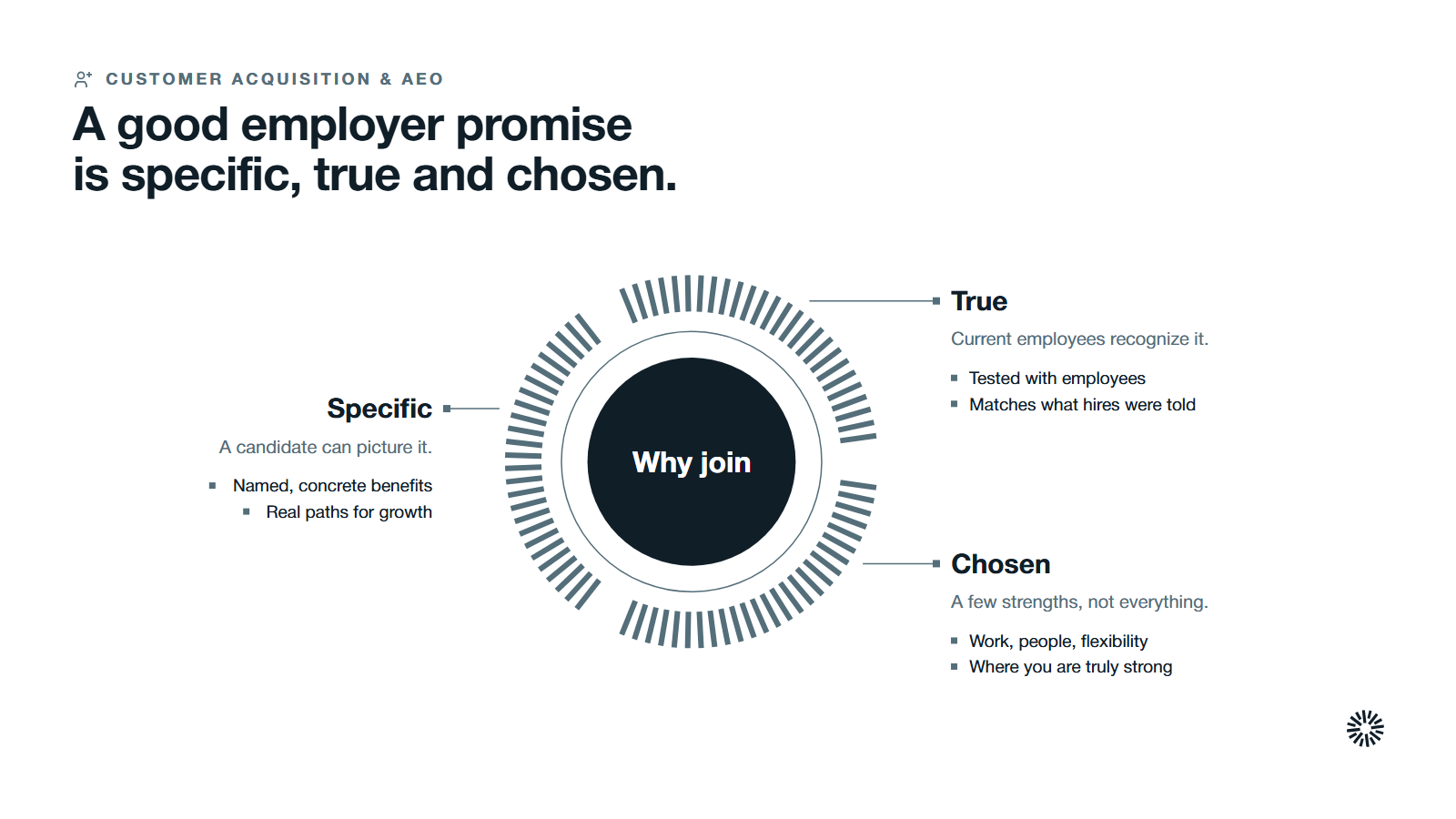
An employer value proposition, or EVP, is the set of reasons a person would join and stay with your company, so it helps you attract and retain talented employees. It covers what you offer, what you ask in return and what makes the experience of working with you different from the alternatives.
A good EVP is the core of a compelling employer brand. It is specific, true and chosen. Specific means a candidate can picture it. True means current employees recognize it.
Chosen means you picked the few things that set you apart rather than listing everything. An EVP that reflects real strengths and employee priorities also gives candidates concrete reasons to accept an offer.
What goes into an EVP
Most EVPs draw on a handful of themes: the work itself, career growth, the people, pay and employee benefits, flexibility, and the company's values. You do not need all of them. Pick the ones where you are strong and where your target candidates care.
Career growth deserves a close look. Many people leave because they cannot see how the job fits their career goals or where the next step leads. If your company offers real paths, show them with examples. If it does not, a vague promise will be tested in the first interview.
How to test your EVP
Test it three ways. Ask current employees whether it matches their employee experiences. Ask recent hires whether it matched what they were told. Ask job candidates who declined why they chose another offer.
If those groups disagree with the EVP, fix the company or fix the wording, but do not publish a promise the experience contradicts. A gap between the message and the reality is the fastest way to damage a positive employer brand and hurt employee retention.
Write employer brand messaging in a consistent voice
Once the EVP is clear, promoting your employer brand starts with employer brand messaging in a voice that matches the rest of the company. Candidates often meet your marketing before they meet your people, and a career site that sounds like a different company creates doubt.
Our guide to brand voice guidelines shows how to describe tone and word choice so everyone who writes for the company sounds the same. Apply it to job descriptions, careers content and recruiter emails, not just product pages.
Your careers page and content do most of the converting
Your career site is where interest becomes action. Job seekers arrive from search, social media and referrals with one question: is this a place I want to work?
A career site works best when it is candidate-centric: built around what a candidate needs to decide, not around your org chart. Your career site content has to answer it quickly and with evidence.
What a careers page needs
A strong careers page makes five things easy to find. What the company does and why it matters. What the company culture is like, in the words of employees. What the hiring process looks like from first call to offer.
What roles are open, with honest descriptions. How to apply, or how to stay in touch if nothing fits.
Show the employee experiences and the company's values in action that matter most to your target candidates. Short employee testimonials, team introductions and examples of what people worked on this year build more trust than adjectives. Keep them real and specific.
Include a way to join a talent community for people who are interested but not ready to apply. A short form that asks for a name, an email and the type of role is enough. It feeds the nurture work described later in this guide.
Write job descriptions that convert
Job descriptions are marketing copy that candidates read closely. Write them for the person, not for the approval process. Lead with the problem the role solves and the outcome expected in the first year. Keep requirements to what the work truly needs.
Honesty here has a measurable edge. In its 2024 Candidate Experience Report, Greenhouse found that more than half of employees (53%) said companies had advertised job responsibilities that differed significantly from reality once they started their role.
AI tools can help personalize outreach and tailor job descriptions, but they should support human judgment, not replace it. Read each posting aloud before it goes live.
If a candidate who accepts the role would feel surprised in week two, rewrite it. Accurate job postings reduce early exits and make your hiring process faster, because fewer applicants drop out after learning the truth.
Publish content for each stage
Content is how you reach passive candidates before they apply, and how you build relationships with them over time. Match it to the journey.
For initial awareness, publish stories about the work, the team and the problems you solve, in formats people share. For consideration, publish detail: how you make decisions, how you grow people and what a normal week looks like.
For interest, publish practical help: how your interview process works, what to prepare and who they will meet. Candidates value this more than most employers expect, and it signals that you respect their time. Storytelling engages candidates more than a list of perks.
Employer branding content works best when your own people create it, and promoting your employer brand through their voices builds enthusiastic brand advocates. A team lead explaining a hard decision is more believable than a polished brand film. Give employees a simple process to contribute, and credit them by name.
Choose channels by where each candidate group already looks
Channels are a means, not a plan. Start from the candidate persona and ask where those potential candidates, including top talent, spend time and what they trust. Then pick a small number of channels you can run well.
Create campaigns around them. Recruitment marketing campaigns work best when each has one audience and one call to action. Every channel should carry the same employer brand.
Owned channels
Your careers page, your blog, your email list and your talent community are yours. They compound, because content you publish keeps attracting people long after the post goes live, and search brings in candidates who were not looking for you by name.
Search deserves attention. Job seekers search for what the job is like, what the pay and growth look like and what the company culture is like. If the answers are on your site, you meet them at the moment they are deciding.
Earned and social channels
Online content and social media platforms are crucial channels: they show your people and your work, and they reach passive talent who are not looking at job boards. Choose the one or two social media channels where your target candidates are active, and post consistently.
Employee advocacy extends your reach. When current employees share their own work and their own view of the company on social media, their networks see it, and those networks look like your target candidates. Make sharing optional and easy, and never script it.
Referrals sit between earned and owned, and they reach passive candidates well. A strong referral program gives existing employees a clear way to introduce people they trust, with a fast response for every referral so the person is not left waiting.
Paid channels and job boards
Job boards still matter for active job seekers. Use them to reach people who are ready to apply, and keep your listings consistent with your career site. Paid social and search ads support targeted campaigns by role, skill and location, which suits roles that are hard to fill.
Recruitment marketing examples that work for B2B teams
Examples help most when they are concrete. These key strategies are patterns that fit B2B companies without a famous brand.
A hiring manager writes a short article on how their team makes decisions, and recruiters share it with candidates who asked about culture. A careers page lists each stage of the hiring process, with the people the candidate will meet.
An employee shares a project on social media and the company reshares it with a link to open roles.
A talent community email goes out each quarter with company news and new roles, segmented by skill. A referral campaign, one of several targeted campaigns, asks the whole team for introductions to one specific role. A search-focused article answers the questions candidates type about working in your industry.
Candidate experience is the part of your brand candidates test first
Candidate experience is everything a person goes through from first contact to the end of the process, whether they get an offer or not. It is how your promise gets tested, and job candidates talk about it afterward. Top talent has options, so a slow process sends it elsewhere.
Poor experience has a cost you can see. In the same Greenhouse report, one in every five candidates (20%) said they had rejected an offer because of a poor interview experience. A strong employer brand does not survive a slow, unclear process.
Where candidate experience breaks
Most breakdowns are about communication, not content, and clear communication is the cheapest way to improve candidate experience. Applicants wait without hearing back. Interviews run late or repeat the same questions. Feedback never arrives. The role described in the posting is not the role discussed in the interview.
Recruitment marketing must deliver on the expectations it sets, or candidate interest fades. Small fixes make a large difference. Confirm receipt of every application. Tell candidates when they will hear next, and keep to it. Prepare each interviewer with the candidate's background. Say no promptly and kindly when the answer is no.
Who is responsible for candidate experience
Candidate experience crosses teams, so it needs a named owner. Usually that is the head of talent acquisition or the hiring leader, with the marketing department owning the front of the journey and hiring managers owning the interview stages.
How to measure candidate experience
Keep the measurement simple. Send a short survey after the application and after the interview stage, ask what was clear and what was not, and track the answers over time. Pair the survey with process data such as time between steps.
Nurture talent in your CRM so strong candidates stay warm
Most good candidates, especially passive candidates, are not ready the day they find you.
Some are happy where they are, some are waiting for the right role, and some will be ready in a year. A talent community keeps those relationships alive ahead of any opening, and a pool you nurture turns the timing gap into an advantage.
A CRM gives the talent pipeline a home. Each person is a contact with a record of where they came from, what they care about and what they have seen from you. That lets you send the right message at the right time instead of starting from nothing at each hire.
Track candidates like contacts in a pipeline
Treat the stages of the recruitment funnel as stages in a pipeline. In HubSpot, lifecycle stages track how contacts move forward in your process, and you can customize them or create your own. That makes it possible to mark a person as a talent community member, an engaged candidate or an applicant.
Our guide to HubSpot lifecycle stages explains how to design stages that match a real process. The same logic applies when the contact is a candidate instead of a buyer.
Keep hiring data separate from customer data, and respect consent. Candidates who joined a talent community expect relevant updates, not a flood of marketing. Make it easy to change preferences or leave.
Send updates that fit the stage
Segment by interest and stage. A person who read about engineering roles should hear about engineering, not sales. A person who applied and was not selected should get an honest note and an invitation to stay in touch, since that person may be a strong fit for a future role.
Build a simple nurture sequence. A welcome message explains what the community is and what to expect. A short series shares the company's story, the team and open roles. After that, a regular update keeps the relationship alive without pressure.
Alumni and referrals as a talent pool
Former employees are an underused source. They know the company, they often speak well of it, and some will return. Keep a respectful alumni list and tell people when roles they would suit open.
Put the strategy on paper so the work compounds
You now have the parts: a target candidate, an employer value proposition, content, channels, a candidate experience standard and a nurture process. A recruitment marketing strategy is the document that links them with goals, owners and a calendar.
Write the recruitment marketing strategy once and review it monthly. Name the goal, the audience, the message, the channels, the owner of each piece of work and the numbers you will watch. Effective recruitment marketing strategies are short plans that get used, while long plans get filed.
For the step-by-step version, with what done looks like at each point, read our guide on how to build your recruitment marketing strategy. This pillar shows the whole system, and that guide shows how to build and run it.
A talent attraction strategy sits alongside your wider talent acquisition strategy and other hiring strategies. It defines how you will attract talent for the roles that matter most this year.
It also shows how recruitment marketing supports the rest of your recruitment efforts when roles open unexpectedly. Align it with your growth plan so hiring follows the business instead of reacting to it.
Measure the funnel with metrics you already own
Measurement keeps recruitment marketing honest. Data analytics is essential to improving recruitment marketing, so set measurable objectives for each campaign. You do not need industry benchmarks to start. You need your own baseline, a short list of metrics and a regular review.
LinkedIn's Future of Recruiting 2025 report, based on a survey of 1,271 recruiting professionals, points to the same gap.
It says as many as 89% of talent acquisition professionals agree it will become increasingly important to measure quality of hire, with only 25% reporting they feel highly confident in their organization's ability to do so effectively.
Metrics for each stage
For awareness, track brand awareness through reach and visits to your career site and content, and where they come from. For consideration, track time on page, return visits and sign-ups to your talent community. For interest, track click-through rates, applications started, applications completed and the share of applicants who match your persona.
For hiring, track time to hire, offer acceptance rates and the source of each hire. Traditional recruiting measures success with time to fill and cost per hire for one role.
Recruitment marketing adds awareness and candidate engagement, so you see the pipeline before a role opens. Add retention at six and twelve months, since a hire who leaves early was not a good outcome. These are all measures you can read from the systems you already use.
Use the same discipline marketing uses for a dashboard. Our guide to a marketing KPI dashboard explains how to pick a few numbers, show them together and review them on a schedule. The principle carries over to hiring.
Connect hiring data to business outcomes
The best metric is a link to results the business cares about. Look at which sources bring in top talent that performs and stays, not only which produce the most applications. A channel that sends fewer people who fit better is worth more than one that sends many who do not.
Be careful with attribution. A hire often comes after many touches across months. Record the first source and the sources that mattered along the way, and read them as a pattern rather than a single answer.
A simple review rhythm
Review weekly for open roles, monthly for the funnel and quarterly for the strategy. Weekly, check applications and response times. Monthly, look at stage conversion and the best-performing content. Quarterly, ask whether the EVP, the persona and the channels still fit.
Mistakes that stall recruitment marketing
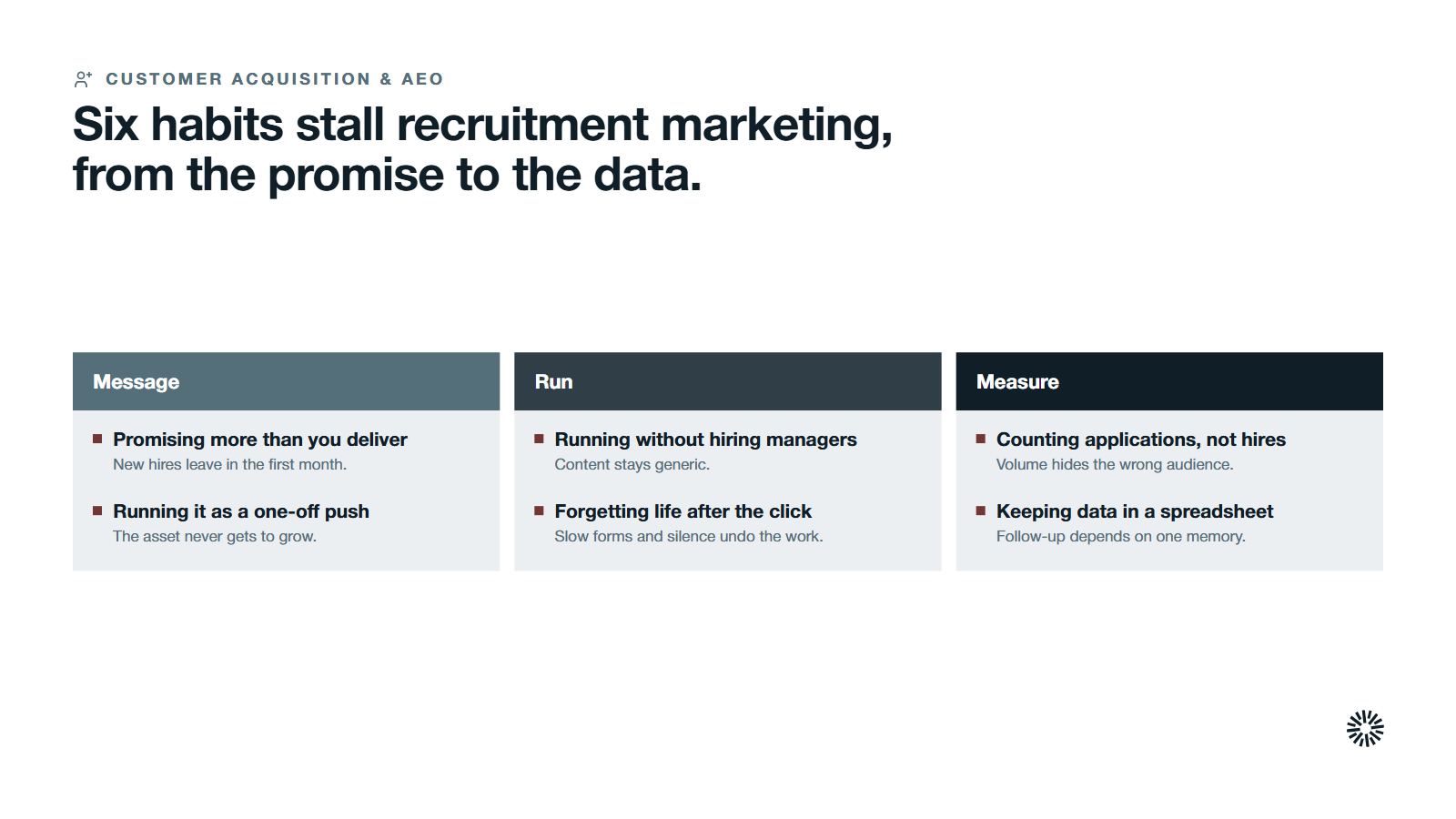
Most failures come from a short list of habits. Knowing them helps you avoid the slow, expensive version of learning them.
Promising more than the company delivers
An employer brand promise that oversells brings people in and loses them in the first month. Candidates compare what they were told with what they find, and they repeat the difference to others. Describe the job and the company as they are.
Treating it as a one-time campaign
A burst of activity around one hard role helps for a few weeks. Recruitment marketing works because it is continuous, and it builds an asset that grows over time. Plan for steady effort with a small number of channels.
Running it without the hiring managers
Marketing can write the message, but hiring managers hold the credibility. When they are not involved, content stays generic and interviews do not match the promise. Give them a clear and small role: a few minutes of input, an occasional article or a short video.
Ignoring the experience after the click
Many programs invest in attracting people and neglect what happens next. A slow application form, no reply and a vague process undo the work above it. Fix the stages after the click before you buy more reach.
Measuring applications instead of hires
Volume is easy to count and easy to misread. Track quality, speed and retention alongside it. If applications rise while good hires fall, the message is attracting the wrong people.
Keeping the data in a spreadsheet
Without a shared system, candidates fall out of view and follow-up depends on one person's memory. Put the talent pool in a CRM, define the stages and give every contact an owner.
What you gain when this is done properly
When recruitment marketing runs as a system, the benefits reach the whole revenue team, because the people you hire carry the pipeline.
Sales gets better hires, faster
Sales leaders fill seats with people who already understand the company and the buyer. A warm talent pool shortens the search for new reps and helps reduce hiring costs, and a clear EVP means new hires start with accurate expectations. Ramp-up improves because fewer people leave early.
Marketing builds an asset that compounds
Marketing applies its own skills to a second audience. Content, search and social work attract candidates as well as customers, and the same voice and message serve both. A strong employer brand also supports sales conversations, and every article and employee story keeps working after it is published.
Customer success keeps its people
Customer success teams depend on stable relationships. Hiring people who chose the role with open eyes lowers turnover and supports employee engagement, so customers see the same faces from onboarding through renewal. Teams spend less time on training and more on customers.
Treat hiring as a funnel you can run
Recruitment marketing works when you treat hiring like the rest of your go-to-market system: a defined audience, a clear promise, content for each stage, an honest process and numbers you review. None of the parts is complicated. Doing them together and continuously is what sets a company apart.
Start with the person you most need to hire. Write the promise they would believe. Make the career site and the process match it. Then keep the talent pool warm and measure what happens.
Propello designs and builds connected go-to-market systems on HubSpot for CEOs and revenue leaders at growing B2B companies. If you want a second pair of eyes on how your hiring and growth systems fit together, an audit is the place to start.
